
Content Distribution — You Have Been Doing It All Wrong!
Most content fails not because it’s bad, but because nobody sees it. You can write the best blog post in your niche, and it’ll still collect dust if your distribution strategy is broken.
I’ve published over 1,800 articles since 2008. The biggest lesson? Creating content is maybe 40% of the work. The other 60% is getting it in front of the right people. And that’s where most marketers get it wrong.
In 2026, content distribution has fundamentally changed. Social platforms suppress organic reach more aggressively than ever. Email remains the only channel you truly own. And new platforms like Threads, Bluesky, and AI-powered distribution tools are creating fresh opportunities that most marketers haven’t tapped.
This guide covers what’s actually working for content distribution right now, what’s broken, and how to build a system that drives traffic back to your website, where it matters.
You Don’t Own Most of Your Content
A true content marketing strategy understands the importance of your website as a command center. Everything you create should ultimately live on or point back to your owned platform.
But here’s the reality for most creators in 2026:
- Videos live on YouTube and TikTok
- Podcasts live on Spotify and Apple Podcasts
- Short-form content lives on Instagram Reels, TikTok, YouTube Shorts
- Newsletters live on Substack, Beehiiv, or ConvertKit
- Fan base lives on Facebook, X, LinkedIn, Instagram, Threads, Bluesky
- Selected articles live on Medium, guest blogs, LinkedIn articles
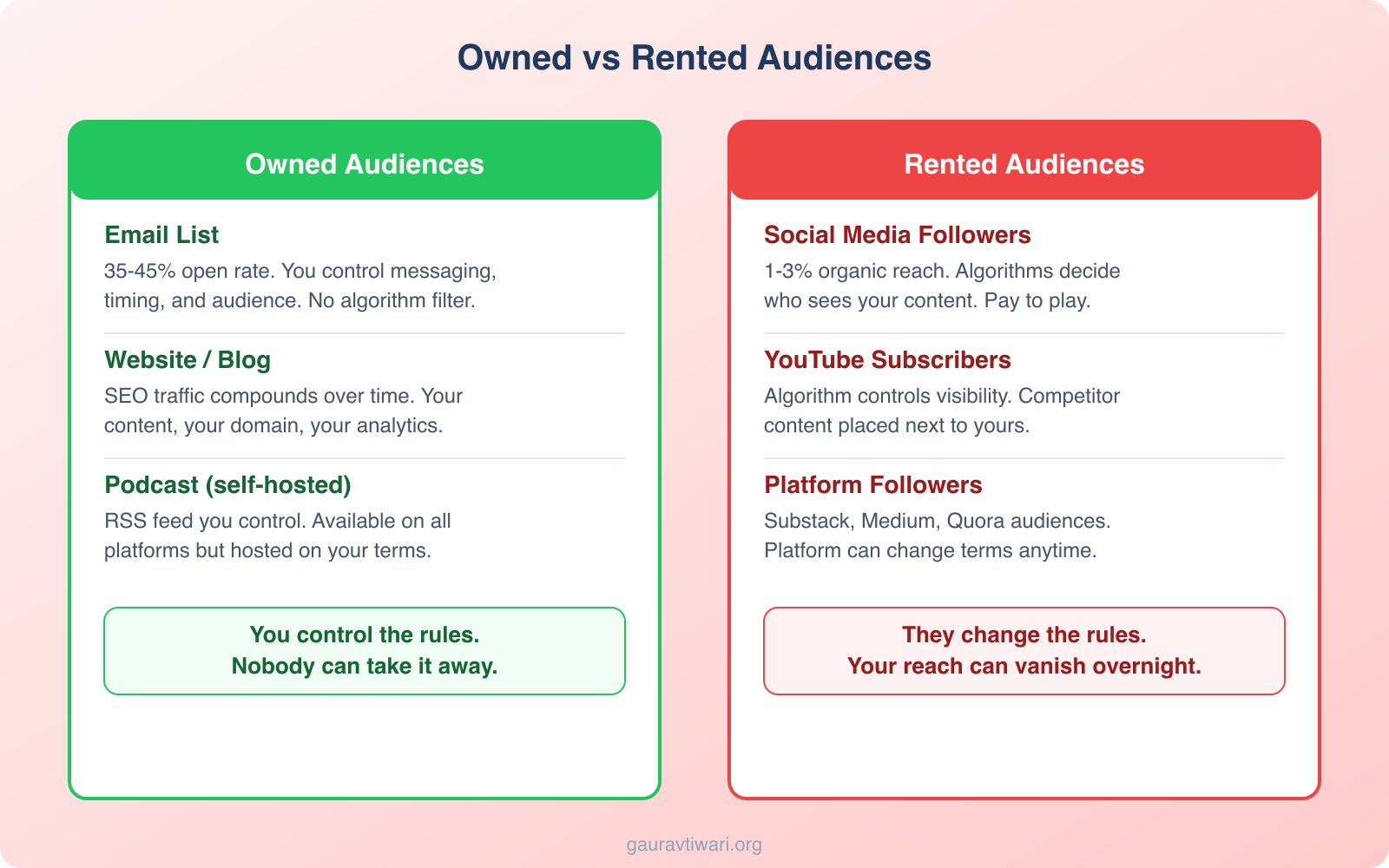
Step back and look at the totality of your online presence. 60-90% of the media assets you spend time and money creating are not owned by you.
This isn’t inherently bad. Distribution requires being where people already are. But it becomes a problem when those platforms are your only strategy. Because they change the rules whenever they want.
How Content Distribution Goes Wrong
The reason most people get distribution wrong is simple. They’re chasing reach without building ownership.
Every third-party platform exists to serve its own business model, not yours. They’ll happily let you build an audience, then throttle your access to it. Facebook did it. Instagram did it. X does it. LinkedIn does it. Even YouTube does it.
I’ve run social campaigns for many clients. The pattern is always the same. Build a following, get decent reach, then watch it decline as the platform pushes you toward paid promotion.
Here’s the uncomfortable truth:
- Facebook organic reach — Down to 1-3% for business pages. A page with 100,000 followers reaches maybe 2,000 people per post
- Instagram — Feed algorithm heavily favors Reels. Static posts reach a fraction of your followers
- X (Twitter) — Algorithm throttles links to external sites. Post a link and watch your reach drop by 70%
- LinkedIn — Same pattern. Links in posts get suppressed. Native content gets rewarded
- YouTube — Your video gets surrounded by competitor content and pre-roll ads before your commercial
It’s impossible to convert people if they never visit your website. And social media algorithms are designed to keep people on the platform, not send them to yours.
The Right Way to Distribute Content in 2026
Good distribution follows one rule: every touchpoint should drive people back to your owned platform. Your website. Your email list. Your direct audience.
The reason this is critical:
- You can’t convert people who never visit your website. Social likes don’t pay bills
- Third-party sites own your followers. They can change the rules and alienate you from your audience overnight. All social networks have done this
- Your email list is the only audience you own. Unlike social followers, subscribers are yours. The rest could disappear tomorrow
Distribution via free and paid channels should point back to your website. Your website should be optimized to convert visitors into email subscribers. Because it’s all about building an audience you control.
Your social media strategy should not be to build a huge following on a given platform. It should be to build a huge email following. Social media is the distribution channel. Email is the destination.
Content Distribution Channels That Actually Work in 2026
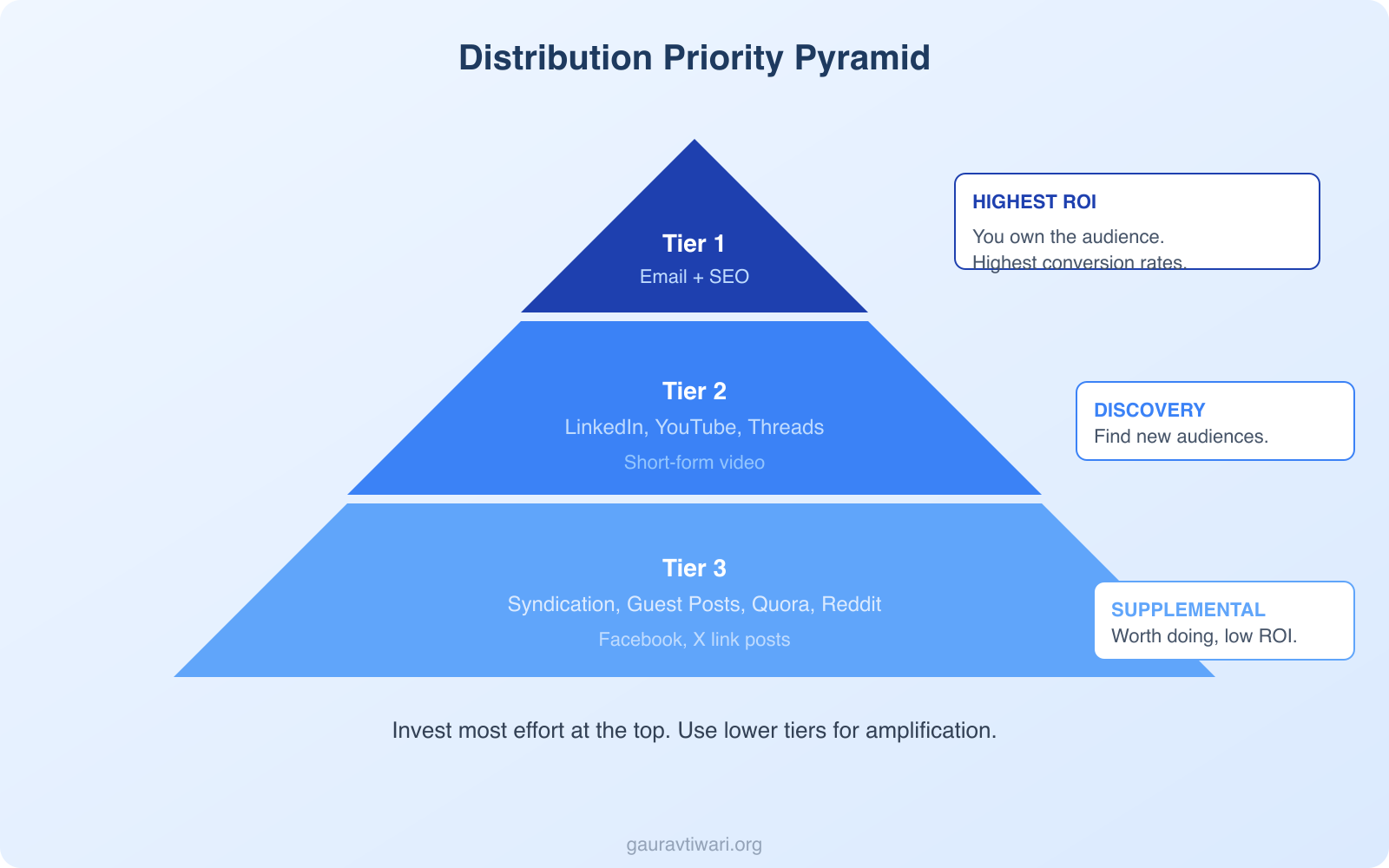
Not all distribution channels deliver equal results. Here’s how I rank them based on ROI for content creators and businesses:
Email Newsletters (Tier 1)
Email remains the highest-ROI distribution channel. Period. You own the list. You control the timing. You reach nearly everyone on it. Average email open rates are 35-45% for well-maintained lists, compared to 1-3% organic reach on social media.
For newsletter platforms, I recommend ConvertKit (now called Kit). It’s built specifically for creators, handles automation well, and the free plan covers up to 10,000 subscribers. I’ve used it across multiple projects and it’s the cleanest solution for writers and bloggers.
Other newsletter platforms worth considering:
- Beehiiv — Great for newsletter-first businesses. Built-in monetization through ad networks and paid subscriptions. Their referral program helps grow your list
- Substack — Good for writers who want a built-in audience. But remember, Substack owns the platform, so you’re still dependent on them
- Ghost — Open-source, self-hosted option. Best for people who want full control of their email and content platform
Search Engine Optimization (Tier 1)
SEO is the only distribution channel that compounds over time. A blog post optimized for search can drive traffic for years without ongoing effort. Social media posts have a lifespan of hours.
The caveat: Google’s AI Overviews now answer many queries directly in the SERP. This reduces click-through for some informational queries. But for commercial and transactional intent, organic search still drives the most qualified traffic.
My approach: optimize every blog post for SEO, then distribute it across other channels. SEO is the long game. Everything else is the short game.
LinkedIn and Threads (Tier 2)
LinkedIn in 2026 is one of the few social platforms still giving decent organic reach. Especially for B2B content. The key is posting native content (not links) and then adding the link in the first comment or using LinkedIn Articles.
Threads (Meta’s platform) is still growing and organic reach is higher than Instagram or Facebook for text-based content. It’s worth testing for your niche, especially if your audience skews toward the creator/tech space.
Bluesky is smaller but has an engaged tech and media audience. If that’s your niche, it’s worth being early.
YouTube and Short-Form Video (Tier 2)
Video distribution in 2026 is powerful but requires more production effort. The upside: YouTube is the second largest search engine, and short-form video (Reels, Shorts, TikTok) gets massive reach.
The downside: you’re building on someone else’s platform. YouTube places competitor videos next to yours. Ads play before your content. And the algorithm controls who sees your work.
My recommendation: use YouTube for discovery and embed your videos on your own website. This way, the deep engagement (comments, shares, backlinks) happens on your domain.
Content Syndication (Tier 3)
Syndicating your content to platforms like Medium, LinkedIn Articles, or industry-specific publications can expand reach. But always use canonical tags pointing back to your original post, or wait 7-14 days before syndicating so Google indexes your version first.
Guest posting still works for building authority and earning backlinks, but it’s a Tier 3 strategy because the effort-to-return ratio is high. Pick 2-3 high-authority publications in your niche and contribute consistently rather than spraying guest posts everywhere.
AI-Powered Distribution Tools
AI has added a new dimension to content distribution in 2026. These tools can automate and optimize the distribution process:
- Content repurposing with AI — Tools like Claude, ChatGPT, and Jasper can take a single blog post and generate LinkedIn posts, tweet threads, newsletter snippets, and video scripts. One piece of content becomes 10+ distribution assets
- Automated social scheduling — Buffer, Hootsuite, and Publer use AI to suggest optimal posting times and generate variations of your social content
- AI email subject line testing — ConvertKit and other platforms now offer AI-powered subject line suggestions based on what performs best for your audience
- Smart content curation — Tools like Feedly and Pocket use AI to surface trending topics in your niche, helping you create timely content that’s more likely to be shared
The biggest win from AI distribution isn’t automation. It’s repurposing. Taking one piece of long-form content and spinning it into dozens of platform-native pieces is the highest-leverage play available right now.
The Content Repurposing Workflow
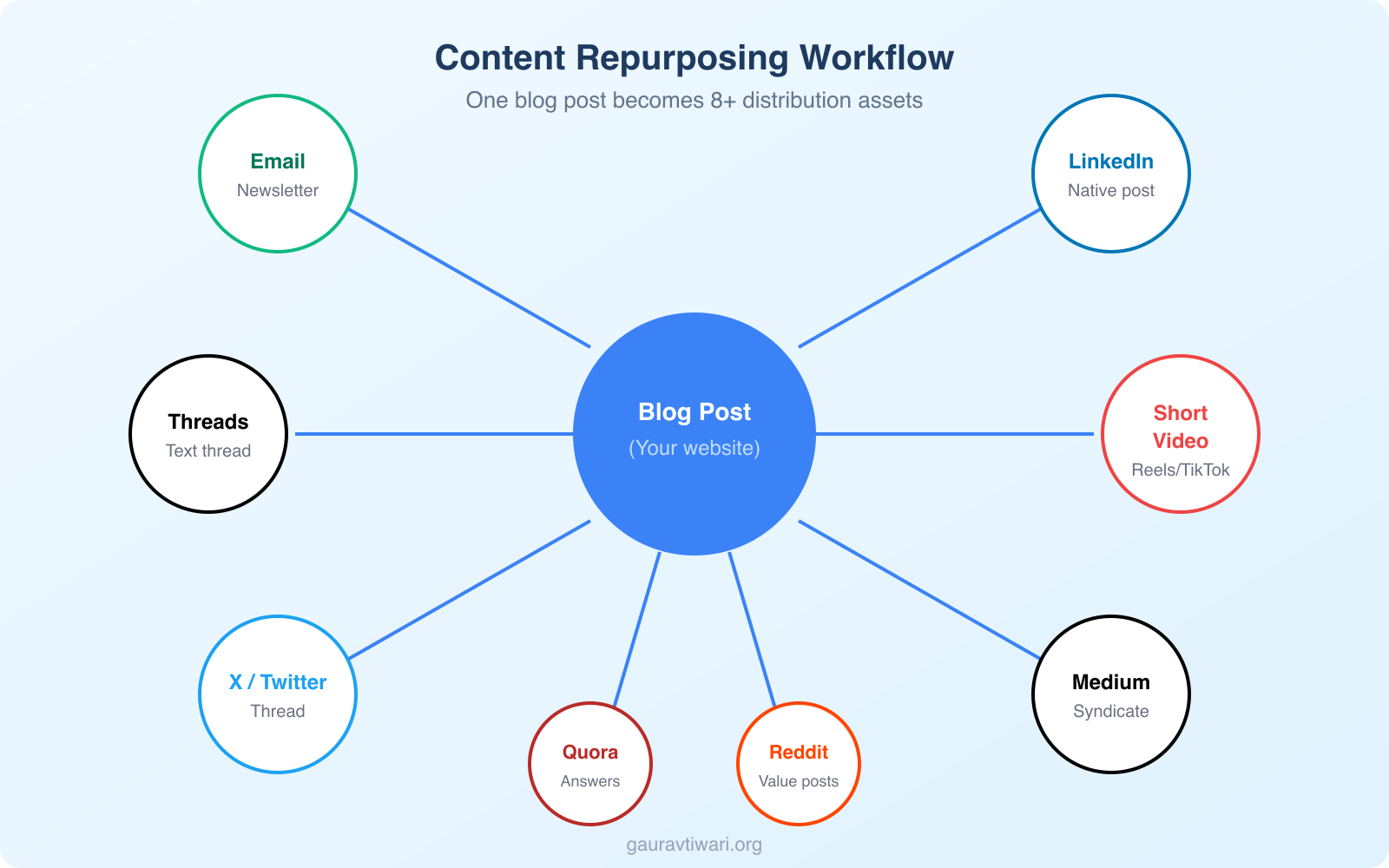
Here’s the exact workflow I use to distribute a single blog post across multiple channels:
- Publish the blog post — Fully optimized for SEO on your website
- Send to your email list — A newsletter featuring the key takeaways with a link to the full post
- Create a LinkedIn post — Share a key insight or data point as a native post. Add the link in the first comment
- Post on Threads/X — A thread breaking down the main points. Link to full post at the end
- Create a short-form video — 60-second summary for TikTok, Reels, and Shorts
- Answer related questions — Find Quora and Reddit threads about the topic. Provide genuine answers and reference your post
- Syndicate after 14 days — Republish on Medium with canonical tag
- Revisit in 30 days — Check performance. Double down on the channels that drove the most traffic
This workflow turns one blog post into 8+ distribution touchpoints. The effort compounds because each channel sends signals back to your website (backlinks, social shares, brand searches) that improve your SEO over time.
Distribution Channel Comparison
Here’s how the major distribution channels stack up for content creators in 2026:
| Channel | Organic Reach | Effort Level | Ownership | Best For |
|---|---|---|---|---|
| Email Newsletter | 35-45% open rate | Medium | You own it | Direct audience, conversions |
| SEO / Organic Search | Compounds over time | High upfront | You own content | Long-term sustainable traffic |
| 8-15% of followers | Medium | Platform owned | B2B, professional content | |
| Threads | High (growing platform) | Low | Platform owned | Text-based content, tech audience |
| YouTube | Variable (algorithm) | High | Platform owned | Tutorials, reviews, search intent |
| TikTok / Reels / Shorts | High reach potential | Medium-High | Platform owned | Discovery, brand awareness |
| X (Twitter) | 2-5% (links suppressed) | Low | Platform owned | Real-time conversation |
| 1-3% for pages | Low | Platform owned | Groups, community building | |
| Medium / Syndication | Variable | Low | Platform owned | Reaching new audiences |
Notice the pattern? The channels you own (email, SEO) deliver the most reliable results. Platform-owned channels are useful for discovery but unreliable for sustained reach. Build your strategy around owned channels first, then use social for amplification.
My Game Plan for Content Distribution
After years of testing, here’s the distribution strategy I use and recommend:
- SEO first. Every piece of content should be optimized for search. This is your long-term distribution engine that works while you sleep
- Email second. Build your list relentlessly. Every social touchpoint should have one goal: get people onto your email list. Use ConvertKit or a similar creator-focused platform
- Social media third. Use social platforms for discovery and brand building, but always drive traffic back to your website. Post native content to get reach, then lead people to your site
- Repurpose everything. One blog post should become 5-10 social posts, a newsletter, and a video. AI tools make this faster than ever
- Measure what matters. Track email subscribers and website traffic, not social media followers. Followers are vanity metrics. Subscribers are revenue potential
The goal of all distribution is simple: build an audience you own. Everything else is a means to that end.
Frequently Asked Questions
What is the best content distribution channel in 2026?
Email is the best distribution channel for consistent, owned reach. SEO is the best for long-term compounding traffic. For discovery and new audiences, LinkedIn and short-form video (Reels, TikTok, Shorts) currently offer the highest organic reach. The ideal strategy combines all three: SEO for long-term, email for direct audience, and social for discovery.
Is social media still worth it for content distribution?
Yes, but with realistic expectations. Social media is a discovery channel, not an ownership channel. Use it to find new audience members and drive them to your email list or website. Don’t rely on social media as your primary distribution channel because platforms will always change algorithms to prioritize their business model over yours.
How do I repurpose one blog post into multiple pieces of content?
Take your blog post’s key points and create: a LinkedIn post highlighting one insight, a Twitter/X thread breaking down the main points, a short-form video summarizing the topic in 60 seconds, a newsletter email with key takeaways, and quote graphics for Instagram. AI tools like Claude or ChatGPT can help generate these variations quickly. One 2,000-word blog post can easily produce 8-10 platform-native pieces.
Which newsletter platform should I use?
For most creators and bloggers, ConvertKit (Kit) is the best option. It handles automation, segmentation, and landing pages in one tool. Beehiiv is excellent if you want built-in monetization through ads and paid subscriptions. Substack works if you want a built-in audience but you sacrifice some platform control. Ghost is the self-hosted option for maximum ownership.
How do AI tools help with content distribution?
AI tools accelerate the repurposing process. They can transform a blog post into social media posts, email newsletters, video scripts, and tweet threads in minutes. They also help with scheduling optimization (suggesting best posting times), subject line testing, and content curation. The biggest win is turning one piece of content into many platform-native versions without starting from scratch each time.
Final Thoughts
Content distribution in 2026 boils down to one principle: build what you own, use what you don’t.
Your website and email list are the assets that compound over time. Social media platforms are rental properties where the landlord can change the lease anytime. Use them strategically, but never depend on them.
Start with SEO. Build your email list. Repurpose content across platforms. Measure subscribers and website traffic, not likes and followers.
The creators who win long-term aren’t the ones with the biggest social followings. They’re the ones who built direct relationships with their audience through email, content, and trust.
That’s the game. Play it right.
Disclaimer: This site is reader-supported. If you buy through some links, I may earn a small commission at no extra cost to you. I only recommend tools I trust and would use myself. Your support helps keep gauravtiwari.org free and focused on real-world advice. Thanks. - Gaurav Tiwari