
Build a Great Niche Website with 4 Right Steps
I’ve built niche websites that make $50/month and niche websites that make $5,000/month. The difference isn’t talent or luck. It’s process. Most people skip the research phase, pick a domain on impulse, publish 20 random articles, wait 6 months, see no results, and quit. Then they blame “SEO is dead” or “the niche is too competitive.” The real problem? They built on a foundation of guesses instead of data. A proper niche website follows a repeatable framework: validate the niche, set up the technical foundation, execute a content strategy built around topical clusters, and layer monetization on top of traffic. Let me walk you through exactly how to do each step.
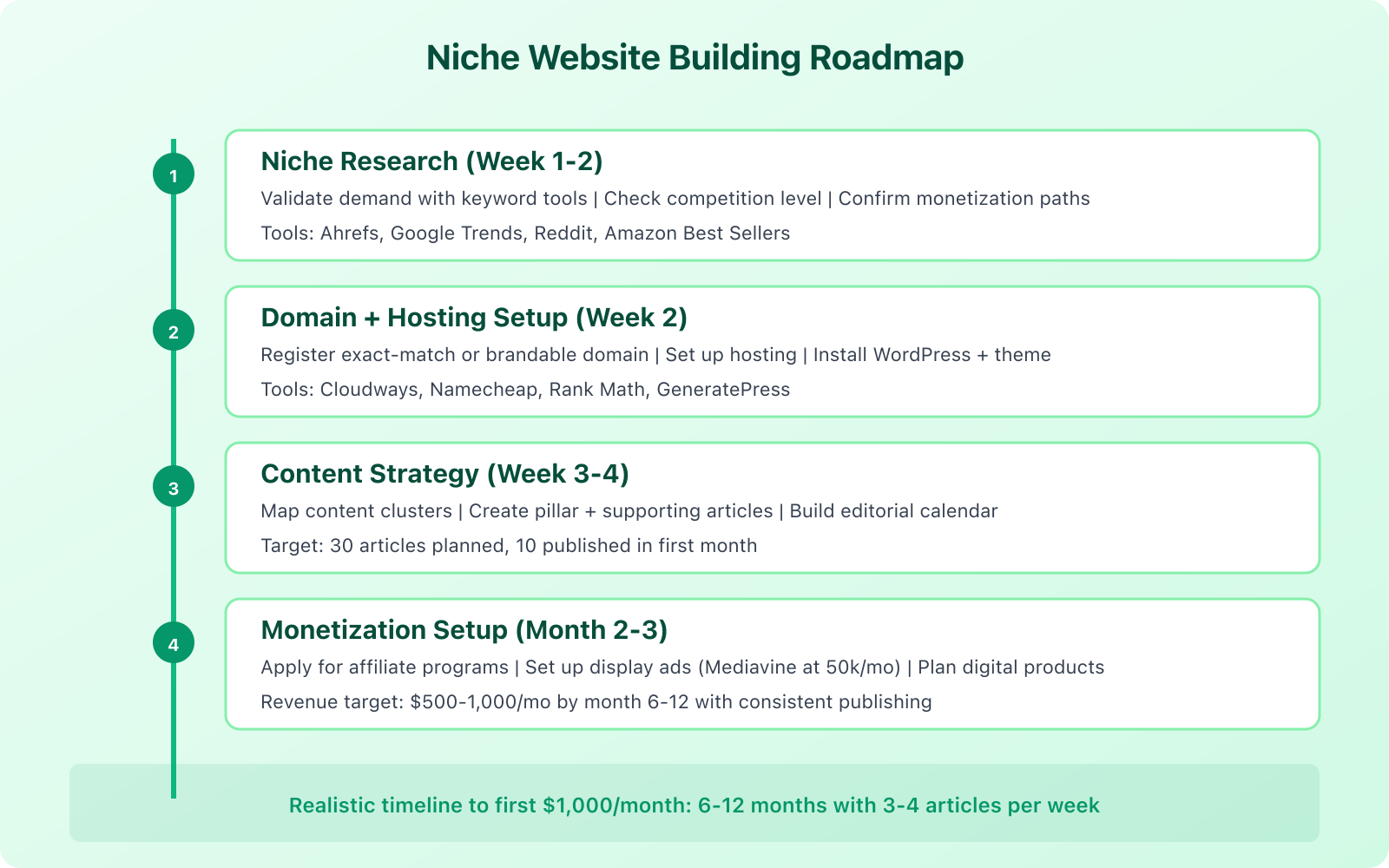
Step 1: Validate Your Niche with Data
Picking a niche based on “passion” is the #1 mistake beginners make. Passion is great for motivation, but it doesn’t pay the bills if nobody is searching for what you write about. You need a niche that has demonstrable search demand, reasonable competition, and clear monetization potential.
Here’s my niche validation checklist:
Check Search Demand
Use Ahrefs Keywords Explorer or Google Keyword Planner to find how many people search for your niche’s core topics monthly. You want to see multiple keywords with 1,000+ monthly searches and dozens of long-tail keywords with 100-500 searches each. If the total addressable search volume across your niche is under 50,000 searches/month, it might be too small to build a sustainable site around.
Evaluate Competition
Search your target keywords in Google. Look at the sites ranking on page 1. If every result is a massive authority site (Forbes, Healthline, NerdWallet), you’ll struggle to compete as a new site. But if you see forums, Reddit threads, thin content from small blogs, or pages that don’t directly answer the query, there’s room for you.
The sweet spot: niches where existing content is mediocre but search demand is solid. That’s where a new site with better content can break through within 6-12 months.
Confirm Monetization Paths
Before you write a single article, make sure there’s money in the niche. Check Amazon Associates for products in your niche. Search affiliate networks like ShareASale and Impact for relevant programs. Look at whether competitors are running display ads (a sign that the RPMs are worthwhile). Consider whether you could sell digital products (templates, courses, ebooks) to your audience.
The best niches have at least two monetization options. If you can only make money one way and that revenue stream dries up, you’re stuck.
Use Google Trends to check if your niche has stable or growing interest. A niche with declining search trends (like “fidget spinners” or “cryptocurrency mining at home”) might not be worth investing 12 months of work into. Look for steady or upward curves over the past 5 years.
Step 2: Set Up Your Site the Right Way
Your technical foundation matters more than most people realize. A slow site with poor hosting loses visitors before they even read your content. Here’s what I recommend for every new niche site.
Domain Name
You have two approaches: exact-match domains (like bestcoffeegrinders.com) or brandable domains (like BrewGeek.com). I lean toward brandable domains in 2026. Exact-match domains used to carry SEO weight, but Google has devalued that signal. A brandable domain is easier to remember, looks more professional, and gives you room to expand beyond a narrow topic.
Keep it short (under 15 characters), easy to spell, and available as a .com. Register through Namecheap or Cloudflare Registrar (cheapest renewal prices).
Hosting
Don’t cheap out on hosting. A $3/month shared hosting plan might work for your first month, but as traffic grows, your site will slow down, and slow sites lose rankings. I recommend Cloudways for niche sites. You get managed cloud hosting starting at $14/month with DigitalOcean, automatic backups, free SSL, built-in CDN, and server-level caching that makes WordPress genuinely fast.
I’ve moved multiple sites from shared hosting to Cloudways and seen page load times drop from 3-4 seconds to under 1 second. That matters for both user experience and Google’s Core Web Vitals.
WordPress Setup Essentials
WordPress powers the vast majority of successful niche sites, and for good reason. Here’s the minimal setup I install on every new site:
- Theme: GeneratePress or Astra. Lightweight, fast, and customizable without code. Avoid heavy multipurpose themes with page builders baked in.
- SEO Plugin: Rank Math. Handles sitemaps, schema markup, canonical tags, and on-page optimization in one plugin. The free version covers everything a new niche site needs.
- Caching: If using Cloudways, their built-in Breeze cache is enough. Otherwise, WP Rocket is the best premium option.
- Analytics: Google Analytics (GA4) + Google Search Console. Both free. Non-negotiable.
- Image optimization: ShortPixel or Imagify. Compress images automatically on upload. Large images are the #1 reason niche sites load slowly.
Step 3: Build a Content Strategy That Actually Works
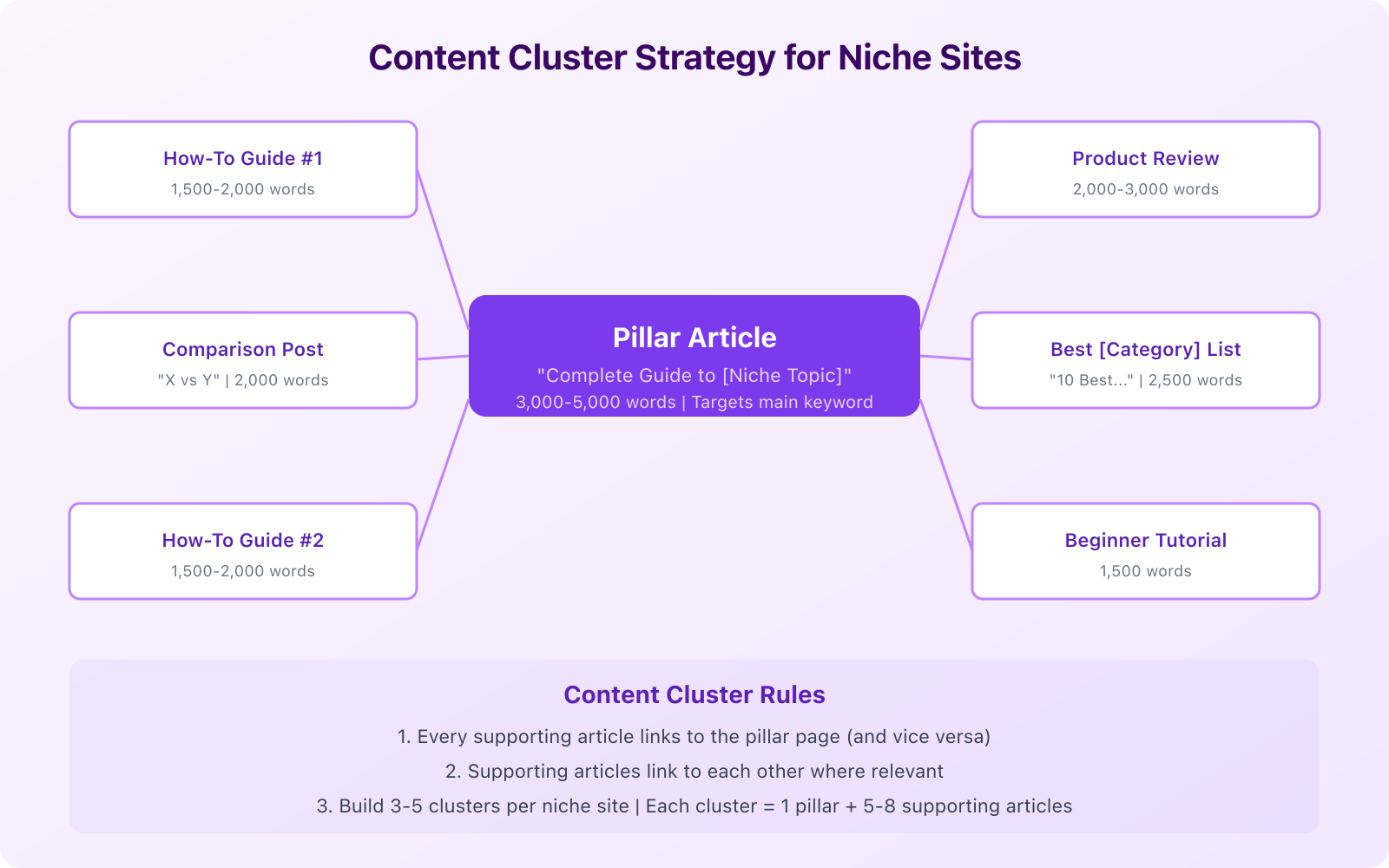
Random publishing doesn’t work anymore. Google rewards topical authority, which means you need to cover a topic comprehensively with interlinked content. The way to do this is through content clusters.
How Content Clusters Work
A content cluster has one pillar article (a comprehensive 3,000-5,000 word guide on a broad topic) surrounded by 5-8 supporting articles that cover specific subtopics in depth. Every supporting article links back to the pillar page, and the pillar page links to every supporting article.
For example, if your niche is home espresso, your cluster might look like this:
- Pillar: “Complete Guide to Making Espresso at Home” (3,500 words)
- Supporting: “Best Espresso Machines Under $500” (2,500 words)
- Supporting: “Espresso Grinder Buying Guide” (2,000 words)
- Supporting: “How to Dial in Your Espresso Shot” (1,500 words)
- Supporting: “Breville vs DeLonghi: Which is Better?” (2,000 words)
- Supporting: “Espresso Tamping Technique for Beginners” (1,500 words)
Plan 3-5 clusters for your niche site. That’s 15-40 articles total, which gives you a solid foundation of content that signals topical authority to Google.
Keyword Research for Each Article
Use Ahrefs or Semrush to find the primary keyword for each article. Target keywords where you can realistically rank: Keyword Difficulty under 30 for a new site, search volume of 100+ per month, and clear search intent that matches your content format.
For each primary keyword, find 3-5 secondary keywords and related terms to weave naturally into the content. This helps you rank for multiple variations of the same search query.
Using AI in Your Content Workflow
AI tools can speed up content creation significantly, but they shouldn’t replace human expertise. Here’s how I use AI for niche site content:
- Research and outlines: AI is great at generating comprehensive outlines and identifying subtopics to cover.
- First drafts: Use AI for a rough draft, then rewrite with your own voice, opinions, and experience.
- Product descriptions: AI can summarize product features from multiple sources quickly.
- What AI can’t do: Provide genuine product testing results, share personal experience, give authentic recommendations, or add original screenshots and photos.
The sites that win in 2026 combine AI efficiency with human depth. Writing quality content still requires human judgment, opinions, and real-world testing.
Step 4: Monetize with Multiple Revenue Streams
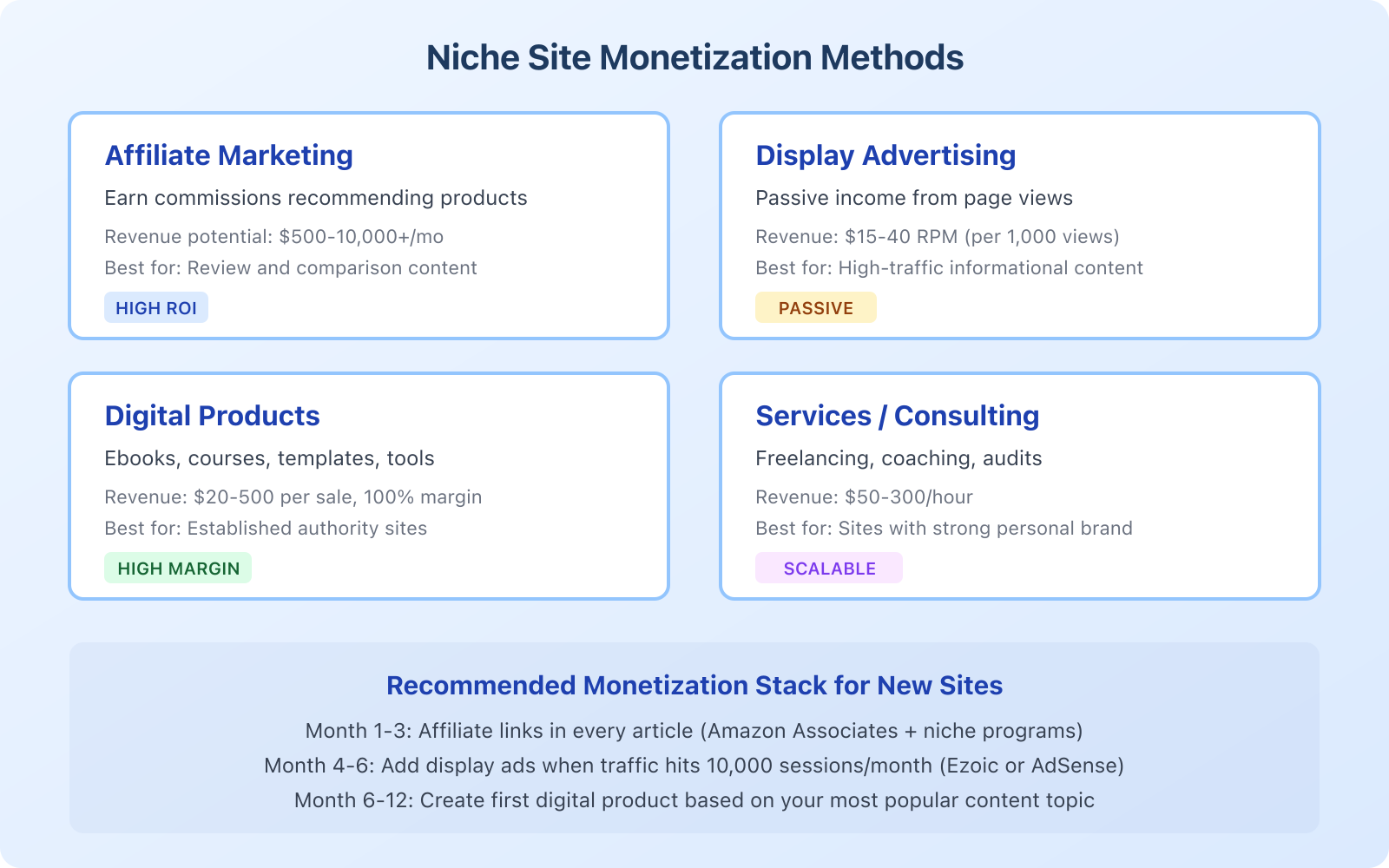
Don’t wait until you have 100,000 monthly pageviews to think about monetization. Set up revenue streams from day one, even if they earn pennies initially. The structure needs to be in place so that when traffic arrives, money follows automatically.
Affiliate Marketing (Start Immediately)
Apply for affiliate programs relevant to your niche. Amazon Associates is the easiest starting point (4-10% commissions on physical products). For higher commissions, find niche-specific affiliate programs through networks like ShareASale, Impact, and CJ Affiliate.
Place affiliate links naturally in product reviews, comparison articles, and “best of” lists. Don’t force them into informational content where they don’t belong.
Display Advertising (At 10k+ Sessions/Month)
Once you hit 10,000 sessions per month, apply for Ezoic or Mediavine (Mediavine requires 50,000 sessions). Display ads are passive income: they pay you per pageview with zero effort after setup. RPMs (revenue per thousand impressions) range from $15-40 depending on your niche. Finance and health niches pay the most.
Don’t use Google AdSense as your long-term ad solution. AdSense RPMs are typically $5-15, while Mediavine and Raptive (formerly AdThrive) pay $25-40+ RPMs. The difference between AdSense and Mediavine at 100,000 pageviews/month could be $1,000-2,500/month in revenue.
Digital Products (At 6+ Months)
Once you understand what your audience needs (through comments, emails, and analytics data), create a digital product. This could be an ebook, a template pack, a mini-course, or a tool. Digital products have near-100% profit margins and can generate $500-5,000+/month from a niche site with modest traffic.
The key is to solve a specific problem your audience has. Look at your most-visited articles and ask: “What product would make implementing this advice easier?”
Growing Your Niche Site: What Comes After Launch
Building the site is only the beginning. Growth requires consistent effort across three areas.
Content velocity: Aim for 3-4 articles per week in the first 6 months. This builds your topical authority quickly and gives Google enough content to establish your site as a relevant resource. Quality matters, but so does volume when you’re starting from zero.
Link building: New sites need backlinks to establish domain authority. Focus on guest posting on related sites, creating linkable assets (original data, infographics, free tools), and building relationships with other bloggers in your niche. Even 5-10 quality backlinks per month makes a significant difference for a new site.
Email list: Start building an email list from day one. Add a signup form to your most popular articles. An email list is the only traffic source you fully own. When Google changes its algorithm (and it will), your email subscribers are still there.
Realistic Timeline and Income Expectations
Let me be honest about timelines because most niche site advice is unrealistically optimistic.
Month 1-3: You’ll see very little organic traffic. Google takes time to discover, crawl, and rank new content. Focus on publishing, not checking analytics. Income: $0-50.
Month 3-6: Some articles start ranking for long-tail keywords. You’ll see 1,000-5,000 organic sessions per month if you’ve been consistent. Income: $50-300 from affiliate commissions.
Month 6-12: Compound growth kicks in. Your domain authority builds, content clusters mature, and individual articles start climbing to page 1. You’ll see 10,000-30,000 sessions per month. Income: $300-1,500 from affiliate + display ads.
Month 12-24: If you’ve been consistent and strategic, 50,000-100,000+ sessions per month is achievable. Income: $1,500-5,000+ from diversified revenue streams.
These numbers assume 3-4 quality articles per week and active link building. If you publish once a week and don’t build links, multiply those timelines by 2-3x.
Frequently Asked Questions
How much does it cost to start a niche website?
A basic setup costs $150-300 for the first year: domain registration ($10-15/year), hosting ($14-30/month on Cloudways), and a premium theme ($50-80 one-time). Optional costs include SEO tools like Ahrefs ($99/month) or Semrush ($129/month) for keyword research, though you can start with free alternatives like Google Keyword Planner and Ubersuggest.
How do I choose a profitable niche?
Look for niches with high affiliate commission rates (software, finance, outdoor gear), consistent search demand (check Google Trends), manageable competition (new sites ranking on page 1 for related keywords), and multiple monetization options (affiliate + ads + products). Avoid niches that are purely seasonal, extremely competitive (insurance, credit cards), or too narrow to sustain 50+ articles.
Can I build a niche site using only AI content?
You can, but I wouldn’t recommend it for long-term success. Google’s Helpful Content Update specifically targets sites that publish content primarily for search engines rather than people. AI-only content tends to be generic and lacks the personal experience, original data, and authentic opinions that Google rewards. The best approach is a hybrid workflow: use AI for research, outlines, and first drafts, then add human expertise, voice, and unique insights.
How many articles does a niche site need to start making money?
There’s no magic number, but most successful niche sites hit their stride around 30-50 quality articles organized in content clusters. The first affiliate commissions often come from product review and comparison articles. Aim for 10 articles per content cluster, with 3-5 clusters covering your niche’s main topics. Focus on quality and topical relevance over raw article count.
Is it still worth starting a niche site in 2026?
Yes, but the bar is higher than it was 5 years ago. You need better content, stronger topical authority, and genuine expertise or experience in your niche. AI has flooded the internet with mediocre content, which actually creates an opportunity for sites that publish genuinely helpful, experience-backed content. The sites that struggle are the ones publishing generic content at scale. The ones that succeed combine niche expertise with solid SEO fundamentals.
Disclaimer: This site is reader-supported. If you buy through some links, I may earn a small commission at no extra cost to you. I only recommend tools I trust and would use myself. Your support helps keep gauravtiwari.org free and focused on real-world advice. Thanks. - Gaurav Tiwari