
Tunnel through the Earth
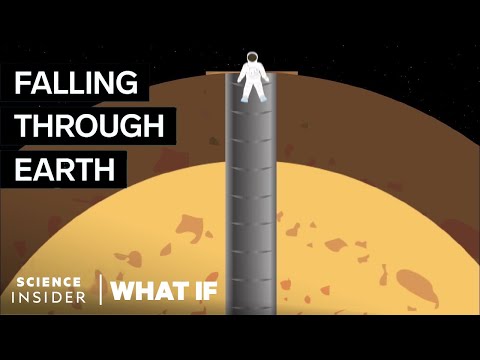
Drop a ball through a tunnel drilled straight through Earth. It won’t fall forever—it’ll oscillate back and forth, popping out on the other side in exactly 42 minutes. Every. Single. Time. Here’s the physics behind one of the most elegant thought experiments in classical mechanics.
The Setup: A Tunnel Straight Through Earth

Imagine drilling a tunnel straight through Earth’s center—from New York to somewhere in the Indian Ocean, say. You step to the edge and drop a ball. What happens?
This isn’t just a fun thought experiment. It shows up in physics exams, competitive tests, and university lectures because it beautifully demonstrates how gravity works inside a massive body. The answer reveals something surprising about orbital mechanics.
Our assumptions:
- No friction or air resistance (vacuum tunnel)
- Ball released from rest at Earth’s surface
- Earth has uniform density (we’ll relax this later)
- Non-rotating Earth (no Coriolis effects)
These simplifications let us see the core physics clearly. We’ll add reality back in later.
How Gravity Changes Inside Earth
Here’s the first surprise: gravity doesn’t increase as you fall toward Earth’s center. It decreases.
At Earth’s surface, gravitational acceleration is:
$$ g = G \frac{M}{R^2} \approx 9.8 \, \text{m/s}^2 $$
Where:
- \( G = 6.67 \times 10^{-11} \, \text{N} \cdot \text{m}^2 / \text{kg}^2 \) (gravitational constant)
- \( M = 5.97 \times 10^{24} \, \text{kg} \) (Earth’s mass)
- \( R = 6.37 \times 10^{6} \, \text{m} \) (Earth’s radius)
But once you’re inside Earth, something changes. Newton’s Shell Theorem tells us that:
- Mass above you cancels out. The spherical shell of Earth above your position contributes zero net gravitational force.
- Only the mass below you pulls. You’re only attracted to the sphere of Earth that’s closer to the center than you are.
This means gravitational acceleration at distance \( r \) from Earth’s center (for uniform density) is:
$$ g(r) = g_{\text{surface}} \cdot \frac{r}{R} = \frac{4}{3} \pi G \rho \cdot r $$
Where \( \rho \) is Earth’s density.
Key insight: Gravity is directly proportional to distance from center. At \( r = R/2 \), gravity is half of surface value. At \( r = 0 \) (Earth’s center), gravity is zero. You’d be weightless!
| Position | Distance from Center | Gravitational Acceleration |
|---|---|---|
| Surface | \( R \) | \( 9.8 \, \text{m/s}^2 \) |
| Halfway down | \( R/2 \) | \( 4.9 \, \text{m/s}^2 \) |
| Earth’s center | \( 0 \) | \( 0 \, \text{m/s}^2 \) |

The Motion: Simple Harmonic Oscillation
Here’s where it gets beautiful. Let’s write out the force on our falling ball.
If the ball is at distance \( r \) from Earth’s center, and \( x = R – r \) is the depth from surface:
$$ F = -m \cdot g(r) = -m \cdot \frac{g_{\text{surface}}}{R} \cdot r $$
The negative sign indicates the force always points toward the center. Rewriting:
$$ F = -\left( \frac{mg}{R} \right) r = -kr $$
Where \( k = mg/R \) is a constant.
Wait—that’s Hooke’s Law! The force is proportional to displacement and points toward equilibrium (Earth’s center). This is the defining equation of Simple Harmonic Motion.
The ball doesn’t just fall and stop. It oscillates like a mass on a spring, with Earth’s center as the equilibrium point.
Calculating the Period
For SHM, the period is:
$$ T = 2\pi \sqrt{\frac{m}{k}} = 2\pi \sqrt{\frac{m}{\frac{mg}{R}}} = 2\pi \sqrt{\frac{R}{g}} $$
Plug in the numbers:
$$ T = 2\pi \sqrt{\frac{6.37 \times 10^6 \, \text{m}}{9.8 \, \text{m/s}^2}} $$
$$ T \approx 5068 \, \text{seconds} \approx 84.5 \, \text{minutes} $$
The Answer
One-way trip (surface to surface): 42.2 minutes
Round trip: 84.5 minutes
The ball emerges on the other side after 42 minutes, momentarily stops, then falls back. Without friction, this continues forever.

Velocity Profile: How Fast Does It Go?
The ball doesn’t move at constant speed. Let’s figure out its velocity profile.
Using energy conservation (no friction means mechanical energy is conserved):
$$ \frac{1}{2}mv^2 + U(r) = E_{\text{total}} $$
The gravitational potential energy inside a uniform sphere is:
$$ U(r) = -\frac{GMm}{2R^3}(3R^2 – r^2) $$
At Earth’s center (\( r = 0 \)), all potential energy has converted to kinetic energy. The maximum velocity is:
$$ v_{\text{max}} = \sqrt{gR} = \sqrt{9.8 \times 6.37 \times 10^6} \approx 7,900 \, \text{m/s} $$
That’s about 28,400 km/h or Mach 23. The ball screams through Earth’s center at nearly escape velocity!
| Position | Velocity | Acceleration |
|---|---|---|
| Surface (start) | \( 0 \, \text{m/s} \) | \( 9.8 \, \text{m/s}^2 \) (down) |
| Halfway to center | \( 5,590 \, \text{m/s} \) | \( 4.9 \, \text{m/s}^2 \) (down) |
| Earth’s center | \( 7,900 \, \text{m/s} \) | \( 0 \, \text{m/s}^2 \) |
| Opposite surface | \( 0 \, \text{m/s} \) | \( 9.8 \, \text{m/s}^2 \) (back) |
The Surprising Chord Result
Here’s something that blew my mind when I first learned it.
The tunnel doesn’t have to go through the center. You could drill a straight tunnel between any two points on Earth—New York to London, for example—and the travel time is still 42 minutes.
Wait, what?
A shorter tunnel should mean a shorter trip, right? But shorter tunnels are also shallower, so gravity pulls less strongly, so you accelerate more slowly. These effects cancel perfectly.
The math: For any chord tunnel, the component of gravity along the tunnel is:
$$ a = -\frac{g}{R} \cdot x $$
Where \( x \) is displacement along the tunnel from midpoint. Same SHM equation, same period.
Mind-blowing implication: A frictionless “gravity train” between any two cities on Earth would take 42 minutes. New York to Beijing? 42 minutes. Your house to your neighbor’s? Also 42 minutes (though that tunnel would be nearly horizontal).
Reality Check: What About Earth’s Actual Structure?
We assumed uniform density. Earth is not uniform. Here’s what’s actually inside:
| Layer | Depth Range | Density |
|---|---|---|
| Crust | 0–35 km | \( 2,700–2,900 \, \text{kg/m}^3 \) |
| Upper Mantle | 35–670 km | \( 3,400–4,400 \, \text{kg/m}^3 \) |
| Lower Mantle | 670–2,891 km | \( 4,400–5,600 \, \text{kg/m}^3 \) |
| Outer Core | 2,891–5,150 km | \( 9,900–12,200 \, \text{kg/m}^3 \) |
| Inner Core | 5,150–6,371 km | \( 12,800–13,100 \, \text{kg/m}^3 \) |
Earth’s core is much denser than its crust. This changes the gravity profile significantly:
- Gravity stays roughly constant (~9.8 m/s²) through the mantle
- At the core-mantle boundary (2,891 km deep), gravity actually increases to about 10.7 m/s²
- Only inside the core does gravity decrease toward zero
The result? For a realistic Earth model (PREM—Preliminary Reference Earth Model), the round-trip time drops to approximately 76 minutes instead of 84.5 minutes. The one-way trip takes about 38 minutes.
The motion is still oscillatory, but it’s no longer pure SHM—the restoring force isn’t strictly linear.
Why We’ll Never Build This (And What We’d Face If We Tried)
Let’s be real: this tunnel isn’t getting built. Here’s why:
- Temperature: Earth’s core is about 5,400°C—as hot as the Sun’s surface. Any tunnel would need materials that don’t exist.
- Pressure: At the center, pressure exceeds 360 GPa (3.6 million atmospheres). The tunnel walls would need to withstand forces beyond any known material.
- Vacuum maintenance: You’d need to pump out 10²¹ kg of air and keep it pumped.
- Earth’s rotation: Coriolis forces would slam the ball into the tunnel walls. You’d need active guidance or a curved tunnel.
- Tidal forces: The Moon and Sun would perturb the motion slightly.
Fun fact: The deepest hole ever drilled is the Kola Superdeep Borehole in Russia—12.3 km. That’s 0.2% of the way to Earth’s center. We gave up because it got too hot (180°C) and the rocks started behaving like plastic.
The Orbital Connection: A Surprising Link
Here’s the kicker: that 84.5-minute period isn’t arbitrary. It’s the orbital period of a satellite skimming Earth’s surface.
For a circular orbit at radius \( R \):
$$ T_{\text{orbit}} = 2\pi \sqrt{\frac{R^3}{GM}} = 2\pi \sqrt{\frac{R}{g}} $$
Same formula! The tunnel oscillation and the grazing orbit have identical periods.
This isn’t coincidence. Both motions are governed by the same gravitational dynamics. The ball in the tunnel traces a diameter; a satellite traces a circle. Both complete their journeys in 84.5 minutes (for uniform density Earth).
In fact, for any uniform-density sphere, these periods match. It’s a deep geometric result connecting linear oscillation to orbital mechanics.
Summary of Key Formulas
| Quantity | Formula | Value for Earth |
|---|---|---|
| Gravity inside Earth | \( g(r) = g \cdot \frac{r}{R} \) | Linear decrease to 0 |
| Oscillation period | \( T = 2\pi\sqrt{R/g} \) | 84.5 minutes |
| One-way travel time | \( T/2 \) | 42.2 minutes |
| Max velocity (at center) | \( v = \sqrt{gR} \) | 7,900 m/s |
| Chord tunnel time | \( T/2 \) (same!) | 42.2 minutes |
Frequently Asked Questions
Would you feel weightless at Earth’s center?
Yes! At Earth’s center, gravitational acceleration is zero because mass pulls equally in all directions. You’d float freely—though you’d be moving at 7,900 m/s, so ‘floating’ might not be the right word. You’d zoom through in a fraction of a second.
Why doesn’t gravity increase as you get closer to Earth’s center?
Newton’s Shell Theorem explains this. The spherical shell of mass above you exerts zero net gravitational force—its pulls cancel out. Only the mass closer to the center than you contributes. As you descend, this ‘inner sphere’ shrinks, so gravity decreases (for uniform density).
Could we actually use gravity trains for transportation?
Not with current technology. The engineering challenges (extreme heat, pressure, vacuum) are insurmountable. However, the concept inspired proposals for shorter evacuated tube transport systems using maglev technology—which could achieve similar speeds over shorter distances without drilling through the mantle.
What happens if there’s friction in the tunnel?
With friction (air resistance or surface friction), the ball loses energy on each pass. The oscillations decay—each swing is smaller than the last. Eventually, the ball comes to rest at Earth’s center, the equilibrium point. This is damped harmonic motion.
Does the 42-minute result depend on Earth’s size or mass?
It depends on density, not size or mass separately. The period T = 2π√(R/g) can be rewritten as T = √(3π/Gρ), where ρ is density. Any uniform sphere with Earth’s average density (5,517 kg/m³) would have the same 84.5-minute period—whether it’s Earth-sized or marble-sized!
How does this relate to actual satellite orbits?
The tunnel period (84.5 min) equals the period of a satellite orbiting at Earth’s surface. Real low-Earth-orbit satellites at ~400 km altitude have periods around 90 minutes. The International Space Station orbits in about 92 minutes. The connection isn’t coincidence—it’s the same gravitational physics.
The Bottom Line
The tunnel-through-Earth problem is physics poetry. You start with Newton’s laws, apply the Shell Theorem, recognize the SHM equation, and arrive at a beautiful result: 42 minutes to anywhere on Earth, regardless of distance.
It’s impractical to build. But it teaches us deep truths about how gravity works inside massive bodies—truths that matter for understanding planetary interiors, stellar structure, and the behavior of neutron stars.
Sometimes the best physics problems are the ones we can never actually run.