
The Best ACT Prep Books and Guides for Acing ACT
I’ve helped hundreds of students pick the right study materials over the years, and the ACT is one exam where your prep book choice genuinely matters. The wrong book wastes your time with outdated questions and vague strategies. The right one gives you real practice tests, clear explanations, and a study plan that actually works.
The ACT tests four areas: English, Math, Reading, and Science Reasoning, with an optional Writing section. Every college in the United States accepts it, and your score can make or break scholarship applications. I’ve seen students jump 4-6 points just by switching from a mediocre prep book to one that matches how they learn.
Here’s what I’ve found after reviewing dozens of ACT prep books: you don’t need ten different guides. You need one solid comprehensive book and maybe one or two subject-specific supplements for your weak areas. That’s it. I’ve organized this list so you can find exactly what you need, whether you’re starting from scratch or targeting a specific section.
The Official ACT Prep and Subject Guides Complete Set
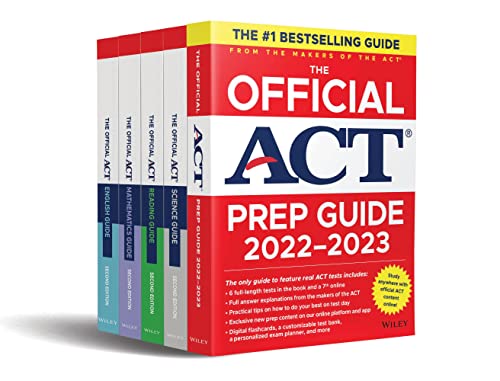
The Official ACT Prep and Subject Guides Complete Set
- Published by ACT itself, with six full-length practice tests available online and offline
- Includes subject-specific guides for English, Math, Reading, and Science
- Real ACT questions from past exams with detailed answer explanations
- Written by the test makers, ensuring questions match actual ACT difficulty exactly
- Online access portal with additional practice questions and score tracking
- Covers all four ACT sections plus the optional Writing section
- Updated regularly to reflect current ACT format and scoring changes
- Best resource for understanding official scoring rubrics and benchmarks
This is the one book I tell every student to start with. It’s published by ACT itself, which means you’re practicing with actual questions from past exams. No third-party approximations, no “ACT-style” questions that don’t quite match the real thing. You get six full-length practice tests, both online and in print, plus subject-specific guides that break down exactly what each section tests.
If you prefer online prep over books, Magoosh ACT Prep offers 250+ video lessons and 1,300+ practice questions with detailed explanations. Their score improvement guarantee and affordable pricing make it a solid companion to any prep book. Check Magoosh plans here.
The complete set is pricier than individual guides, but it saves you from buying four separate subject books. If you’re the kind of student who wants everything in one place with zero guesswork about whether the material is accurate, this is your pick. The official guide won’t teach you tricks or shortcuts, but it gives you the most authentic practice experience available. Pair it with one of the strategy-focused books below, and you’ve got a complete prep system.
Princeton Review ACT Prep
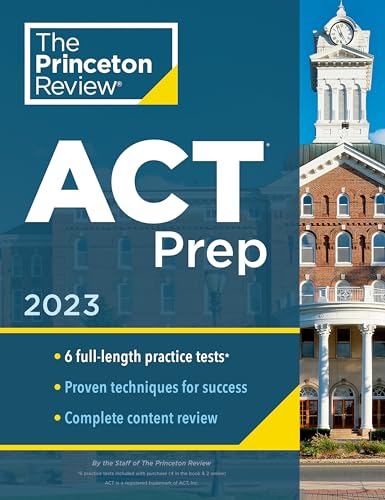
Princeton Review ACT Prep – 6 Practice Tests + Content Review + Strategies
- 6 full-length practice tests with detailed answer explanations
- Comprehensive content review covering all four ACT sections
- Proven test-taking strategies and score-raising tips
- Six full-length practice tests with detailed scoring and answer explanations
- Content review chapters for English, Math, Reading, and Science sections
- Online access to additional drills and score reports for tracking progress
- Test-taking strategies specific to each ACT section with timing tips
- Premium online portal with video tutorials and interactive practice
The Princeton Review ACT Prep is the book I’d recommend if you want strategy alongside practice. Where the official guide gives you raw material, Princeton Review teaches you how to think about the test. You get six practice tests, a full content review, and strategies that have been refined over decades of test prep coaching.
You don’t need ten prep books. One comprehensive guide plus one book of practice tests covers 90% of students. Only add subject-specific books if you’re consistently scoring below 25 in a particular section.
At $23.99, this is one of the best values on this list. The content review sections are well-organized, and the practice tests are close enough to real ACT questions that you won’t feel surprised on test day. I especially like how they break down the Science section, which is the part most students panic about. Princeton Review makes it clear that the Science section is really about reading data and graphs, not memorizing biology facts. If you can only buy one prep book and you want something that covers both content and strategy, this is the one.
ACT Prep Black Book
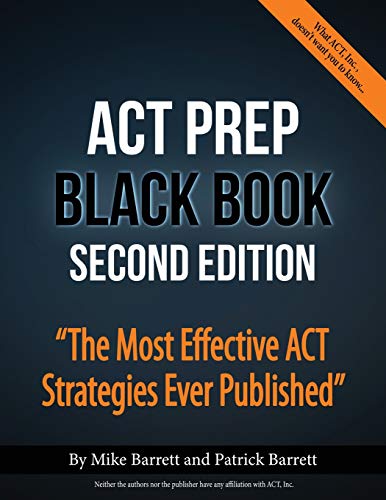
ACT Prep Black Book – The Most Effective ACT Strategies Ever Published
- Unique strategies that go beyond standard test prep approaches
- Detailed walkthroughs of real ACT questions with step-by-step explanations
- Best used alongside the official ACT guide as a strategy companion
- Strategy-focused approach teaches you how to think through ACT questions
- Walks through official ACT practice questions with detailed reasoning
- Written by Mike Barrett who scored a perfect 36 on the ACT
- Focuses on understanding question design rather than memorizing content
- Works best as a companion to the Official ACT Prep Guide
The ACT Prep Black Book by Mike Barrett takes a completely different approach from traditional prep books. Instead of drowning you in practice questions, it focuses on teaching you how the ACT is designed and how to exploit its patterns. Barrett argues that most prep books teach you the wrong way to think about the test, and after reading this, I tend to agree.
This book works best as a companion to the official ACT guide. Barrett actually walks you through real ACT questions from the official book and shows you exactly how to break them down. You won’t find practice tests here. What you’ll find are strategies that change how you approach every question type. If you’ve already done a bunch of practice tests and your score isn’t moving, the Black Book might be what unlocks the next 2-3 points. It’s one of those books that makes you feel smarter about the test itself, not just better at memorizing content.
Kaplan ACT Prep Plus
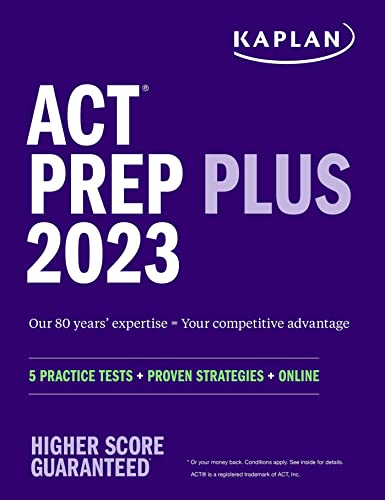
Kaplan ACT Prep Plus – 5 Full Length Practice Tests + 100s of Practice Questions + Online Access
- Kaplan is an official ACT partner with 5 full-length practice tests included
- Hundreds of additional practice questions with detailed explanations
- 1-year access to online quizzes, video instruction, and practice tools
- Includes Qbank with 1,000+ additional online practice questions
- Video lessons available through Kaplan's online learning platform
- Diagnostic test helps identify weak areas before you start studying
- Score guarantee program if your ACT score doesn't improve
- Expert tips for the optional Writing section with sample essays
Kaplan is an official ACT partner, and that relationship shows in the quality of their practice material. The Prep Plus edition gives you five full-length practice tests (two in print, three online), hundreds of additional practice questions, and something most books don’t offer: one year of access to online video lessons and quizzes through kaptest.com.
The online component is what sets Kaplan apart. If you’re the kind of learner who benefits from video explanations alongside reading, this hybrid approach works really well. The book covers all four sections with clear content reviews and test-taking strategies. I’d recommend this over the Princeton Review if you want that digital learning experience. The print-only practice tests are solid, but the real value is in the online portal where you can take timed practice tests, review your weak areas, and watch instructors walk through problem types. For students who are self-studying without a tutor, the Kaplan online access is the closest thing to having one.
McGraw-Hill Education: 10 ACT Practice Tests
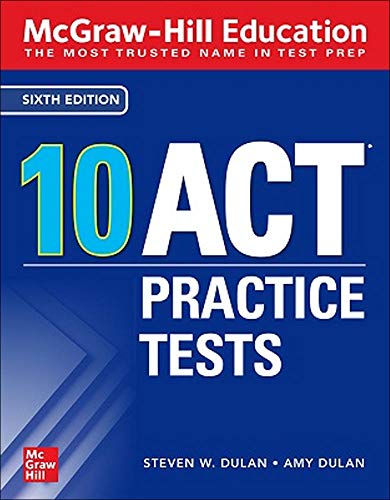
McGraw-Hill Education: 10 ACT Practice Tests, Sixth Edition
- 10 full-length practice tests with detailed scoring and explanations
- Updated to match the latest ACT format and question types
- Includes free access to additional practice tests online
- Ten complete practice tests provide extensive test-day simulation
- Answer explanations for every question across all four sections
- Score conversion charts help predict actual ACT composite score
- Organized by test number for easy scheduling across study plan
- Best pure practice test volume available at this price point
If you’ve finished your main prep book and you still want more practice, McGraw-Hill’s 10 ACT Practice Tests is the volume play. Ten full-length tests in one book. That’s 40+ hours of timed practice if you simulate real test conditions, which you absolutely should.
Always start with the Official ACT Prep Guide or Complete Set. Third-party publishers write good strategy content, but only ACT’s own questions match the exact difficulty and style of the real test.
This book doesn’t waste time on content review or strategy. It assumes you already know the material and just need to practice applying it under time pressure. Each test comes with detailed scoring and answer explanations, so you can figure out where you’re losing points. The sixth edition has been updated to match the current ACT format, and you also get access to additional practice tests online. I’d say this book is a must-have if you’re in the final 2-3 weeks before test day and want to build stamina and confidence. It’s not a replacement for a strategy book, but as a practice companion, nothing beats the sheer volume you get here for $20.
The Official ACT Prep Guide
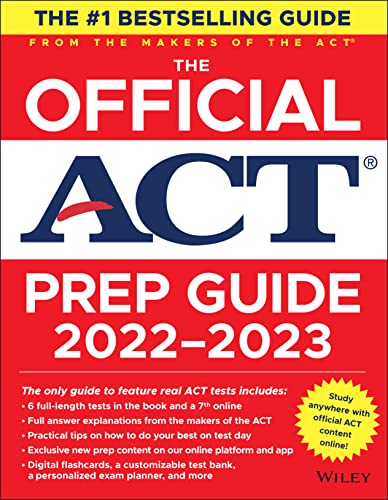
The Official ACT Prep Guide – The ONLY Official Prep Guide From the Makers of the ACT
- The only prep guide made by the same people who create the ACT
- Contains real ACT test questions from previous exams
- Includes test-taking tips and strategies directly from ACT
- Contains five previously administered ACT tests with all answer keys
- Official scoring rubrics and percentile tables from actual test data
- Writing section prompts with scored sample essays at each score point
- Question-by-question explanations written by ACT content experts
- Free online companion with additional practice and score reporting
If the complete set above feels like overkill for your needs, the standalone Official ACT Prep Guide gives you the core experience at a lower price. This is the single-volume version published by ACT, and it’s the one book that every ACT student should own. You get real test questions from past exams, which no third-party publisher can match.
The guide includes test-taking tips directly from the people who write the exam. That’s a detail I don’t think students appreciate enough. When ACT tells you what they’re testing and how to approach each section, listen. The strategies might seem basic compared to the flashy techniques in third-party books, but they’re accurate. I’d recommend this as your baseline book and then adding the Black Book or Princeton Review on top for deeper strategy work.
Other Comprehensive ACT Prep Books Worth Considering
Beyond the five main picks above, there are a few more solid options depending on your learning style and budget. Each of these brings something slightly different to the table.
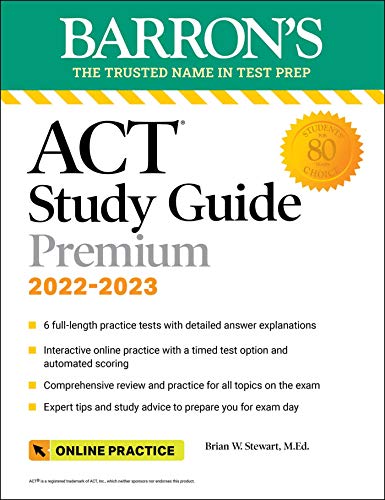
Barron's ACT Premium Study Guide – 6 Practice Tests + Comprehensive Review + Online Practice
- 6 full-length practice tests with comprehensive answer explanations
- Detailed content review for all ACT subject areas
- Online practice tools and additional resources included
- Comprehensive content review for all four tested subjects
- Online practice tests with automatic scoring and performance analytics
- Bonus online-only practice tests beyond what's in the physical book
- Subject-specific study tips and common mistake warnings per section
- College planning advice and ACT score interpretation guidance
Barron’s has been a trusted name in test prep for decades, and their ACT Premium Study Guide delivers exactly what you’d expect: six practice tests, thorough content reviews, and online practice tools. Barron’s tends to write slightly harder questions than what you’ll see on the real ACT, which isn’t a bad thing. If you can handle Barron’s practice tests, the real exam will feel more manageable.
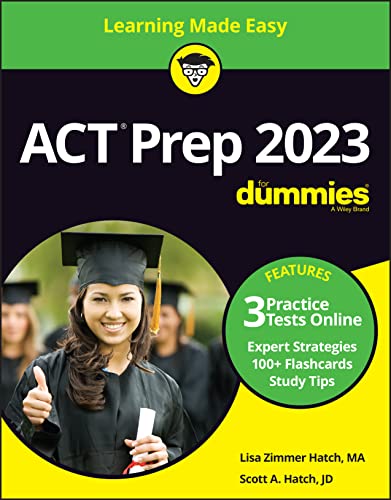
ACT Prep For Dummies with Online Practice
- Beginner-friendly explanations that break down complex concepts
- Full-length practice tests with online access
- Step-by-step approach perfect for first-time test takers
- Beginner-friendly explanations for students new to standardized test prep
- Online practice with customizable quizzes by subject and difficulty
- Cheat sheets and quick-reference guides for test day strategies
- Math fundamentals review starting from pre-algebra through trigonometry
- Reading comprehension strategies broken down into simple, repeatable steps
Don’t let the “For Dummies” branding turn you off. This is actually one of the most approachable ACT prep books available, and it’s perfect for students who feel overwhelmed by the test. The writing style is conversational and clear, breaking down complex concepts without talking down to you. If you’re a first-time test taker or someone who hasn’t touched test prep before, this is a comfortable starting point. It comes with online practice tests too.
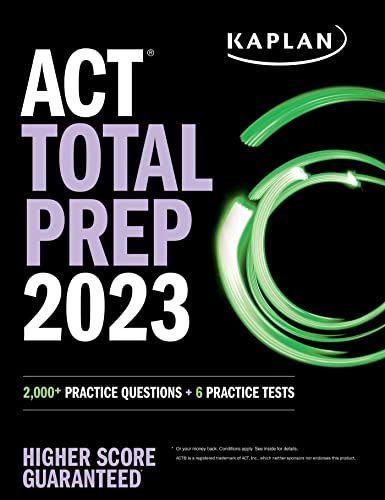
Kaplan ACT Total Prep – 2,000+ Practice Questions + 6 Practice Tests
- Over 2,000 practice questions across all ACT sections
- 6 full-length practice tests to build test-day confidence
- Comprehensive content review with Kaplan's proven strategies
- 2,000+ practice questions across all ACT sections in one package
- Six full-length practice tests with detailed answer explanations
- Online Qbank lets you create custom practice sets by topic
- Kaplan's proven test-taking strategies developed over 80+ years
- Mobile-friendly online resources for studying on the go
Kaplan’s Total Prep is the heavyweight version of their lineup. With 2,000+ practice questions and six full-length tests, this is for students who want to leave no stone unturned. It includes everything in the Prep Plus edition and adds significantly more practice material. If you’re aiming for a 30+ composite score and you’ve got 8-12 weeks to prep, this level of practice volume makes sense.
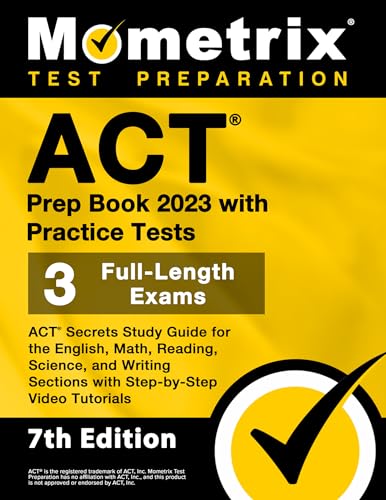
ACT Prep Book – 3 Full-Length Exams + ACT Secrets Study Guide with Step-by-Step Video Tutorials
- 3 full-length practice exams covering all ACT sections
- Step-by-step video tutorials for visual learners
- Covers English, Math, Reading, Science, and Writing sections
- Focused study guide covers high-yield topics most likely to appear on test
- Three full-length practice exams with complete answer explanations
- Test anxiety management strategies and mental preparation techniques
- Step-by-step approach to each question type across all ACT sections
- Concise format ideal for students with limited study time
Mometrix’s ACT Secrets Study Guide takes a different approach with step-by-step video tutorials that accompany the printed material. You get three full-length practice exams and coverage of all five sections (including Writing). The video component is helpful if you’re the kind of learner who needs to see someone solve problems rather than just read about it. A solid budget option.
Best ACT Math Books
Math is where most students either gain or lose the biggest points on the ACT. If your practice test scores show a gap between your Math section and everything else, one of these subject-specific books can help you close it. I recommend pairing a math-focused book with your main comprehensive guide, especially if algebra, geometry, or trigonometry isn’t your strong suit. Also see: the best calculus textbooks if you’re preparing for advanced coursework alongside the ACT.
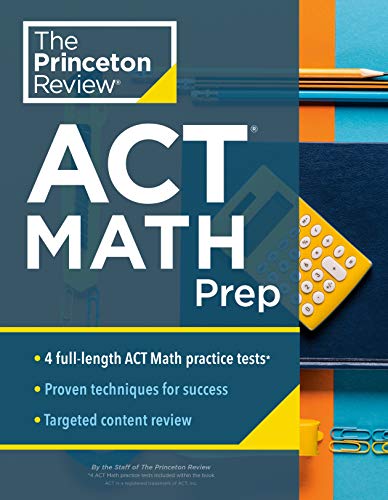
Princeton Review ACT Math Prep – 4 Practice Tests + Review + Strategy
- 4 math-specific practice tests designed for the ACT Math section
- Targeted review of algebra, geometry, and trigonometry concepts
- Strategic approaches to the 60-question, 60-minute math section
- Focused math review from basic algebra through advanced trigonometry
- Four math-specific practice tests with detailed solution walkthroughs
- Technique chapters for calculator and no-calculator problem strategies
- Common math trap answers identified and explained per question type
- Progressive difficulty organization from easy to hard within each topic
Princeton Review’s math-specific guide gives you four focused practice tests and a thorough review of every math concept the ACT tests. The 60-question, 60-minute math section is one of the most time-pressured parts of the exam, and this book teaches you how to work efficiently. It covers pre-algebra through basic trigonometry, with strategies for identifying which questions to answer first and which to skip. This is my top pick for math-focused prep.
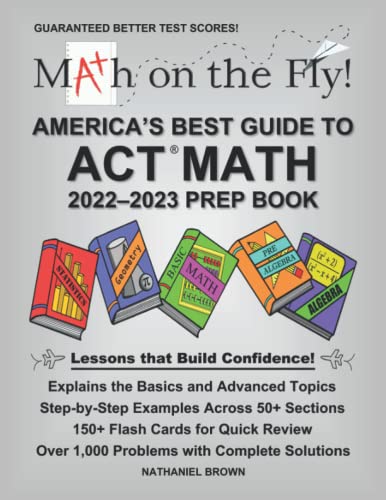
Math on the Fly – America's Best Guide to ACT Math
- Focused exclusively on ACT Math with quick, practical strategies
- Written in plain language that makes math concepts easier to grasp
- Designed for students who want to improve their math score quickly
- Unconventional teaching approach makes ACT math concepts more intuitive
- Written by an instructor who specializes in making math accessible
- Covers all ACT math topics with emphasis on pattern recognition
- Includes real student examples showing common mistakes and fixes
- Short chapters designed for 20-30 minute focused study sessions
Math on the Fly is a niche ACT math guide that focuses on quick, practical problem-solving strategies. It’s written in plain, accessible language and is designed for students who need to improve their math score fast. If you’re 3-4 weeks out from the test and math is your weakest area, this book cuts straight to what you need to know without overwhelming you with theory.
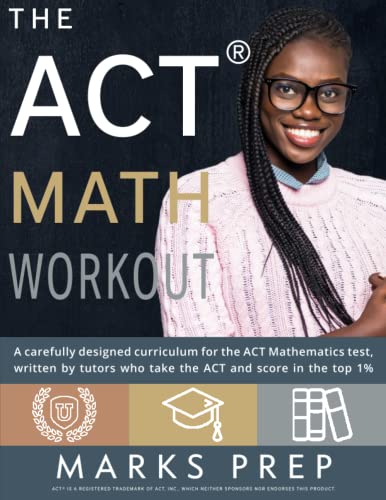
ACT Math Workout – A Carefully Designed Curriculum for the ACT Math Section
- Structured curriculum that builds math skills progressively
- Carefully designed practice problems that mirror real ACT math questions
- Works well as a supplement to any comprehensive ACT prep book
- Drill-based format provides intensive math practice by topic area
- Timed exercise sets simulate real ACT math section time pressure
- Covers coordinate geometry, functions, and statistics in depth
- Answer explanations show multiple solving methods per problem
- Ideal supplement for students scoring below 25 on ACT Math
ACT Math Workout takes a curriculum-based approach where you build skills progressively rather than jumping straight into practice tests. The problems mirror real ACT math questions, and the structure helps you identify specific areas where you’re weak. I’d recommend this for students who score below 25 on the math section and need to rebuild their fundamentals before tackling full-length practice tests.
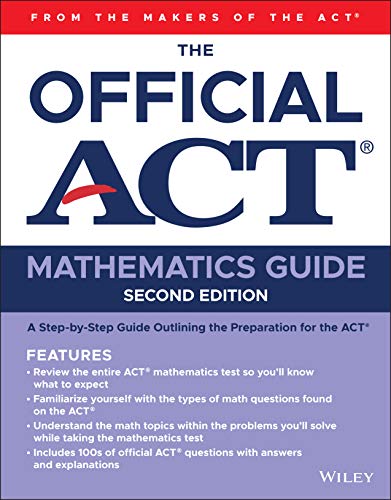
The Official ACT Mathematics Guide
- Published by ACT with real math questions from past exams
- Detailed explanations for every math concept tested on the ACT
- The most authentic math practice material available
- Contains hundreds of real ACT math questions from past exams
- Detailed answer explanations written by ACT's own math experts
- Organized by math topic for targeted practice on weak areas
- Difficulty ratings for each question help structure study sessions
- The most authentic ACT math practice available outside of the full test
Just like the main prep guide, this is the official math-specific guide from ACT. Real questions, real format, no guesswork about whether the practice material matches the actual test. If you’re going to buy one math book, make it this one. The questions here are the closest thing to what you’ll see on test day.
Best ACT English, Reading, and Writing Books
The English, Reading, and Writing sections of the ACT reward strong grammar knowledge, reading speed, and the ability to analyze passages quickly. If you’re scoring below 28 on these sections, a targeted book can help you identify the specific grammar rules and passage strategies you’re missing. These are my top picks for improving your verbal scores.
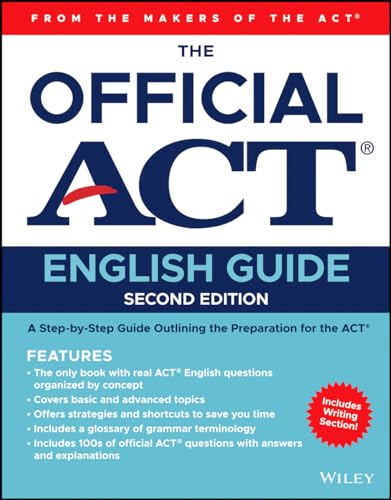
The Official ACT English Guide
- Official ACT English questions from real past exams
- Covers grammar, punctuation, sentence structure, and rhetorical skills
- Published by ACT for the most authentic English section practice
- Real ACT English questions from previously administered exams
- Covers grammar, punctuation, sentence structure, and rhetorical skills
- Organized by skill type for focused practice on specific weaknesses
- Answer explanations reference the exact grammar rules being tested
- Best resource for understanding how ACT scores English responses
The official English guide from ACT is the gold standard for English section prep. It uses real questions from past exams, which means you’re practicing with the exact type of grammar and rhetoric questions you’ll face. The guide covers punctuation, sentence structure, and rhetorical skills in a straightforward way. If grammar has always been your strength, you might not need this. But if you’re losing points on English, start here before moving to any third-party book.
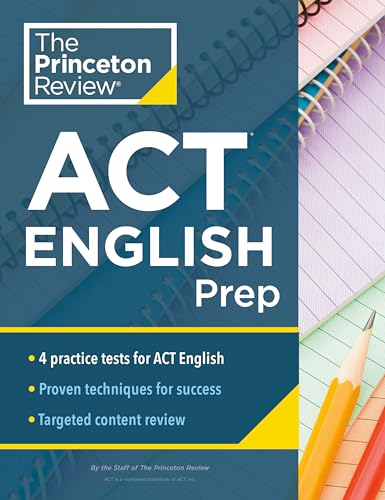
Princeton Review ACT English Prep – 4 Practice Tests + Review + Strategy
- 4 English-focused practice tests with detailed answer explanations
- Comprehensive review of grammar rules and rhetorical strategies
- Princeton Review's proven test-taking strategies for the English section
- Four complete English practice tests with section-by-section analysis
- Grammar and usage rules presented with clear examples and exceptions
- Rhetorical skills strategies for passage organization questions
- Common English trap answers identified and explained per question type
- Quick-reference grammar guide useful for last-minute review before test
Princeton Review’s English Prep gives you four targeted practice tests and a comprehensive review of the grammar rules that show up most frequently on the ACT. The answer explanations are particularly good here, walking you through not just the correct answer but why each wrong answer is wrong. This helps you build the pattern recognition that makes the English section feel almost automatic after enough practice.
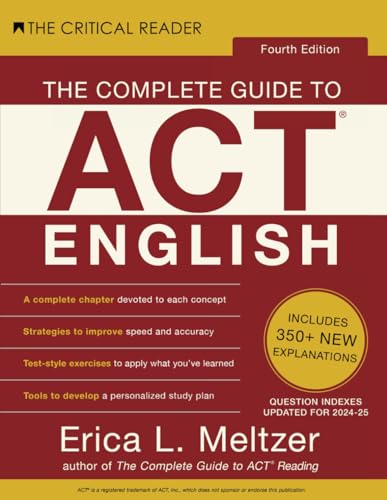
The Complete Guide to ACT English, Fourth Edition
- Deep dive into every grammar rule tested on the ACT English section
- Hundreds of practice questions organized by grammar concept
- Fourth edition updated with the latest ACT English question patterns
- Deep dive into every grammar and rhetoric concept tested on the ACT
- Written by Erica Meltzer who is widely regarded as a top ACT English expert
- Progressive skill building from basic grammar through advanced rhetoric
- Hundreds of practice problems with detailed explanations per concept
- Fourth edition updated to reflect current ACT English question patterns
The Complete Guide to ACT English is one of the most thorough single-subject prep books you’ll find. It breaks down every grammar rule the ACT tests, organizes practice questions by concept, and helps you build a systematic approach to the English section. The fourth edition is current with the latest question patterns. If your English score is lagging behind your other sections by 3+ points, this book will close that gap.
Best ACT Science Books
The ACT Science section scares students more than any other, but here’s the thing: it’s not really a science test. It’s a data interpretation test. You don’t need to memorize the periodic table or know the names of cell organelles. You need to read graphs, interpret experimental results, and draw conclusions from data. These books will teach you exactly how to do that.
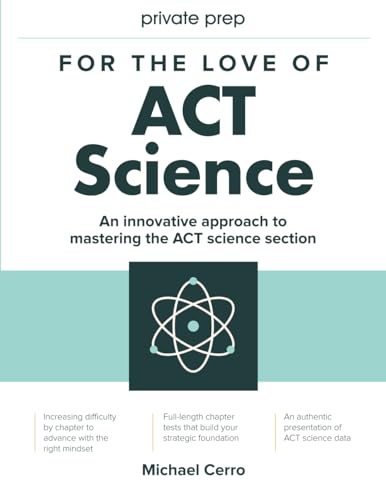
For the Love of ACT Science – An Innovative Approach to Mastering the ACT Science Section
- Innovative approach that demystifies the ACT Science section
- Teaches data interpretation and graph reading skills, not memorization
- Written by Michael Cerro with practical, student-tested strategies
- Breaks ACT Science into learnable categories most prep books ignore
- Teaches graph and data interpretation skills specific to ACT format
- Conflicting viewpoints passage strategies that consistently improve scores
- Written in an engaging style that makes science concepts approachable
- Practice sets mirror the exact question types found on real ACT Science
For the Love of ACT Science by Michael Cerro is the book that finally makes the Science section click for students. Instead of treating it like a traditional science review, Cerro teaches you how to quickly parse data presentations, research summaries, and conflicting viewpoints passages. His approach is practical and student-tested. If the Science section has you stressed, this is the single best book to calm those nerves and actually improve your score. I recommend it over any other science-specific guide.
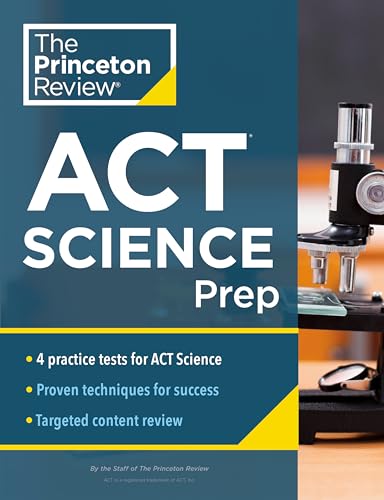
Princeton Review ACT Science Prep – 4 Practice Tests + Review + Strategy
- 4 science-focused practice tests targeting the ACT Science section
- Review of data interpretation, research summaries, and conflicting viewpoints
- Princeton Review strategies for managing the 35-minute time limit
- Four science-specific practice tests with full answer explanations
- Data analysis and experimental design strategies for each passage type
- Scientific reasoning shortcuts that save time on test day
- Review of key science concepts that frequently appear on the ACT
- Online companion with additional practice drills and score tracking
Princeton Review’s Science Prep is the practice-heavy option. Four focused practice tests give you plenty of reps with the three passage types you’ll encounter: data representation, research summaries, and conflicting viewpoints. At $14.97, it’s a steal. The time management strategies are especially useful since the Science section gives you just 35 minutes for 40 questions, making it one of the fastest-paced sections on the entire test.
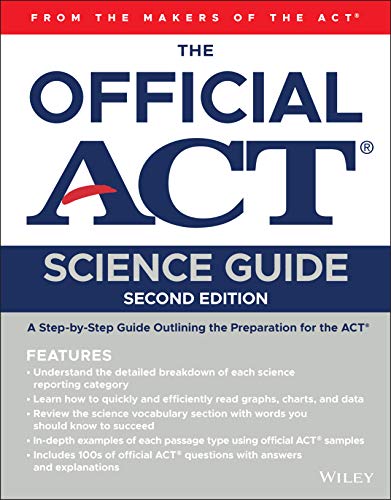
The Official ACT Science Guide
- Real ACT Science questions directly from past exams
- Official explanations and scoring guidance from ACT
- The most accurate representation of what you'll see on test day
- Authentic ACT science questions from previously administered tests
- Organized by passage type: data representation, research summaries, conflicting viewpoints
- Answer explanations from ACT's own science content development team
- Difficulty ratings help students prioritize which questions to tackle first
- The definitive science practice resource for serious ACT preparation
Rounding out the science picks is the official guide from ACT. As with all the official guides, the biggest advantage is authenticity. These are real questions from real exams. The explanations come directly from ACT, so you know the reasoning behind each answer is exactly how the test makers think. Pair this with For the Love of ACT Science for a complete science prep system: Cerro teaches you the strategy, and the official guide gives you the most realistic practice.
How to Choose the Right ACT Prep Book
With 20 books on this list, you might be wondering which ones you actually need. Here’s my honest take: most students need two books, maybe three. One comprehensive guide and one or two subject-specific supplements for their weak areas. That’s it.
If you’re starting from scratch, grab the Princeton Review ACT Prep for strategy and content review, then add the Official ACT Prep Guide for authentic practice tests. That combination covers both bases for under $60.
If your score is stuck and you need a breakthrough, the ACT Prep Black Book changes how you think about the test. Use it alongside the official guide for maximum impact.
If you’re 2-3 weeks from test day and need volume practice, McGraw-Hill’s 10 Practice Tests gives you the most tests per dollar.
And if you prefer video-based learning, Kaplan’s Prep Plus with its online access is the way to go.
Tips for Effective ACT Preparation
Having the right books is only half the battle. How you use them makes the real difference. Here are the study strategies I’ve seen work best for students preparing for the ACT.
Take a full diagnostic test before you open any prep book. You need to know where you stand so you can focus your time on the sections that need the most work. There’s no point spending 20 hours on English if you’re already scoring 30+ there but getting a 22 in Math. The Pomodoro technique works really well for ACT prep, breaking your study sessions into focused 25-minute blocks with short breaks in between.
Simulate real test conditions at least once a week. That means sitting down for the full 2 hours and 55 minutes (3 hours 40 minutes with the optional Writing section), no phone, no breaks except the scheduled ones. Students who only practice individual sections in isolation often struggle with the fatigue and mental stamina the full test demands.
Review every wrong answer, not just the ones you got wrong by guessing. The questions you got wrong because you misread the passage or made a careless error are the easiest points to recover on your next test. Keep a running log of your mistakes and look for patterns. If you’re consistently missing the same type of question, that’s where your next study session should focus.
For more study tools and resources for college-level preparation, I’ve put together a separate guide that covers apps, websites, and strategies that complement your ACT prep books. And if you’re also considering the MCAT for medical school down the road, check out my guide on how to prepare for the MCAT to get a head start on your long-term test prep strategy.
Frequently Asked Questions
How many ACT prep books do I actually need?
Most students do well with two books: one comprehensive guide for strategy and content review, and one for pure practice tests. If you have a specific weak section like Math or Science, add a third subject-specific book. Buying more than three prep books usually leads to overwhelm rather than better scores. Focus on quality study time with fewer resources rather than spreading yourself thin across six different books.
Is the official ACT prep guide better than Princeton Review or Kaplan?
They serve different purposes. The official guide gives you the most authentic practice questions since they come from real past exams. Princeton Review and Kaplan are better at teaching strategies and providing content review. The ideal combination is using the official guide for practice and a third-party book like Princeton Review for strategy. Don’t choose one over the other. Use them together.
How long should I study for the ACT?
Most students benefit from 8 to 12 weeks of consistent preparation, studying about 1 to 2 hours per day. If you’re starting with a strong baseline score (27+), 4 to 6 weeks might be enough. Students aiming for a major score improvement of 5+ points should plan for the full 12 weeks. The key is consistency, not cramming. Studying 30 minutes every day beats studying 4 hours once a week.
What’s a good ACT score in 2026?
The average ACT composite score is around 20 out of 36. A score of 24+ puts you above the 75th percentile, which is competitive for most state universities. For top-tier schools and Ivy League universities, you’ll want a 32 or higher. A 30+ composite score also makes you eligible for significant merit scholarships at many colleges. Check the middle 50% score range for your target schools to set a realistic goal.
Should I take the ACT or the SAT?
All US colleges accept both tests equally. The ACT includes a Science section and tests more straightforward math, while the SAT focuses more on evidence-based reading and has trickier math word problems. Take a practice test for each and see which one you score higher on naturally. Many students find that the ACT rewards speed and content knowledge, while the SAT rewards careful reading and problem-solving. Go with whichever format plays to your strengths.
Can I improve my ACT score by 5 or more points?
A 5-point improvement is absolutely realistic with 8 to 12 weeks of focused preparation. Students who start with lower scores (18-24) often see the biggest jumps because there are more easy points to recover through better strategies and fixing knowledge gaps. Students scoring 28+ will find it harder to gain 5 points since those top-tier questions require deeper understanding. The key is identifying your weakest areas and targeting them specifically rather than studying everything equally.
Are online ACT prep courses better than books?
Online courses like Magoosh and Khan Academy are great supplements, but they shouldn’t replace books entirely. Books give you the concentrated practice and portability that online courses can’t match, while online tools offer adaptive learning, video explanations, and progress tracking. The best approach is combining a solid prep book with an online resource. If budget is a concern, Khan Academy offers free ACT prep that pairs well with any book on this list.
When should I start preparing for the ACT?
Most students take the ACT in their junior year of high school, either in the spring or early fall. Start your focused prep 10 to 12 weeks before your test date. If you’re a sophomore, you can begin light preparation by taking a diagnostic test and working on your weakest subject areas. Don’t start too early though, because burnout is real with standardized test prep. A focused 10-week study plan beats 6 months of unfocused, on-and-off studying every time.
Disclaimer: This site is reader-supported. If you buy through some links, I may earn a small commission at no extra cost to you. I only recommend tools I trust and would use myself. Your support helps keep gauravtiwari.org free and focused on real-world advice. Thanks. - Gaurav Tiwari