
How to Prepare for the MCAT on a Budget in 2026
How to prepare for the MCAT on a budget with a practical $0-$500 self-study plan. Use free AAMC and Khan Academy resources first, spend on official practice exams, buy used books only when needed, and skip expensive prep courses unless you need structure.
 by
by
You can learn how to prepare for the MCAT on a budget without turning MCAT prep into a $2,000 panic purchase. Start with free official material, spend only on practice that mirrors the real exam, and buy used books only when a content gap keeps showing up in review.
The MCAT is still a long, tiring exam: 230 questions, four scored sections, 6 hours and 15 minutes of content time, and about 7 hours and 30 minutes seated on test day. The budget problem is not that you need more resources. It is that too many students buy resources before they know what problem they are solving.
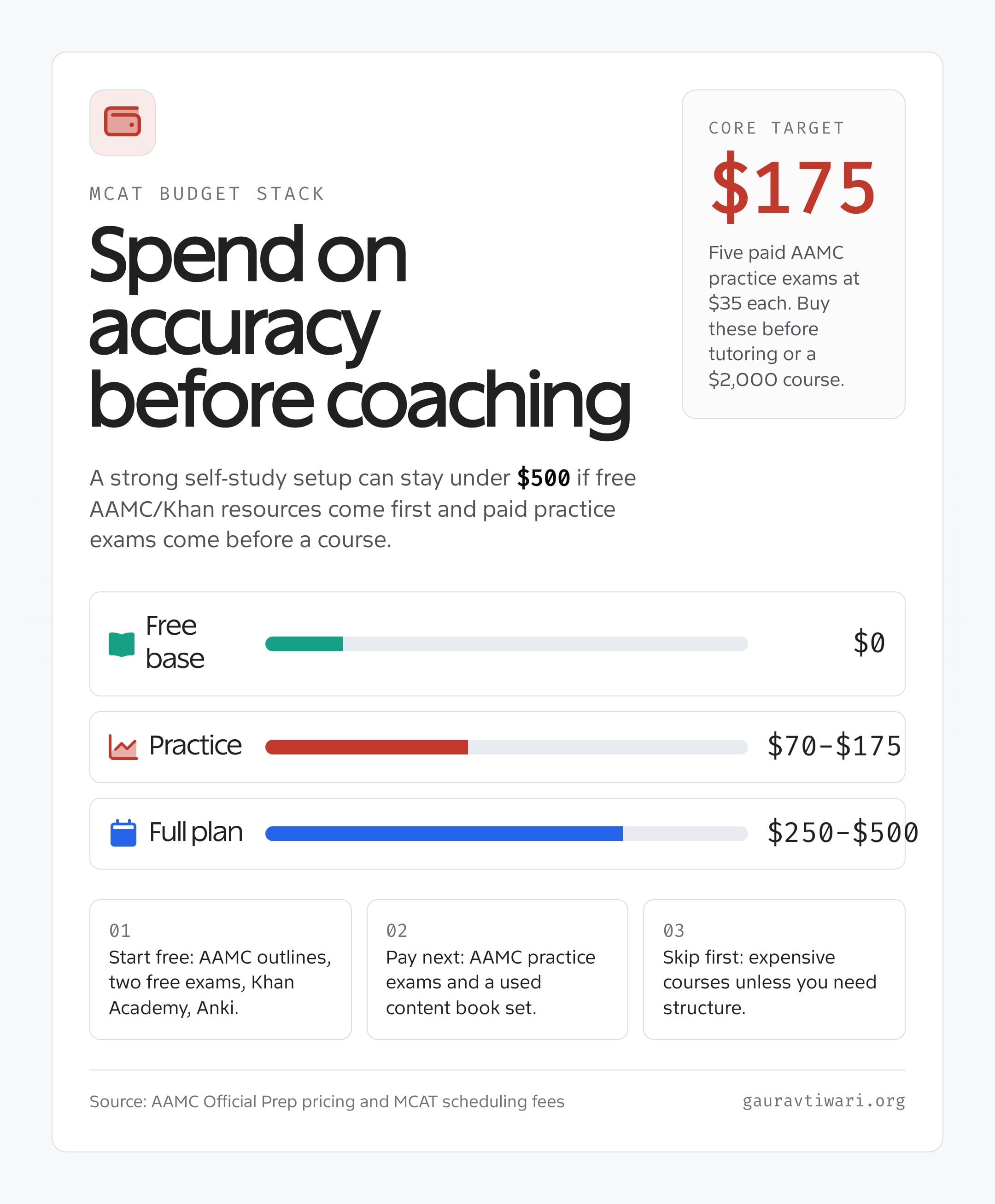
My honest recommendation: build a $0 base first, then budget $70-$175 for AAMC official practice exams, then add a used review book set if your diagnostic review shows real content gaps. A paid course is useful only if you need outside structure and accountability. It should not be your first purchase.
Summary: MCAT on a Budget at a Glance
- Budget plan – Start with $0 resources, then buy official practice before any course.
- What to buy first – AAMC practice exams beat fancy notes, tutoring, and most subscriptions.
- MCAT structure – Four sections, 230 questions, and about 7.5 seated hours.
- Free AAMC resources – Use the exam-maker’s outlines, free exams, and planning tools before spending.
- Practice tests – Official full-length exams are the highest-ROI spend for most students.
- Books and free tools – Used Kaplan or Princeton Review books, Khan Academy, Anki, and study groups cover most needs.
- Study timeline – A 3-6 month plan that keeps spending tied to milestones.
- Paid courses – Buy one only when structure is the bottleneck, not fear.
- FAQs – Budget, free resources, practice exams, books, and coaching decisions.
How to Prepare for the MCAT on a Budget: The $0-$500 Plan
How to prepare for the MCAT on a budget is mostly a spending-order problem. Use free AAMC and Khan Academy resources for content orientation, buy official AAMC practice exams for accuracy, and use used review books only for weak topics. For many disciplined students, $150-$350 is enough for prep materials.
| Budget level | Use this setup | Approx. prep cost | Best for |
|---|---|---|---|
| Free start | AAMC free resources, two free official exams, Khan Academy MCAT videos, Anki, campus library books | $0 | Students checking baseline before buying anything |
| Core budget | Free stack plus 2-5 AAMC paid practice exams at $35 each | $70-$175 | Self-study students who need real exam pacing and score feedback |
| Practical budget | Core budget plus used Kaplan or Princeton Review book set | $150-$350 | Students with content gaps in biochemistry, physics, CARS, or psych/soc |
| Upper self-study cap | AAMC Online-Only Bundle plus used books or one targeted month of a question bank | $323.70-$500 | Students who want official practice depth but not a full course |
The current AAMC numbers matter here: standard MCAT registration is $355, Fee Assistance Program registration is $145, paid AAMC practice exams cost $35 each, and AAMC says the Online-Only Bundle is $323.70 after the Practice Exam 6 update. That is why I would reserve money for official practice before buying a commercial course.
What Should You Buy First?
Buy MCAT prep in the order that improves your score feedback, not in the order prep companies advertise. A diagnostic, official practice, and honest review of wrong answers tell you what to study. A big course bought too early mostly gives you a calendar and a false feeling of safety.
- Start with the official free base: AAMC content outline, AAMC free planning resources, Khan Academy MCAT videos, and Anki. Cost: $0.
- Take one baseline exam: Use an AAMC free exam before deciding whether books, a question bank, or tutoring would help. Cost: $0.
- Buy official AAMC practice exams: Start with 2-3 paid exams if your budget is tight. Add more only if you can review them properly. Cost: $70-$175.
- Add used books for content gaps: Buy a used Kaplan or Princeton Review set if missed questions point to weak science content. Cost: roughly $40-$100 used, depending on market.
- Pay for structure only when needed: A course or tutor makes sense when you keep missing study deadlines or cannot diagnose mistakes on your own.
Bottom line: If your budget is limited, do not spend the first $500 on videos. Spend the first dollars on accurate practice and review. Then use my MCAT preparation guide for the bigger exam overview and my MCAT prep books guide only when you know a book set is actually needed.
Understand the MCAT Structure First
The MCAT has four scored sections, and each section rewards a different kind of preparation. If you do not know the structure first, you will waste money on the loudest resource instead of the weakest section. AAMC lists 230 scored questions and about 7 hours and 30 minutes of seated time.
| MCAT section | Questions | Time | Budget prep angle |
|---|---|---|---|
| Chemical and Physical Foundations of Biological Systems | 59 | 95 minutes | Use content review plus passage practice. Physics and general chemistry gaps show up fast. |
| Critical Analysis and Reasoning Skills (CARS) | 53 | 90 minutes | Buy less. Practice daily reading, passage timing, and error patterns. |
| Biological and Biochemical Foundations of Living Systems | 59 | 95 minutes | Use used books, Anki, and question review for biochemistry and metabolism. |
| Psychological, Social, and Biological Foundations of Behavior | 59 | 95 minutes | Use Khan Academy, Anki decks, and repeated term review before paying for help. |
AAMC’s official MCAT exam outline is the source of truth. Print it, save it, or turn it into a checklist. Every commercial prep company is ultimately mapping back to those same categories.
Use Free AAMC Resources Before Buying Anything
AAMC free resources should be the first stop because AAMC writes the MCAT. Start with the free planning tools, the official content outline, and the free practice exams before you buy books or courses. Free does not mean low-quality here. It means source material.
- AAMC free planning resources: Use the official study plan material and content guidance from AAMC’s free MCAT resources.
- Two free official full-length exams: AAMC now lists the Unscored Sample Test and Practice Exam 1 as free official practice exams.
- Content Outline Course: AAMC says 120 free practice questions from the retired Official Guide are now included in the What’s on the MCAT Content Outline Course.
- Khan Academy MCAT: Use it for science review and psych/soc topics before buying a video course.
- Anki: Use spaced repetition for amino acids, biochemistry pathways, formulas, and psychology/sociology terms.
Bottom line: spend your first week building a free system, not shopping. If the free system shows you are weak in organic chemistry or physics, then buy a used book set. If the free system shows timing is the problem, buy practice exams.
Practice Tests Are Your Best Investment
Official practice tests are the best MCAT budget purchase because they test stamina, timing, passage interpretation, and content under real pressure. A cheap book can teach content, but only a full-length practice exam tells you whether you can think clearly after five hours.
AAMC says there are seven official practice exams available, including two free exams and five paid exams at $35 each. If you cannot buy all five, start with two or three paid exams and protect enough time to review them properly.
- Take the first exam early: Use a baseline exam after 1-2 weeks of orientation, not after months of hiding in content review.
- Review longer than you test: Spend 2-3 hours reviewing wrong answers and guessed-right answers after each full-length.
- Tag the reason for every miss: content gap, passage misread, formula recall, timing, or careless answer choice.
- Retake strategy should be careful: repeated exams can inflate scores because you remember passages. Use retakes for reasoning review, not score prediction.
- Do not collect practice tests: five unopened exams are worthless. Three deeply reviewed exams beat seven rushed exams.
Bottom line: if you have $100 for MCAT prep, I would rather see you buy official practice than another shiny course subscription. Accuracy is the purchase.
This is the simple rule behind MCAT prep on a budget: pay for the resource that makes your next mistake clearer. If a purchase does not improve practice accuracy, error review, or consistency, it can wait.
Use Used Books and Free Tools for Content Review
Used MCAT prep books are usually enough for content review because the modern MCAT format has been stable since 2015. You do not need the newest boxed set just because the cover changed. You need explanations you can understand and enough practice to expose weak topics.
| Resource | Budget use | What to watch |
|---|---|---|
| Used Kaplan 7-book set | Good broad content review for biology, biochemistry, chemistry, physics, CARS, and psych/soc | Do not read every page passively. Pair chapters with questions. |
| Used Princeton Review set | Good if you prefer more guided explanations and structured review | Older editions are fine for core science, but verify any strategy or exam-policy details. |
| Khan Academy MCAT | Free explanations for content gaps and psych/soc review | Videos can feel productive while hiding weak recall. Follow with questions. |
| Anki decks | Free spaced repetition for formulas, amino acids, equations, and terminology | Do not collect ten decks. Pick one main deck and maintain it daily. |
| Campus library or pre-med club | Free or borrowed prep books, sometimes with study groups or old notes | Check edition age and missing access codes before relying on the set. |
If you need better study organization, use my study tools for college students guide to build a calendar, task list, and review system. Tools cannot replace discipline, but a clean system removes friction.
Build a Study Group Without Turning It Into Noise
A study group can save money if it creates accountability and explanation practice. It wastes time if it becomes a weekly anxiety meeting. Keep the group small, give each meeting a job, and make every member teach something instead of just sharing resources.
- Group size: 3-5 students is enough. Larger groups drift.
- Weekly agenda: one content theme, one passage set, one error-review block.
- Teaching rule: each person explains one missed question without reading the explanation aloud.
- Resource sharing: swap used books, library links, Anki settings, and practice schedules.
- Accountability: report full-length dates and review completion, not just hours studied.
Bottom line: the best study group makes you explain what you think you know. The moment everyone starts comparing resources instead of solving questions, the group has lost the plot.
Use Pomodoro Blocks for Dense MCAT Review
Pomodoro blocks work for MCAT prep because the exam rewards focused review, not heroic all-night sessions. Use 25-minute blocks for content recall, Anki, passage review, and equation practice. Use longer timed blocks only when you are training section stamina.
- Content review: 3-4 Pomodoro cycles with one topic, one note page, and follow-up questions.
- Anki review: one short daily block, preferably before new content.
- Passage review: use my Pomodoro Technique guide for focused cycles, then switch to untimed review after the timer ends.
- Full-length days: do not Pomodoro the exam itself. Simulate the real timing and breaks.
For most students, 20-30 focused Pomodoro cycles per week beats a vague goal like ‘study more.’ You can count focused work. You cannot count guilt.
Create a 3-6 Month MCAT Study Timeline
A budget MCAT study plan works best over 3-6 months. Three months can work if your science foundation is strong and you can study consistently. Six months is safer if you are rebuilding biochemistry, physics, CARS, or psychology/sociology from scratch.
| Phase | What to do | Budget move |
|---|---|---|
| Weeks 1-2 | Read the AAMC outline, take a baseline exam, create an error log | $0 |
| Weeks 3-8 | Review weak content with Khan Academy, used books, and Anki | $0-$100 |
| Weeks 9-14 | Move into passage sets and official section-style practice | $35-$105 |
| Weeks 15-22 | Take a full-length every 1-2 weeks and review every mistake | $70-$175 |
| Final 2 weeks | Light review, formula refresh, sleep schedule, test-day logistics | $0 |
Bottom line: your timeline should spend money only when the next phase needs it. Do not buy five things on day one. Let your error log decide.
When Does a Paid MCAT Course Make Sense?
A paid MCAT course makes sense when structure is the real bottleneck. If you skip study sessions, avoid full-length exams, or cannot diagnose wrong answers, a course can help. If you are already disciplined, most courses are just expensive packaging around content you can get cheaper.
- Consider a course if: you need a fixed schedule, external accountability, or live help with repeated weak areas.
- Consider tutoring if: one section is stubbornly stuck after multiple reviewed full-length exams.
- Skip a course if: you mainly need content review, official practice, or a better study calendar.
- Do not buy from fear: a $2,000 course cannot review your mistakes for you. You still have to do the work.
My rule: pay for human help when a human is solving a specific problem. Do not pay for a giant course just to feel less anxious.
That is also why how to prepare for the MCAT on a budget is not the same as how to prepare with the fewest tools. The point is to spend late, spend deliberately, and spend only after your practice data tells you where the money will help.
How to Avoid Fake Savings
The cheapest MCAT plan is not the plan with the lowest receipt. It is the plan that gets you ready without forcing a retake. Saving $100 on practice exams and then paying another $355 registration fee is not savings. It is delayed cost.
- Do not skip official practice: third-party exams are useful, but they do not replace AAMC style.
- Do not buy books you will not use: one used set plus an error log beats three untouched sets.
- Do not ignore Fee Assistance: if you qualify, the AAMC Fee Assistance Program can cut registration from $355 to $145 and include official prep benefits.
- Do not over-study strengths: budget time is still budget. Spend it where score gains are likely.
- Do not reschedule casually: rescheduling fees add up. Pick a date after you understand your baseline.
This is where budget students sometimes get too proud. Free resources are enough for learning, but official practice is worth paying for because it protects the bigger investment: the exam attempt itself.
The Expensive MCAT Prep Myth
The expensive MCAT prep myth is that a high price creates a high score. It does not. The score comes from content mastery, passage reasoning, timing, stamina, and mistake review. A course can support those things, but it cannot replace them.
Plenty of students do well with free and low-cost resources because the exam does not care what you bought. The MCAT cares whether you can apply biology, biochemistry, chemistry, physics, psychology, sociology, and CARS reasoning under time pressure.
If I were preparing on a tight budget, I would rather own a boring error log, three deeply reviewed AAMC exams, one used book set, and a daily Anki habit than a dashboard full of course videos I never finish.
That is the version of MCAT prep on a budget I trust: less shopping, more reviewed passages, and no purchase made just because everyone on Reddit seems to own it.
Related MCAT and Study Resources
Use this budget article as the spending plan for how to prepare for the MCAT on a budget. For the full exam overview, read my MCAT preparation guide. For book-specific choices, use the best MCAT prep books guide. If you also help younger students with standardized tests, my ACT prep books and guides article covers that separate track.
Frequently Asked Questions
How much does it cost to prepare for the MCAT on a budget?
If you want to know how to prepare for the MCAT on a budget, plan for $150-$350 if you use free AAMC and Khan Academy resources, buy 2-5 AAMC practice exams at $35 each, and add used books only for content gaps. A $0 start is possible, but official practice is worth budgeting for.
Can I prepare for the MCAT for free?
Yes. The free version of how to prepare for the MCAT on a budget starts with AAMC planning resources, AAMC free practice exams, Khan Academy MCAT videos, Anki decks, library books, and study groups. Free prep works best when you still take timed practice seriously and track every mistake.
What is the best paid MCAT resource on a tight budget?
For how to prepare for the MCAT on a budget, AAMC official practice exams are the best paid MCAT resource on a tight budget. They cost $35 each and are closer to the real exam than third-party practice. Buy two or three before spending on a course, tutoring, or a large question bank.
Should I buy new or used MCAT prep books?
Buy used MCAT prep books unless you need a new access code. The modern MCAT format has been stable since 2015, so recent used Kaplan or Princeton Review sets still cover the core science. Use books for weak topics, not as a reason to delay practice exams.
Is Khan Academy enough for MCAT prep?
Khan Academy is enough for many content-review gaps, especially when paired with Anki and AAMC practice. It is not enough by itself because the MCAT is passage-heavy. After watching a lesson, test the idea with questions and add missed facts to your error log.
How many AAMC practice exams should I buy?
Buy at least two or three paid AAMC practice exams if your budget allows. If you can afford all five paid exams and have time to review them deeply, buy all five. Do not buy more exams than you can review properly.
When is an MCAT prep course worth it?
In a plan for how to prepare for the MCAT on a budget, an MCAT prep course is worth it when you need structure, deadlines, and outside accountability. It is not worth it if your real issue is avoiding practice review. Try a free plan plus AAMC exams first, then pay for targeted help if a section stays stuck.
Can the AAMC Fee Assistance Program lower MCAT costs?
Yes. AAMC lists Fee Assistance Program MCAT registration at $145 instead of the standard $355, and AAMC says eligible recipients receive MCAT Official Prep benefits. If money is the main barrier, check the program before buying any prep material.
Tell Google you want more of this.
Add Gaurav Tiwari as a preferred sourceOne tap, and this site shows up more often in your own Top Stories, AI Overviews and AI Mode. Remove it any time.
Disclaimer: This site is reader-supported. If you buy through some links, I may earn a small commission at no extra cost to you. I only recommend tools I trust and would use myself. Your support helps keep gauravtiwari.org free and focused on real-world advice. Thanks. - Gaurav Tiwari