by
by
Archimedes’ principle states that any object placed in a fluid experiences an upward buoyant force equal to the weight of the fluid it displaces. It explains why ships float, why you feel lighter in water, why hot-air balloons rise, and why submarines can sink and resurface at will. Discovered by the Greek mathematician Archimedes around 250 BCE, the principle is still the foundation of fluid statics, naval architecture, and density measurement.
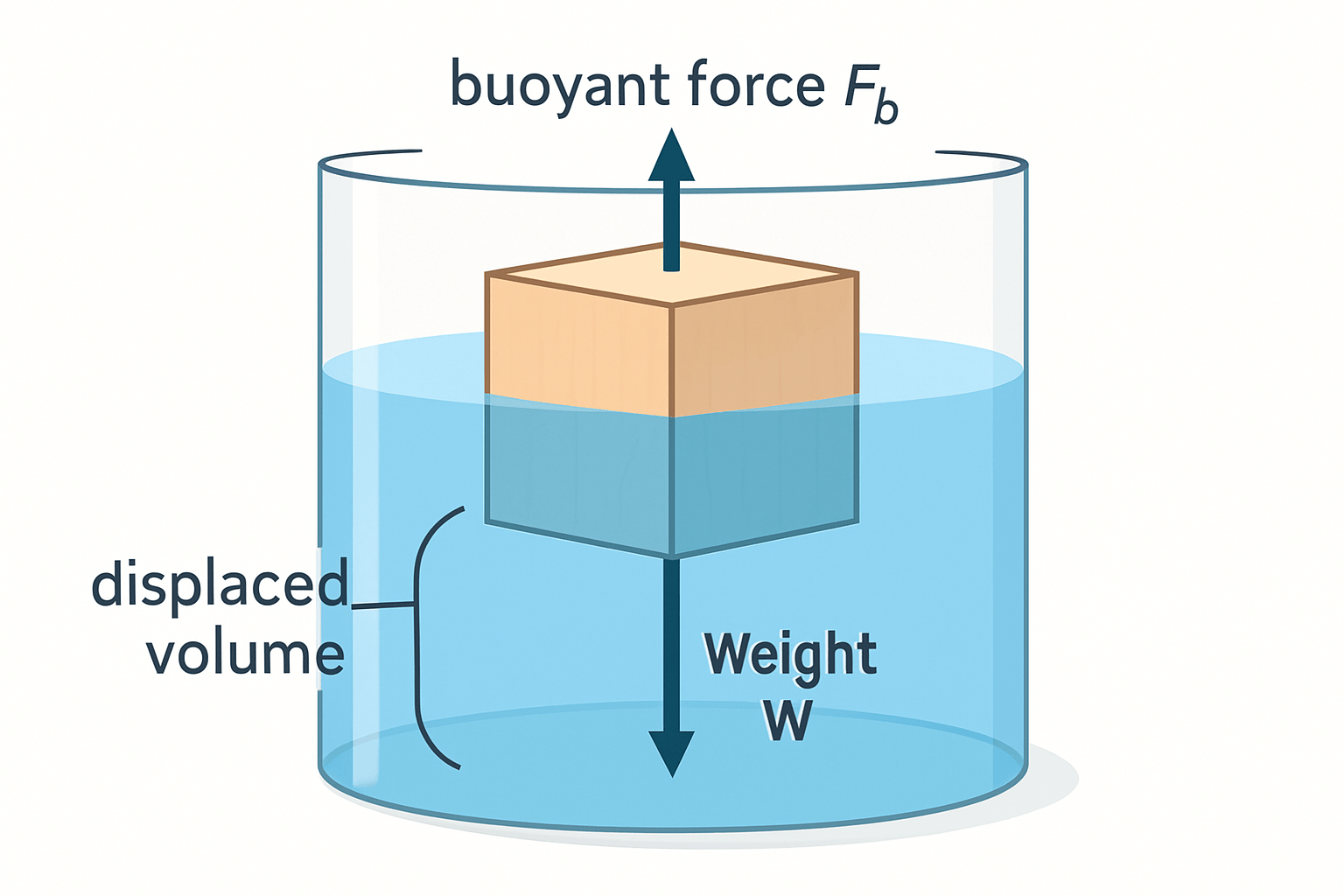
Buoyant force depends on the volume of displaced fluid and its density. A floating object displaces enough fluid to balance its weight in equilibrium.
Statement and Formula
For an object fully or partially submerged in a fluid at rest, the buoyant force \( F_b \) acting upward on the object equals the weight of the displaced fluid:
$$ F_b = \rho_{\text{fluid}} \cdot V_{\text{displaced}} \cdot g $$
where \( \rho_{\text{fluid}} \) is the fluid’s density, \( V_{\text{displaced}} \) is the volume of fluid pushed aside by the object, and \( g \) is gravitational acceleration (9.81 m/s²).
Why It Works
Pressure in a fluid increases with depth. The bottom of a submerged object sits in a higher-pressure region than the top, so the upward push on the bottom exceeds the downward push on the top. The net upward force is the buoyant force. A short calculation shows this difference equals exactly \( \rho g V \), the weight of the displaced fluid. The result depends only on the fluid and the volume, not on the object’s shape or material.
Floating, Sinking, and Neutral Buoyancy
- Sinks if the object’s average density exceeds the fluid’s density: its weight is greater than the maximum buoyant force.
- Floats if its average density is less than the fluid’s: it settles at a depth such that the weight of displaced fluid equals its own weight.
- Neutrally buoyant if the densities are equal: it stays at any depth without rising or sinking. Submarines and SCUBA divers actively adjust their average density to achieve this state.
A steel ship floats not because steel is light, it’s not, but because the ship’s hull encloses a large volume of air. The average density of (steel hull + enclosed air) is well below water’s density.
Worked Examples
Example 1: Wooden block in water. A wooden cube of side 0.10 m and density 600 kg/m³ floats in water (\( \rho = 1000 \) kg/m³). At equilibrium, weight = buoyant force, so \( 600 \cdot 0.001 \cdot g = 1000 \cdot V_{\text{sub}} \cdot g \). Solving: \( V_{\text{sub}} = 6 \times 10^{-4} \) m³, which is 60% of the cube’s volume. The cube floats with 60% submerged and 40% above water, matching the density ratio.
Example 2: Iceberg. Ice density is 917 kg/m³, seawater density 1025 kg/m³. The fraction submerged is \( 917/1025 \approx 0.895 \). Roughly 90% of an iceberg sits below the waterline, the source of the iceberg metaphor.
Example 3: Apparent weight underwater. A 5.0 kg rock of density 2500 kg/m³ has volume \( 5/2500 = 2 \times 10^{-3} \) m³. Submerged in water, the buoyant force is \( 1000 \cdot 2 \times 10^{-3} \cdot 9.81 = 19.6 \) N. Its real weight is \( 5 \cdot 9.81 = 49 \) N. Apparent weight in water: \( 49 – 19.6 \approx 29 \) N, feels 40% lighter.
Applications
- Ship design. Naval architects calculate displacement tonnage from the volume of water a hull pushes aside.
- Hydrometers. Floating instruments that measure liquid density (urine specific gravity, battery acid, alcohol content in spirits) work entirely by Archimedes’ principle.
- Hot-air balloons. Hot air inside the envelope is less dense than the surrounding cool air; the difference produces lift equal to the weight of displaced cool air minus the weight of the heated air and the balloon.
- Submarines. Ballast tanks are flooded with seawater to add weight (sink) or blown clear with compressed air to displace water (rise).
- Density measurement. Archimedes legendarily used the principle to verify the gold content of King Hiero’s crown, comparing weight in air with apparent weight in water gave the density.
Related study notes: Pascal’s Law, Density, Newton’s Laws of Motion, Pressure.
The OpenStax physics textbooks develop the corresponding physical models with further worked problems.
A Floating Fraction
A uniform block of density 600 kg/m³ floats in water of density 1,000 kg/m³. Neglecting other support forces, 60% of its volume is submerged because the displaced water weight balances the block weight.
For a block volume of 0.01 m³, its mass is 6 kg and its weight is about 58.8 N. The displaced water volume is 0.006 m³, whose weight is also 58.8 N. If the same block is fully submerged, the buoyant force exceeds its weight and it tends to rise when released.
The points to check in this example are:
- The displaced volume is the submerged volume, not always the entire object volume.
- Floating equilibrium balances forces; it does not eliminate gravity.
- Fluid density changes the buoyant force at a fixed displaced volume.
Check Your Understanding
Try the questions before reading the answers.
Question 1. What fraction floats above the surface here?
Answer. 40%.
Question 2. Does a hollow steel ship need to have an average density above water?
Answer. No. Its total mass divided by its enclosed displacement volume can be lower.
Practice Questions
Work each question before reading its solution. The set runs from direct recall and substitution to the applied questions that exams actually use to separate grades. The downloadable PDF includes these questions and their solutions.
Question 1. State Archimedes’ principle and give the buoyant-force formula.
Solution. A body in a fluid feels an upward force equal to the weight of the fluid it displaces: \(F_b = \rho_{fluid} \, g \, V_{displaced}\). Only the displaced volume and the FLUID’s density matter; the object’s own material enters the story only when comparing \(F_b\) with its weight.
Question 2. A 2,000 cm³ block is fully submerged in water. Find the buoyant force.
Solution. \(V = 2 \times 10^{-3}\) m³, water density 1000 kg/m³: \(F_b = 1000 \times 9.8 \times 0.002 = 19.6\) N, the weight of 2 kg of water. Whatever the block is made of, iron or foam, the buoyant force is the same while fully submerged.
Question 3. That same block weighs 50 N in air. What does a spring scale read with the block submerged?
Solution. Apparent weight \(= 50 – 19.6 = 30.4\) N. Submerged weighing measures true weight minus buoyancy, which is exactly how Archimedes could test the king’s crown: measure weight in air and in water, and the loss reveals the volume, hence the density.
Question 4. Give the flotation condition in terms of densities, and predict: ice (917 kg/m³) in water, and in ethanol (789 kg/m³).
Solution. A solid floats when its average density is below the fluid’s. Ice floats in water (917 < 1000) with about 92% of its volume submerged, but sinks in ethanol (917 > 789). Same ice, different verdicts: buoyancy is a comparison, not a property of the object alone.
Question 5. What fraction of a floating iceberg (917 kg/m³) hides below seawater (1025 kg/m³)?
Solution. Floating equilibrium: \(\rho_{ice} V_{total} = \rho_{sea} V_{sub}\), so \(V_{sub}/V_{total} = 917/1025 \approx 0.89\). About 89% below, 11% visible: the literal tip of the iceberg. The submerged fraction is always the density ratio.
Question 6. A steel ship floats though steel is 8 times denser than water. Resolve the paradox.
Solution. The hull encloses mostly air, so the ship’s AVERAGE density, steel plus enclosed air over the hull volume, drops below water’s. The hull displaces a huge water volume whose weight matches the ship’s. Load the ship and it settles deeper, displacing more; overload it past the point where required displacement exceeds hull volume, and it founders. Shape buys displacement; displacement buys lift.
Question 7. A 60-tonne barge floats in a lock. How much water does it displace?
Solution. Floating means \(F_b\) equals weight, so displaced water weighs exactly 60 tonnes: about 60 m³ of fresh water. A floating body always displaces its own WEIGHT in fluid; a sunken body displaces only its own VOLUME. That distinction is the whole subject in one sentence.
Question 8. A crown weighs 25.0 N in air and 23.6 N in water. Is it pure gold (19,300 kg/m³)?
Solution. Buoyant force \(= 1.4\) N, so displaced volume \(= 1.4/(1000 \times 9.8) = 1.43 \times 10^{-4}\) m³. Mass \(= 25/9.8 = 2.55\) kg, density \(= 2.55/1.43\times 10^{-4} \approx 17{,}800\) kg/m³. Below gold’s 19,300: the crown is alloyed. This is the legendary bath-time measurement, done with a spring scale.
Question 9. Why does a helium balloon rise, and why does it stop rising?
Solution. Air is a fluid too: the balloon displaces air weighing more than the balloon-plus-helium, so the net buoyant force points up. With altitude the air thins, the displaced air weighs less, and at the altitude where buoyancy equals total weight the balloon hovers: neutral buoyancy. Submarines run the same equation in water, trading ballast for altitude.
Question 10. A boat carrying a rock floats in a small pool. The rock is thrown overboard and sinks. Does the pool level rise, fall, or stay the same?
Solution. It falls. Aboard, the rock displaces its WEIGHT in water, a large volume for a dense object. Sunk, it displaces only its VOLUME. The displacement shrinks by the difference, so the water level drops. The classic trick question, and the float-versus-sink displacement rule answers it cleanly.
Frequently Asked Questions
What does Archimedes’ principle state?
Any object fully or partially submerged in a fluid experiences an upward buoyant force equal to the weight of the fluid it displaces. The formula is F_b = ρ × V × g, where ρ is the fluid’s density, V is the displaced volume, and g is gravitational acceleration.
Why do heavy steel ships float?
Because the average density of the ship, hull plus enclosed air, is less than water’s density. Although steel is denser than water, a hollow steel hull encloses a large volume, mostly air. The total weight is well below the weight of the water the hull can displace, so it floats.
What percentage of an iceberg is below the water?
Around 90%, sometimes called the ‘iceberg ratio.’ Ice density (~917 kg/m³) divided by seawater density (~1025 kg/m³) gives 0.895. That fraction of the iceberg’s volume must sit below the waterline to displace enough water to balance the iceberg’s weight.
Why do you feel lighter in a swimming pool?
Because the water exerts an upward buoyant force on your body. Your apparent weight equals your actual weight minus this buoyant force. Since your body’s average density (~985 kg/m³) is close to water’s, the buoyant force is close to your full weight, so you feel almost weightless when fully submerged.
How do submarines sink and float?
They adjust their average density. Flooding ballast tanks with seawater increases the sub’s total mass without changing its volume, so its average density rises above seawater’s and it sinks. Blowing the tanks empty with compressed air reduces mass and the sub rises. Modern subs make fine adjustments using trim tanks to stay neutrally buoyant.
Did Archimedes really discover this in a bathtub?
The famous ‘Eureka!’ story comes from Roman writer Vitruvius about 200 years after Archimedes. The historical claim, that he noticed his body displacing water in a bath, may or may not be accurate. What’s certain is that Archimedes (c. 287-212 BCE) wrote ‘On Floating Bodies’, a rigorous mathematical treatment of buoyancy that remains the foundation of fluid statics.
Browse more in Physics.