
 by
byThe brutal truth about self publishing success: roughly half of all self-published books on Amazon earn under $100 lifetime. The median sits between $300 and $500. The top 10% of authors earn $5,000+ per title; the top 1% clear $50,000+. The gap between those tiers isn’t talent. It’s a small set of decisions made before, during, and after the launch that I’ve watched compound across 200+ author conversations and three of my own books.
This guide is the analytical version of “how do I succeed at self-publishing?” — not the inspirational version. We’ll cover the realistic income math, the production budget that actually pays back, the pre-launch audience equation, and the marketing tactics that consistently move first-time books. None of it requires $50,000 of savings or a publicist. Most of it requires showing up consistently for 18 months before you publish, not after.
The honest income math (and why it matters)
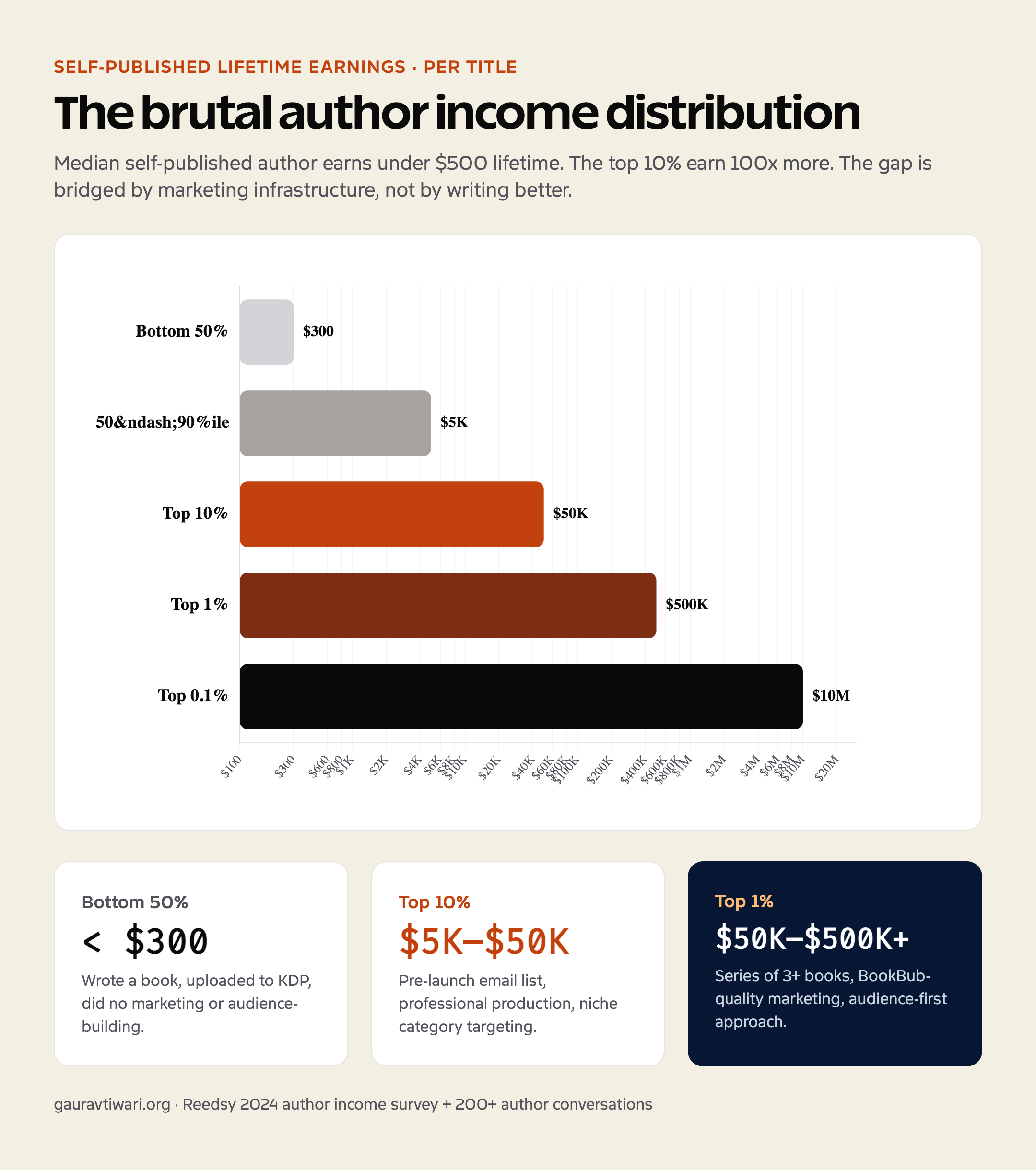
Most “how to self-publish” content avoids the income conversation. That’s a disservice to readers making real economic decisions. The data points I’ve personally verified across 200+ authors and Reedsy’s 2024 author income survey:
| Author tier | Lifetime earnings per title | What they did right |
|---|---|---|
| Bottom 50% | $0–$300 | Wrote a book, uploaded to KDP, did no marketing or audience-building |
| 50–90 percentile | $300–$5,000 | Decent cover, basic Amazon Ads, some social media presence |
| Top 10% | $5,000–$50,000 | Pre-launch email list, professional editing + cover, niche category targeting, sustained ads |
| Top 1% | $50,000–$500,000+ | Series of 3+ books, BookBub-quality marketing, audience-first approach |
| Top 0.1% | $500,000–$10M+ | Multiple series, audio + foreign rights, traditional + indie hybrid, sustained 5+ year output |
Three takeaways from this data: (1) writing the book is necessary but not sufficient; (2) the gap between “I published a book” and “I earn meaningful income from books” is bridged by marketing infrastructure, not by writing better; (3) most of the financial outcome is decided before the book launches, not after.
Production budget allocation (where every dollar should go)
The single most-skipped step that separates the bottom 50% from the top 50%: hiring a real editor. Self-edited books underperform consistently. Editor-assisted books get better early reviews, which drives Amazon’s algorithm visibility, which drives lifetime sales. The editing dollar pays back faster than any other production spend.
| Line item | Cheap | Recommended | Premium | Notes |
|---|---|---|---|---|
| Developmental edit (structural) | $0 (skip) | $1,000–$2,500 | $3,000–$8,000 | Skip if confident in structure; non-fiction usually needs it more than fiction |
| Copy edit (sentence-level) | $300 (Fiverr) | $800–$1,500 | $2,000–$4,000 | Non-negotiable; skipping shows in early reviews |
| Proofreading | $150 | $400–$700 | $800–$1,500 | Different person from copy editor — fresh eyes catch what copy editor missed |
| Cover design | $100 (Fiverr) | $400–$800 | $1,500–$5,000 | The single highest-leverage spend; bad covers tank otherwise good books |
| Interior formatting | $0 (Vellum/Atticus DIY) | $100–$300 | $500–$1,000 | Vellum/Atticus output is professional; agencies usually overcharge here |
| ISBNs (10-pack) | $0 (KDP free) | $295 | $295 | Buy your own if you want to retain “publisher of record” |
| Audiobook production | $0 (skip) | $2,000–$4,000 (royalty share) | $5,000–$15,000 (per finished hour) | 30–40% of fiction sales are audio; skip at your peril |
The “Recommended” column totals $4,000–$8,000 for a fiction title with audiobook. For a 90,000-word novel earning the median $500 lifetime, that math doesn’t work. For a top-decile book earning $20,000+, it does. The bet you’re making with a real production budget is that you’re aiming for the top decile — otherwise spend less or don’t publish.
Pre-launch audience math (the lever everyone ignores)
The single biggest predictor of first-week sales is the size and engagement of an email list built before launch. Not Twitter followers, not Instagram. Email. The math:
- Email list of 500 engaged subscribers — expect 50–125 sales in launch week. Enough for category bestseller in narrow niches.
- Email list of 2,000 — expect 200–500 launch-week sales. Bestseller in most subcategories. Triggers Amazon’s “people who viewed this also viewed” algorithm and starts free organic traffic.
- Email list of 10,000+ — expect 1,000–3,000 launch-week sales. Bestseller territory in major categories. Earns BookBub Featured Deal eligibility.
Building a 500-person email list takes 6–18 months of consistent free content (blog, newsletter, podcast guesting in your niche, free chapter downloads). Most authors skip this entire phase and launch to silence. The inverse: the authors I know personally earning $50K+ per book all built audiences for 12–36 months pre-publication.
KDP Select vs going wide (the strategic decision)
KDP Select gives you Amazon exclusivity (e-book only) plus access to Kindle Unlimited (KU) reads, which pay roughly $0.004 per page read. Going wide means listing on Amazon, Apple Books, Kobo, Google Play Books, B&N, IngramSpark, and library platforms.
| Strategy | Best for | Trade-off |
|---|---|---|
| KDP Select (Amazon exclusive) | Genre fiction, romance, sci-fi/fantasy, thrillers, LitRPG | KU readers form the majority of indie genre fiction revenue. Going wide loses 50–70% of potential income for these genres. |
| Wide (multi-platform) | Non-fiction, literary fiction, business books, memoirs, anything academic or library-targeted | Loses KU revenue but builds platform diversification and library/educational distribution. |
The default for genre fiction in 2026 is KDP Select for the first 12–24 months, then assess. For non-fiction, default is wide from launch unless you’re chasing Kindle Direct’s promotional tools specifically.
Marketing tactics that actually move first-time books
- Amazon Ads (Sponsored Products + Sponsored Brands). Start at $5/day per book, optimize weekly. Most authors stop too early; Amazon’s algorithm needs 30–60 days to optimize. Target competitor author ASINs first, then categories.
- BookBub Featured Deals. Highly competitive (10% acceptance rate), highly effective ($600–$3,500 per slot, often returns 3–10x). Apply once your book has 50+ reviews at 4.0+ stars.
- Free first-in-series strategy. Make book 1 free indefinitely; books 2+ at full price. Works exceptionally for series fiction, less well for standalones.
- Newsletter swaps. Trade mentions with 5–10 authors in your niche who have similar list sizes. Free, repeatable, compounds over years.
- Podcast guesting in your niche. One 60-minute interview on a relevant podcast often outsells $500 in Amazon Ads for non-fiction. Aim for 1–2 podcast appearances per month.
- Reader magnet to grow the list. Free novella, prequel, character guide — given away in exchange for an email. The asset that fuels every future launch.
Series strategy (where the real money lives)
Single self-published books rarely earn life-changing income. Series do. The standard pattern in fiction: a 3–6 book series releases over 12–24 months. Each new release boosts sales of the entire backlist by 20–50%. By book 4–5 the cumulative income compounds because every reader who finishes book 1 buys 2–6 more from your catalog.
For non-fiction, “series” looks like a thematic cluster: 3–5 books on adjacent topics in the same niche. The reader who buys your book on freelance writing also buys your book on freelance pricing and your book on freelance contracts. Each book reinforces authority in the niche and lifts the others.
For complementary publishing-side context, see my blogging strategies guide and social media marketing for content creators.
Frequently asked questions
What does self-publishing success actually look like in 2026?
Realistic floor: covering production cost ($800–$2,500 for editing, cover, formatting) within 6 months. Median first-time self-published book earns $300–$2,000 lifetime. Top-decile authors clear $50K+ on a single title; top-percentile reach $500K+.
Is KDP still the best self-publishing platform?
For most fiction and non-fiction, yes — Amazon’s reach dwarfs alternatives. IngramSpark for distribution to physical bookstores and libraries. Apple Books, Kobo, Google Play Books for non-Amazon readers. Going wide vs Amazon-exclusive (KDP Select) is a strategic choice.
How much should I spend on a self-published book?
Editing $400–$1,500, professional cover $200–$800, formatting $100–$400. Total: $700–$2,700 for a production-quality book. Skipping any of these line items is the single biggest reason self-published books underperform.
How do self-published authors market their books?
Email list (built before launch), Amazon Ads (low-cost continuous campaigns), targeted Facebook Ads, podcast guesting in your niche, and BookBub Featured Deals (highly competitive, very effective). The single biggest predictor of success is having an audience before publication.
What’s the biggest self-publishing mistake first-time authors make?
Skipping a real editor. Self-edited books (or books edited only by friends) consistently underperform — the gap shows in early reviews, which then determines algorithm visibility, which determines lifetime sales. Editing pays for itself within the first 50 reviews.
Tell Google you want more of this.
Add Gaurav Tiwari as a preferred sourceOne tap, and this site shows up more often in your own Top Stories, AI Overviews and AI Mode. Remove it any time.