
4 Signs it is Time to Rebrand Your Business
Your logo looked fresh in 2015. Your tagline made sense when you had 3 employees. But now your brand feels like a suit you’ve outgrown, and customers are starting to notice. Rebranding isn’t just a cosmetic exercise. It’s a strategic decision that can revive stagnant revenue, attract a completely different customer base, and position you for the next decade of growth.
I’ve helped businesses through brand overhauls that doubled their lead flow within 6 months, and I’ve also watched companies torch $50,000+ on pointless logo swaps that changed nothing. The difference? Knowing when to rebrand, how to execute the process, and what to protect along the way. This guide covers all three.
When to Rebrand: 4 Clear Signs You Can’t Ignore
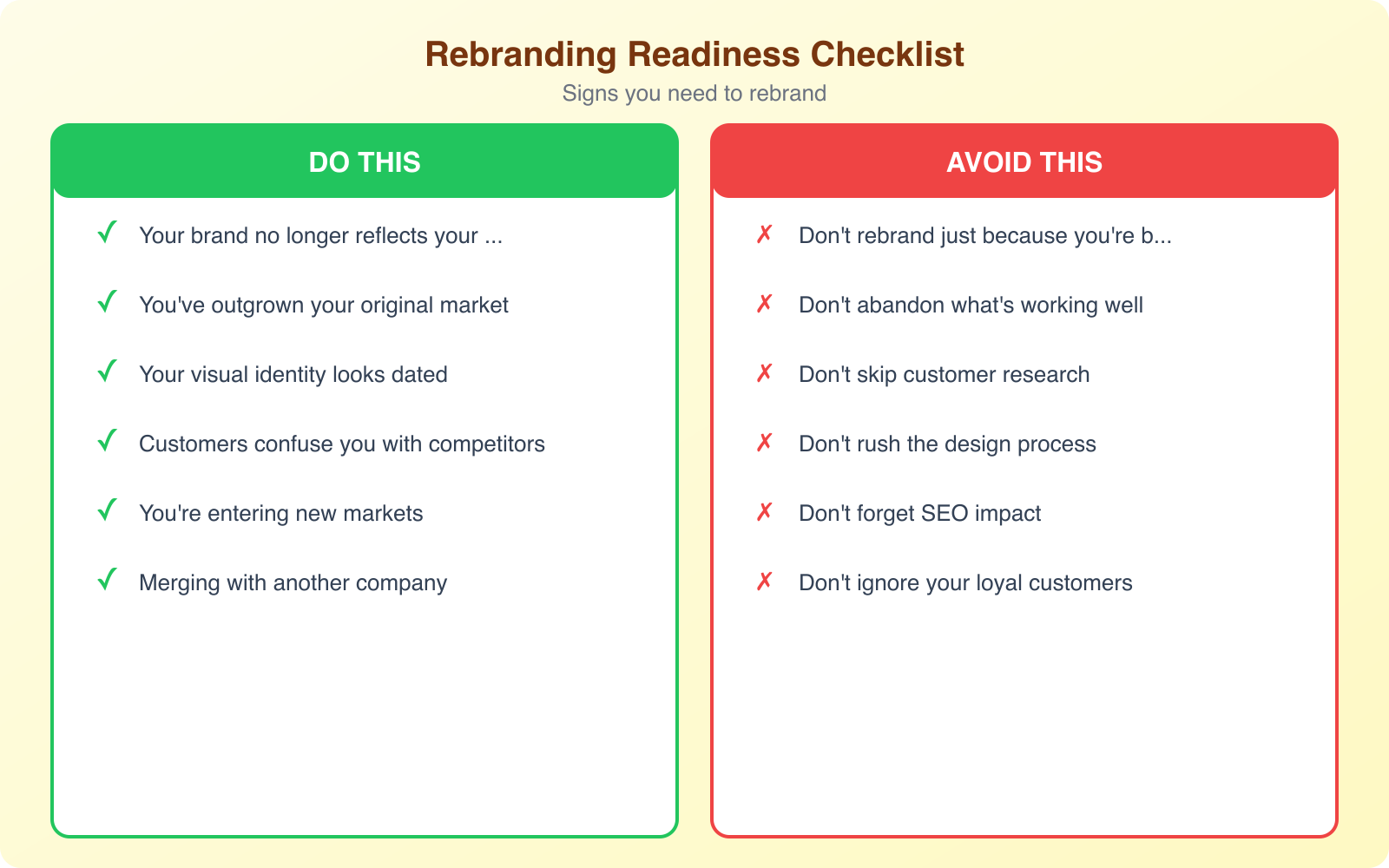
Rebranding costs real money and takes real time. You don’t do it on a whim. But if any of these four signals are showing up in your business, it’s time to stop delaying and start planning.
1. Your Visual Identity Looks Outdated
Design trends move fast. A logo that looked modern in 2012 can look dated by 2026. If your brand assets use gradients, bevels, or design elements that scream “early web era,” customers notice. They might not say it out loud, but they associate outdated visuals with outdated services. First impressions form in 0.05 seconds, and your visual identity is doing most of that heavy lifting.
Look at major brands. Google has simplified its logo three times. Airbnb completely reimagined its mark in 2014. Mastercard dropped its text entirely. These aren’t random aesthetic choices. They’re calculated moves to stay relevant in markets that keep evolving. If your competitors have refreshed their look and you haven’t, you’re already behind.
2. Customer Needs Have Shifted
Your brand promise was built for a specific customer at a specific time. Markets change. Demographics shift. What resonated with your audience 5 years ago might feel completely disconnected from what they care about now. If your brand messaging talks about features while your customers now prioritize sustainability, convenience, or community, there’s a gap that no amount of marketing spend can fix.
I’ve seen this with e-commerce clients who started as budget-focused brands but whose customer base matured into wanting premium products. The old brand held them back because it attracted the wrong audience. A rebrand repositioned them and average order value jumped 40% within a quarter.
3. Your Reputation Needs a Reset
Bad press, a viral complaint, or a string of negative reviews can tank a brand faster than any competitor ever could. In 2026, one unhappy customer with a social media following can reach millions of people in hours. If your brand name has become associated with poor service, a failed product launch, or a PR crisis, sometimes a clean break is the only practical path forward.
This doesn’t mean slapping a new name on the same problems. You fix the underlying issues first, then rebrand to signal genuine change. Companies like Burberry successfully shed their negative associations through a complete brand overhaul that included product changes, new leadership, and refreshed visual identity.
4. You’re Launching Something Big
Entering a new market, launching a flagship product, or going through a merger creates natural momentum. A rebrand during these moments capitalizes on the excitement and attention your business is already generating. It’s much easier to introduce a new brand identity when you’re already making headlines for something else.
Facebook’s rebrand to Meta coincided with their pivot to virtual reality. Dunkin’ Donuts dropped the “Donuts” when they expanded beyond breakfast pastries. The timing wasn’t accidental. Aligning a rebrand with a major business milestone gives it context and makes it feel intentional rather than random.
Don’t rebrand because you’re bored with your logo. Rebrand because there’s a measurable gap between how customers perceive your business and what your business actually delivers. If those two things align, a visual refresh is all you need, not a full rebrand.
The Step-by-Step Rebranding Process
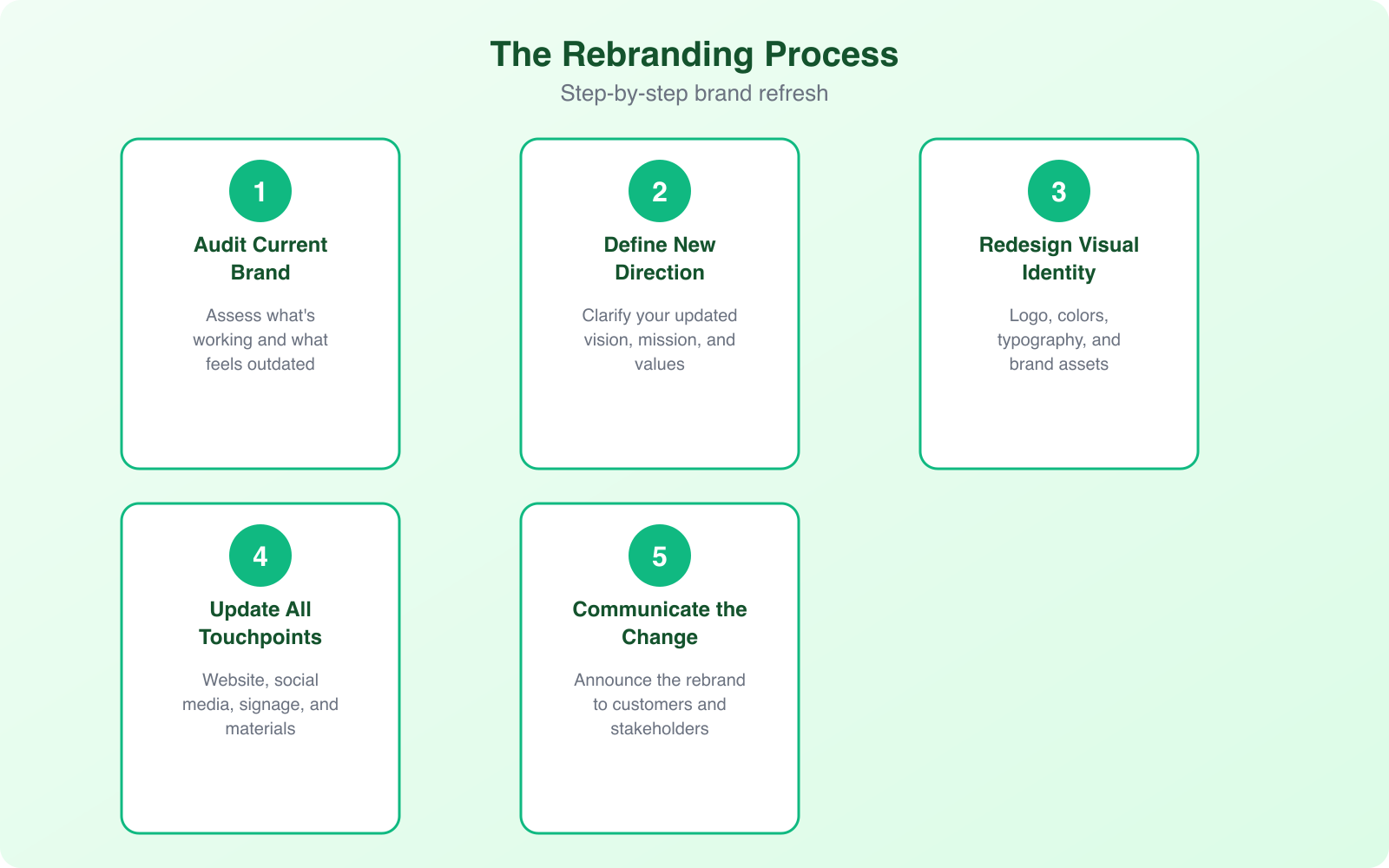
Rebranding without a process is how businesses waste money and confuse customers. Here’s the framework I recommend after watching dozens of rebrands succeed (and fail).
Step 1: Audit Your Current Brand
Before you change anything, document everything. What does your current brand look like across every touchpoint? Website, social profiles, email signatures, packaging, business cards, invoices, pitch decks. Most businesses are shocked by how inconsistent their brand already is across these channels. This audit becomes your baseline for measuring what needs to change.
Step 2: Define Your New Positioning
This is where most rebrands fall apart. Businesses skip straight to logo design without answering fundamental questions. Who is your target customer now? What problem do you solve better than anyone? What do you want people to feel when they interact with your brand? These answers drive every visual and verbal decision that follows. Without them, you’re decorating without a floor plan.
Step 3: Develop Visual Identity
Now you design. Your visual identity includes your logo, color palette, typography, photography style, and iconography. The best rebrands create a visual system, not just a logo. A system gives you flexibility across different contexts (digital, print, merchandise, signage) while maintaining consistency. Budget 4-8 weeks for this phase with a professional designer or agency.
Step 4: Update All Touchpoints
This is the grind. Your website, email templates, social media profiles, Google Business Profile, packaging, signage, uniforms, vehicle wraps, internal documents. Every single touchpoint needs to reflect the new brand simultaneously. Staggered rollouts create confusion. Plan for a coordinated launch day where everything flips at once.
Step 5: Communicate the Change
Your customers, partners, and employees need to understand why you’re rebranding. A good rebrand announcement tells a story: here’s where we were, here’s where we’re going, and here’s what this means for you. Don’t just post a “we have a new look” graphic and call it done. Create dedicated landing pages, email campaigns, and social content that explains the reasoning and builds excitement.

Logo and Visual Identity Refresh
Your logo is the most visible element of your brand, but it’s not the only element. A proper visual refresh goes beyond just the mark. Here’s what to consider for each component.
Logo Design Principles
Great logos work at 16 pixels (favicon) and 16 feet (storefront sign). They’re simple enough to recognize at a glance and distinctive enough to stand out in a crowded feed. The trend in 2026 is toward simplification. Flat design, geometric shapes, and clean typography dominate because they scale across devices and mediums without losing clarity.
Test your new logo in black and white first. If it doesn’t work without color, the design is relying on a crutch. Then test it at multiple sizes. Then test it on both light and dark backgrounds. These constraints force better design decisions.
Color Palette Selection
Colors trigger emotional responses. Blue builds trust (finance, healthcare). Red creates urgency (food, retail). Green signals growth or sustainability. Your palette should include a primary color, 1-2 secondary colors, and neutral tones. Keep it to 5 colors maximum. Any more and your brand starts looking inconsistent across different materials.
Typography System
Pick two fonts: one for headings and one for body text. Sans-serif fonts feel modern and clean. Serif fonts feel established and trustworthy. The combination matters more than any individual font. Make sure your chosen fonts are available as web fonts so your website and digital materials look consistent with your print materials.
Protecting Your SEO During a Rebrand
This is where I’ve seen the most damage from poorly executed rebrands. A business spends years building search rankings, then changes their domain name or URL structure during a rebrand and loses 50-80% of their organic traffic overnight. It’s avoidable, but only if you plan for it.
Keep Your Domain If Possible
If your rebrand doesn’t require a new company name, keep your existing domain. Your domain authority is one of your most valuable digital assets. A domain that’s been around for 10 years with solid backlinks is worth far more than a fresh domain, no matter how clever the new name is.
Implement 301 Redirects
If you must change domains, set up 301 redirects for every single page on your old site pointing to its equivalent on the new site. Not just the homepage. Every page. Use a crawl tool like Semrush or Screaming Frog to generate a complete URL list before the switch, then map each old URL to its new destination.
Update Google Business Profile
Your Google Business Profile needs to reflect your new brand immediately on launch day. Update your business name, logo, cover photo, and any brand-specific descriptions. Also update your profile on Bing Places, Apple Maps, and any industry-specific directories. Inconsistent NAP (Name, Address, Phone) data across the web confuses search engines and can hurt your local SEO rankings.
Monitor Traffic Post-Launch
Expect some traffic fluctuation in the first 2-4 weeks after a domain change. A 10-20% dip is normal and usually recovers within 3 months. If you see drops larger than that, check for redirect errors, missing pages, or broken canonical tags. Set up alerts in Google Search Console so you catch issues immediately instead of discovering them months later.
Your Rebranding Communication Strategy
The best rebrand in the world fails if nobody knows about it, or worse, if people feel blindsided by the change. Communication is the bridge between your old brand and your new one, and it needs to reach three distinct audiences: your team, your existing customers, and the broader market.
Internal Communication First
Your employees should know about the rebrand before anyone else. They’re the ones who interact with customers daily, and they need to be able to explain the change confidently. I recommend a company-wide meeting 2-3 weeks before launch where you present the new brand, explain the reasoning, and give everyone time to ask questions. Provide talking points for customer-facing staff.
Customer Communication
Send a personalized email to existing customers 1 week before launch. Include a preview of the new look, reassure them that the quality of service isn’t changing, and address common concerns upfront. For subscription businesses, make it crystal clear that their accounts, billing, and access won’t be affected. Customers don’t mind change when they feel included in the journey.
Public Announcement
On launch day, go everywhere at once. Social media posts, a blog announcement, a press release for industry publications, and updated brand assets across all channels. The more coordinated the launch, the more professional it looks. Staggering your announcement across platforms makes it look like you’re making it up as you go.
Keep your old domain active with redirects for at least 12 months after a rebrand. Some customers will have bookmarked your old URLs, and search engines need time to fully index and transfer authority to the new domain. Shutting down the old domain too early is one of the most common (and costly) rebrand mistakes.
Common Rebranding Mistakes to Avoid
After working with businesses through multiple rebranding projects, these are the mistakes I see most often. Each one is completely preventable with proper planning.
Rebranding without fixing underlying problems. A new logo doesn’t fix bad customer service. If your brand’s negative perception comes from real operational issues, fix those first. Otherwise you’ll spend money on a rebrand and still end up with unhappy customers.
Designing by committee. The more people involved in design decisions, the more generic the result. Keep the decision-making team to 3-5 people maximum. Get broader feedback, yes, but don’t let 20 people vote on font choices.
Ignoring brand equity you’ve already built. Some elements of your current brand are working. Customer surveys and brand recognition studies can tell you which elements are worth preserving. Mailchimp kept its chimp mascot through multiple redesigns because it was their most recognized brand element.
Underbudgeting the rollout. The design phase is usually 30-40% of the total cost. The rest goes to updating every touchpoint: website redesign, new print materials, signage, packaging, uniforms, vehicle wraps. Budget for the full scope or you’ll end up with a half-finished rebrand that looks worse than what you started with.
Skipping the style guide. A brand style guide documents exactly how your brand should look, sound, and behave across every context. Without one, your new brand will drift into inconsistency within months as different team members interpret the brand differently. Even a 10-page document is better than nothing.
Measuring Rebranding Success
You can’t manage what you don’t measure. Before your rebrand launches, establish baseline metrics so you can track whether the rebrand is actually working. Here are the metrics that matter most.
Brand awareness: Use surveys or tools like Google Trends to track how often people search for your brand name before and after the rebrand. A successful rebrand should show increased brand searches within 3-6 months.
Website traffic: Track both total traffic and organic search traffic. Some short-term dips are normal, but traffic should recover and grow within 90 days if SEO was preserved correctly.
Customer sentiment: Monitor social media mentions, review scores, and NPS (Net Promoter Score). Customer sentiment should trend positive after a well-executed rebrand.
Revenue impact: Ultimately, a rebrand should move the needle on revenue. Track average order value, conversion rates, and new customer acquisition for the 6 months following launch.
Employee engagement: A strong rebrand energizes your team. Track internal metrics like employee satisfaction and retention in the months following launch. If your team doesn’t believe in the new brand, customers won’t either.
Frequently Asked Questions
How much does a rebrand typically cost for a small business?
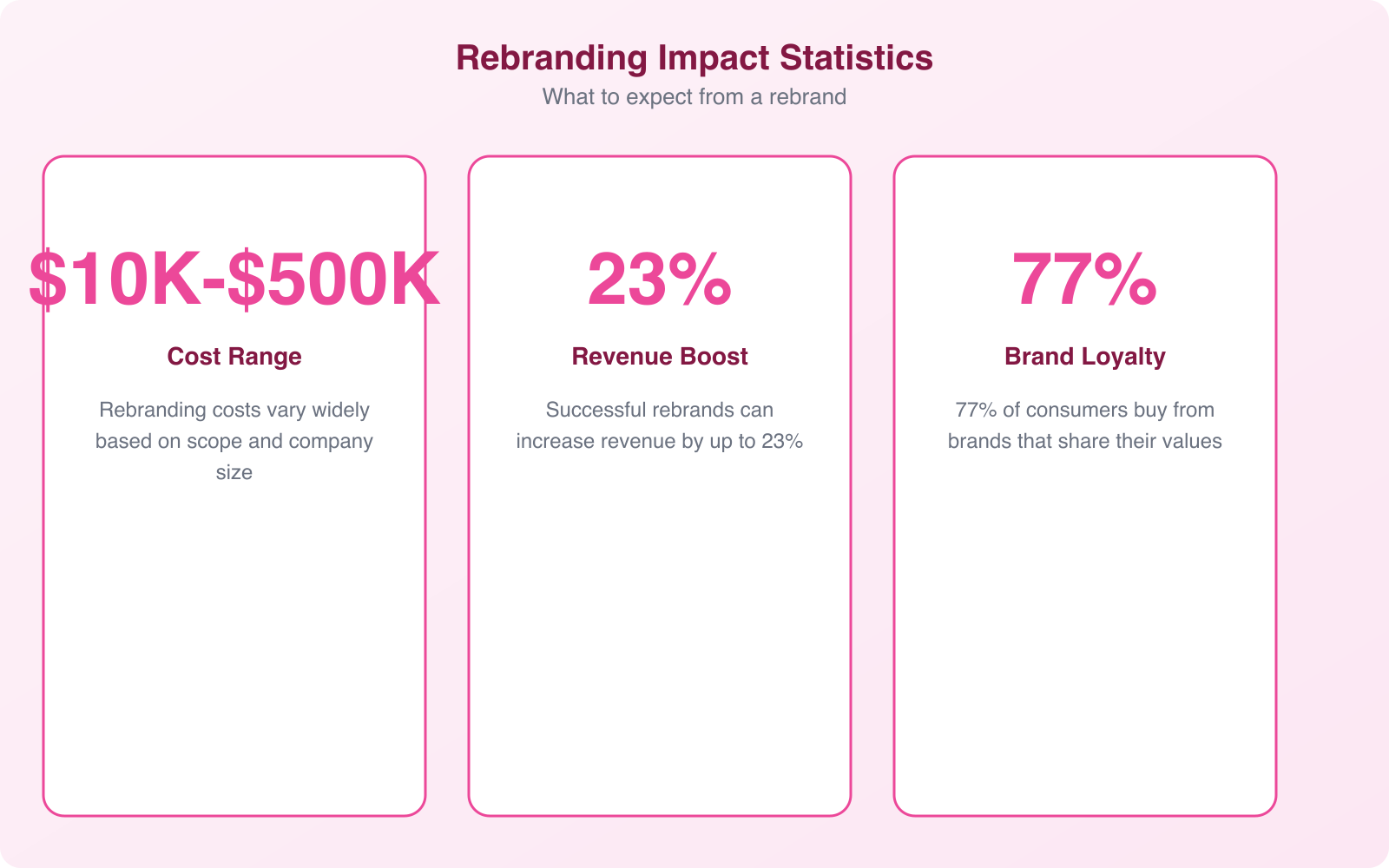
A small business rebrand typically costs between $5,000 and $50,000 depending on scope. A basic visual refresh (logo, colors, typography) runs $5,000-$15,000. A full rebrand that includes strategy, website redesign, and marketing collateral lands in the $15,000-$50,000 range. Enterprise rebrands can exceed $100,000. The biggest cost driver is usually website redesign, which accounts for roughly 30% of the total budget.
How long does a rebranding process take from start to finish?
Most small to mid-size business rebrands take 10-18 weeks from initial strategy through launch. The breakdown is roughly 1-2 weeks for brand audit, 2-3 weeks for positioning and strategy, 4-8 weeks for visual design and development, 2-4 weeks for rollout preparation, and 1 week for launch. Rushing the process usually leads to costly mistakes, so build in buffer time for revisions and unexpected delays.
Will rebranding hurt my search engine rankings?
It doesn’t have to. If you keep the same domain, your SEO impact should be minimal. If you change domains, expect a temporary 10-20% traffic dip that typically recovers within 90 days with proper 301 redirects in place. The key is mapping every old URL to its new equivalent, submitting an updated sitemap to Google Search Console, and keeping the old domain active with redirects for at least 12 months.
Should I rebrand or just do a visual refresh?
A visual refresh updates your look while keeping your name, positioning, and messaging intact. A full rebrand changes fundamental elements like your name, target audience, or value proposition. If your brand strategy still works but your visuals feel dated, a refresh is enough. If you have changed what you sell, who you sell to, or how you want to be perceived, you need a full rebrand. Visual refreshes cost 60-70% less and carry far less risk.
How do I tell existing customers about a rebrand without losing them?
Start communicating 1-2 weeks before launch. Send a personalized email explaining what’s changing and, more importantly, what isn’t. Reassure customers that their accounts, pricing, and service quality remain the same. Give them a preview of the new look so the change doesn’t feel sudden. After launch, keep the conversation going on social media and address questions quickly. The businesses that lose customers during a rebrand are almost always the ones that spring it as a surprise.
Final Thoughts
Rebranding is one of the highest-stakes decisions a business can make. Done right, it opens doors to new markets, attracts better customers, and re-energizes your entire team. Done wrong, it wastes money and confuses the people who already trust you. The difference between the two outcomes comes down to planning, timing, and execution.
Start with the fundamentals. Know exactly why you’re rebranding. Define your new positioning before you touch any visuals. Protect your SEO. Communicate clearly with everyone who matters. And measure the results so you know whether the investment paid off. If your business is showing the signs I described above, the time to start planning is now, not six months from now when a competitor beats you to the punch. For more on building a strong business identity, check out my guide on the logo design process and digital marketing strategy.
Disclaimer: This site is reader-supported. If you buy through some links, I may earn a small commission at no extra cost to you. I only recommend tools I trust and would use myself. Your support helps keep gauravtiwari.org free and focused on real-world advice. Thanks. - Gaurav Tiwari