
 by
by
A merchant cash advance gives a business a lump sum in exchange for a stated share of future sales up to a fixed repayment ceiling. It can fund quickly, but the factor rate hides the time value of the cost. Convert the offer into cash flows and an annual percentage rate before comparing it with a loan or line of credit.
My rule is simple: use an MCA only when the cash solves a short, measurable problem, cheaper capital is unavailable, and the incremental gross profit comfortably exceeds every fee. Speed is the product. If you do not need the speed, you usually should not pay for it.
In this article →
- The verdict: is a merchant cash advance worth it?
- What is a merchant cash advance and how it works
- What an MCA factor rate really costs
- Who should avoid an MCA (and what to use instead)
- MCA vs. the alternatives: cost, speed, risk
- What changed in MCA regulation
- A practical merchant cash advance example
- Questions to ask before you sign
- Frequently asked questions
The verdict: is a merchant cash advance worth it?
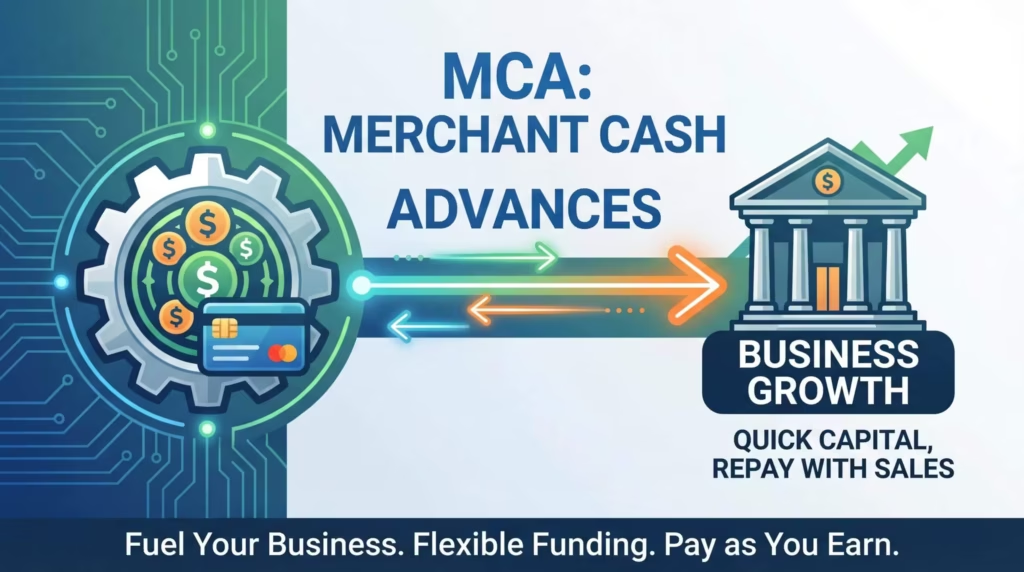
A merchant cash advance is worth considering only in a narrow situation: revenue is steady, timing is critical, cheaper financing is unavailable, and the funded purchase can produce cash before the withdrawals damage operations. Outside that window, the math usually works against the business.
The reason is simple. An MCA isn’t priced like a loan. It uses a “factor rate” instead of an interest rate, and because you repay it fast, that factor rate translates into an effective annual cost that can dwarf a credit card or a bank loan. Fast and easy are real benefits. They’re just expensive benefits.
Bottom line: Treat an MCA as a short-term bridge, not routine working capital. A $50,000 advance at a 1.35 factor requires $67,500 back. Repaid in 26 equal weekly withdrawals, the cash flows imply about a 123% nominal APR. The same fixed repayment over 52 weeks is about 62%. Time, not the factor alone, determines the annualized cost. This is general information, not financial or legal advice.
Current public evidence gives a better picture than unsourced industry averages:
- The Federal Reserve’s 2026 report, based on the 2025 Small Business Credit Survey, shows 71% of 298 MCA applicants were fully approved. The sample is self-reported and does not show that the financing was affordable. Read the Federal Reserve report.
- Among applicants approved for at least some financing, only 35% of online-lender applicants reported being satisfied, versus 65% at small banks. Online lenders include more than MCA providers, so this is context, not an MCA satisfaction score.
- The FTC secured a permanent industry ban against one MCA owner after a federal court found extensive misconduct, including deception about terms and unauthorized withdrawals. Review the FTC enforcement case.
What is a merchant cash advance and how it works
A merchant cash advance is commonly structured as a purchase of future sales rather than a conventional term loan. The CFPB’s current Regulation B describes it as a lump-sum payment in exchange for a percentage of future sales or income up to a ceiling amount. See the current CFPB definition. The contract and state law still matter, so do not rely on the product label alone.
The mechanics are quick. The funder advances, say, $50,000. You agree to repay a set total, calculated with a factor rate, by handing over a slice of every day’s sales. That slice is the “holdback,” usually 10% to 20% of daily card receipts. On a strong sales day you pay more; on a slow day you pay less. Repayment scales with revenue, which is the genuine upside of this structure.
The 2025 Small Business Credit Survey explains the appeal without pretending approval equals value. MCA applicants in its sample were more likely to receive full approval than applicants for several other products, while online-lender applicants also reported more problems with high rates and unfavorable repayment terms. If you want to understand how fast financing differs from a bank product, my breakdown of instant loans versus traditional loans covers the trade-offs in detail.
What an MCA factor rate really costs
The single most important number in any MCA is the factor rate, and it’s the one most likely to mislead you. A factor rate is a multiplier, not a percentage. If you borrow $50,000 at a factor rate of 1.3, you repay $65,000, full stop. That $15,000 fee doesn’t shrink if you pay early, and it isn’t quoted as an annual rate, so it looks smaller than it is.
A factor rate is not an APR. For a $50,000 advance at 1.35, the fee is $17,500 and total repayment is $67,500. To compare offers, model the actual withdrawal dates and solve for the periodic rate that makes their present value equal the cash received.
| Equal repayment period | Weekly withdrawal | Nominal APR from weekly cash flows |
|---|---|---|
| 13 weeks | $5,192.31 | 239% |
| 26 weeks | $2,596.15 | 123% |
| 39 weeks | $1,730.77 | 83% |
| 52 weeks | $1,298.08 | 62% |
These are calculated examples, not quoted market rates. They assume the full $50,000 arrives on day zero, no extra fee is deducted, and 13 to 52 equal weekly withdrawals follow. Upfront fees increase the APR because the business receives less cash while repaying the same ceiling amount.
Watch the daily debit. Many MCAs collect through fixed daily ACH withdrawals rather than a true percentage of sales. If your revenue dips but the debit doesn’t, that fixed pull can drain your account and trigger a cash crunch, the exact problem you took the advance to solve. Always confirm whether repayment is a real percentage of sales or a flat daily amount.
Three numbers decide whether an MCA is survivable: the factor rate (how much you repay in total), the holdback percentage (how much daily cash flow you give up), and the expected term (which drives the real APR). Get all three in writing. If a broker quotes only the factor rate and dodges the APR question, that’s a signal to walk. For more on protecting your day-to-day cash position, see my guide to cash flow killers that sink otherwise healthy businesses.
Who should avoid an MCA (and what to use instead)
Most businesses that qualify for something cheaper should take the cheaper option. An MCA earns its keep only when speed is non-negotiable and nothing else is available. If you have time, decent credit, or assets, you almost certainly have better choices.
Avoid a merchant cash advance, and reach for a loan or line of credit instead, if you fit any of these:
- You have thin margins. If a 10% to 20% holdback would push your daily operating cash negative, the advance will starve the business it’s meant to save.
- You qualify for a bank product. If your credit and revenue can land a small business administration (SBA) loan or a line of credit, the cost gap versus an MCA is enormous.
- You need the money for something slow-earning. MCAs only pencil out when the cash quickly produces more revenue than the fee. Don’t fund payroll gaps or old debts with one.
- You’re already carrying an MCA. Stacking a second advance on top of a first is how owners end up in a debt spiral. If you’re refinancing one advance with another, stop and get advice.
A business cash advance fits a narrow profile: steady daily card volume, a short-term need that pays for itself, and no faster, cheaper option on the table. A seasonal retailer buying inventory that will sell through in eight weeks is a reasonable fit. A struggling business borrowing to cover last month’s bills is not. If you’re weighing whether to borrow at all, my piece on how business owners should be spending their money is worth reading first.
MCA vs. the alternatives: cost, speed, risk
Before you sign anything, compare the MCA against the products it’s competing with. Speed is the only category where an MCA wins outright. On cost and risk, almost every alternative beats it. Here’s how the main small business financing options stack up.
| Option | Cost evidence to compare | Cash-flow pattern | Main constraint |
|---|---|---|---|
| Merchant cash advance | Calculated APR from amount received, all fees, and dates | Daily or weekly share/debit until ceiling is paid | Fast withdrawals and limited federal reporting transparency |
| Business line of credit | APR, unused-line fee, draw fee, and renewal fee | Interest on drawn balance; revolving access | Variable rate and renewal risk |
| SBA 7(a) WCP | For $50,000 or less, maximum variable rate is base +6.5% | Monitored line; maturity up to 60 months | Eligibility, documentation, and slower underwriting |
| Business credit card | Purchase APR, cash-advance APR, annual fee, and promo expiry | Monthly minimum payment | Revolving balance can become permanent |
| Invoice factoring | Advance rate, discount fee, recourse, and aging charges | Receivables sold or assigned | Requires eligible invoices and customer verification |
The SBA’s Working Capital Pilot gives a useful official benchmark. For advances of $50,000 or less, its maximum variable rate is the base rate plus 6.5%, with maturity up to 60 months. Eligibility and timing are different from an MCA, but the published ceiling makes the cost gap visible. Check current SBA 7(a) terms. Compare the actual offer, not a generic product label.
If you’re new to comparing these products, two reads will save you money: my dos and don’ts of applying for business loans, and for readers in India weighing government-backed options, this look at whether MSME loans are a boon or a curse.
What changed in MCA regulation
Current U.S. position: Federal and state rules do not provide one uniform MCA disclosure regime. The CFPB’s May 2026 Regulation B revision excludes merchant cash advances from the small-business data-reporting rule. That reduces planned federal visibility into applications and outcomes. It does not cancel state disclosure laws or the FTC Act.
California’s commercial-financing rules cover merchant cash advances and require disclosures including the amount of funding, APR, payment amount, term, prepayment policy, and average monthly cost where applicable. Read the California DFPI summary. Other states use different forms and thresholds, so verify the rules for the business location and transaction.
The FTC case against RCG Advances is the practical warning: a financing label does not permit deceptive terms, unauthorized withdrawals, or abusive collections. Ask for the net amount delivered, ceiling repayment, complete withdrawal schedule, reconciliation process, personal guarantee, default triggers, and every fee in writing.
A practical merchant cash advance example
Use the same $50,000 advance at a 1.35 factor. Total repayment is $67,500, so the fixed financing cost is $17,500 before any broker or origination fee. At 26 equal weekly withdrawals, the payment is $2,596.15 and the nominal APR from those cash flows is about 123%.
Now test the business outcome. The project must earn more than $17,500 in incremental gross profit just to cover the MCA fee. The revenue threshold depends on gross margin:
| Incremental gross margin | Revenue needed to cover $17,500 fee | Revenue needed with 25% safety buffer |
|---|---|---|
| 20% | $87,500 | $109,375 |
| 30% | $58,333 | $72,917 |
| 40% | $43,750 | $54,688 |
| 50% | $35,000 | $43,750 |
The formula is required revenue = financing cost ÷ incremental gross margin. The safety column multiplies that revenue by 1.25. This still excludes refunds, spoilage, labor, fulfillment, and taxes. If the conservative case does not clear the buffered threshold before the withdrawals strain cash, the answer is no.
Questions to ask before you sign
If you’ve weighed the alternatives and an MCA is still the right tool for your situation, protect yourself at the contract stage. These are the questions I’d put to any funder before signing.
- What’s the total repayment amount and the effective APR? Get both in writing, not just the factor rate.
- Is repayment a true percentage of sales or a fixed daily ACH debit? A fixed debit removes the flexibility that makes an MCA tolerable.
- Is there a confession of judgment clause or personal guarantee? Either can expose your personal assets.
- Are there broker fees, origination fees, or early-payoff penalties? Hidden costs can push the real price well past the headline factor rate.
- What happens to the holdback if my sales drop? Make sure a bad month won’t tip you into default.
Strong, predictable card sales make an MCA workable. Thin margins, a slow-earning use of funds, or an existing advance make it dangerous. Whatever you decide, keeping a clear handle on what’s owed and when matters more than ever once daily debits start, which is why I’d pair any advance with tighter discipline on managing outstanding payments so your cash position never catches you off guard.
Frequently asked questions
Is a merchant cash advance a loan?
An MCA is commonly structured as a purchase of future sales, but classification depends on the contract and applicable law. The CFPB’s current small-business reporting regulation defines merchant cash advances and excludes them from covered transactions under that reporting rule.
What is a good MCA factor rate?
A lower factor rate is better only when every other term is equal. A 1.3 factor on $50,000 means $65,000 total repayment, but the APR also depends on the net amount received, fees, payment dates, and collection speed.
How is MCA APR so high if the factor rate looks low?
The fixed fee is collected while the outstanding balance falls. In the worked example, $50,000 at a 1.35 factor repaid in 26 equal weekly withdrawals produces about a 123% nominal APR; over 52 weeks it is about 62%.
What is a cheaper alternative to an MCA?
A business line of credit is usually the closest structural alternative. Eligible borrowers can also compare the SBA 7(a) Working Capital Pilot’s published maximum spreads over a base rate.
Can an MCA hurt my business?
Yes. Daily or weekly withdrawals can starve a thin-margin business, and stacking advances compounds the pressure. Model the lowest-sales case and inspect default, reconciliation, and personal-guarantee terms.
Tell Google you want more of this.
Add Gaurav Tiwari as a preferred sourceOne tap, and this site shows up more often in your own Top Stories, AI Overviews and AI Mode. Remove it any time.