by
by
Applying for business loans is a cash-flow decision before it is a credit decision. A lender can approve an amount that your business should still refuse. Start with the payment, the use of funds, and the revenue threshold. Then decide which financing structure fits.
The latest national data makes the risk plain. In the Federal Reserve’s 2025 survey, 60% of small employer firms applied for financing. Among applicants, 42% received the full amount sought, 36% received some or most, and 22% received none. Approval is not the only hurdle. The offered amount, price, collateral, and repayment schedule must still work.
The 2026 Small Business Credit Survey report covers 6,525 US employer firms with 1 to 499 employees and was fielded from September 3 to November 14, 2025. It is a weighted convenience sample, not a random census. I use it as a directional benchmark, not a promise about your application. The product rules and rate examples below are US-specific unless stated otherwise.
Quick verdict: Borrow only when conservative cash flow covers the payment and the project still clears your decision threshold. Compare total repayment, fees, collateral, personal guarantees, covenants, and timing. Do not choose a loan because the application felt easy.
Bootstrap First: Why a Loan Should Be Your Last Resort
Debt works best when it accelerates a proven use of capital. It works badly when it hides recurring losses. Before borrowing, test a smaller launch, supplier terms, staged equipment purchases, presales, and cutting your startup costs. A lower funding need improves both the payment and the margin for error.
The Federal Reserve report shows why the use of funds matters:
- 56% of financing seekers cited operating expenses.
- 46% cited expansion or a new opportunity.
- 31% of firms reported no outstanding debt.
- Among firms with debt, 59% used a personal guarantee and 51% used business assets.
- Among firms denied all or some financing in 2024, 41% cited too much existing debt, up from 22% in 2021.
Operating expenses are not automatically a bad use. A seasonal working-capital cycle can be financeable. The danger is borrowing for a permanent monthly deficit with no dated path back to positive cash flow. If the business is still an untested idea, finish the basics in starting a new business before adding a fixed payment.
7 Types of Business Financing Compared
The cheapest-looking percentage is not always the cheapest financing. Compare the pricing unit, payment frequency, term, fees, security, and what happens when revenue falls.
| Type | Pricing form | Repayment pattern | Best use |
|---|---|---|---|
| Traditional bank loan | Interest rate plus fees | Fixed or variable installments | Established cash flow and a defined asset or project |
| SBA 7(a) | Negotiated rate subject to an SBA ceiling, plus applicable fees | Usually amortizing; maturity depends on use | Eligible US firms needing working capital, equipment, ownership change, or real estate |
| Revenue-based financing | Flat fee or revenue share | Percentage of revenue until a cap is reached | Predictable recurring revenue with strong contribution margin |
| Business line of credit | Interest on the amount drawn, plus possible fees | Revolving draws and repayments | Short timing gaps, seasonality, and receivables |
| Invoice factoring | Discount or factor fee | Receivable is sold or assigned | Creditworthy B2B invoices with slow payment terms |
| Crowdfunding | Platform, payment, fulfillment, and campaign costs | No debt payment for rewards-based campaigns | Presales with validated delivery economics |
| Merchant cash advance | Factor amount or fixed receivables purchase price | Daily or weekly debit or sales holdback | Only when the full cash-flow cost survives a downside test |
Traditional Bank Loans
A conventional bank loan can be attractive when the business has clean records, stable cash flow, and time for underwriting. There is no reliable universal APR or minimum score for 2026. Ask for the annual rate, compounding method, fees, amortization schedule, balloon amount, collateral, guarantee, covenants, and prepayment terms in one written offer.
SBA Loans
The Small Business Administration does not normally lend the money directly. A participating lender makes the loan under SBA rules. Most 7(a) loans cap at $5 million, while SBA Express caps at $500,000. For most 7(a) loans, the SBA guaranty can reach 85% at $150,000 or less and 75% above $150,000.
The official 7(a) terms set maximum variable rates by loan size. They do not set the final quote. For loans over $350,000, the ceiling is base rate plus 3.0 percentage points; for $50,000 or less, it is base plus 6.5 points. The official 2026 microloan guidance keeps the microloan maximum at $50,000 and reports an average near $13,000. Readers in India should use the separate guide to MSME loans for Indian businesses because US SBA terms do not apply there.
Revenue-Based Financing
Revenue-based financing changes the payment pattern, not the need for cost analysis. Convert the promised repayment cap and expected payment period into total dollars. Then stress-test a slow month. A variable payment can soften a downturn, but a flat fee may still make early repayment expensive.
Business Lines of Credit
A line of credit fits a recurring timing gap better than a one-time five-year asset. You pay on draws, but unused-line, maintenance, draw, and renewal fees can change the real cost. Match the line’s renewal date to the cash cycle instead of treating it as permanent capital.
Invoice Factoring
Factoring turns receivables into earlier cash. The important inputs are the advance rate, fee period, recourse, reserve, customer notice, and what happens to disputed or late invoices. Improving managing outstanding payments may reduce the amount you need to sell.
Crowdfunding
Rewards crowdfunding avoids scheduled debt service but creates a delivery liability. Model platform and payment fees, refunds, taxes, manufacturing, freight, support, and late-delivery risk. Presale cash is not profit.
Merchant Cash Advances (The Trap)
A merchant cash advance can look simple because the quote is often a purchased amount and repayment amount, not a familiar APR. Divide total repayment by the cash actually received, model the expected daily or weekly debit, and calculate how the payment behaves when sales fall. Demand the annualized cost and complete payment schedule.
Fintech Lending: The Modern Alternatives
Online lending has widened access and shortened decisions, but the latest borrower data shows a cost tradeoff. The Federal Reserve reports that 29% of loan, line, and cash-advance applicants sought financing from an online fintech lender in 2025, up from 17% in 2020.
- 60% of borrowers from online lenders said actual borrowing costs were higher than expected.
- The comparable figures were 37% for small-bank borrowers and 32% for large-bank borrowers.
- High interest rates and unfavorable repayment terms were the most common online-lender challenges.
- Small banks had the highest full-approval share in the survey at 57%.
Those are survey outcomes, not a verdict on every lender. The practical response is to compare standardized cash flows. Put each offer into a month-by-month schedule and include every fee. Speed has value only when the financed opportunity earns more than the speed premium.
What Lenders Actually Look at When Reviewing Your Application
The SBA eligibility page reduces the core test to creditworthiness and a reasonable ability to repay, alongside program eligibility. Individual lenders then apply their own models. Treat any universal score or ratio advertised online as a screening estimate, not a rule.
Credit Scores (Personal and Business)
Review both personal and business credit files for errors before you apply, but do not assume one score guarantees a result. A lender may evaluate payment history, utilization, recent inquiries, public records, owner guarantees, and business cash flow together. Ask whether prequalification uses a soft or hard inquiry before you submit.
Time in Business
Operating history gives a lender more statements, tax periods, and seasonal evidence. There is no single age cutoff across banks, SBA lenders, microloan intermediaries, and online lenders. A newer firm needs stronger projections, owner experience, equity contribution, contracts, or collateral to replace the missing history.
Revenue and Cash Flow
Cash flow is the repayment source. One useful internal screen is debt service coverage ratio: cash available for debt service divided by required principal and interest payments. A modeled 1.25 ratio means $1.25 of cash for each $1.00 of debt service. That 1.25 is a planning assumption in this article, not a universal lender cutoff.
Debt-to-Income Ratio
Consumer debt-to-income percentages do not transfer cleanly to every business loan. Build a global debt schedule instead: existing business payments, proposed payment, personally guaranteed debt, balloons, leases, and contingent obligations. The Federal Reserve survey found that existing debt was increasingly cited when firms received less than requested.
Industry Risk
Industry affects volatility, collateral value, concentration, regulation, and the lender’s own portfolio limits. Do not fight a generic label. Show monthly seasonality, customer concentration, cancellation or default rates, supplier exposure, insurance, and a downside case specific to your operation.
Documents You Need Before Applying
The exact package varies by lender, size, use of funds, and processing method. Start with a reconciliation-ready core and ask the lender for its checklist before sending sensitive records.
- Identity and ownership: formation documents, beneficial owners, licenses, and tax IDs.
- Historical results: business and requested personal tax returns, income statements, balance sheets, and cash-flow statements for the periods the lender specifies.
- Bank evidence: statements that reconcile to revenue and explain unusual transfers, overdrafts, and owner contributions.
- Current position: interim profit and loss statement, balance sheet, accounts receivable and payable aging, inventory, and debt schedule.
- Request: exact amount, itemized use of funds, supplier quotes, purchase agreement or lease, requested term, and repayment source.
- Forecast: monthly base, downside, and upside cash flow with assumptions tied to actual sales, margin, and capacity.
- Support: contracts, permits, insurance, resumes, collateral schedule, and any litigation, liens, or contingent liabilities the form asks about.
The current SBA Form 1919 asks about the applicant, owners, loan request, existing indebtedness, government financing, and other eligibility topics. It is a useful warning against building a generic checklist. Your lender determines the actual package.
FreshBooks can produce accounting reports, but software cannot repair a reconciliation gap. Review the period, accounting basis, owner transactions, and statement totals before export.

- Automated P&L and balance sheet reports
- Bank reconciliation and expense tracking
- Professional invoice generation
- Tax-ready financial summaries
- Multi-currency support
- Exportable reports for lender review
Cloud accounting software for producing profit and loss statements, balance sheets, invoices, and expense reports. Confirm the exact reports your lender wants before exporting.
How to Write a Business Plan That Gets Loans Approved
A lender-facing plan should connect the request to repayment. The SBA business-plan guide asks established firms for three to five years of historical statements and a five-year outlook, with the first year shown monthly or quarterly. Your lender may require a different period, so confirm it.
Build the funding request around numbers:
- Amount: the smallest defensible amount that completes the project.
- Use: invoice-level allocation to equipment, inventory, working capital, acquisition, or property.
- Capacity change: units, billable hours, seats, orders, or cycle time added.
- Economics: price, contribution margin, incremental fixed costs, payment, and total repayment.
- Timing: when cash leaves, when the asset becomes productive, and when collections arrive.
- Downside: what happens if revenue is 20% below plan or the launch is delayed.
Use Google Workspace if it helps the team control versions, but keep a frozen lender copy and a separate assumptions sheet. The spreadsheet should reproduce every headline number in the plan.
- Google Docs for business plan writing
- Google Sheets for financial projections
- Google Slides for lender presentations
- Centralized file storage and permissions
- Real-time collaboration and version history
- Plans and prices vary by account and region
Productivity suite for drafting a business plan, maintaining financial projections, and controlling versions of the lender package.
Red Flags That Get Your Application Rejected
A rejection can come from eligibility, credit, capacity, collateral, documentation, or the lender’s portfolio policy. Avoid claims about one universal rejection order. Fix the evidence you control.
- Statements do not reconcile. Reported sales, deposits, tax returns, and receivables conflict without an explanation.
- Existing debt is incomplete. Payments, liens, advances, leases, or personal guarantees are missing from the schedule.
- The use of funds is vague. The request says working capital but has no vendor, quantity, timing, or cash-cycle model.
- Forecasts ignore history. Revenue jumps while price, capacity, conversion, and staffing remain unexplained.
- Owner and business funds are mixed. Transfers cannot be classified as revenue, loan, draw, or contribution.
- The downside case breaks immediately. One slow month pushes cash below the payment with no reserve or corrective action.
- Terms are not understood. The applicant cannot explain the guarantee, collateral, covenant, balloon, or default trigger.
Interest Rate Reality Check
For 2026, separate a market benchmark, a program ceiling, and the lender’s quote. They are three different numbers. The Federal Reserve H.15 release dated July 27, 2026 reported the bank prime loan rate at 6.75%.
Applying the official SBA variable-rate margins to that 6.75% base produces these ceilings. A lender can quote less. A different permitted base rate can also change the ceiling.
| 7(a) amount | Official maximum margin | Ceiling using 6.75% base |
|---|---|---|
| $50,000 or less | Base + 6.5 points | 13.25% |
| $50,001 to $250,000 | Base + 6.0 points | 12.75% |
| $250,001 to $350,000 | Base + 4.5 points | 11.25% |
| More than $350,000 | Base + 3.0 points | 9.75% |
SBA’s FY2025 lending release provides program scale rather than approval odds for one borrower. SBA reported roughly 84,400 7(a) and 504 loans totaling $44.8 billion: about 77,600 7(a) loans totaling $37 billion and 6,750 504 loans totaling $7.8 billion for the fiscal year.
Now run the decision model. Assume a $100,000 fully amortizing five-year loan, a 40% contribution margin, $500 of incremental monthly project overhead, and a modeled 1.25 DSCR target.
| APR | Monthly payment | Total interest | Monthly revenue threshold |
|---|---|---|---|
| 8% | $2,027.64 | $21,658.37 | $7,586.37 |
| 10% | $2,124.70 | $27,482.27 | $7,889.70 |
| 12% | $2,224.44 | $33,466.69 | $8,201.39 |
| 14% | $2,326.83 | $39,609.51 | $8,521.33 |
The formula is monthly payment = P x r x (1 + r)^n / ((1 + r)^n – 1), where r is the monthly rate. Required incremental revenue = (monthly payment x 1.25 + $500) / 40%. At 10%, the decision threshold is $7,889.70 per month.
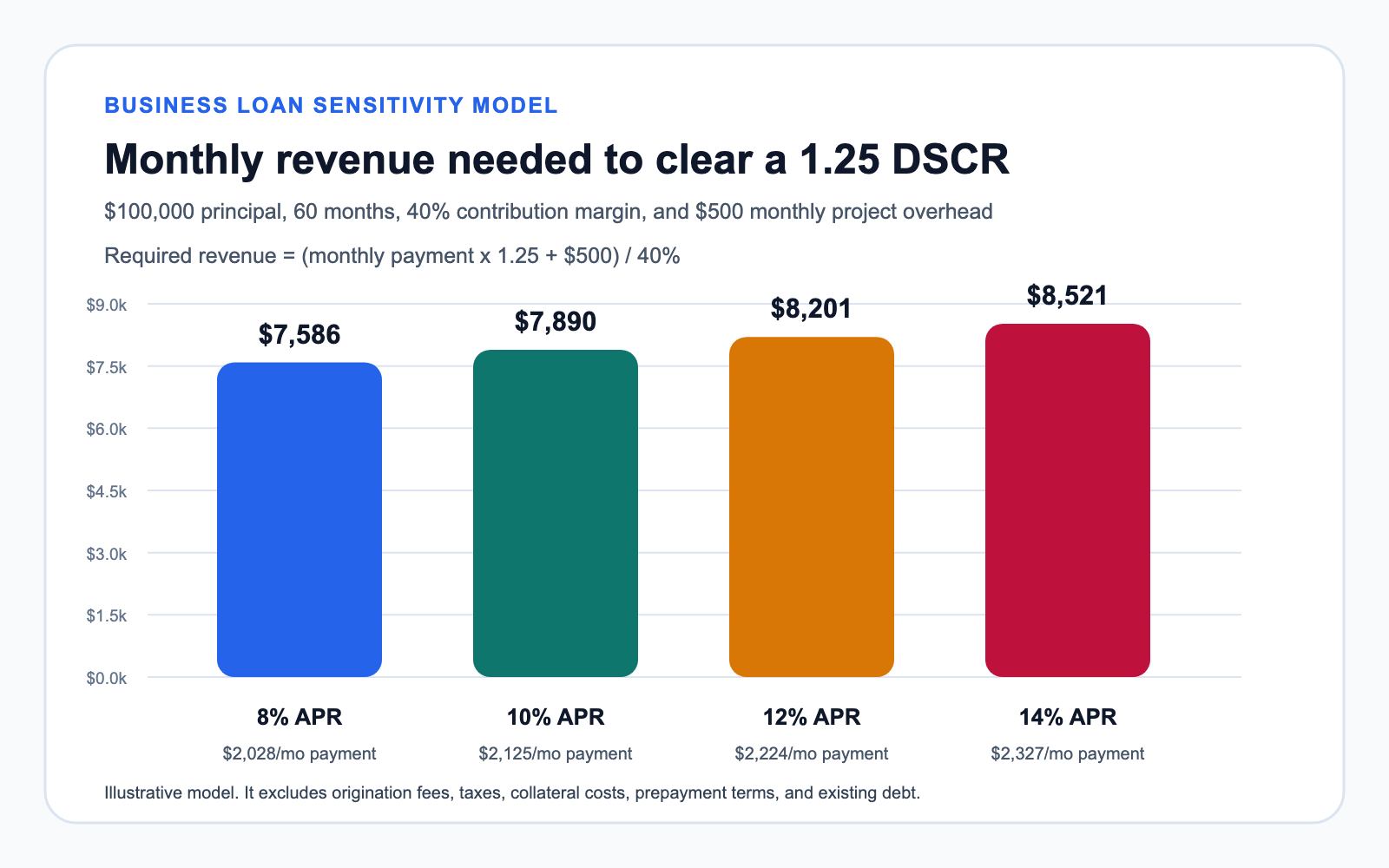
At 10% APR, the revenue sensitivity is even more useful:
| Incremental monthly revenue | Cash before debt | Modeled DSCR | Cash after debt | 1.25 screen |
|---|---|---|---|---|
| $6,000 | $1,900.00 | 0.89 | -$224.70 | Fail |
| $8,000 | $2,700.00 | 1.27 | $575.30 | Pass |
| $10,000 | $3,500.00 | 1.65 | $1,375.30 | Pass |
The SBA break-even guide uses the same discipline: fixed costs divided by contribution margin. This model excludes origination and guaranty fees, taxes, collateral costs, prepayment terms, existing debt, and a delayed launch. Add them.
Organizing Your Loan Application for Success
Organize for traceability, not decoration. Create an index that maps each lender requirement to one current file, its period, and its source. Use stable names such as Q3-2026-PnL.pdf, and keep personally identifiable information in access-controlled storage.
Notion can track requests, owners, dates, and status. Do not store bank credentials or unprotected tax records in a general project board. The best tracker shows what is missing, what changed, and which version went to each lender.

- Custom databases for document tracking
- Template gallery with business planning tools
- Checklist and task management
- File storage and organization
- Collaborative workspace for teams
- Plans and limits vary by account
All-in-one workspace for organizing loan documents, tracking application status across lenders, and building checklists that keep your financing process on track.
Alternative Funding for Content Creators and Solopreneurs
The July 2026 Federal Reserve chartbook on nonemployer firms shows why a one-owner business needs a different lens:
- About half of nonemployer firms had no debt in the 2025 survey.
- 31% said they did not regularly use external financing.
- 64% used owners’ personal funds to address financial challenges, compared with 54% of employer firms.
- Nearly one-third planned to add employees in the next 12 months.
Personal funding is common, but it still has opportunity cost and risk. For a creator or freelancer, compare presales, milestone billing, annual plans, client deposits, a smaller launch, and partner financing before pledging personal assets. If you are opening your first business, validate demand before financing a large fixed cost.
Applying for a Business Loan: The Step-by-Step Process
Applying for business loans in 2026 still works best when the process narrows risk before it creates a hard-to-reverse obligation. Work in this order:
- 1. Define the project. Itemize the amount, supplier, timing, capacity change, and collection date.
- 2. Build the baseline. Reconcile statements and create Creating a business budget with current debt and a downside case.
- 3. Calculate the threshold. Model payment, fees, contribution margin, overhead, DSCR, break-even revenue, and delay risk.
- 4. Match the product. Use a term loan for a durable asset, a line for a recurring timing gap, and receivables finance only for eligible invoices.
- 5. Compare lenders. SBA Lender Match says more than 800 participating lenders use the service, but a match is not an application or approval.
- 6. Ask about the credit pull. Confirm whether prequalification is soft or hard, then compare annual rate, fees, payments, security, guarantees, covenants, and default terms.
- 7. Read the final schedule. Verify net proceeds after fees, first payment date, total repayment, balloon, prepayment treatment, and every personal obligation before signing.
Do not add a generic 10% to 15% borrowing buffer. Add contingency to the project plan, then borrow only the amount that the approved use and downside cash flow can support.
Protecting Your Business After Getting the Loan
The loan becomes an operating system once funded. Track proceeds against the approved use, reconcile the lender statement, and compare actual project cash flow with the underwriting case every month.
- Reserve: set a payment buffer based on seasonality and downside cash flow, not a universal number of months.
- Covenants: calendar reporting dates, ratio tests, insurance, tax, and notice requirements.
- Variance: compare actual volume, price, margin, overhead, and collection timing with the loan model.
- Trigger: decide in advance what variance causes a spending freeze, lender call, or revised forecast.
- Refinancing: compare remaining total cost after fees and prepayment terms; a lower rate alone does not prove savings.
Debt magnifies both discipline and mistakes. The same controls used to protect your business income should now include debt service, covenant headroom, and a dated response plan.
Frequently Asked Questions
These answers are planning guidance. A lender, accountant, attorney, and the applicable program documents control the actual decision.
What credit score do I need to get a business loan?
There is no universal score across conventional banks, SBA lenders, microloan intermediaries, and online lenders. Ask each lender for its screening criteria. Review personal and business credit for errors, then evaluate cash flow, existing debt, collateral, guarantees, and the use of funds together.
How long does business-loan approval take?
It depends on the product, lender, loan size, documentation, collateral, and appraisal or closing requirements. Treat advertised speed as a best-case service claim. Ask for the steps from complete application to decision and from approval to funding.
Can I get a business loan without collateral?
Some products may not require specific collateral, but that does not mean the financing is risk-free. A lender may require a personal guarantee, a general lien, a higher price, or stronger cash flow. Read the security and guarantee provisions, not only the marketing label.
How much can I borrow with an SBA 7(a) loan?
Most 7(a) loans have a $5 million maximum, and SBA Express loans cap at $500,000. The approved amount depends on eligibility, use of funds, ability to repay, lender underwriting, and SBA rules. A program maximum is not a likely approval amount.
What is the current SBA 7(a) interest rate?
There is no single 7(a) rate. Rates are negotiated but subject to SBA ceilings based on a permitted base rate and loan size. With the 6.75% bank prime rate reported on July 27, 2026, the variable-rate ceilings modeled here range from 9.75% for loans over $350,000 to 13.25% for loans of $50,000 or less.
What documents will a business lender require?
Requirements vary. Expect identity and ownership records, requested historical financial statements and tax returns, bank statements, a debt schedule, an itemized use of funds, projections, and supporting contracts or collateral records. Ask the lender for the exact checklist before sending sensitive information.
Should a new solopreneur use a personal loan for the business?
Only after comparing personal liability, the loan agreement’s permitted use, repayment capacity if the business earns nothing, and debt-free alternatives such as presales or milestone billing. Keep the decision separate from whether the application is easy.
How do I compare two business-loan offers?
Put both offers into a cash-flow schedule. Compare net proceeds, annual rate, every fee, payment dates, total repayment, balloon amount, collateral, personal guarantee, covenants, prepayment treatment, and default terms. Then run the same base and downside business assumptions through both.
The right question is not whether you can get approved. It is whether the borrowed capital still works after realistic fees, slower sales, lower margin, and a delayed collection cycle. Run that test first. A refusal made on a spreadsheet is cheaper than a lesson collected from your bank account.
Tell Google you want more of this.
Add Gaurav Tiwari as a preferred sourceOne tap, and this site shows up more often in your own Top Stories, AI Overviews and AI Mode. Remove it any time.
Disclaimer: This site is reader-supported. If you buy through some links, I may earn a small commission at no extra cost to you. I only recommend tools I trust and would use myself. Your support helps keep gauravtiwari.org free and focused on real-world advice. Thanks. - Gaurav Tiwari