
 by
by
The safest way to reduce startup costs is to separate required costs from optional tools, then calculate how many sales must repay the cash you commit. A universal ‘$48 launch’ is not a budget. It ignores the business model, location, permits, insurance, equipment, taxes, inventory, and the cost of delivering each order.
Use a three-part cost sheet: one-time startup costs, monthly fixed costs, and variable costs per sale. Then put a revenue threshold beside every optional expense. This turns ‘keep costs low’ into a decision you can audit.
Over 18 years of building businesses, the useful distinction has been between spending that lets the business sell and deliver safely, and spending that only makes the setup look finished. This guide keeps that line visible.
The $500 Starter Kit: What You Actually Need
Treat $500 as a constrained planning case for a low-risk, home-based online service, not as a promise. The SBA’s startup-cost worksheet separates one-time and monthly expenses because the timing of cash matters.
- One-time: registration, licenses, initial equipment, setup, deposits, professional advice, and launch materials.
- Monthly fixed: software, hosting, insurance, rent, bookkeeping, retainers, and minimum marketing commitments.
- Variable: fulfillment labor, materials, shipping, payment fees, sales commissions, refunds, and support per order.
- Cash reserve: a separate buffer for timing gaps and surprises, not a number quietly counted as available profit.
For a simple web presence, compare current quotes rather than copying a price from an old list. That may include a domain through Namecheap, hosting through Hostinger, and the labor involved in building sites with WordPress. Record the introductory price, renewal price, taxes, migration cost, and cancellation terms.
Email and measurement can begin on appropriately limited plans. Check MailerLite’s current subscriber and feature limits, and use Google Search Console to measure search visibility. Free does not mean permanent; put the upgrade trigger on the budget before you hit it.
Here is the reproducible base model. It assumes a $300 order, $75 of direct delivery cost, and a 3% payment fee. Contribution per order is $300 – $75 – $9 = $216.
| Case | One-time cost | Monthly fixed | First-month cash | Whole orders to break even | Revenue at that order count |
|---|---|---|---|---|---|
| Lean | $500 | $250 | $750 | 4 | $1,200 |
| Base | $800 | $400 | $1,200 | 6 | $1,800 |
| Higher-cost | $1,500 | $700 | $2,200 | 11 | $3,300 |
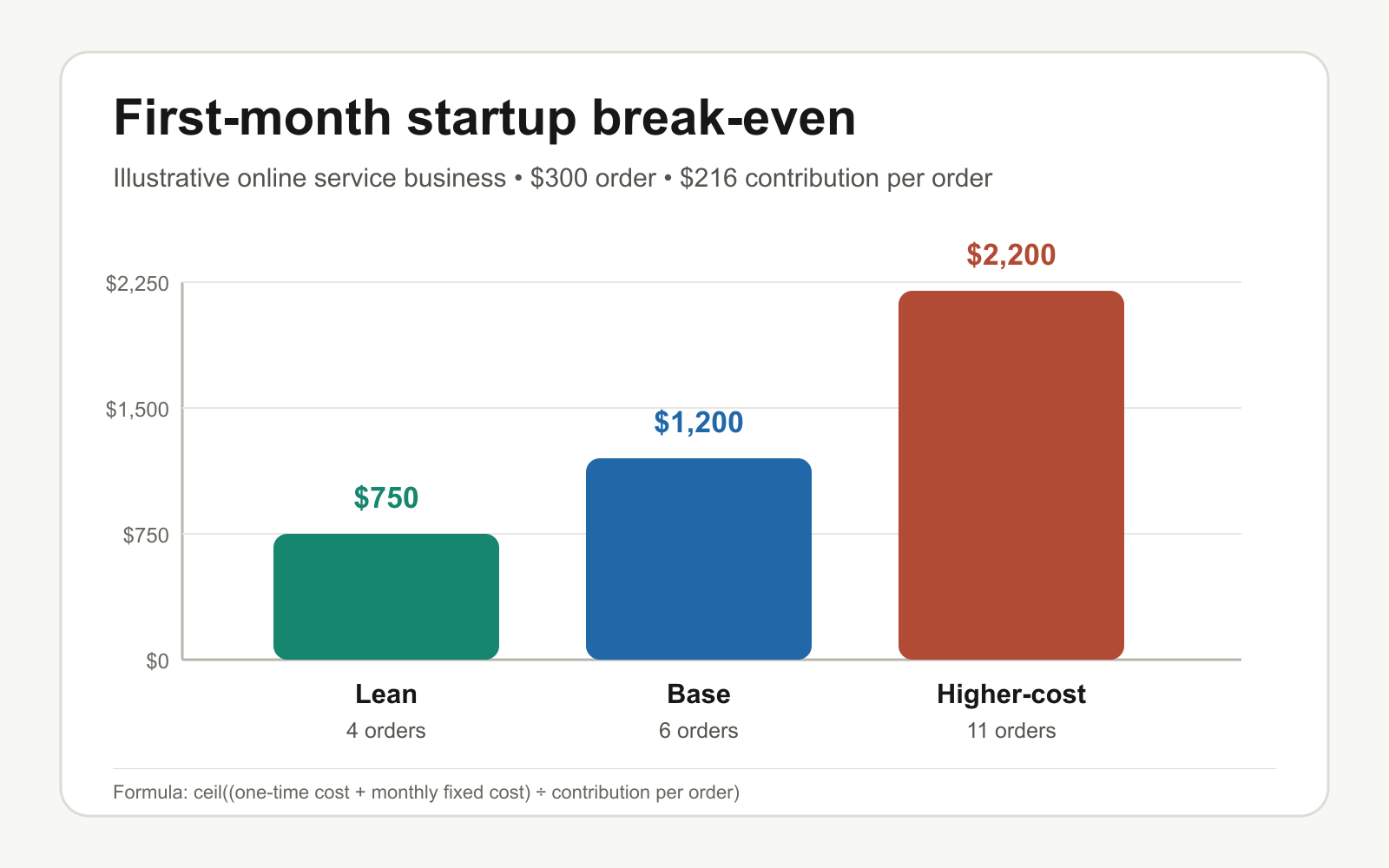
Formula: whole orders = ceiling((one-time startup cost + monthly fixed cost) / contribution per order). In the base case, $1,200 / $216 = 5.56, so six whole orders are required. At $200 per order the sensitivity case needs nine orders; at $400 it needs five.
Free Alternatives: The Fastest Way to Reduce Startup Costs
A free tier reduces cash cost only when it still meets the required job. Check usage rights, data export, security, support, storage, seats, automation, and the paid migration path. A free tool that creates manual rework can be the expensive option.
| Job | Low-cash starting point | Upgrade trigger |
|---|---|---|
| Planning and records | Notion or a spreadsheet | Missing permissions, history, automation, or reliable export |
| Business email and files | Google Workspace trial or an existing compliant system | Domain email, administration, storage, or collaboration is required |
| Design | A simple editor and reusable brand template | A paid feature saves measured labor or replaces outsourcing |
| Accounting | A jurisdiction-appropriate ledger or spreadsheet | Volume, payroll, tax, inventory, audit, or accountant needs exceed it |
Do not rely on remembered plan limits. Review the official Google Workspace pricing, Notion pricing, and Canva pricing when the decision is due.
Three Product Boxes: Tools Worth Paying For (Eventually)
These tools can be useful, but none deserves a permanent place in the budget without a measured job. The boxes retain the practical use cases; the payback gate below decides whether a paid plan belongs in your stack.
- Professional email with your domain name
- 30 GB cloud storage per user
- Google Meet, Docs, Sheets, Slides included
- Works on every device, no setup needed
- Check current official pricing before upgrading
- Free plan covers notes, docs, and basic databases
- Replaces Trello, Evernote, and Google Docs
- AI assistant built in (paid plans)
- Templates for everything from CRM to content calendars
- Check current official pricing before upgrading

- Free plan available; current features may change
- Drag-and-drop editor, no design skills needed
- Pro adds brand kit, background remover, resize
- 100 GB cloud storage on Pro plan
- Check current official pricing before upgrading
For a $29 monthly tool and a founder-hour value of $25, one measured hour saved produces $25 of value and fails by $4. Two hours produce $50 and pass by $21. Three hours produce $75 and pass by $46. Count verification, setup, maintenance, migration, and correction time, not just the click the tool removes.
Where You Absolutely Cannot Cut Costs
Do not optimize away costs that control legal exposure, security, recoverability, or the ability to accept and fulfill an order. Which costs are required depends on the activity and location.
Your Domain Name
If the website is a core sales channel, register the domain in an account the business controls, enable strong authentication, document renewal, and keep recovery details current. The decision is about ownership and continuity, not an unsupported claim that a custom domain guarantees more search clicks.
SSL Certificate
HTTPS protects data in transit and is expected for modern sites. Let’s Encrypt issues free certificates, but certificate renewal, secure configuration, updates, and application security still need an owner.
Backups
A backup is useful only if it is separate from the production failure, retained long enough, and restored in a test. Define recovery-point and recovery-time targets, keep more than one copy for critical data, and record the latest successful restore test.
The Revenue-First Approach
Revenue-first means validating contribution, not accepting any sale at any price. A $300 order with $75 of direct cost and a 3% payment fee contributes $216 before fixed costs and taxes. A discount that removes that contribution can create activity while making the cash problem worse.
The Federal Reserve survey shows how firms responded to financial pressure: 54% used personal funds, 48% raised prices, 47% used cash reserves, 47% reduced costs, and 36% took on debt. These actions are not endorsements. They show why price, cost, and cash decisions must be evaluated together.
- Define one buyer, one deliverable, one price, and the direct cost to fulfill it.
- Calculate contribution per order and the first-month cash break-even.
- Set a bounded outreach or sales test and record every result.
- Review refunds, delivery time, support load, and repeat demand before scaling.
If demand remains weak after a controlled test, diagnose the offer before adding software. The guide for when a small business is struggling to take off covers the wider pricing, positioning, acquisition, and cash-flow checks.
Lean Validation: Test Before You Invest
The SBA’s market-research guide separates demand, market size, economic indicators, customer location, saturation, and pricing. Search trends are one clue, not proof that people will buy from you.
- Interview: talk to intended buyers about the existing problem, current alternative, urgency, and purchasing process.
- Offer: state the deliverable, price, boundaries, timeline, and refund or cancellation terms.
- Test: use a paid pilot, signed proposal, or compliant preorder when appropriate; do not count likes as sales.
- Gate: set the minimum paid result and deadline before the test begins, then stop, revise, or proceed.
Use low-cost business ideas to make money as prompts, not forecasts. Inventory, regulated services, health claims, financial activity, and customer deposits create obligations that a lightweight online-service test may not have.
Financial Tracking From Day One
Track cash before the first purchase. The IRS starting-a-business guidance covers structure, tax IDs, business taxes, and recordkeeping. Publication 583 says the system must clearly show income and expenses and recommends separating the business checking account.
| Metric | Formula | Decision it supports |
|---|---|---|
| Contribution per order | Price – direct cost – variable fees | Can a sale help cover fixed costs? |
| First-month break-even | (Startup + monthly fixed) / contribution | How many whole orders repay the cash? |
| Cash runway | Available cash / monthly cash outflow | How long can the current plan continue? |
| Acquisition ceiling | Contribution – required profit and risk buffer | What is the most you can pay to acquire an order? |
| Tool payback | Measured monthly value – monthly tool cost | Does the subscription earn its place? |
Keep revenue streams distinct, including client work, product sales, and affiliate income. For a broader explanation of working capital, margin, owner pay, and tax reserves, see how business money actually flows.
Do not use a universal tool-to-revenue ratio or profit-margin target. A consulting business, ecommerce store, subscription product, and licensed local service have different cost structures. Compare the number with your own historical baseline and required risk buffer.
When to Scale Your Expenses
Scale an expense when a named bottleneck, measured value, and rollback plan exist. Revenue alone is not enough. A growing business can still destroy cash by buying tools faster than it improves contribution or capacity.
- Administration: add Google Workspace when domain email, access control, storage, or collaboration requirements justify it.
- Workflow: add Notion when a paid feature removes measured coordination or recordkeeping cost.
- Acquisition: pay for SEO tools only when you have a decision the data can change and enough content to analyze.
- Sales operations: add CRM software when lead volume, handoffs, follow-up, permissions, or reporting exceed the current process.
Before purchase, write the monthly cost, setup hours, owner, metric, baseline, review date, and cancellation path. If the expected benefit cannot be measured, run a short trial with a hard stop instead of adding an open-ended subscription.
Common Money Traps That Kill Startups
The common pattern is not one specific purchase. It is committing cash before the purchase controls a real risk or improves a measured outcome.
The Logo Trap
A logo can help recognition, but it does not prove demand. Start with a legible identity that works at small sizes and in one color. Commission a deeper system when inconsistent assets, licensing, packaging, or conversion testing creates a real requirement.
The Course Trap
Buy education against a current bottleneck. Define the skill, deliverable, completion time, and how the result will be checked. A course bought for motivation is an expense; a course that closes a verified capability gap may be an investment.
The Premium Theme Trap
Choose a theme from functional requirements: accessibility, performance, supported blocks, ecommerce needs, update policy, and exit cost. A paid theme is not automatically better, and a free theme is not free if it requires extensive correction.
The Tool Stacking Trap
Ten $15 subscriptions cost $150 per month and $1,800 per year before taxes, setup, integrations, or migration. List overlapping functions, remove duplicate jobs, and review utilization before renewal.
The LLC-First Trap
Do not form or delay an entity based on a made-up revenue threshold. The SBA says structure affects taxes, fundraising, paperwork, and personal liability. Review the business-structure guide, required licenses and permits, and jurisdiction-specific professional advice. Then connect the choice to protecting your business income.
For U.S. federal tax context, IRS Publication 583 says eligible startup and organizational costs may have a $5,000 deduction, reduced when total costs exceed $50,000, with remaining eligible amounts generally amortized. Read Publication 583 and get advice for your facts; a deduction does not make an unnecessary purchase profitable.
Building a Content Engine on Zero Budget
Content has a labor cost even when media spend is zero. Treat research, drafting, editing, graphics, distribution, and updates as hours in the acquisition model. The channel earns more investment only when it produces qualified visits, leads, orders, or retained customers.
Use building a content marketing plan for the full framework. For a 30-day test, choose one buyer problem, publish the best answer you can support, distribute it through one relevant channel, and record impressions, qualified visits, inquiries, orders, and contribution.
Repurposing can lower production cost, but only if each format suits its channel. The guide to creating a lot of content is useful after one source asset has proved worth distributing. Do not multiply an unverified claim into five formats.
The $500 Bootstrap Checklist
This checklist is for a low-risk online service using existing equipment. If permits, professional licensing, insurance, inventory, employees, or customer deposits apply, add them before using the $500 cap.
- Write one-time, monthly fixed, and per-order cost lists.
- Check structure, registration, permit, tax, insurance, privacy, and contract requirements.
- Define the offer, price, direct delivery cost, and payment fee.
- Calculate contribution and whole orders required for first-month cash break-even.
- Keep a contingency reserve separate from the operating budget.
- Run a bounded paid-validation test with a result threshold and deadline.
- Add only the tools required to sell, deliver, record, secure, and recover.
- Review cash, contribution, tool payback, and renewal dates every month.
Related Resources
These two guides cover the next decisions without repeating the model:
Do You Really Need a Website? Use it to decide whether a site is required for the current offer and what the minimum useful version must do.
How to Protect Your Business Income Use it after mapping cash, liability, insurance, contracts, taxes, and continuity risks.
Frequently Asked Questions
These answers use decision rules because business type, location, risk, and cash constraints change the correct amount.
Can I really start a business for under $500?
Sometimes, but only for a narrow low-risk model that uses existing equipment and has minimal registration, permit, insurance, inventory, and professional-service costs. Build one-time, monthly, and per-sale cost lists for your location and activity before treating $500 as a cap.
Do I need an LLC to start an online business?
There is no safe revenue threshold for this decision. Structure affects liability, taxes, paperwork, fundraising, and state obligations. Compare the risks with the SBA guide and get jurisdiction-specific legal or tax advice when exposure is material.
What’s the fastest way to get my first customer?
Start with a specific offer and direct conversations with qualified buyers. Track contacts, replies, proposals, orders, refunds, and contribution per order. A sale is stronger evidence than interest, but one discounted order still does not prove repeatable demand.
Should I use WordPress or a website builder like Squarespace?
Choose from requirements, not ideology. WordPress is useful when you need ownership, extensibility, and portable hosting. A hosted builder may be cheaper in labor when simplicity and support matter more. Compare the full first-year cost, renewal cost, export path, maintenance time, and the features required to sell.
When should I start paying for email marketing?
Pay when the free plan’s current limits block a measured need, such as subscriber volume, automation, seats, support, or deliverability controls. Check the vendor’s official pricing page because limits and features change. Include migration time in the decision.
How do I know if my business idea is worth pursuing?
Define the buyer, problem, offer, price, direct cost, and evidence that the buyer will pay. Interviews and search trends help with discovery; a compliant preorder, paid pilot, or signed proposal is stronger validation. Set a deadline and a minimum result before spending on a full build.
What’s the biggest mistake bootstrapped founders make?
Confusing setup with risk reduction. A logo, theme, or AI subscription can feel productive without improving demand, contribution margin, compliance, delivery, or cash runway. Every proposed expense needs an owner, a measurable outcome, and a stop rule.
How much should I spend on marketing as a new business?
There is no universal zero-dollar or revenue-percentage rule. Start with the amount you can lose without threatening required operating costs. Set a maximum acquisition cost from contribution margin, test a bounded budget, and stop when the measured economics miss the threshold.
In 2026, software can make a small launch cheaper, but it cannot erase compliance, delivery, taxes, or unit economics. Reduce startup costs by making each cost defend itself against a requirement, a measured risk, or the contribution it helps produce.
Tell Google you want more of this.
Add Gaurav Tiwari as a preferred sourceOne tap, and this site shows up more often in your own Top Stories, AI Overviews and AI Mode. Remove it any time.
Disclaimer: This site is reader-supported. If you buy through some links, I may earn a small commission at no extra cost to you. I only recommend tools I trust and would use myself. Your support helps keep gauravtiwari.org free and focused on real-world advice. Thanks. - Gaurav Tiwari