by
by
Look at the Eagle Nebula long enough and you’ll see faces. Human figures. A wolf-man. A queen. Hundreds of viewers reported seeing them when Hubble’s images first aired on CNN in 1995.
They’re not there. And that’s the interesting part.
What you’re experiencing is pareidolia, your brain’s hardwired tendency to find familiar patterns (especially faces) in random visual data. It’s the same mechanism that made people see a face on Mars in 1976, that makes you see animals in cloud formations, and that finds the Man in the Moon every clear night. It’s not a flaw. It’s a feature that kept your ancestors alive by detecting predators in dense foliage. The cost is false positives in gas clouds 7,000 light-years away.
What the Eagle Nebula actually is
The Eagle Nebula (Messier 16, NGC 6611) sits approximately 7,000 light-years from Earth in the constellation Serpens Cauda. It was discovered by Jean-Philippe de Chéseaux in 1745-46, and Charles Messier independently catalogued it in 1764. The nebula spans about 70 × 55 light-years and is an active H II region, a cloud of ionized hydrogen gas illuminated by the ultraviolet radiation of young, hot stars in the open cluster NGC 6611.
In simpler terms: it’s a stellar nursery. New stars are being born inside those gas clouds right now. Or rather, they were 7,000 years ago. What we see is 7,000-year-old light.
The nebula earned its name from the overall bird-like shape of its gas clouds, resembling an eagle with outstretched wings. But the most famous feature isn’t the eagle shape. It’s the structures inside it.
The Pillars of Creation: Hubble’s most iconic photograph
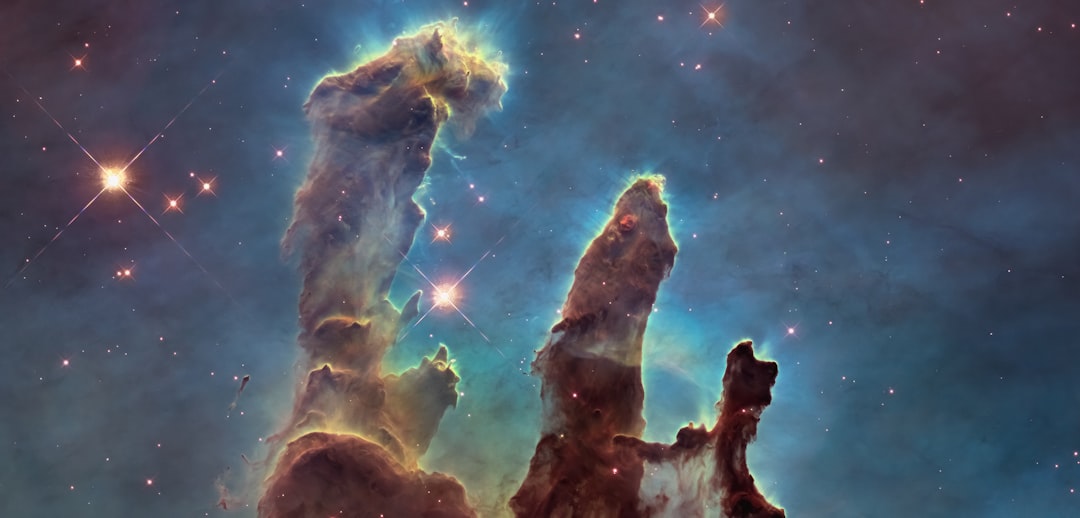
On April 1, 1995, astronomers Jeff Hester and Paul Scowen at Arizona State University pointed the Hubble Space Telescope at a small region within the Eagle Nebula. The resulting image became arguably the most famous photograph in the history of astronomy.
Three towering columns of interstellar gas and dust, the Pillars of Creation. The tallest extends roughly 4 light-years from base to tip. That’s the distance from our Sun to Proxima Centauri. An entire interstellar journey, captured in a single pillar of cold hydrogen.
The pillars are sculpted by photoevaporation. Intense ultraviolet radiation and stellar winds from nearby O-type and B-type stars in NGC 6611 (the hottest, most massive star types) erode the less-dense gas surrounding the pillars. The denser regions resist erosion, creating the column shapes. At the tips of the pillars, small dense pockets called Evaporating Gaseous Globules (EGGs) are sites where new stars are actively forming through gravitational collapse.
The composition: primarily molecular hydrogen (H₂), with dust grains (silicates and carbon compounds) and trace molecules including CO and HCN. Dense cores within the pillars reach temperatures as low as 10-20 Kelvin. Cold enough for gravity to win over thermal pressure. Cold enough to make stars.
JWST’s 2022 reveal: what Hubble couldn’t see
In October 2022, the James Webb Space Telescope captured the Pillars of Creation in near-infrared light. And everything changed.
Hubble saw the pillars in visible light, which means it saw the dust. The columns appeared opaque, dark, mysterious. Beautiful but closed. JWST’s infrared instruments penetrate that dust. For the first time, we could see the protostars, newborn stars still embedded in the gas that formed them, glowing red at the edges of the pillars.
JWST’s mid-infrared image went further. It showed the dust itself glowing, revealing the internal structure of the columns. The pillars that looked solid in Hubble’s image turned out to be lacy, threaded, almost translucent. The boundary between “pillar” and “surrounding space” wasn’t a wall. It was a gradient.
This matters because it changes our understanding of how star formation works in these environments. The protostars at the pillar tips aren’t passive objects waiting for the gas to clear. They’re actively shaping the pillars from within, their own radiation beginning to erode the columns that created them. Stars born from destruction, becoming destroyers of their own birthplace.
Are the pillars already destroyed?
Here’s the most unsettling fact about the Pillars of Creation. They might not exist anymore.
In 2007, the Spitzer Space Telescope captured infrared observations suggesting that a supernova shock wave may have already blown through the region roughly 6,000 years ago, destroying the pillars. But because the Eagle Nebula is 7,000 light-years away, the light showing the destruction hasn’t reached us yet. If this interpretation is correct, the pillars were destroyed about 1,000 years ago in real time, and we won’t see it happen for another ~1,000 years.
This remains debated. The Spitzer evidence isn’t conclusive. But the possibility is genuinely mind-bending: one of the most photographed objects in the universe, a structure we’ve studied for decades, may already be gone. We’re looking at a ghost.
The science of seeing faces in space
Back to the faces. When Hubble’s Eagle Nebula images first aired, viewers reported seeing a human figure, a face, even a “Star Queen” within the gas formations. These reports are genuine perceptual experiences, not imagination. Your brain’s fusiform face area, a region in the temporal lobe specifically tuned to detect face-like configurations, fires when it encounters anything with two dots above a line (eyes over a mouth). It’s automatic and involuntary.
The most famous astronomical pareidolia: the “Face on Mars,” photographed by Viking 1 on July 25, 1976, in the Cydonia region. The low-resolution image showed what looked unmistakably like a humanoid face staring up from the Martian surface. It spawned conspiracy theories, books, and a Hollywood movie. Then Mars Global Surveyor took higher-resolution photographs in 1998 and 2001. The face was an ordinary mesa. Shadows and low resolution had done the rest.
Pareidolia isn’t limited to space. You see it in wood grain, toast, water stains, rock formations. It’s the product of an evolutionary trade-off: your pattern-recognition system is tuned to minimize false negatives (missing a real face = potentially lethal) at the cost of maximizing false positives (seeing a face in a cloud = harmless). In survival terms, it’s better to see a tiger that isn’t there than to miss one that is.
Every time NASA updates its images of the Eagle Nebula with better instruments and different wavelengths, new “figures” seem to appear. This isn’t the nebula changing. It’s your brain working on new data, finding new patterns to lock onto. The problem-solving machinery in your visual cortex is always running, always looking for structure, even when there’s none to find.
Why the Eagle Nebula still matters
The Eagle Nebula isn’t interesting because of phantom faces. It’s interesting because it’s one of the best laboratories we have for studying star formation in real time (or as close to real time as 7,000-year-old light allows).
The nebula contains stars at every stage of their lifecycle. The hot O-type stars of NGC 6611 are already burning through their hydrogen fuel. The EGGs at the pillar tips contain protostars that haven’t yet ignited nuclear fusion. Between these extremes is every intermediate stage of stellar evolution, all visible within a single 70-light-year frame.
JWST will continue observing the Eagle Nebula across multiple infrared wavelengths. Each new dataset reveals features Hubble couldn’t resolve. The science here isn’t about mysterious appearances. It’s about understanding how stars, including our own Sun 4.6 billion years ago, come into existence from cold, dark clouds of hydrogen.
The faces in the gas are a product of your brain. The stars forming inside the gas are a product of gravity. One is a cognitive illusion. The other is the engine of the universe. Knowing the difference is the beginning of science.
Frequently Asked Questions
What is the Eagle Nebula?
The Eagle Nebula (Messier 16, NGC 6611) is an active star-forming region approximately 7,000 light-years from Earth in the constellation Serpens Cauda. It spans about 70 × 55 light-years and contains the famous Pillars of Creation. It was discovered by Jean-Philippe de Chéseaux in 1745-46.
What are the Pillars of Creation?
Three towering columns of interstellar gas and dust within the Eagle Nebula, photographed by Hubble in 1995. The tallest extends roughly 4 light-years. They’re sculpted by photoevaporation from nearby hot stars and contain dense pockets (EGGs) where new stars are actively forming.
Why do people see faces in the Eagle Nebula?
Pareidolia — the brain’s tendency to perceive familiar patterns (especially faces) in random visual data. Your fusiform face area, a region in the temporal lobe, automatically fires when it detects anything resembling two eyes over a mouth. It’s an evolutionary adaptation that produces false positives in ambiguous images like nebula photographs.
How did JWST’s images differ from Hubble’s?
Hubble photographed the pillars in visible light, showing opaque dust columns. JWST’s near-infrared instruments (October 2022) penetrated the dust, revealing protostars hidden within the pillars for the first time. JWST’s mid-infrared view showed the dust itself glowing, revealing the pillars’ internal lacy structure.
Have the Pillars of Creation been destroyed?
Possibly. Spitzer Space Telescope observations in 2007 suggested a supernova shock wave may have destroyed the pillars roughly 6,000 years ago. Because the nebula is 7,000 light-years away, the destruction light wouldn’t reach Earth for another ~1,000 years. This remains debated and unconfirmed.
What is the Face on Mars?
A mesa in the Cydonia region of Mars photographed by Viking 1 on July 25, 1976, that appeared to show a humanoid face. Higher-resolution images from Mars Global Surveyor (1998, 2001) revealed it as an ordinary geological formation. It’s the most famous example of astronomical pareidolia.
How are new stars born inside the pillars?
Dense cores within the pillars reach temperatures of 10-20 Kelvin, cold enough for gravitational collapse. Evaporating Gaseous Globules (EGGs) at the pillar tips are sites of active protostellar formation. The surrounding gas (molecular hydrogen, dust, CO, HCN) feeds the growing protostars until they ignite nuclear fusion.
How far away is the Eagle Nebula?
Approximately 7,000 light-years from Earth. This means the light we see today left the nebula 7,000 years ago. Any changes happening there now (including possible destruction by a supernova) won’t be visible from Earth for thousands of years.
Tell Google you want more of this.
Add Gaurav Tiwari as a preferred sourceOne tap, and this site shows up more often in your own Top Stories, AI Overviews and AI Mode. Remove it any time.