
How to Get Research Paper Ideas: A Complete Guide for 2026
Finding a research paper topic feels like the hardest part of any academic project, and honestly, it usually is. You’re staring at a blank document, your advisor wants a proposal by next month, and every idea you consider feels either too broad, too narrow, or already done to death. I’ve been there. Most researchers have.
The good news: in 2026, you have tools that didn’t exist even three years ago. AI research assistants like Consensus, Elicit, and Connected Papers can map entire research landscapes in minutes. Semantic Scholar processes 200 million academic papers. These tools don’t replace critical thinking, but they dramatically compress the exploration phase that used to take weeks.
This guide walks you through the complete process of finding, validating, and refining research paper ideas, from understanding your field to identifying gaps that no one else has filled yet.
Why Choosing the Right Research Topic Matters
Your research topic determines the next 6 months to 5 years of your academic life. A poorly chosen topic leads to dead ends, scope creep, advisor conflicts, and the worst outcome of all: a completed paper that nobody reads because it didn’t address a genuine gap in the literature.
A well-chosen topic, on the other hand, creates a cascade of positive effects:
- Motivation: You’ll spend hundreds of hours on this research. If the topic doesn’t genuinely interest you, the quality of your work will suffer around month 3
- Publishability: Journals reject papers that don’t address clear research gaps. The topic selection phase is where publishability is won or lost
- Career impact: Your research topic becomes your professional identity. It determines which conferences invite you, which labs want you, and which industry roles you’re qualified for
- Feasibility: A brilliant idea that requires data you can’t access or methods you can’t afford is worthless. Practical constraints matter as much as intellectual ambition
The best research topics sit at the intersection of three things: what interests you, what the field needs, and what’s feasible with your resources and timeline.
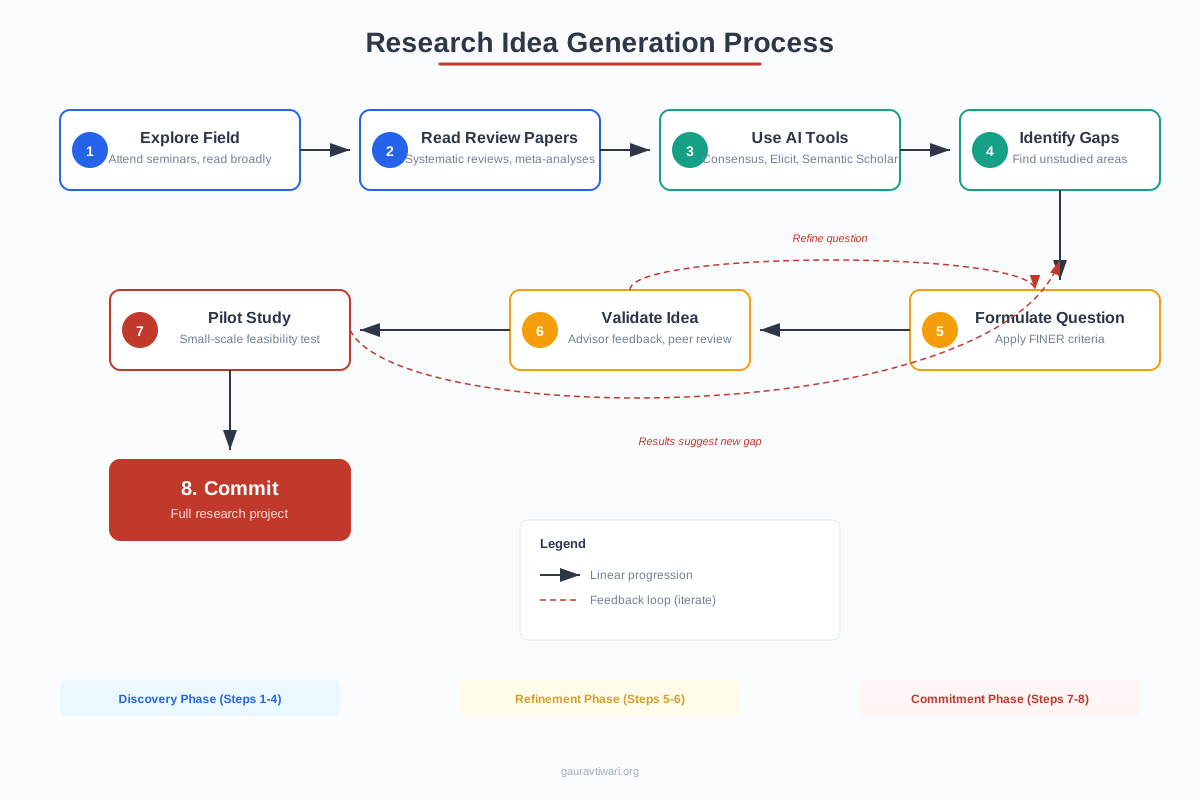
Explore and Understand Your Field
Before you can identify gaps, you need to understand the terrain. This means reading broadly (not just deeply) in your field. Most students make the mistake of diving too quickly into a narrow subtopic without understanding the bigger picture. That’s how you end up researching something that was already solved in a parallel subfield.
How to build field awareness efficiently:
- Read review papers first: Annual reviews, systematic reviews, and meta-analyses give you the state of the field in 20-30 pages. Search “[your field] systematic review 2026” on Google Scholar
- Follow citation trails: When a review paper mentions an open question or limitation, follow the citations. These are breadcrumbs leading to research gaps
- Read “Future Directions” sections: Every good paper ends with suggestions for future research. These are literally researchers telling you what to study next
- Attend conferences (even virtually): Poster sessions and Q&A periods reveal what the field is actively debating. The questions asked after a talk often point to gaps the presenter didn’t address
- Join academic communities: ResearchGate, academic Twitter/X, and subreddits like r/AskAcademia surface conversations about emerging trends and unanswered questions
Before committing to a topic, read (at minimum) 50 papers in your general area. Not deeply. Skim abstracts, conclusions, and “future directions” sections. This takes 2-3 days and gives you a mental map of the field that no amount of Googling can replace. Tools like Semantic Scholar’s TLDR summaries can speed this up considerably.
Use AI Research Tools to Accelerate Discovery
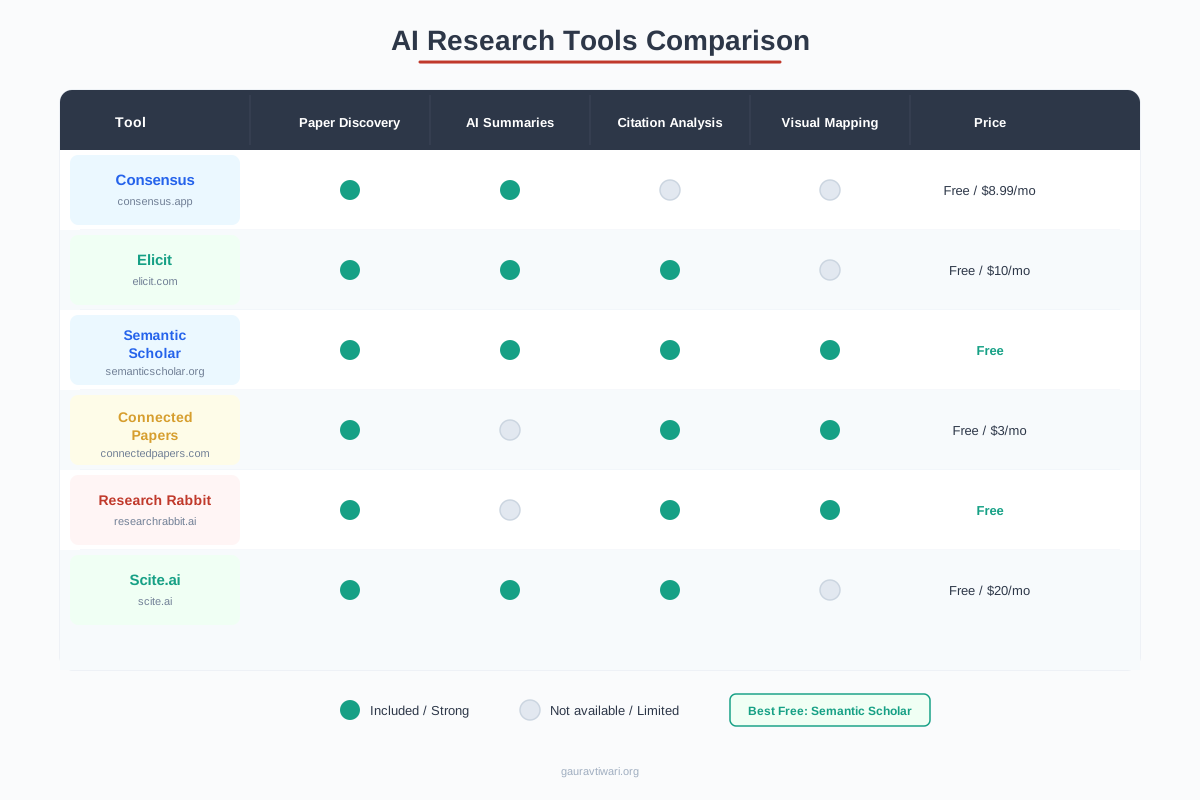
AI research tools have transformed the discovery phase. What used to take weeks of manual literature searching now takes hours. These aren’t shortcuts that replace critical thinking. They’re power tools that let you survey more ground faster.
The best AI research tools in 2026:
- Consensus: Ask research questions in plain English and get answers backed by peer-reviewed papers. “Does remote work increase productivity?” returns a synthesized answer with citations. Free for basic searches, $9.99/month for unlimited
- Elicit: AI research assistant that finds relevant papers, extracts key findings, and helps you synthesize across studies. Excellent for literature reviews. Identifies patterns across papers that manual reading might miss. Free tier available
- Semantic Scholar: 200+ million papers indexed with AI-generated TLDR summaries, citation context, and influence scores. Its “Research Feed” learns your interests and surfaces new relevant papers. Free
- Connected Papers: Builds a visual graph of papers related to any paper you input. Shows you the landscape of a topic at a glance: clusters of related work, seminal papers, and recent additions. Free for 5 graphs/month
- Research Rabbit: “Spotify for research.” Feed it papers you like, and it recommends related work. Discovers papers you’d never find through keyword searching alone. Free
- Scite.ai: Shows how papers have been cited: supporting, contrasting, or mentioning. This helps you understand whether a finding has been replicated, challenged, or ignored. From $20/month
For organizing what you find, Notion works well for research databases with tags and properties. Traditional reference managers like Zotero (free, open-source) and Mendeley handle citations and PDFs. ProWritingAid helps clean up your academic writing once you start drafting.
Identify Research Gaps
A research gap is a question that existing literature hasn’t adequately answered. Finding one is the single most important step in developing a viable research topic. Without a clear gap, your paper is redundant, and reviewers will reject it.
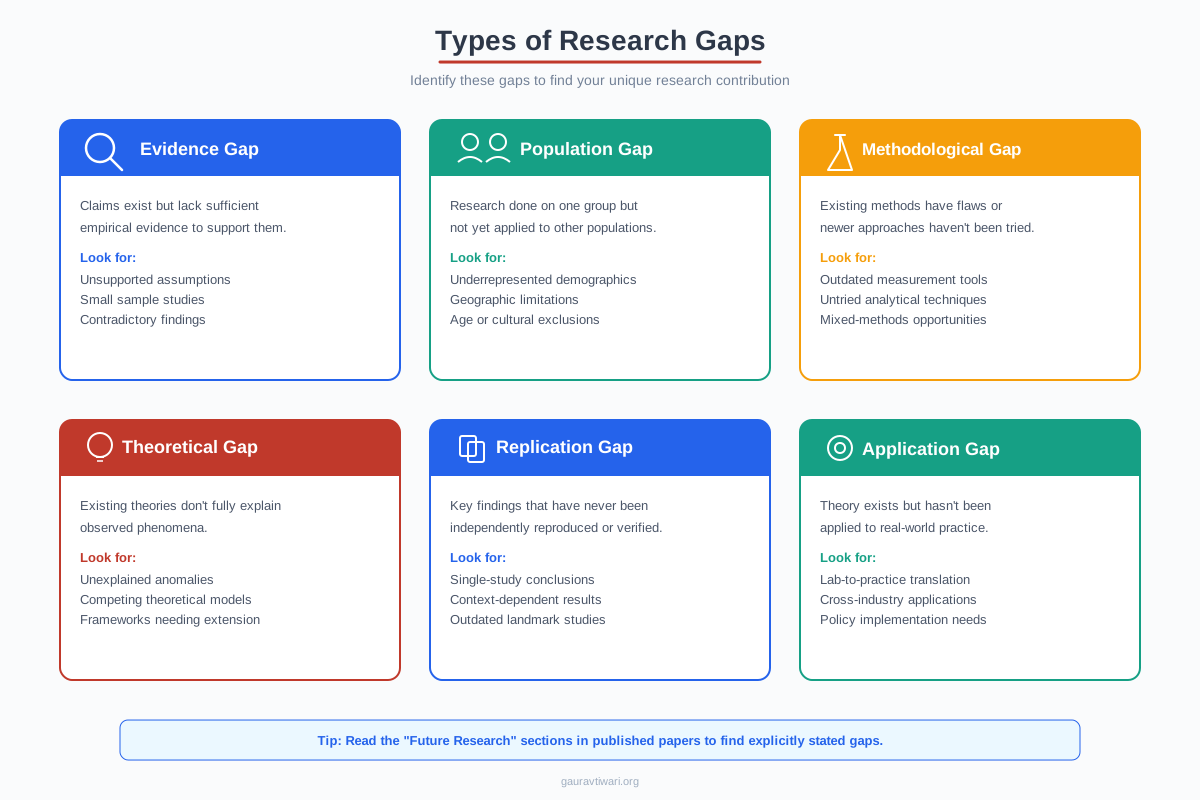
Types of research gaps to look for:
- Evidence gaps: A claim is widely accepted but lacks rigorous empirical support. “Everyone believes X, but nobody has actually tested it properly”
- Population gaps: A phenomenon has been studied in one context but not others. Drug efficacy studies often lack data on elderly populations, pregnant women, or specific ethnic groups
- Methodological gaps: Existing studies used outdated or limited methods. A topic studied only through surveys might benefit from experimental or computational approaches
- Theoretical gaps: Observations exist that current theories can’t explain. These lead to the most impactful research but are hardest to address
- Replication gaps: A study’s findings were never independently replicated. The replication crisis has made this a legitimate and valuable research direction
- Application gaps: Research exists in theory but hasn’t been applied to practical settings. Bridging lab findings to real-world applications is highly publishable
The “Limitations” section of published papers is literally a list of problems the authors couldn’t solve. Read the limitations sections of the 10 most-cited papers in your area. Each limitation is a potential research topic. This is the most reliable gap-finding technique in academia.
Develop Your Research Question
A research gap is not a research question. The gap is the empty space. Your research question is the specific, answerable question you’ll investigate to fill part of that space. Vague questions produce vague research. Specific questions produce publishable papers.
A strong research question has these characteristics:
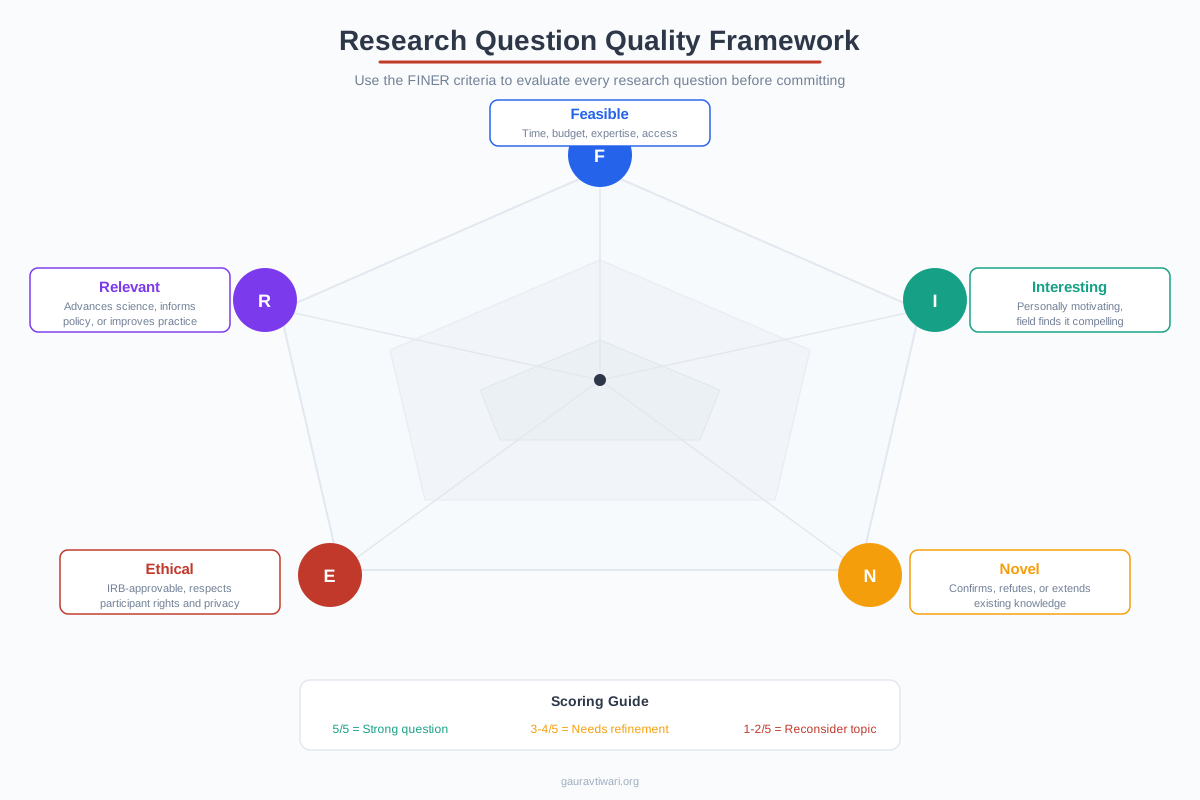
- Focused: “How does social media affect mental health?” is too broad. “How does daily Instagram usage exceeding 2 hours correlate with anxiety symptoms in college students aged 18-22?” is researchable
- Answerable: Can you realistically answer this with available methods and data? If not, narrow it further
- Novel: Does answering this question contribute something new? If the answer is already well-established, you’re confirming, not discovering
- Significant: Does anyone care about the answer? Research that answers a question nobody asked is technically valid but practically useless
- Ethical: Can you investigate this question without causing harm? IRB approval is required for human subjects research, and ethical constraints should shape your question from the start
Use the PICO framework (Population, Intervention, Comparison, Outcome) for clinical and social science research, or the FINER criteria (Feasible, Interesting, Novel, Ethical, Relevant) for any field.
Validate Your Research Idea Before Committing
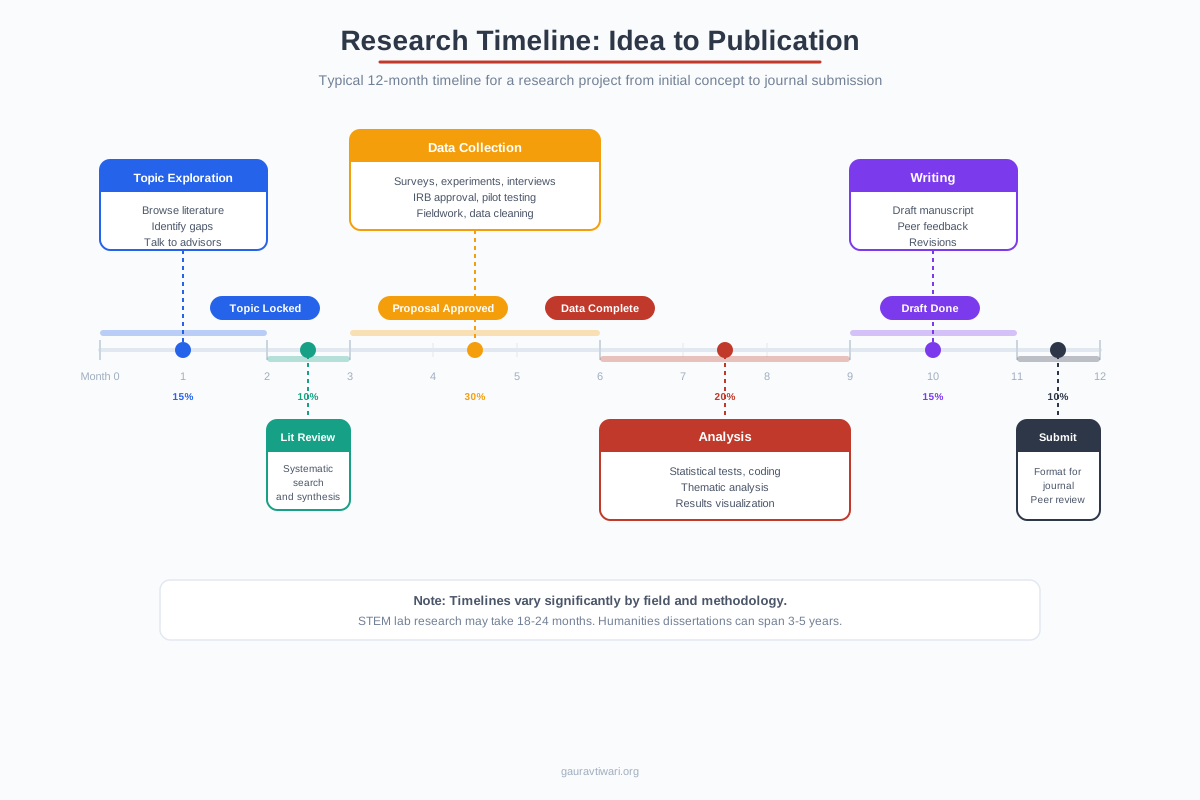
The worst time to discover your research idea is flawed is after you’ve spent 6 months on it. Validation upfront saves you from the two most common research disasters: discovering someone already published your exact study, and realizing your methodology can’t answer your question.
Validation checklist:
- Novelty check: Search your exact research question on Google Scholar, Semantic Scholar, and your field’s primary databases (PubMed, IEEE, SSRN, etc.). If someone published the same study last year, you need a new angle
- Advisor feedback: Present your idea to your advisor in a structured 1-page summary: the gap, the question, the proposed method, and the expected contribution. Their experience will catch problems you can’t see
- Feasibility assessment: Can you access the required data? Do you have the necessary equipment or software? Is the timeline realistic for your degree program or publication goals?
- Preliminary investigation: Run a small pilot study or analysis. If the initial data doesn’t show the patterns you expected, better to know now than after 6 months of data collection
- Publication venue check: Identify 3-5 journals that would publish your completed study. If you can’t find a suitable venue, the topic might not have enough academic interest
Stay Current with Emerging Trends
Research fields evolve constantly. A topic that was cutting-edge when you started graduate school might be well-trodden by the time you defend. Staying informed about emerging trends helps you position your research at the frontier rather than the center.
Strategies for staying informed:
- Set up Google Scholar alerts: Create alerts for key terms in your research area. You’ll get email notifications when new papers match your keywords
- Follow preprint servers: arXiv (STEM), SSRN (social sciences), bioRxiv (biology), and medRxiv (medicine) publish papers before peer review. This gives you a 6-12 month head start on published literature
- Use Research Rabbit or Semantic Scholar feeds: These AI tools learn your interests and surface relevant new papers automatically
- Track funding announcements: When NSF, NIH, or EU Horizon Europe announce funding priorities, those topics will dominate research for the next 3-5 years. Aligning your research with funding trends improves both funding prospects and relevance
- Monitor interdisciplinary intersections: The most exciting research often happens at the intersection of two fields. AI + medicine, blockchain + supply chain, neuroscience + education. If you can bridge two domains, you’re automatically filling a gap
Essential Research Help Websites and Tools
Beyond the AI tools mentioned earlier, these platforms are essential for every stage of the research process:
Paper Discovery and Access:
- Google Scholar: The starting point for any literature search. Covers most academic databases. Use the “Cited by” feature to trace a paper’s influence forward in time
- JSTOR: Digital library with 12 million+ academic journal articles, books, and primary sources. Essential for humanities and social sciences. Free access to some content
- Free paper access methods: Interlibrary loans, author preprints, institutional repositories, and legal open-access routes to get past paywalls
Reference Management:
- Zotero: Free, open-source reference manager. Browser extension captures citations automatically. Generates bibliographies in any citation style. Syncs across devices
- Mendeley: Reference manager with built-in PDF reader and annotation tools. Social features let you discover what researchers in your field are reading
- Notion: Not a traditional reference manager, but excellent for organizing research ideas, building literature review databases, and tracking your reading progress with tags and properties
Writing and Editing:
- ProWritingAid: Grammar and style checker designed for long-form writing. Catches academic-specific issues like passive voice overuse, readability problems, and consistency errors. Better than Grammarly for research papers
- Overleaf: Online LaTeX editor used by most STEM researchers. Collaborative, with templates for every major journal. Free tier is generous
For more tools, check the ultimate AI study toolkit for students and 25+ study tools for college students.
Research Title Ideas by Field
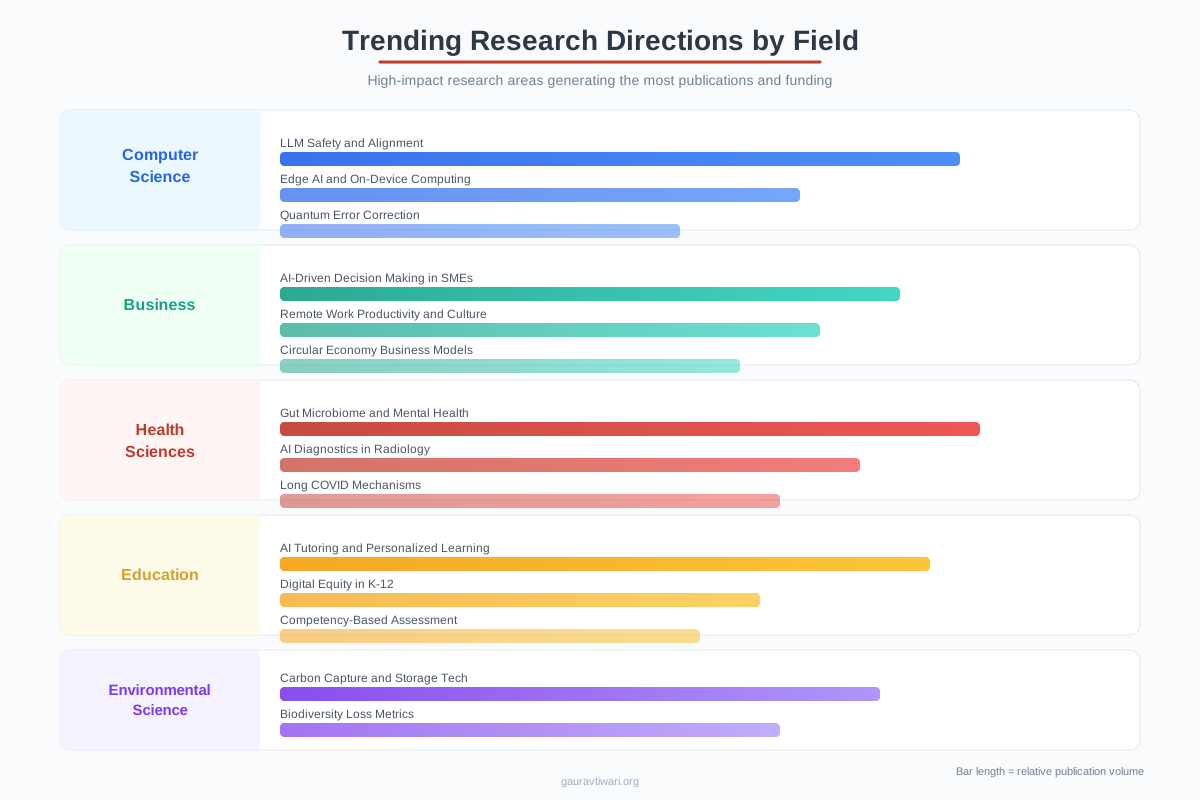
If you’re still stuck, here are research directions that are actively producing publishable results in 2026. These aren’t complete topics. They’re starting points for you to narrow based on your specific interests and available resources.
Computer Science and AI:
- Bias detection and mitigation in large language models (GPT-4, Claude, Gemini)
- Energy consumption and environmental impact of AI training at scale
- AI safety and alignment: preventing unintended behaviors in autonomous systems
- Multimodal AI: combining text, image, audio, and video understanding
- Privacy-preserving machine learning (federated learning, differential privacy)
Business and Economics:
- Impact of AI automation on employment in developing economies
- Creator economy: income sustainability and platform dependency
- Remote work’s long-term effects on organizational culture and innovation
- Subscription economy fatigue: consumer behavior when subscriptions accumulate
- ESG reporting: measuring actual impact vs greenwashing
Health Sciences:
- AI-assisted diagnostic accuracy compared to specialist physicians
- Long COVID: neurological impacts and recovery trajectories
- Mental health interventions delivered via mobile apps: efficacy meta-analysis
- Microbiome’s role in autoimmune disease development
- Health equity in telehealth: access disparities across socioeconomic groups
Education:
- AI tutoring effectiveness compared to human tutoring (Khanmigo, Duolingo Max)
- Micro-credentials and digital badges: employer perception and hiring impact
- Academic integrity in the age of AI: new frameworks beyond plagiarism detection
- Screen time and cognitive development: longitudinal studies in children
- Gamification in higher education: engagement vs learning outcomes
Environmental Science:
- Carbon capture technology: scalability analysis and cost projections
- Urban heat island mitigation strategies: comparative effectiveness
- Microplastics in drinking water: health impacts and filtration methods
- Biodiversity loss prediction models using satellite imagery and AI
- Renewable energy grid integration: storage solutions and reliability
For more ideas and detailed research paper inspiration, explore cross-disciplinary intersections. The most cited papers increasingly bridge multiple fields.
For every research idea, ask: “So what?” If you can’t articulate why someone outside your immediate subfield would care about the answer, the topic might be too narrow or too incremental. The best research answers questions that matter beyond academia: to policymakers, practitioners, or the public.
Adapt Your Approach and Stay Resilient
Research rarely goes as planned. Your initial hypothesis might be wrong. Your data might show unexpected patterns. A competing lab might publish something similar halfway through your project. These aren’t failures. They’re the normal research process.
How to handle common setbacks:
- If someone publishes your topic: Don’t panic. Read their paper carefully. Find what they missed, used different methods, or studied a different population. Your research can build on theirs rather than duplicate it
- If your data doesn’t support your hypothesis: Negative results are publishable and valuable. Journals like PLOS ONE and the Journal of Negative Results specifically welcome null findings. A well-designed study with unexpected results is still a contribution
- If your scope is too large: Narrow ruthlessly. A narrow, thorough study is always better than a broad, shallow one. Your advisor and committee will respect focused work
- If you lose interest: Talk to your advisor. It’s possible to pivot your angle without starting over. Sometimes a methodology change or a new data source can reignite your enthusiasm
The students who finish their research aren’t necessarily the smartest. They’re the most persistent. Set small milestones (100 words a day, one paper read per day, one analysis per week) and track your progress. Research paper writing services can help with specific components like statistical analysis or language editing if you hit a wall.
Using AI to discover topics, find papers, and organize notes is smart. Using AI to generate the actual content of your research paper is academic misconduct at most institutions and will be detected. AI detectors aren’t perfect, but your advisor will notice when your writing style suddenly changes. Use AI as a research assistant, not a ghostwriter.
Finding the right research paper idea is an iterative process. You won’t nail it on the first try, and that’s fine. Start broad, read widely, use AI tools to map the landscape, identify gaps, narrow your focus, and validate before committing. The process gets easier with each paper you write because you develop an intuition for where the interesting questions live.
Start today. Open Connected Papers or Semantic Scholar, type in a topic that genuinely interests you, and spend 30 minutes exploring. That first 30 minutes is always the hardest step. Everything after that is momentum.
Frequently Asked Questions
How do I find a research gap in my field?
Read the Limitations and Future Directions sections of the 10 most-cited recent papers in your area. Use Connected Papers to visualize the research landscape and spot underexplored clusters. Search for systematic reviews that explicitly identify gaps. Ask your advisor what questions the field is currently struggling with. Use Elicit or Consensus to ask specific questions and see where the evidence is thin or contradictory.
Can I use AI tools for my research paper?
Yes, for discovery and organization. Tools like Consensus, Elicit, Semantic Scholar, and Connected Papers are legitimate research aids. Using AI for literature search, data analysis, and reference management is accepted at most institutions. However, using AI to generate the actual text of your paper is considered academic misconduct at most universities. Always check your institution’s specific AI policy and disclose any AI tools used in your methodology section.
How narrow should my research topic be?
Narrow enough to be thoroughly investigated within your timeline and resources, but broad enough that the findings matter to others. A Master’s thesis should address one specific question with clear methodology. A PhD dissertation can be broader but should still have a focused central question with sub-questions. Test by explaining your topic in one sentence. If you can’t, it’s probably too broad.
What if my research idea has already been done?
This is more common than you think, and it’s not a dead end. You can: study the same topic in a different population or context, use a different methodology, extend the findings to a new application, replicate the study (replication is valuable), or combine it with another underexplored angle. Read the existing study carefully for gaps it acknowledges. Very few topics are truly exhausted.
How long does it take to find a good research topic?
Expect 2-6 weeks of focused exploration. The first week is broad reading (review papers, field surveys). The second week is gap identification (reading limitations sections, using AI tools). Weeks 3-4 are narrowing and validation (advisor feedback, feasibility checks, novelty verification). Some researchers find their topic in a flash of insight. Most find it through systematic exploration. AI research tools have compressed this timeline significantly compared to even 5 years ago.
What are the best free tools for academic research?
Google Scholar (paper discovery), Semantic Scholar (AI-powered search with TLDR summaries), Connected Papers (visual research mapping, 5 free graphs/month), Research Rabbit (paper recommendations), Zotero (reference management), Overleaf (LaTeX editing), Consensus (AI research Q&A, limited free searches), and Elicit (AI research assistant, free tier). Together, these cover discovery, organization, and writing at zero cost.
How do I know if my research topic is publishable?
A publishable topic addresses a clear gap in existing literature, uses appropriate methodology, and contributes something new (data, perspective, method, or application). Check by identifying 3-5 journals that have published similar work. Read their scope statements and recent issues. If your topic fits their scope and doesn’t duplicate recent publications, it’s likely publishable. Your advisor’s opinion on publishability is also invaluable since they know the field’s editorial landscape.
Disclaimer: This site is reader-supported. If you buy through some links, I may earn a small commission at no extra cost to you. I only recommend tools I trust and would use myself. Your support helps keep gauravtiwari.org free and focused on real-world advice. Thanks. - Gaurav Tiwari