
The Economy’s Impact on HR in 2026 (And How to Respond)
The economy's impact on HR in 2026: health benefit costs are rising 9.5% while salary budgets sit at 3.5%, and AI skills are now the hardest role to fill. Here are six economic forces reshaping HR and the response strategy for each.
 by
by

Seventy-two percent of employers worldwide reported difficulty finding qualified candidates in 2026, according to ManpowerGroup’s survey of 39,000 employers across 41 countries. That’s not a hiring problem. That’s the economy’s impact on HR, reshaping how every department plans, pays, and retains people.
Here’s the short version, so you can act on it before you finish reading. In a tough economy, HR’s job shifts from filling seats to defending budget, proving ROI, and keeping the people you already have. The factors below are uncontrollable. Your response to each one isn’t. Build the strategies now, before the next budget cycle forces your hand.
Verdict: The economy’s impact on HR in 2026 comes down to one tension: health benefit costs are rising 9.5% while salary budgets sit at 3.5%. If you lead HR in a tough economy, prioritize skills-based hiring, internal upskilling for AI-adjacent roles, and total-rewards clarity over chasing base-pay raises you can’t fund. The teams that plan for economic cycles outlast the ones that react to them.
I’ve watched HR leaders scramble when economic conditions shift. Some get caught off guard. Others thrive. The difference? Understanding how economic forces translate into tactical HR challenges and having strategies ready before you need them. This article breaks down the specific economic factors affecting HR in 2026 and gives you an actionable response for each.
Why the Economy’s Impact on HR Matters More Than Ever
Economic uncertainty is the defining challenge for Chief Human Resources Officers in 2026. Finance departments are scrutinizing HR budgets more closely than ever, demanding demonstrable, scalable impact from every investment. When money tightens, HR stops being treated as a cost center and starts being asked to prove it isn’t one.
Here’s what that looks like in practice:
- Employer health benefit costs are projected to rise 9.5% in 2026, per Aon, the third straight year near double digits and the steepest jump in 15 years (Mercer)
- Average salary budget increases are stuck around 3.5%, per WTW, Mercer, and PayScale, barely tracking inflation
- 91% of employers are already deploying mixed strategies to handle structural talent scarcity
- Many organizations are maintaining or reducing headcount under economic pressure, with U.S. tech alone announcing 123,653 job cuts in the first five months of 2026
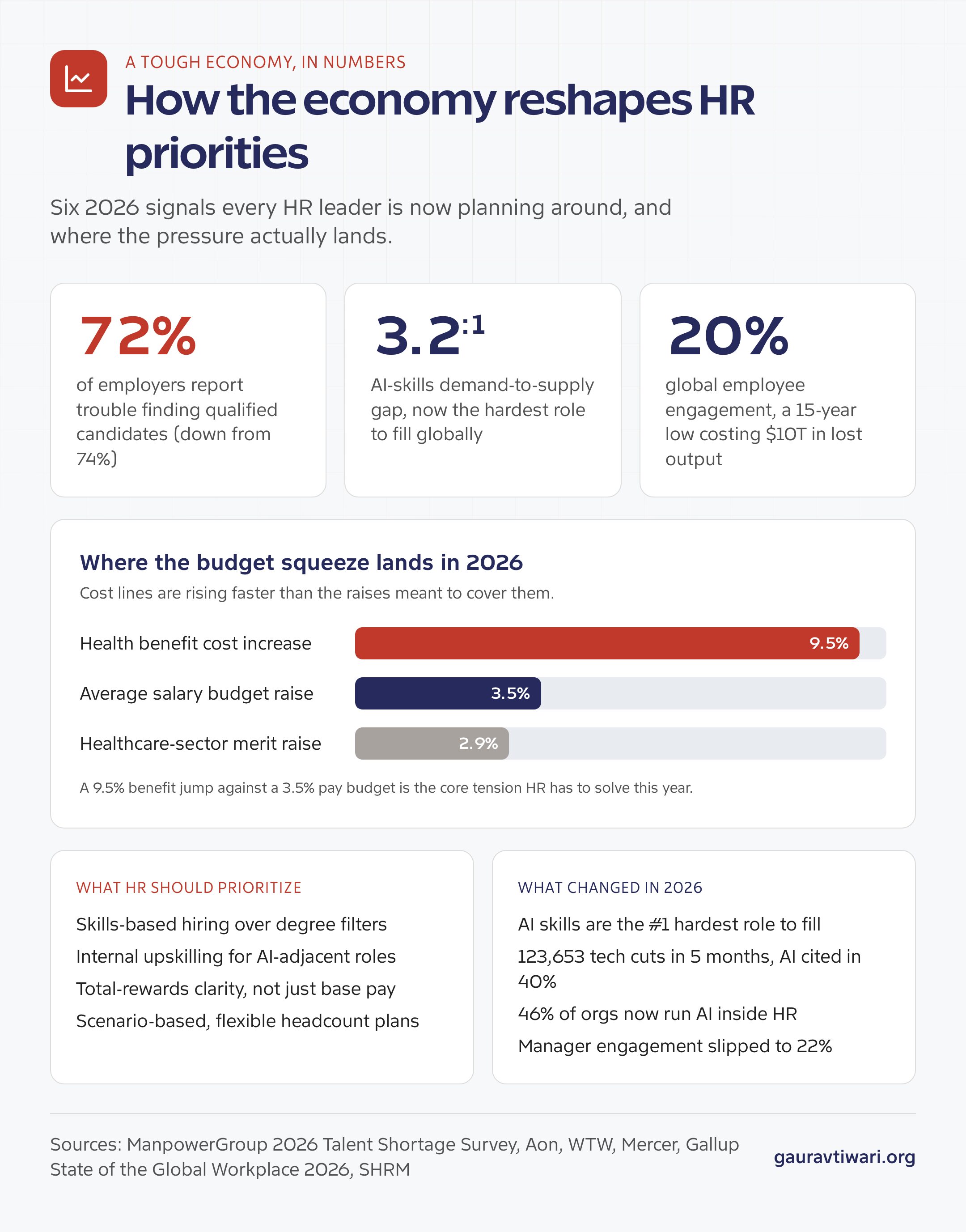
What changed in 2026: For the first time, AI skills are the single hardest capability for employers to find globally, overtaking traditional engineering and IT. Demand outstrips supply roughly 3.2 to 1, about 1.6 million open roles against 518,000 qualified candidates, and AI roles command salaries 67% higher than comparable software jobs. Meanwhile 46% of organizations now run AI inside HR itself, most often in recruiting. The economy’s impact on HR is now an AI story as much as a budget one.
The HR department that understood these forces five years ago looks very different from the one that ignored them. And the gap is widening. The four external factors affecting HR are economic, political and regulatory, social and cultural, and technological. Our focus here is the economic forces that directly hit your operations.
1. Workforce Demographics: The Talent Pool Is Shrinking
Here’s an uncomfortable truth: the workforce is aging faster than it’s being replaced.
Baby Boomers are retiring at an accelerating rate, outpacing the entry of younger qualified workers. By 2030, one in five Americans will be over 65. Birth rates are declining across most developed economies, and immigration patterns are shifting. The result? Management and professional positions are opening gaps that existing talent pools simply can’t fill.
What This Means for HR
The population is large. The qualified candidates are not.
I’ve seen HR managers celebrate the size of their applicant pool only to discover that maybe 5-10% meet basic qualifications. Large populations create an illusion of abundance. When you filter for education, experience, soft skills, and culture fit, the number shrinks fast.
Competition for qualified candidates is intense.
You’re not the only organization hunting skilled workers. The hardest-hit categories right now are AI and machine learning, healthcare, skilled trades, and cybersecurity. Construction needs nearly 500,000 additional workers by 2026, and AI talent demand keeps outpacing a thin supply. This is where leveraging AI and automation in your own operations buys back capacity you can’t hire for.
How to Respond
- Shift to skills-based hiring. Prioritize demonstrated capabilities over traditional degrees. The World Economic Forum projects 39% of core job-market skills will transform by 2030, so degrees become less predictive while skills assessments become more valuable.
- Build internal talent pipelines. Upskilling and reskilling programs aren’t optional anymore. They’re strategic imperatives for building a workforce you can’t find externally, especially for AI-adjacent roles.
- Expand your geographic reach. Remote and hybrid models let you tap talent pools beyond your local market. If qualified candidates won’t relocate, bring the work to them.
- Partner with educational institutions. Get involved earlier in the talent development cycle. Internships, apprenticeships, and university partnerships build relationships before candidates enter the competitive market.
2. Monetary Policy and Interest Rates: The Hidden HR Impact
Monetary policy sounds like something for the finance department to worry about. But it directly affects your ability to hire and retain talent.
When central banks adjust interest rates, the effects ripple through the entire economy. Higher rates typically mean tighter budgets, more cautious hiring, and pressure to demonstrate ROI on every HR initiative. That’s the economy’s impact on HR working through a channel most people never connect to the people function.
What This Means for HR
Budget scrutiny intensifies.
When money becomes more expensive to borrow, organizations look for places to cut costs. HR budgets often land under the microscope. Every benefit, every training program, every hire gets questioned.
Employment opportunities expand and contract.
Monetary policy influences job creation. Expansionary policies typically increase employment opportunities. Contractionary policies do the opposite. HR managers need to anticipate these cycles, not react to them.
How to Respond
- Build a data-driven case for HR investments. When finance asks for justification, have the numbers ready. Show retention rates, time-to-productivity, and training ROI. Make HR spending defensible.
- Create flexible hiring plans. Develop scenarios for different economic conditions. Know which positions are essential and which can wait if budgets tighten.
- Consider variable compensation structures. Performance bonuses and profit-sharing align pay with company performance. When times are good, employees benefit. When times are tight, fixed costs stay manageable.
3. Globalization: Managing a Borderless Workforce
The integration of global economies has fundamentally changed talent management. Your competitors for talent aren’t just local businesses anymore. They’re companies in other countries who can hire remotely.
Globalization creates four types of capital flow that affect HR: human capital, financial capital, resource capital, and influence capital. HR sits at the intersection of all four.
What This Means for HR
Competition is now global.
A remote-capable role can be filled by someone in another country. This cuts both ways. You can access broader talent pools, but you’re also competing with employers worldwide who might offer a different value proposition.
Workforce management becomes complex.
Different countries mean different labor laws, tax implications, benefit expectations, and cultural norms. Managing a multinational team requires expertise that didn’t exist a generation ago. It also raises the bar on the qualities great business managers need to lead people they may never meet in person.
Collaboration skills become essential.
Cross-cultural collaboration is now a core competency, not a nice-to-have. Teams spanning time zones and cultures need managers who can bridge those gaps. It’s a big part of the future of workplace collaboration that economic pressure is accelerating.
How to Respond
- Develop global hiring capabilities. Understand international employment regulations. Partner with Employer of Record (EOR) services if you’re not ready to set up legal entities abroad.
- Invest in cross-cultural training. Don’t assume collaboration happens naturally. Train managers on cultural differences in communication, feedback, and work norms.
- Standardize what can be standardized. Core values, performance expectations, and communication protocols should stay consistent. Benefits and working conditions may need local adaptation.
- Use technology for coordination. Async tools, project management platforms, and collaborative workspaces reduce the friction of distributed teams. When work scales past your team, outsourcing for business growth can fill gaps without permanent headcount.
4. Employment Market Conditions: HR in a Tough Economy
The employment market functions like any market. Supply and demand fluctuate. Prices, meaning salaries, adjust accordingly.
In 2026, the balance is still tilted toward candidates in skilled fields. 72% of employers globally struggle to find competent candidates, down only slightly from 74% a year earlier. Running HR in a tough economy means accepting that the talent shortage isn’t easing in the roles you most need.
What This Means for HR
Candidates have leverage in many industries.
When qualified candidates are scarce, they get selective. Salary expectations rise. Benefit demands increase. Time-to-hire stretches as candidates weigh multiple offers.
Some markets are tighter than others.
AI and machine learning, healthcare, cybersecurity, engineering, and construction face the most acute shortages. If you’re hiring in these fields, you’re competing for candidates who have multiple options.
Three factors determine hiring difficulty:
- Work profile requirements – qualifications, experience, and abilities needed
- Geographic factors – willingness to relocate or commute
- Competitor landscape – who else is chasing the same candidates
How to Respond
- Audit your employer brand. What do candidates hear about your organization? Are you positioned competitively for the talent you need?
- Speed up your hiring process. In competitive markets, slow processes lose candidates. Find the bottlenecks and remove them. A purpose-built applicant tracking system like Recruit CRM is what I’d reach for to cut time-to-hire when you’re chasing scarce candidates.
- Get creative with sourcing. Traditional job boards may not reach passive candidates. Employee referrals, industry events, and targeted outreach often work better.
- Consider flexible workforce models. Contractors, consultants, and contingent workers can fill gaps while you search for permanent hires. 91% of employers anticipate needing flexible workforce strategies in 2026.
5. National Income and Per Capita Earnings: Setting Competitive Compensation
National income sets the baseline for what employees expect to earn. Per capita income varies dramatically between countries, between regions, and even between cities.
This creates complexity when setting compensation. What’s competitive in one market may be inadequate in another.
What This Means for HR
Geographic pay differences are significant.
An engineer in San Francisco expects a different salary than an engineer in Austin. Both expect more than an engineer in Bangalore. These aren’t arbitrary differences. They reflect cost of living, local market rates, and economic conditions.
Currency fluctuations add complexity.
For organizations operating internationally, currency values affect the real cost of compensation and the purchasing power employees receive.
Government regulations set minimums.
Minimum wage laws, mandatory benefits, and labor regulations vary by jurisdiction. Compliance isn’t optional, even when those requirements raise your costs.
How to Respond
- Implement location-based pay structures. Develop compensation bands that reflect local market conditions while keeping internal equity intact.
- Use reliable market data. Compensation decisions should be informed by current salary surveys, not outdated benchmarks. Markets move quickly.
- Consider total compensation, not just salary. Benefits, flexibility, growth opportunities, and work environment all shape what employees value. Sometimes non-monetary factors close the gap when salary can’t.
- Stay current on regulatory changes. Pay transparency laws are spreading fast. Minimum wage increases keep happening at state and local levels. Know what’s coming before it arrives.
6. Inflation: The Hidden Tax on Your Workforce
Inflation erodes purchasing power. What employees could buy with their salary last year costs more this year. If salaries don’t keep pace, employees effectively take a pay cut.
In 2026, salary budget increases are averaging around 3.5%, roughly tracking inflation but trailing the 9.5% rise in health benefit costs. Employee expectations often exceed what organizations can afford, and that gap is where retention problems start.
What This Means for HR
Employees expect inflation-adjusted raises.
Workers paying more for housing, groceries, healthcare, and transportation expect compensation to reflect it. An employee earning $80,000 in 2023 might reasonably expect $88,000 to $90,000 in 2026 just to hold the same standard of living.
Cost of living varies by location.
Inflation doesn’t hit uniformly. Some cities see steeper price increases than others. Employees in high-cost areas feel the squeeze more acutely.
Retention pressure increases.
When compensation doesn’t keep pace, employees look elsewhere. Turnover costs typically run 50% to 200% of annual salary, depending on the role. That pressure compounds a harder problem: global employee engagement fell to 20% in 2025, a 15-year low Gallup ties to roughly $10 trillion in lost productivity.
How to Respond
- Communicate total rewards clearly. Employees often undervalue the benefits they receive. Make sure they understand the full value of their package, especially as benefit costs climb.
- Consider more frequent pay reviews. Annual raises may not keep pace with fast-moving conditions. Semi-annual or quarterly adjustments, even if smaller, can help retention.
- Implement structured compensation plans. Some organizations adopt automatic cost-of-living adjustments (COLA) tied to indices like the Consumer Price Index.
- Balance fixed and variable compensation. Performance bonuses, profit-sharing, and equity provide upside without permanently raising fixed costs.
What HR Should Prioritize in a Downturn
The HR department handling “the people” is the backbone of any organization. But that backbone needs to be flexible, not brittle. When you’re running HR in a tough economy, focus beats breadth. Here’s the order I’d work in.
- Protect retention before recruitment. With engagement at a 15-year low and turnover costing up to 200% of salary, keeping a good employee is cheaper than replacing one. Start with total-rewards clarity and manager support.
- Reskill for AI-adjacent work. AI skills are the hardest to hire and the most expensive. Build them internally instead of bidding for the 518,000 candidates everyone else wants.
- Defend the budget with data. When finance questions HR spend, bring retention rates, time-to-productivity, and training ROI. Make every line defensible.
- Flex the workforce, don’t freeze it. Contractors and contingent workers cover scarce roles without locking in fixed cost while budgets are uncertain.
- Equip managers to champion change. Manager engagement slipped to 22%, and managers are the strongest predictor of whether teams adopt AI. Fix that layer first.
Economic factors are uncontrollable. Your response to them isn’t. Build the HR department that thrives regardless of conditions.
Key Takeaways
The economy’s impact on HR is uncontrollable. Your response to it isn’t. Build these strategies now, before you need them.
| Economic Factor | HR Impact | Response Strategy |
|---|---|---|
| Workforce demographics | Shrinking qualified talent pool | Skills-based hiring, internal development |
| Monetary policy | Budget scrutiny, hiring freezes | Data-driven justification, flexible plans |
| Globalization | Global competition for talent | Remote capabilities, cross-cultural training |
| Employment conditions | Candidate leverage, longer time-to-hire | Employer branding, faster ATS-driven hiring |
| National income | Geographic pay expectations | Location-based compensation bands |
| Inflation | Erosion of purchasing power | Total rewards communication, COLA |
| AI skills shortage | #1 hardest role, 67% pay premium | Internal reskilling, AI in recruiting |
FAQs
How does the economy affect HR recruitment?
The economy’s impact on HR recruitment shows up in several ways. During downturns, organizations freeze hiring or cut headcount, while tight markets for skilled roles give candidates leverage and push salary expectations up. Inflation pressures compensation competitiveness, monetary policy affects budget availability, and globalization both widens talent pools and adds international competition. In 2026, 72% of employers worldwide report difficulty finding qualified candidates, and AI skills are now the single hardest capability to hire.
What are the main economic factors that influence HR management?
The main economic factors influencing HR management are workforce demographics and talent availability, monetary policy and interest rates, globalization and international competition, employment market conditions (supply and demand), national income and regional earning expectations, and inflation. Each one directly shapes hiring strategy, compensation planning, and workforce decisions.
How should HR adjust salary strategies during high inflation?
During high inflation, HR should run more frequent compensation reviews (semi-annual instead of annual), communicate total rewards clearly so employees grasp their full package value, consider automatic cost-of-living adjustments tied to indices like CPI, balance fixed salary with variable pay like bonuses and profit-sharing, and lean on non-monetary benefits. This matters more in 2026 because salary budgets sit near 3.5% while employer health benefit costs are rising about 9.5%.
Why is skills-based hiring important for HR in a tough economy?
Skills-based hiring prioritizes demonstrated capability over credentials like degrees. It matters for HR in a tough economy because the World Economic Forum projects 39% of core job-market skills will transform by 2030, making degrees less predictive of performance. With talent shortages across AI, healthcare, and skilled trades, focusing on what candidates can actually do widens the qualified pool and helps fill roles faster, without bidding up salaries you can’t fund.
How is AI changing HR in 2026?
AI is reshaping HR from both sides. As a skill, AI talent is now the hardest role to fill, with demand outpacing supply roughly 3.2 to 1 and salaries 67% above comparable software jobs. As a tool, 46% of organizations now use AI inside HR, most often in recruiting. AI is also cited in a rising share of layoffs, with U.S. tech announcing 123,653 job cuts in the first five months of 2026, so HR has to manage both adoption and displacement at once.
What industries face the worst talent shortages?
The industries facing the most acute shortages in 2026 include AI and machine learning, healthcare and life sciences, cybersecurity, technology and IT, and skilled trades. Construction alone needs nearly 500,000 additional workers. These shortages are driven by demographic shifts, rapid AI advancement, and evolving skill requirements that outpace workforce development.
Tell Google you want more of this.
Add Gaurav Tiwari as a preferred sourceOne tap, and this site shows up more often in your own Top Stories, AI Overviews and AI Mode. Remove it any time.