by
by
Chegg Study is no longer the automatic answer to every homework problem. Its advantage is narrower now: textbook-specific solutions, math steps, writing checks, and a question allowance inside one subscription. General-purpose AI tools are faster and more flexible for many explanations, but they do not consistently match the method used in a specific assigned textbook.
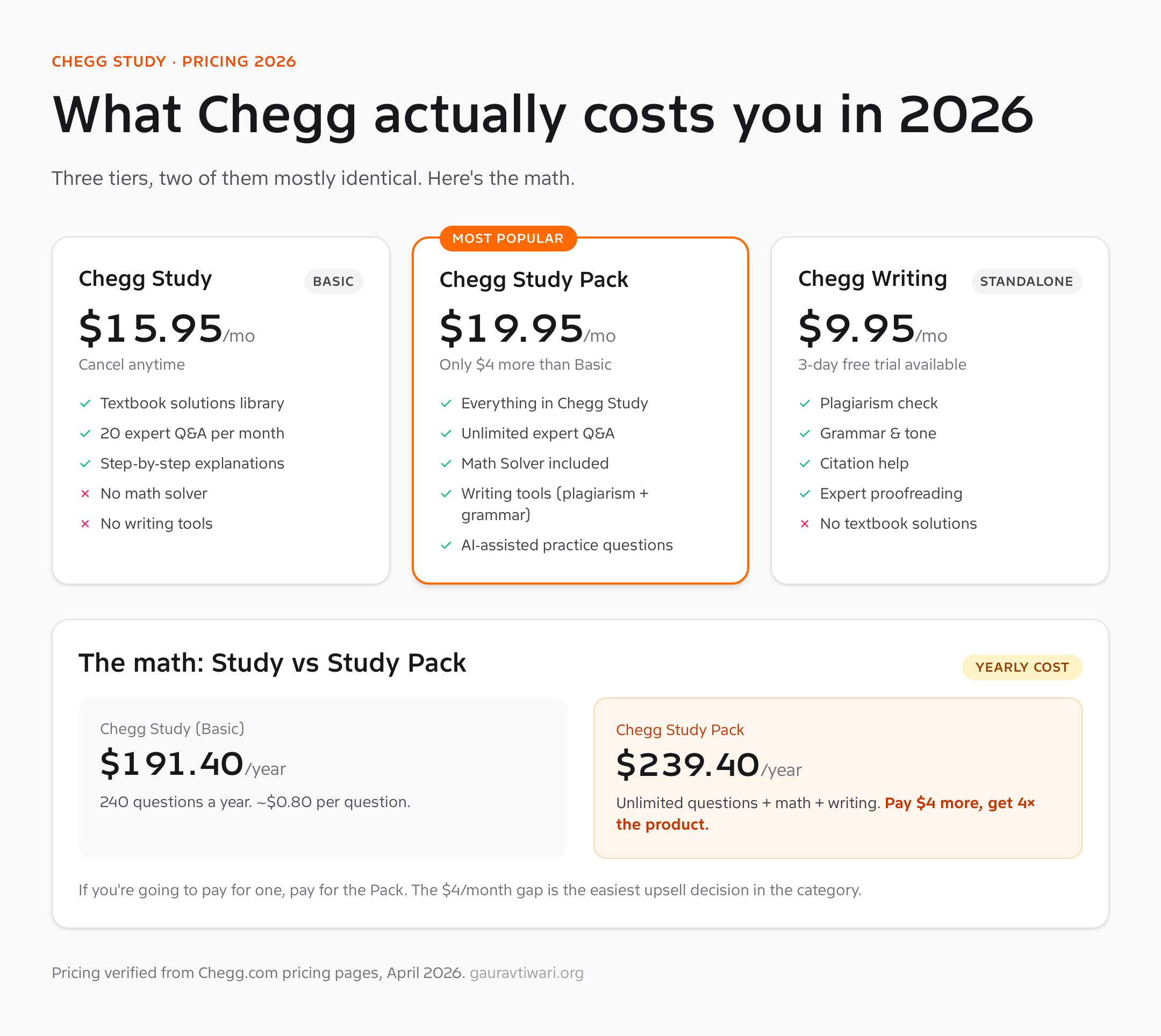
Chegg Study costs $15.95 a month for textbook answers and step-by-step solutions, and Chegg Study Pack costs $19.95 a month with the Math Solver and writing tools added. The Pack caps expert questions at 20 a month, and that limit changes the value calculation more than the $4 gap does.
Verdict: Chegg Study Pack is worth considering for a US undergraduate who works from standard assigned textbooks every week and will use the Math Solver, citations, plagiarism checks, and proofreading. Skip it if you mainly need broad explanations, study outside Chegg’s strongest textbook catalog, or already pay for a flexible AI assistant.
Rating: 3.6/5. The textbook library is still useful, but the 20-question limit, recurring price, uneven subject coverage, and academic-integrity risk keep this from being a universal student recommendation.
What Chegg Study Does
Chegg Study combines step-by-step explanations, textbook solutions, homework Q&A, and math support. Chegg says its wider library contains more than 100 million solutions, while Study Pack specifically advertises access to 6+ million textbook solutions. Coverage varies by title and subject, so check your course book before subscribing.
The AI layer helps Chegg organize answers and study support, but the defensible reason to pay is still the textbook catalog. Use the service to understand a method and check your work, not to submit an answer you cannot explain.
How Much Does Chegg Study Cost per Month?
Chegg Study costs $15.95 per month and Chegg Study Pack costs $19.95 per month, which is about $191 or $239 a year if you keep a plan for 12 months. Both include Chegg’s textbook answers; the difference is what’s bundled on top, and the limits matter more than the $4 gap:
- Chegg Study: $15.95/month for the core study experience and textbook solutions.
- Chegg Study Pack: $19.95/month with 6+ million textbook solutions, up to 20 questions a month, Math Solver, citations, plagiarism and grammar checks, and expert proofreading within 48 hours.
- Chegg Writing: $9.95/month as a separate writing-focused subscription where available.
- Important limit: Chegg’s current Study Pack page says up to 20 questions a month. Do not subscribe on the assumption that expert Q&A is unlimited.
Study Pack is the better bundle only if you will use the math and writing tools. Paying $4 more to unlock features you do not need is not value. Check the current checkout page because product packaging and regional availability can change.
What’s Good About Chegg Study
The textbook solution library is the part Chegg has always been best at and it’s still the strongest part of the product. If you’re working through a problem set in Stewart’s Calculus, Halliday’s Fundamentals of Physics, or any of the standard CS textbooks, you’ll find every exercise with a step-by-step solution. Many textbook solutions are tied to Chegg’s structured catalog, but you should still verify the method and result against your course material. ChatGPT can solve the problems but it cannot reliably point you at the canonical solution that matches your professor’s expected method.
The expert Q&A on the Pack tier is also genuinely useful when you’ve hit a wall. You upload a photo of the problem, response time varies by subject and question, and the answer comes back with the working shown. For obscure problems where the solution isn’t already in the textbook library, this is the differentiator. ChatGPT cannot tell you that your professor uses a slightly non-standard convention for the Lagrangian and your answer needs to be in those terms; a Chegg expert can.
Chegg now uses AI to help route and organize study support, but I would not choose it for a model picker. The useful distinction is between answers anchored to Chegg’s solution library and general AI explanations that may be fluent without matching your course method.
What’s Broken About Chegg Study
The bot detection is aggressive enough to be a usability problem. Chegg puts PerimeterX challenges in front of its pages, and they catch more than scrapers: students on shared campus IPs, VPNs or anything that looks slightly non-standard hit them too. If you’re on a university VPN you’ll probably hit a press-and-hold challenge before you can ask a question.
The Honor Code situation hasn’t gone away. Chegg cooperates with universities on academic integrity investigations and accounts get suspended for violations. The fundamental tension is unresolved and will probably stay that way: students use Chegg to study, some students use it to cheat, and professors and TAs use it to detect cheating. If you’re at a school that’s strict about Chegg use during exams, having an account on file is a real risk vector when the institution requests records.
The 20-question monthly cap is the worst part of the pricing structure. By the time you’ve asked your 20th question of the month it’s the 18th and you have a final next week. Hitting the cap and having to stop asking questions until the next billing cycle is the kind of friction that costs Chegg goodwill it can’t afford right now.
Subscription cancellation is intentionally annoying. The flow buries the cancel option behind multiple confirmation steps and offers retention discounts that don’t apply to your account once you cancel. This isn’t unique to Chegg, but it’s particularly frustrating when the parent decision is “I graduated and don’t need this anymore.”
What the AI Layer Changes
Chegg describes its newer system as a source-agnostic orchestrator that can combine its own educational content with large language models. That is useful when the answer is grounded in a textbook solution or subject resource. It does not remove the need to verify an answer, and Chegg’s own terms do not guarantee that every response is accurate or complete.
Treat AI output as a starting point: compare the method with your course material, reproduce the steps yourself, and ask your instructor when the convention matters.
What Should Be Better
Chegg needs a proper full-access trial. Limited samples do not show whether the textbook coverage, question allowance, and writing tools match a student’s actual courses. A short Pack trial would make the subscription decision easier.
The Honor Code position needs clarification. The current language is vague enough that legitimate study uses (working through assigned textbook problems, checking your work against the official solution) sit uncomfortably close to the prohibited cheating uses (looking up an answer during a closed-book exam). A clearer policy with examples, even a self-classification quiz, would help students use the product without anxiety.
Chegg should make the source of each answer clearer. A student needs to know whether a response came from a textbook solution, an expert, or generated assistance because those sources deserve different levels of trust.
Best Chegg Study Alternatives
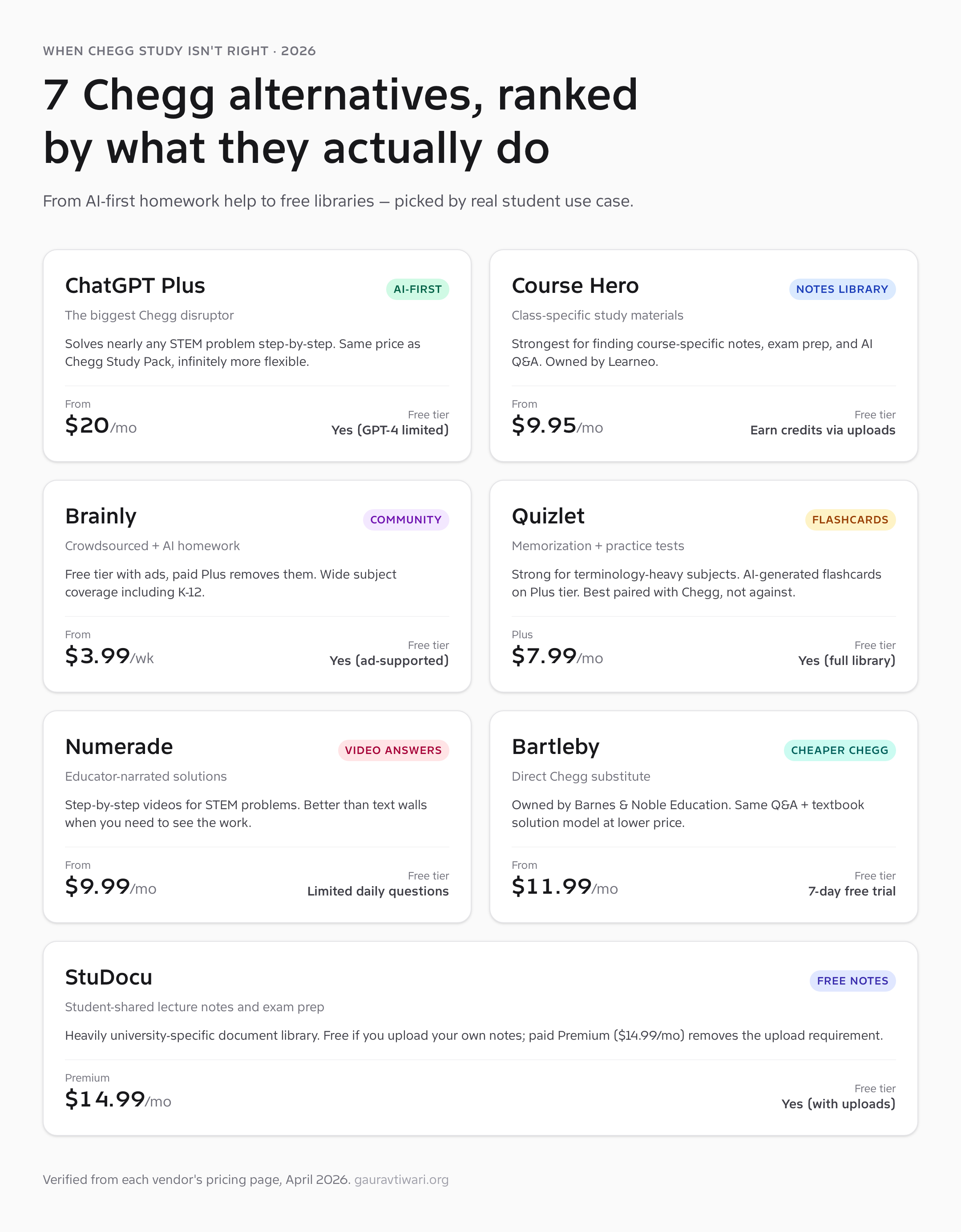
The Chegg-vs-ChatGPT comparison gets most of the attention, but it’s not actually the only fight that matters. Different students need different things, such as flashcards, lecture notes, video walkthroughs or expert tutoring, and Chegg is mediocre at most of those individually. Here’s what I’d reach for instead, broken out by use case.
ChatGPT Plus
What’s good: Same $20/month price point as Chegg Study Pack. Solves nearly any STEM problem step-by-step, writes essays at a level that needs human editing but is genuinely useful as a draft, handles code, and works across mobile and desktop. The voice feature on the iOS app is a legitimate study aid for verbal subjects.
What’s broken: No textbook solution library. ChatGPT will solve a calculus problem correctly but it won’t tell you which method your professor’s textbook expects you to use. For closed-curriculum classes (most engineering and pre-med courses), this is a real gap. Hallucination on edge cases is also still real, especially for graduate-level proofs.
Pick this if: You’re a self-directed learner who’s good at sanity-checking answers and you don’t depend on textbook-exact solutions. See my breakdown of the best ChatGPT alternatives for what to compare it against.
Course Hero
What’s good: Course Hero‘s strength is class-specific study materials: old exams, lecture notes, and study guides shared by students at your university. The AI Q&A feature was added in 2024 and is competitive with Chegg’s. Pricing starts at $9.95/month annual, which undercuts Chegg’s basic tier.
What’s broken: Quality varies wildly. Some uploads are professor-grade prep materials; others are typo-ridden notes from someone who failed the class. The free tier requires you to upload your own course material to earn credits to view others, which is a chicken-and-egg problem on day one of the semester.
Pick this if: You’re at a major US university where other students have already uploaded notes for your specific class. Owned by Learneo, the same parent as several other study-tools brands.
Brainly
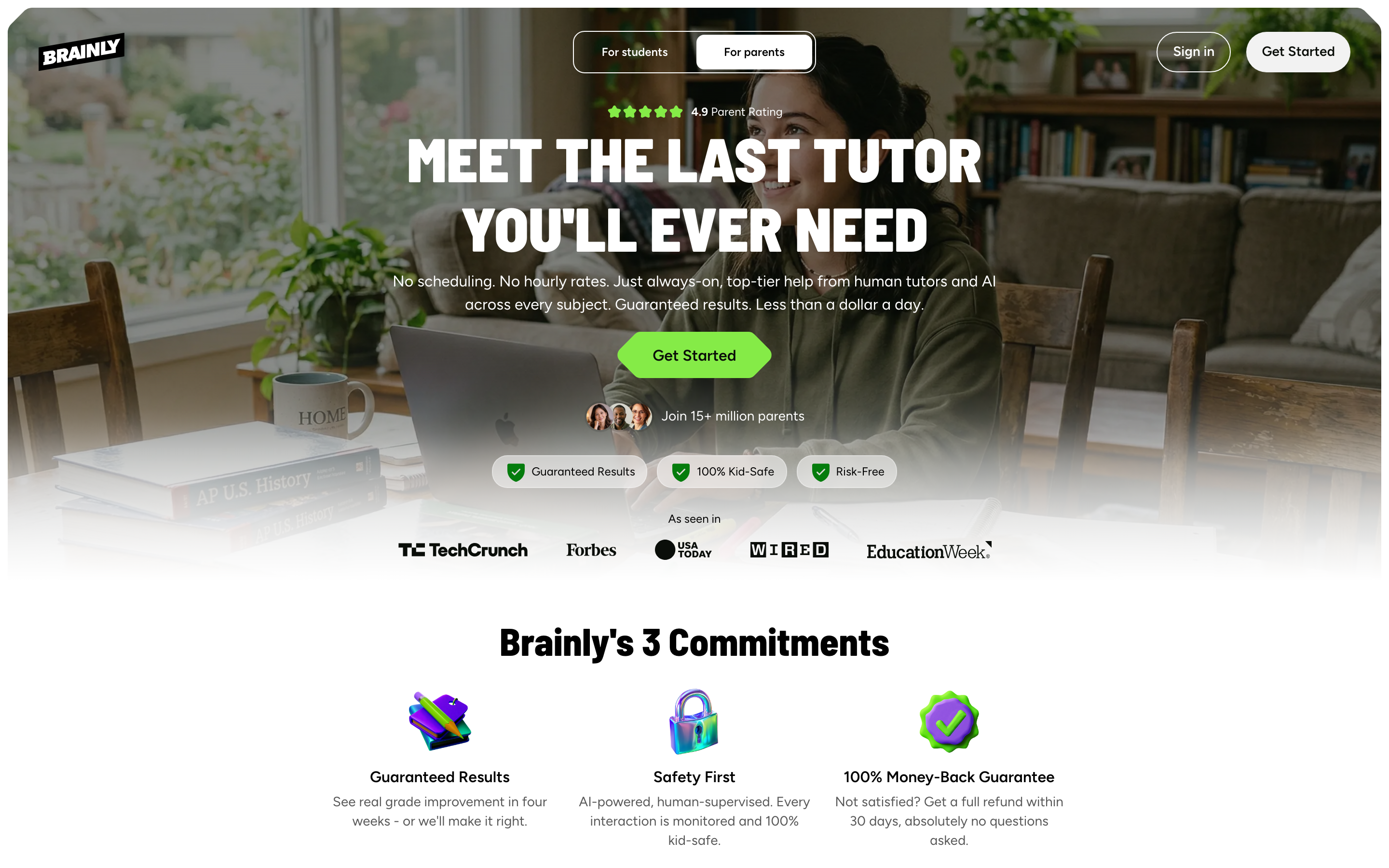
What’s good: Free tier with ads is genuinely usable. Wide subject coverage including K-12 levels Chegg doesn’t really serve. AI-generated answers were added in 2024 and supplement the human-volunteer answers that historically defined the platform. Brainly Plus removes ads at $3.99/week.
What’s broken: Answer quality on the free tier is genuinely mixed: community contributors aren’t subject-matter experts, and some “answers” are wrong in ways that won’t be obvious to a student who needed help in the first place. The AI summaries help but they’re not authoritative.
Pick this if: You’re a high-schooler or undergraduate on a tight budget, you’re using it as one source among several, and you’re sanity-checking answers before submitting them.
Quizlet
What’s good: Industry-standard for flashcard-based study. AI-generated flashcards on Plus tier ($7.99/month) turn any document into a deck. Practice tests, learn mode, and the spaced-repetition logic are well-tuned for terminology-heavy subjects (medicine, law, languages).
What’s broken: Different product entirely from Chegg: Quizlet doesn’t solve problems, it tests recall. If you don’t know the material, Quizlet won’t teach you; it’ll just quiz you on what you already know.
Pick this if: Memorization is the bottleneck (anatomy, vocabulary, chemistry equations). Best paired with Chegg or ChatGPT, not used instead of them. See also AI-designed flashcards for the broader space.
Numerade
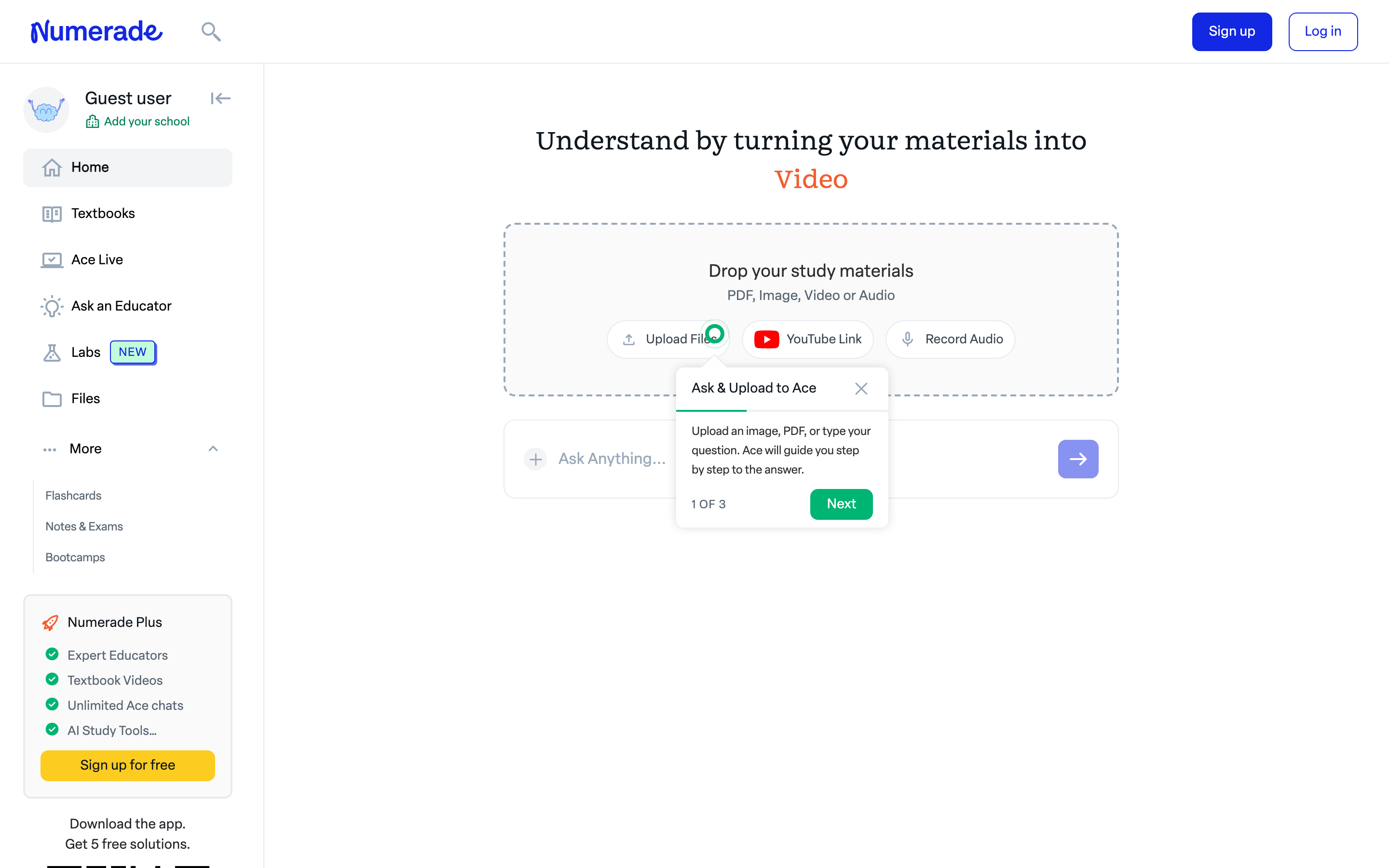
What’s good: Educator-narrated video walkthroughs of problem solutions. For visual learners and anyone who’s tired of reading dense text explanations, watching the solver work through the problem step-by-step is genuinely better. Pricing starts at $9.99/month and the free tier offers a few questions per day.
What’s broken: Library coverage is narrower than Chegg’s: heavy on calculus, physics, chemistry, and lighter on social sciences and humanities. If your homework lives outside STEM, the value drops fast.
Pick this if: You’re in a STEM major and you learn faster from video than from text walls. Numerade‘s video format is rare in this category and worth paying for if it matches your learning style.
Bartleby
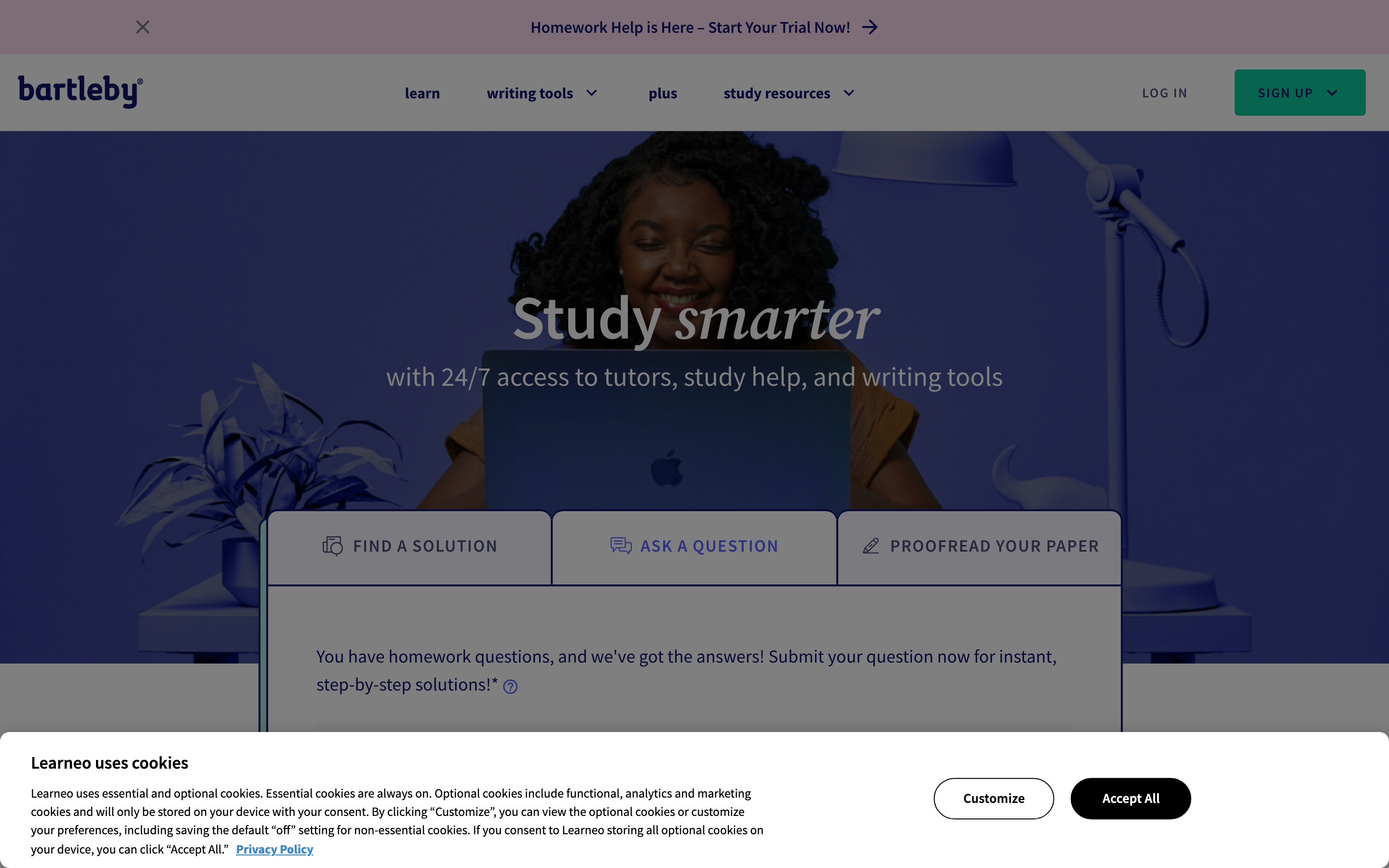
What’s good: Owned by Barnes & Noble Education, so the textbook integration is real and the publisher relationships are legitimate. The model is the same as Chegg’s (Q&A library, textbook solutions and writing tools) at $11.99/month, which is roughly 25% less than Chegg’s bundle. 7-day free trial.
What’s broken: The library is smaller than Chegg’s, and response times vary by subject. The product is better suited to students who already know they need this particular catalog.
Pick this if: You want the Chegg model but Chegg’s pricing is the dealbreaker. Try the Bartleby free trial first to see if the smaller library covers your textbooks.
StuDocu
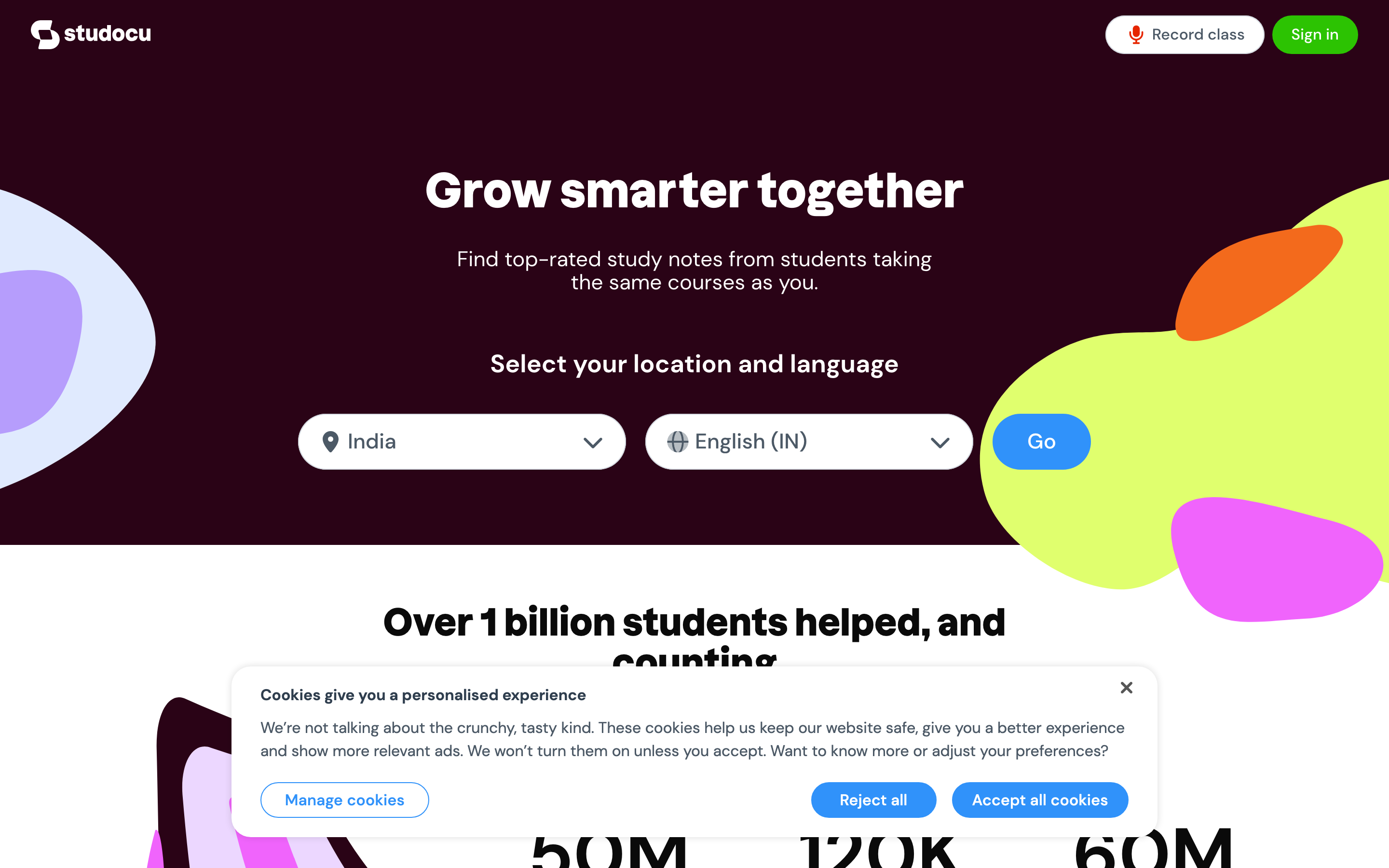
What’s good: Heavily university-specific document library. Lecture notes, exam prep and summaries are uploaded by students at your school. Free tier is genuinely free if you upload your own notes (the upload-to-unlock model). Premium at $14.99/month removes the upload requirement.
What’s broken: Same quality variance problem as Course Hero: some uploads are gold, some are illegible PDFs from someone’s iPhone. The platform’s strength is breadth (lots of universities and courses), not depth (rigorous quality control).
Pick this if: You’re at a European or Indian university where Chegg’s library coverage is weaker. StuDocu has stronger non-US presence than any other alternative on this list.
For a deeper comparison of the entire Chegg-alternatives space, see my full best Chegg alternatives roundup.
Who Should Pay for Chegg Study
Chegg Study Pack is genuinely the right answer for a specific student profile in 2026: undergraduate STEM major, taking 4-5 courses with assigned textbooks from the major US publishers, regularly hits problems that need an expert to verify the answer, and values having textbook-exact step-by-step walkthroughs more than open-ended explanation.
If that’s you, sign up for the Chegg Study Pack at $19.95/month. Skip the Basic tier. The Pack is the version of the product Chegg actually wants you to be on, and it’s priced like Chegg knows that. Use the Math Solver and the Writing tools: they’re the parts of the bundle that punch above their weight.
If you’re a humanities student, a non-traditional learner, a graduate student working on original material, a high schooler on a budget, or someone who already pays for ChatGPT Plus and wants supplementary tools, one of the alternatives above fits better. The textbook solution library that defines Chegg’s value proposition just doesn’t apply to you. Save the $240/year and put it toward a tool that actually fits your workflow.
Related Study Resources
If you’re rethinking your study tooling more broadly, these adjacent guides cover the rest of the stack: active recall study techniques (the foundation that makes any study tool work), apps for virtual study groups, the peer-to-peer tutoring platforms roundup for when AI isn’t enough, and the digital pen tablets guide if you’re moving to a fully digital workflow.
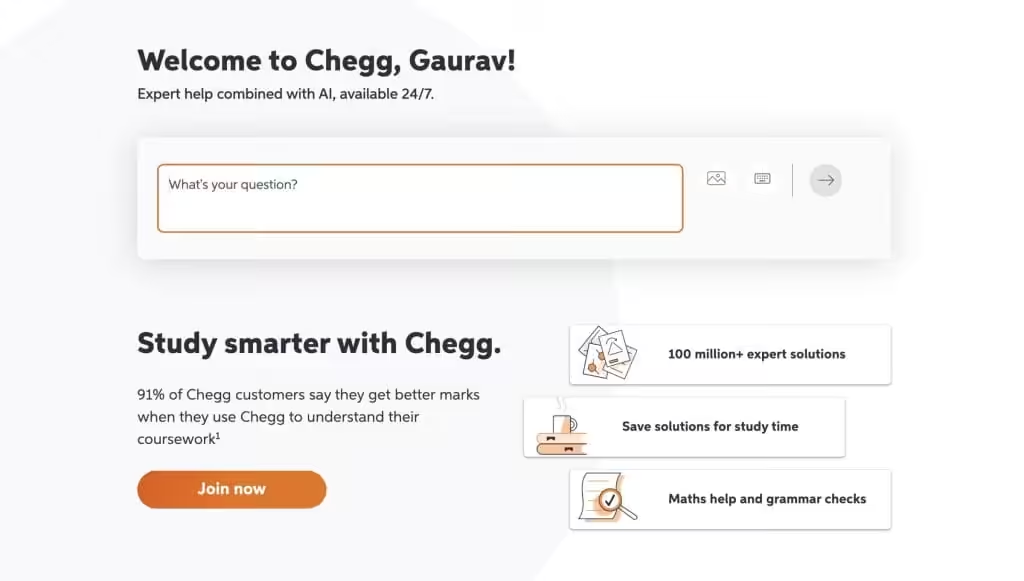
Chegg Study Pack
Pros
- Large textbook-solution library
- Math and writing tools in one plan
- Up to 20 questions per month
- Useful for textbook-assigned STEM work
Cons
- Questions are capped at 20 per month
- Monthly subscription adds up quickly
- Coverage varies by textbook and subject
- Must be used within academic-integrity rules
Summary
Chegg Study Pack is useful for students who regularly need textbook-specific solutions, math steps, citations, plagiarism checks, and expert proofreading in one subscription. The current Pack caps questions at 20 per month. It costs $19.95 per month, so it is poor value when a student mainly needs general explanations that a flexible AI assistant can provide.
Price: USD 19.95 /month
See Chegg Study PackHow much does Chegg Study cost per month?
Chegg Study costs $15.95 per month for textbook answers and step-by-step solutions, and Chegg Study Pack costs $19.95 per month with the Math Solver and writing tools added. Kept for a full year, that’s about $191 or $239.
Does Chegg Study Pack include unlimited questions?
No. Chegg’s current Study Pack page advertises up to 20 questions per month.
Is Chegg Study Pack worth it?
It can be worth it for students who regularly use assigned textbooks and will also use the Math Solver and writing tools. It is poor value for general explanations that a flexible AI assistant can handle.
How many textbook solutions are in Chegg Study Pack?
Chegg advertises 6+ million textbook solutions in Study Pack, while its wider study platform refers to more than 100 million solutions and explanations.
Can I use Chegg for exams?
Use Chegg only within your institution’s academic-integrity rules. It should help you understand and verify work, not complete a closed assessment for you.
Is Chegg better than ChatGPT for homework?
Chegg is stronger when you need a solution tied to a specific assigned textbook. ChatGPT is more flexible for general explanations, code, and open-ended questions, but every generated answer still needs verification.
Does Chegg Study have a free trial?
Not a standing one. Chegg doesn’t advertise a general free trial for Chegg Study, and promotional trials show up only occasionally. Check the checkout page before subscribing, and cancel before any trial converts to the monthly charge.
Tell Google you want more of this.
Add Gaurav Tiwari as a preferred sourceOne tap, and this site shows up more often in your own Top Stories, AI Overviews and AI Mode. Remove it any time.
Disclaimer: This site is reader-supported. If you buy through some links, I may earn a small commission at no extra cost to you. I only recommend tools I trust and would use myself. Your support helps keep gauravtiwari.org free and focused on real-world advice. Thanks. - Gaurav Tiwari