
 by
by
Buying Instagram likes solves the easiest problem to see and ignores the harder one underneath. The number rises, but watch time, saves, sends, profile visits, qualified followers, leads, and sales do not rise with it. That is why my answer is still no: do not buy likes for an account you care about.
This is not a moral lecture about taking shortcuts. It is a measurement problem and a platform-risk problem. Once fake actions are mixed into real results, you can no longer tell which post, hook, offer, or audience actually worked. You paid to make your own analytics less useful.
What the evidence supports: Meta calls services that artificially inflate Instagram likes and followers “fake engagement.” Meta’s fake-engagement lawsuits targeted providers in October 2020, and a Spanish court separately found that an automation service distributing fake Instagram likes and comments violated Instagram’s terms. Meta says enforcement can include warnings, temporary restrictions, down-ranking, or removal.
1. You are buying a count, not attention
The attraction is obvious. A post with 1,000 likes appears more popular than one with 20. Social proof can influence how people evaluate a creator, product, or idea. The mistake is assuming the visible count caused the underlying interest.
A real person can watch, save, send, comment, visit your profile, follow, join a list, or buy. A purchased like guarantees none of those actions. It is closer to adding a number to a dashboard than adding a person to an audience.
If you want broader context before judging any single metric, use the Instagram statistics you need to know as a reference point. The useful question is always the denominator: likes per reached account, sends per reached account, profile visits per reached account, and sales per qualified visitor.
2. The distortion is easy to calculate
Take a simple diagnostic model. A post reaches 100 real people, earns 8 real likes, and produces 12 deeper actions: 3 saves, 4 sends, and 5 profile visits. It has 0.67 visible likes for each deeper action. Now add 500 purchased likes while the deeper actions stay at 12.
- Visible likes: 508
- Purchased share of the like count: 98.4%
- Deeper actions: still 12
- Likes per deeper action: 42.33
- Distortion: 63.5 times the original ratio
This is an illustrative model, not a claim that Instagram uses that exact ratio as a penalty threshold. It shows the business problem: the surface metric jumps 6,250%, while the behaviors that can create reach or revenue do not move. Any brand manager or analyst comparing likes with saves, sends, comments, profile visits, and follower quality can spot the mismatch.
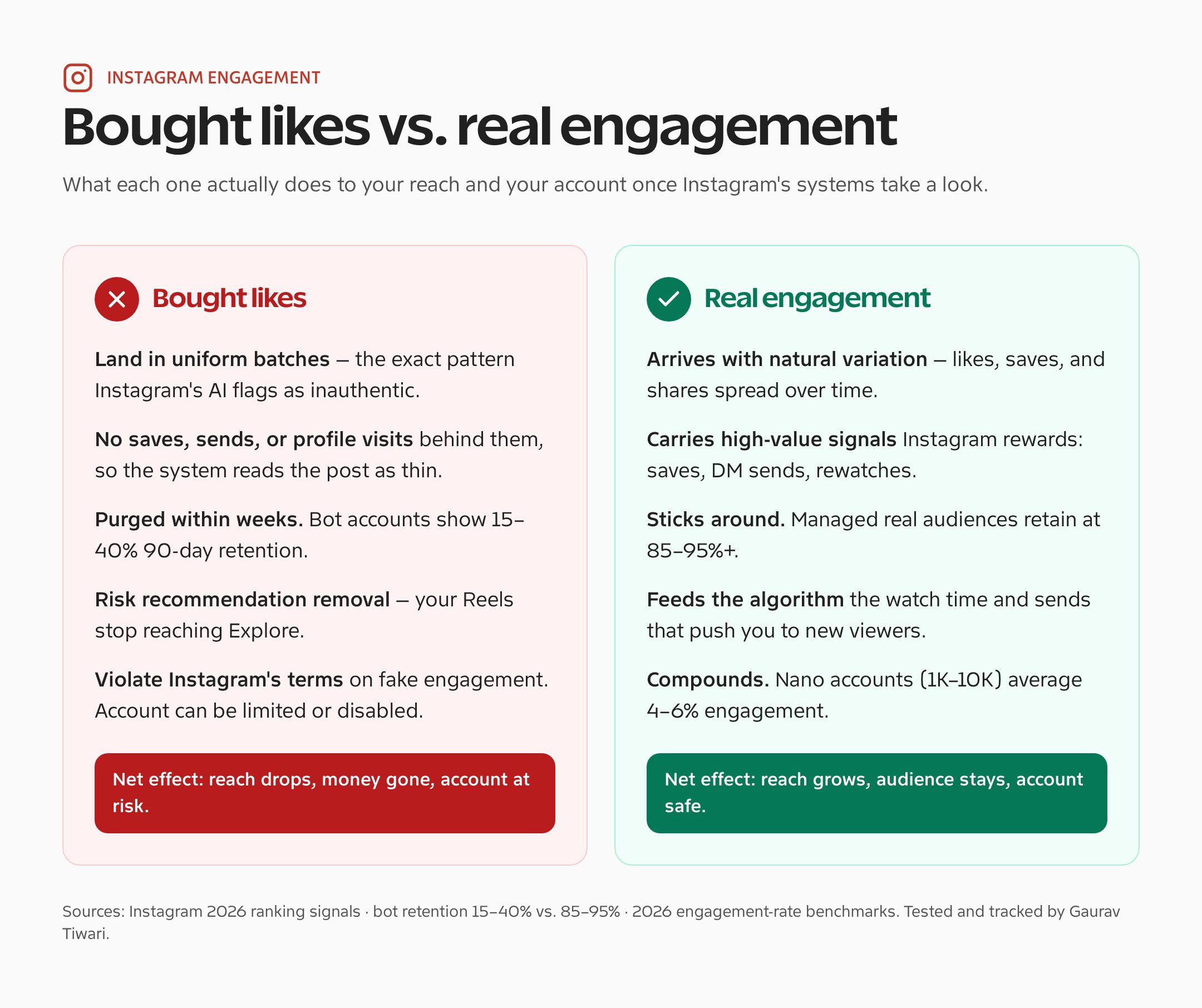
3. Instagram treats artificial inflation as fake engagement
You do not need rumors about a secret purge to understand the risk. Meta has publicly sued businesses that sold automated likes and followers. In its policy explanation on inauthentic behavior, Meta says financially motivated fake-engagement tactics can lead to warnings, temporary restrictions, down-ranking, or removal.
The practical risk is not that every purchase triggers an instant account ban. Meta does not publish a universal threshold, and enforcement is not perfectly visible from outside. The risk is that you are paying for activity the platform has explicitly acted against, delivered by accounts you do not control, using methods the seller rarely explains.
Instagram also lets people hide public like counts. That product decision matters. A like count is not required for someone to consume or share a post, and a creator can choose not to make it the public center of the experience. Building a strategy around inflating that number is weaker than building content people want to pass along.
4. Likes are only one part of distribution
Instagram does not have one simple algorithm that rewards the largest number under a post. Feed, Explore, Reels, and recommendations use different ranking systems. Instagram’s Explore guidance says recommendations consider the accounts someone follows, the photos and Reels they have engaged with, and their connections. Separately, Instagram recommendation eligibility determines whether content from a public account can be shown to people who do not already follow it.
For creators, the useful working metrics are watch time, likes per reach, and sends per reach. Likes can help with connected reach, but sends are especially useful when you want new people to see a post. Meta said in September 2025 that Reels were being reshared more than 4.5 billion times a day across its platforms. That is a better clue about where attention travels than a raw like total.
Use your own Insights to compare formats and topics. Track median reach, watch time, saves, sends, profile visits, follows, and website actions over at least 10 comparable posts. My guide on how to get noticed on Instagram is built around those behaviors rather than a single vanity metric.
5. Fake engagement corrupts business decisions
The quiet cost is bad learning. If bought likes are mixed into one post, you may promote the wrong topic, repeat a weak hook, misprice a brand deal, or conclude that a campaign worked when it produced no qualified response.
| Signal | Bought likes | Earned engagement |
|---|---|---|
| Who acted | Often unknown or low-intent accounts | People who chose the content |
| What happens next | Usually no save, send, profile visit, or purchase | Can produce deeper actions and repeat viewing |
| Business value | A larger visible number | Audience insight, trust, leads, and sales |
| Durability | Can disappear when fake accounts are removed | Persists as audience behavior and learning |
| Policy risk | Meta treats artificial inflation as fake engagement | Normal use of the platform |
| Measurement quality | Corrupts engagement ratios and experiments | Shows which content actually works |
This matters even if Instagram never visibly limits the account. A clean dataset tells you what to make next. A contaminated one rewards the post you artificially boosted. The expense is not just the purchase price. It is the time spent following a false signal.
What to do instead of buying Instagram likes
Put the same budget into one of three things: a stronger creative test, better distribution, or a real collaboration. I would rather test five openings for one useful Reel than buy 5,000 actions from people who will never watch it.
- Run a 10-post test. Keep the topic narrow, vary the hook and format, then compare median watch time, saves, sends, and profile visits.
- Design for a next action. Give viewers a reason to save the post, send it to one person, or visit the profile. Do not ask for every action at once.
- Study retention, not only reach. For video, inspect where viewers leave. The first weak beat usually matters more than another hashtag.
- Collaborate with aligned creators. A small relevant audience can outperform a large indifferent one. The case for micro-influencers in building a brand is relevance, not inflated scale.
- Audit any growth service. Ask exactly how it acquires followers, whether it requires credentials, and whether it uses bots or automated actions. My list of the best Instagram growth services explains the distinctions I look for.
A simple decision rule before you pay
Ask the seller one question: “What valuable behavior will these people perform after the like?” If the answer is vague, the product is a number, not distribution. If the service cannot explain audience source, targeting, consent, retention, and account-safety method, walk away.
Legitimate promotion buys placement in front of a defined audience. Good creator partnerships borrow trust from an aligned audience. Useful services help with strategy, production, outreach, or analytics. None of those need to promise a fixed block of anonymous likes.
The number is not the audience
Buying Instagram likes can make one number look better for a while. It cannot prove attention, improve the content, create trust, or tell you what your real audience wants. Meta treats artificial inflation as fake engagement, and the purchased activity can be removed or used as a basis for enforcement.
Keep the data clean. Make something worth watching, saving, or sending, measure what real people do next, and use that result to improve the next post. Slower feedback you can trust is worth far more than a faster number you bought.
Tell Google you want more of this.
Add Gaurav Tiwari as a preferred sourceOne tap, and this site shows up more often in your own Top Stories, AI Overviews and AI Mode. Remove it any time.