
Bootstrapping vs Funding: Which Path Is Right for Your Business?
I’ve never taken outside investment. Sixteen years of building businesses, and every dollar of capital came from either my own pocket or reinvested profits. That’s not because I think funding is evil. It’s because for my kind of business, bootstrapping made sense. For yours, the answer might be different.
The internet is full of strong opinions on this topic. Bootstrapping advocates act like taking investment is selling your soul. Startup culture worships fundraising like it’s the only legitimate path. Both extremes miss the point. The right choice depends on what you’re building, who you are, and what you actually want from your business.
Let me walk through what each path really looks like so you can make an informed decision instead of an ideological one. For hands-on business building, my WordPress freelancing guide shows a bootstrapping path that works.
What Bootstrapping Actually Means
Bootstrapping means funding your business without external investment. You use your own savings, your own revenue, and your own time. Nobody writes you a check in exchange for ownership or control. Every dollar you make is yours to keep or reinvest as you see fit.
In practice, this usually means starting small and growing organically. You might begin while working a full-time job, building on nights and weekends until the business can support you. You might take consulting work to fund product development. You might grow slower than you’d like because you can only invest what you earn. That’s exactly how I started. Consulting work during the day, product work at night.
The core trade-off is clear. You keep control and ownership, but you accept constraints on how fast you can grow and what resources you have available. For many businesses, especially service businesses, content businesses, and small software tools, those constraints are acceptable. For others, they’re fatal.
What Funding Actually Means
Funding means exchanging ownership in your company for capital. An investor gives you money, and in return they get a stake in the business, voting rights, and often a seat at the table for major decisions. The most common forms are angel investment (individuals writing checks) and venture capital (firms investing pooled money from limited partners).
The capital allows you to grow faster than revenue alone would permit. You can hire before you’re profitable. You can build features before customers are paying for them. You can pursue markets that require significant upfront investment to enter. In exchange, you take on partners who have their own expectations about growth, timelines, and eventual outcomes.
Venture capital in particular comes with a specific expectation. VCs are looking for companies that can return their fund multiple times over. That means they want massive growth, usually culminating in an acquisition or IPO. If you’re not building something with that potential, VC money isn’t just a bad fit. It’s a mismatch that will create conflict down the road.
The Real Differences
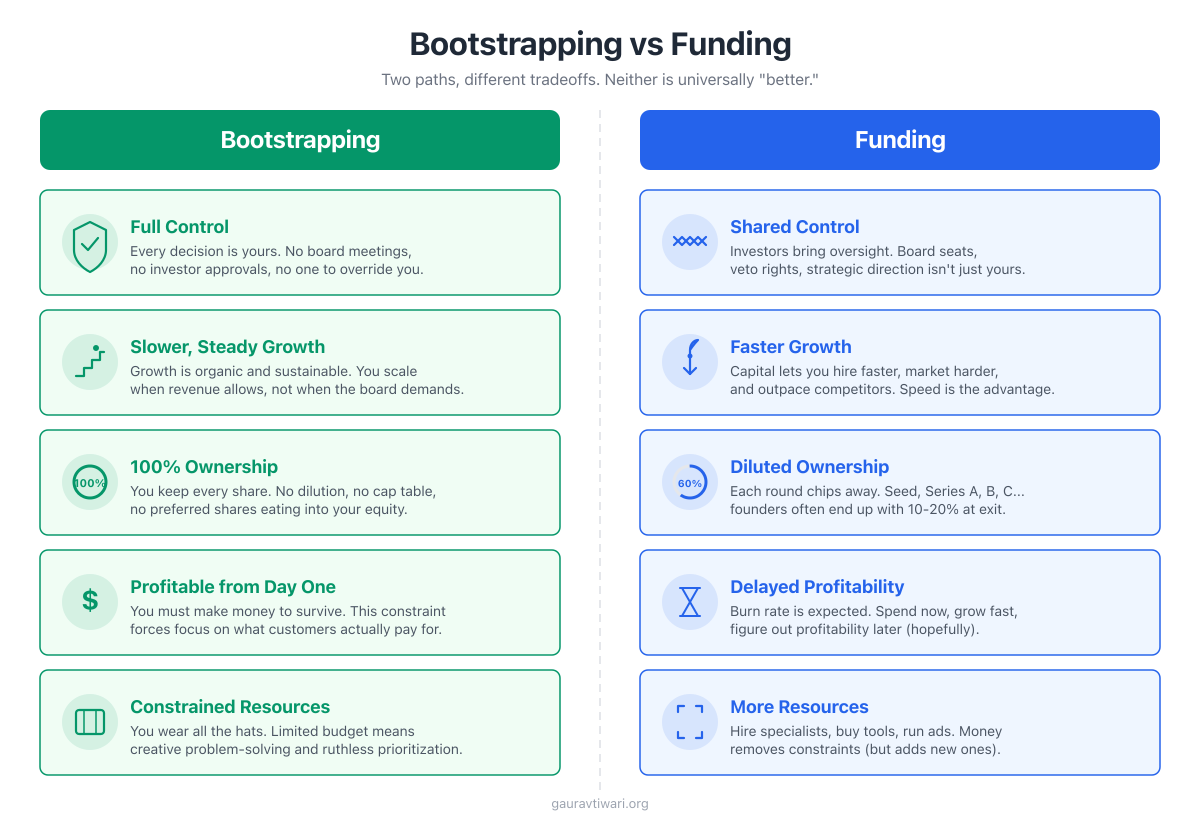
Bootstrapping
- 100% ownership and control
- No investor expectations or timelines
- Freedom to optimize for lifestyle or growth
- Forces profitable business model from day one
- Can pivot, stay small, or sell on your terms
Funding
- Growth capital for faster scaling
- Strategic investors bring networks and expertise
- Runway to pursue long-term plays
- Can enter capital-intensive markets
- Team building before profitability
The surface difference is obvious. Bootstrapping means less money but more control. Funding means more money but less control. But the deeper differences affect everything about how you build and run your business.
Bootstrapping forces profitability. When revenue is your only capital source, you have to make money or die. This constraint, while stressful, pushes you toward sustainable business models from day one. You can’t burn through runway while figuring out product-market fit. You need customers who pay real money for real value, and you need them quickly. I’ve always found this constraint clarifying rather than limiting.
Funding allows for delayed profitability. With a war chest from investors, you can prioritize growth over revenue. You can offer lower prices to gain market share. You can invest in long-term plays that won’t pay off for years. This flexibility is powerful, but it can also mask fundamental problems with your business model. I’ve seen funded companies run for years without ever proving they could sustain themselves.
Bootstrapping keeps decisions simple. When you own 100% of your company, you answer only to yourself and your customers. You can pivot instantly. You can say no to opportunities that don’t fit. You can optimize for lifestyle instead of growth if that’s what you want. Nobody is going to challenge your decision to stay small.
Funding adds stakeholders. Investors are partners, and partners have opinions. They expect regular updates. They expect input on strategy. They expect their investment thesis to play out. Even the most hands-off investors will engage when things go wrong or when major decisions arise. This isn’t necessarily bad. Good investors add real value. But it’s a different way of running a company than doing everything yourself.
When Bootstrapping Works Best
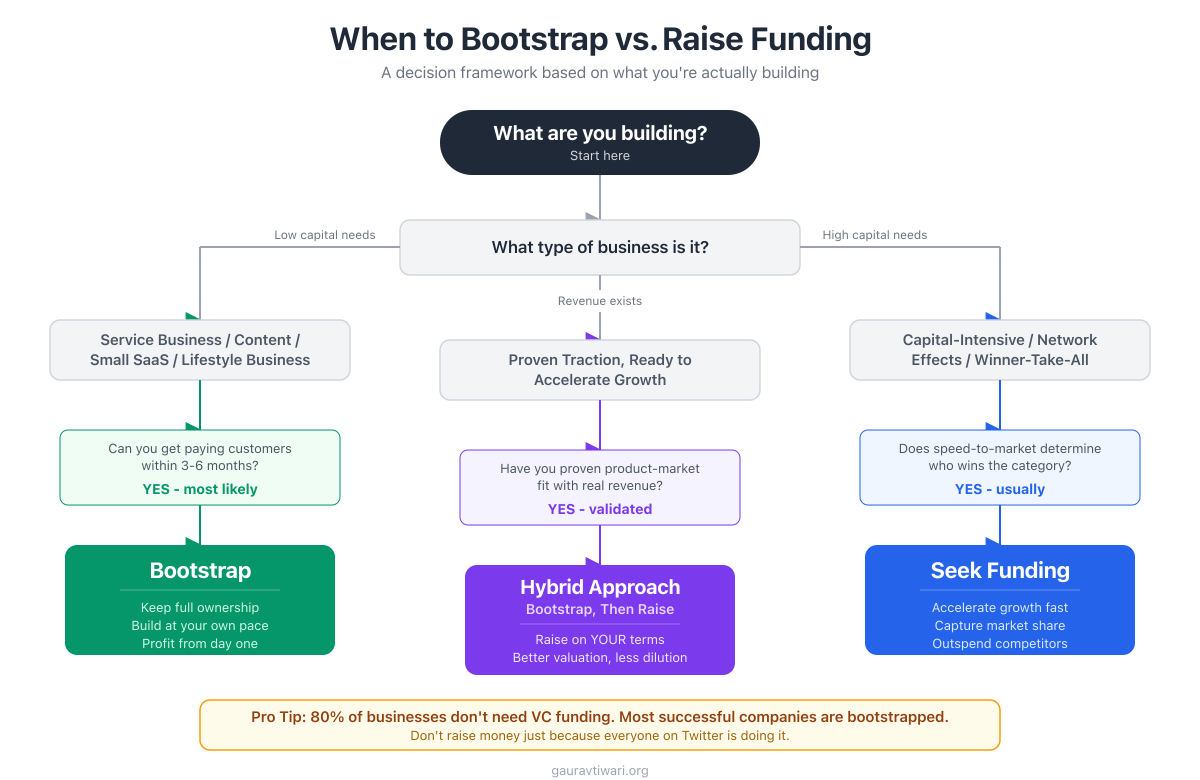
Bootstrapping is ideal when your business can generate revenue quickly without massive upfront investment. Service businesses like agencies, consulting, and freelancing are natural bootstrapping candidates. You can start earning from day one with minimal overhead. Every hour you work can become revenue that funds growth.
Content and media businesses work well bootstrapped. A blog, a newsletter, a YouTube channel, or a podcast can start with zero investment and grow based on the quality of the content. Monetization through ads, affiliates, or sponsorships scales with audience, not capital. My own content businesses required nothing but time and cheap hosting to get started. Learn more in my start a blog guide.
Small SaaS tools can bootstrap successfully. If you can build an MVP yourself and charge from the first customer, you don’t need outside money. Many successful software products were built by one or two people, charging fair prices, and growing slowly into substantial businesses. Basecamp is the famous example, but there are thousands of smaller ones.
The common thread is businesses where initial capital requirements are low and the path to revenue is short. If you can get to profitability with time, effort, and minimal cash, bootstrapping lets you keep everything you build. Productized services are perfect for bootstrapping. For managing clients affordably, see best project management tools for freelancers.
When Funding Makes Sense
Funding makes sense when the opportunity requires capital you don’t have and can’t generate quickly enough. Some markets have winner-take-all dynamics where speed matters more than profitability. If being second to market means being irrelevant, you might need funding to move fast.
Capital-intensive businesses often require funding. If you’re building hardware, opening physical locations, or developing technology that needs years of R&D, bootstrapping might simply be impossible. You can’t build a semiconductor company on nights and weekends.
High-growth software with network effects sometimes benefits from funding. When the value of your product increases with each user, capturing users quickly can be more important than making money from each one. Social networks, marketplaces, and platforms often follow this pattern.
Funding also makes sense when the right investor brings more than money. Some investors have networks, expertise, or credibility that can open doors you couldn’t open alone. If a check comes with genuine strategic value, the dilution might be worth it.
The question isn’t whether funding is good or bad. It’s whether your specific situation requires external capital to succeed, and whether you’re building something that can deliver the returns investors expect. For service businesses specifically, see best side hustle ideas that work without funding.
The Hidden Costs of Each Path
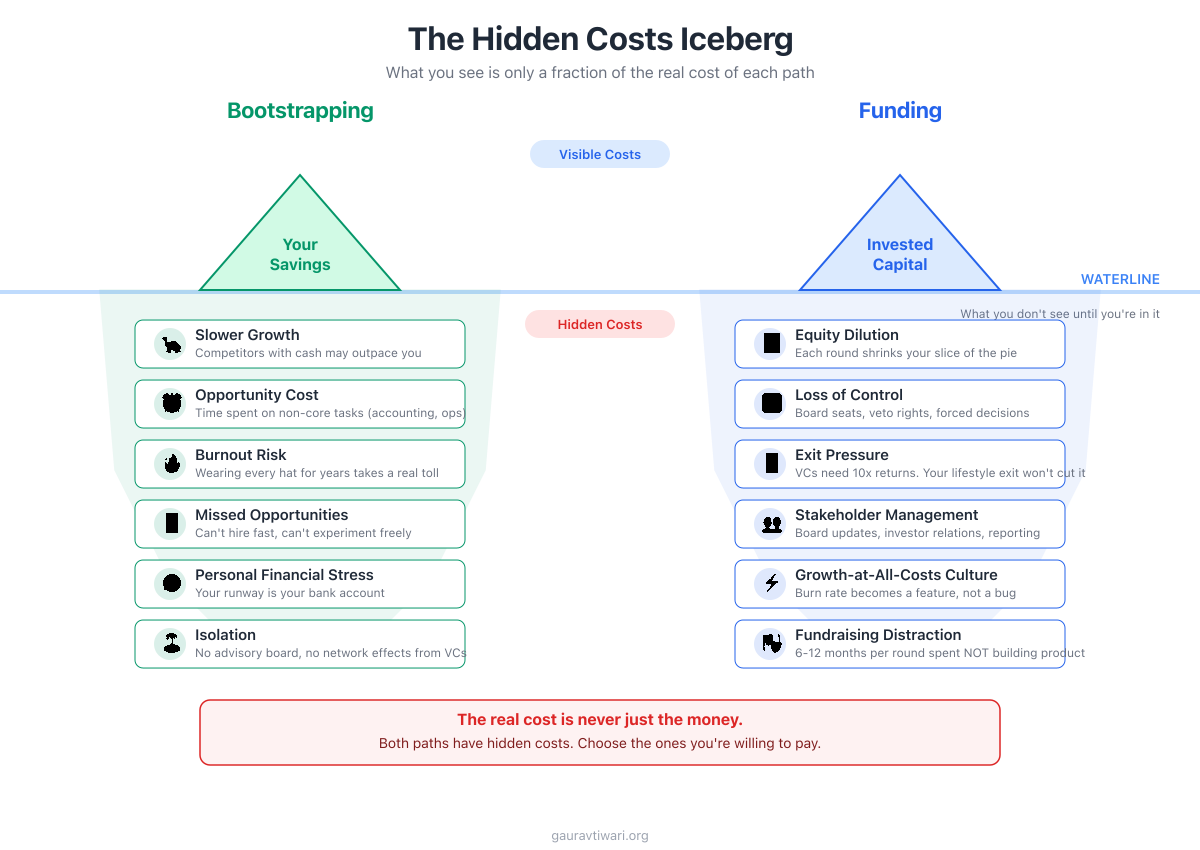
Bootstrapping has costs that aren’t immediately obvious. Growth takes longer. You’ll watch funded competitors outspend you on marketing and hiring. Opportunities will pass because you can’t move fast enough or invest enough. The stress of being capital-constrained is real, especially in the early years when revenue is uncertain.
There’s also opportunity cost. Time spent on client work to fund development is time not spent on the product. Energy spent worrying about cash flow is energy not spent on strategy. Bootstrapping demands you be profitable while also being innovative, and that’s a difficult balance. I’ve had months where I should have been building product but spent them on client work instead because I needed the cash. That tension never fully goes away.
Funding has its own hidden costs. Dilution is the obvious one. If you raise multiple rounds, you might own 10% or less of your company by the time it’s successful. But beyond dilution, there’s the pressure. Investor expectations create a specific kind of stress. You’re accountable to people who have their own timelines and their own definition of success.
There’s also the loss of flexibility. Once you take VC money, certain paths close off. You can’t decide to stay small. You can’t optimize for profit over growth. You can’t sell the company for a “modest” exit that would be life-changing for you but disappointing for your investors. The funding changes what the business can become.
Questions to Ask Yourself
Don’t choose based on ideology. Bootstrapping isn’t morally superior. Funding isn’t selling out. Look at what you’re building, what resources it requires, and what trade-offs you’re willing to make. The mistake is letting Twitter opinions make your decision for you.
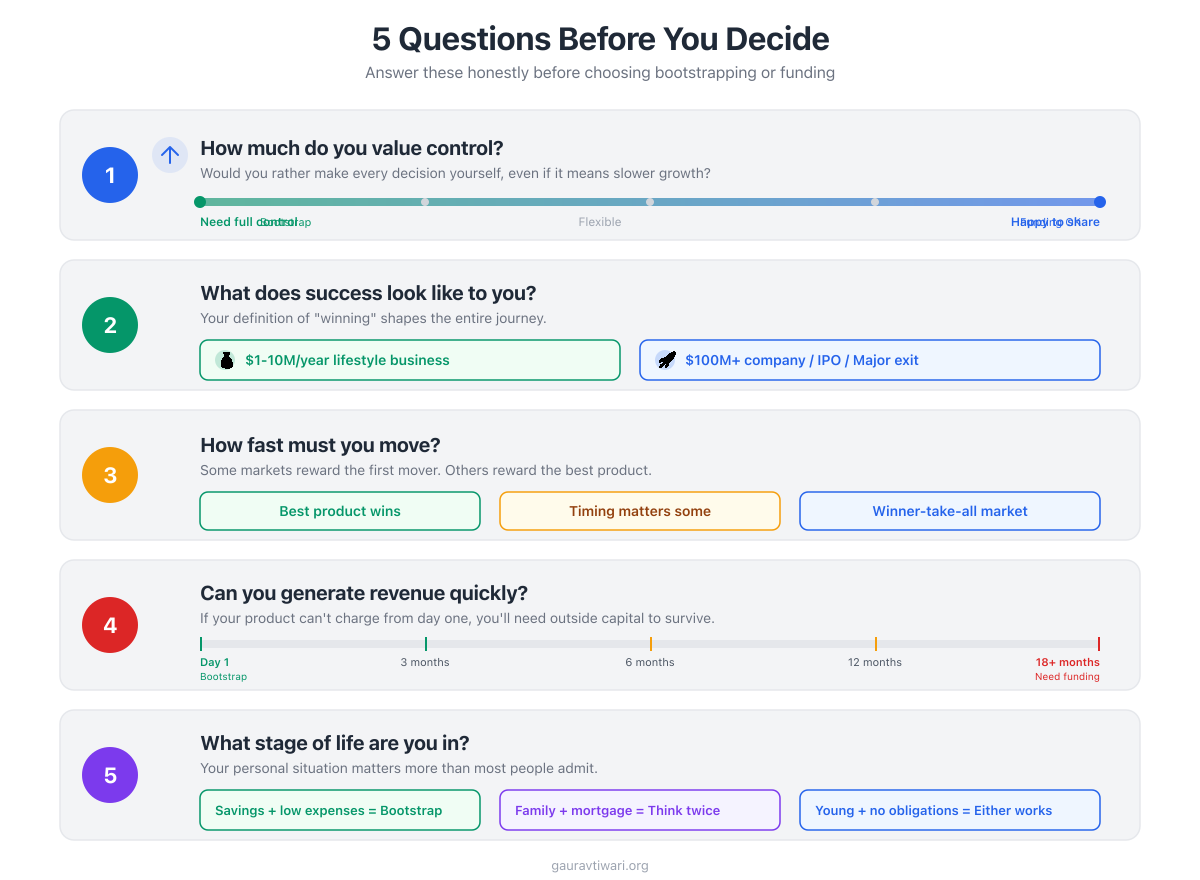
Before choosing a path, get honest about what you want.
How much do you value control? Some people need to make every decision themselves. Others are comfortable with partners and stakeholders. Neither is wrong, but knowing yourself matters. I know which camp I’m in. Took me a while to admit it honestly.
What does success look like? If success is a $10 million exit, bootstrapping might get you there with 100% ownership. If success is a $1 billion company, you probably need funding to reach that scale. Define your goals before choosing your path.
How fast does your market require you to move? In some markets, slow and steady wins. In others, the first mover captures everything. Be honest about your competitive landscape.
Can your business model generate revenue quickly? If you can charge customers from day one, bootstrapping is viable. If you need years of development before you can sell anything, funding might be necessary.
What stage of life are you in? Bootstrapping is harder when you have family obligations, mortgages, and limited savings. Funding can provide stability during the uncertain early years. Your personal situation matters more than anyone in the startup world wants to admit.
My Path and Why I Chose It
I’ve bootstrapped every business I’ve built. The reasons were practical, not ideological. I run service and content businesses that don’t require massive upfront investment. Revenue comes quickly from clients or ads or affiliates. The growth I want doesn’t require outside capital. Learn more in lessons from running a business for 16 years.
More personally, I value control above growth. I don’t want to answer to investors. I don’t want someone else’s timeline imposed on my decisions. I don’t want to be obligated to pursue exits I don’t want. The freedom to run my business exactly as I see fit matters more to me than growing faster.
That’s my preference. It’s not the universally correct choice. If I were building a different kind of company, one that required scale to succeed or capital to develop, I’d consider funding seriously. The tool should fit the job, not the other way around.
The Hybrid Path
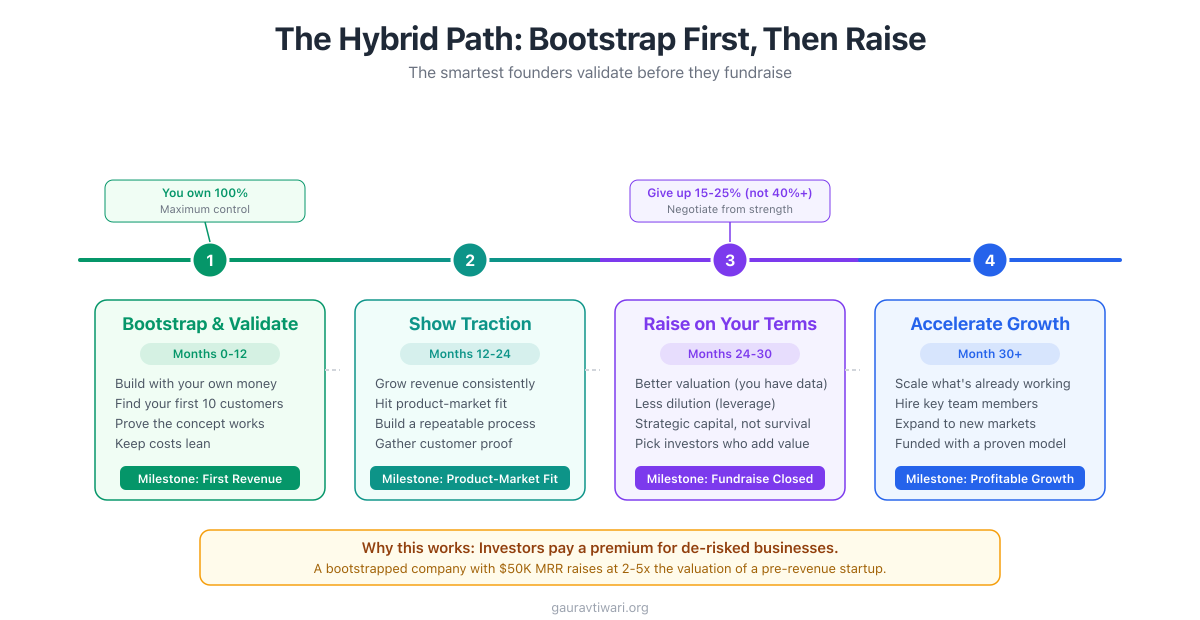
Many successful companies combine both approaches. And honestly, this might be the smartest play for a lot of founders.
Bootstrap first, raise later. Start by proving the concept with your own resources. Once you have traction, real customers paying real money, raise funding to accelerate. This approach gets you better terms because you’ve de-risked the business. Investors pay more for proven concepts.
Strategic funding rounds. Take funding for specific purposes rather than general operations. Fund a product launch. Fund market expansion. Fund a key hire. Then return to sustainable operations. Not every company needs ongoing rounds.
Revenue-based financing. Newer alternatives exist between bootstrapping and equity. Revenue-based financing provides capital in exchange for a percentage of future revenue rather than equity. You keep ownership but get growth capital. This is one of the most interesting developments in startup financing in the past decade.
Debt financing. Traditional loans or lines of credit provide capital without dilution. This works when you have revenue and can service debt. Not suitable for pre-revenue companies but worth considering for established businesses.
The Numbers That Matter
Before deciding, know your numbers. Not guesses. Real numbers.
How much capital do you need? Actually calculate this. Runway required, hiring plans, marketing budget, product development costs. Many founders assume they need more than they actually do. I’ve talked to founders who thought they needed $500K when $50K and some creative problem-solving would have worked fine.
What’s your revenue potential? Estimate realistic revenue in years one, two, and three. Compare this to your capital needs. Can revenue fund growth, or do you need external capital?
What are your costs? Fixed costs, variable costs, customer acquisition costs. Understanding your economics clarifies whether bootstrapping is viable.
What’s your break-even timeline? How long until the business sustains itself? The longer to break-even, the more capital you need.
These numbers don’t lie. They tell you whether bootstrapping is realistic or aspirational.
What Investors Actually Look For
If you’re considering funding, understand what investors evaluate.
Market size. Is this market big enough to produce returns investors expect? VCs need billion-dollar outcomes. Angels can work with smaller markets.
Team. Do the founders have relevant experience, demonstrated ability, and the determination to succeed?
Traction. Evidence that the business works. Revenue, users, partnerships, or other proof points.
Scalability. Can this grow without proportional increases in costs and complexity?
Timing. Why now? What’s changed that makes this opportunity timely?
Competitive moat. What prevents others from copying your success?
If your business doesn’t fit these criteria, fundraising will be frustrating. That’s not a judgment on your business. It might be excellent. But it may not be an investor-appropriate business. Those are two very different things.
Common Mistakes in Both Paths
Bootstrapping mistakes:
- Growing too slowly and losing market opportunity
- Under-investing in sales and marketing
- Burning out from doing too much alone
- Missing scale because you couldn’t afford it
Funding mistakes:
- Raising too early before proving the concept
- Taking money from wrong investors
- Spending before finding product-market fit
- Losing control to investors with different goals
Both paths have traps. Neither is safe. Success requires execution regardless of funding structure.
Making the Choice
There’s no wrong answer here. There are only answers that fit your situation better or worse. Bootstrapping isn’t morally superior. Funding isn’t selling out. Both are legitimate paths to building something valuable.
The mistake is choosing based on ideology instead of analysis. Don’t bootstrap just because you’ve read too many anti-VC takes on Twitter. Don’t raise money just because startup culture glamorizes fundraising. Look at what you’re building, what resources it requires, what your goals are, and what trade-offs you’re willing to make.
I’ve bootstrapped every business I’ve built. Not because funding is evil, but because my service and content businesses don’t need it. Revenue comes quickly. The growth I want doesn’t require outside capital. If I were building something capital-intensive, I’d consider funding seriously. The tool should fit the job.
Then choose the path that actually fits. The best businesses are built by founders who understood their situation clearly and made deliberate choices about how to fund growth. That clarity matters more than which path you ultimately take.
What does bootstrapping mean?
Bootstrapping means funding your business without external investment. You use your own savings, reinvested revenue, and time instead of raising money from investors. You keep full control and ownership but accept slower growth and resource constraints.
When should you raise funding instead of bootstrapping?
Consider funding when your business requires significant upfront capital you can’t generate from revenue, when speed to market is critical, when you’re in a winner-take-all industry, or when the right investor brings strategic value beyond money.
What types of businesses are best suited for bootstrapping?
Service businesses, content and media companies, and small SaaS tools are naturally suited for bootstrapping. These models have low initial capital requirements and can generate revenue quickly, making external funding unnecessary.
What are the hidden costs of taking investor money?
Beyond equity dilution, funded companies lose flexibility. You can’t choose to stay small, optimize for lifestyle, or take modest exits. Investor expectations create pressure and accountability that changes how you run the business.
Can you start bootstrapped and raise funding later?
Yes. Many successful companies bootstrap to prove the concept, then raise money to accelerate growth. Starting bootstrapped lets you validate the business and often negotiate better terms when you do raise, since you’ve demonstrated traction.