
 by
by
If you’re looking for the best Grammarly alternatives, the right choice depends on what you need help with. Harper is a useful starting point for free, local English proofreading. ProWritingAid gives long-form writers more ways to examine a draft. ChatGPT or Claude can help with deliberate editorial review when you want to discuss a passage rather than correct it while typing.
My recommendation is to start with the writing tools you already have, identify what they miss and add a specialist only when that gap matters. Paying less for a subscription doesn’t help much if you spend the difference in time reviewing unnecessary changes.
The recommendations below compare documented features and access limits, not results from a controlled accuracy benchmark. I’ve also included editing prompts and a short evaluation checklist so you can judge the suggestions against your own writing.
Best Grammarly Alternatives at a Glance
For everyday English correction, start with the proofreader in your editor or try Harper. For multilingual checking, LanguageTool deserves a look, but its hosted browser extension requires Premium. For deeper revision, an AI assistant you already use may be enough.
This table separates those jobs before comparing subscriptions.
| Your Editing Job | Starting Point | Where and How You Use It | Free Access or Main Catch | Processing |
|---|---|---|---|---|
| English grammar while you type | Harper | Browser and editor integrations; inline checks | Free and open source; English only | Local checking |
| Multilingual proofreading | LanguageTool | Web checker or paid hosted extension | Limited free web checking; extension needs Premium | Cloud by default; separate self-hosted engine |
| Long-form analysis | ProWritingAid | Writing environment and reports | Free report limits; specialist analysis may cost extra | Hosted service |
| A difficult sentence | DeepL Write | Selected-text improvements in supported integrations or web app | 1,500 characters without an account | Cloud |
| Readability review | Hemingway Editor | Paste a draft and inspect highlights | Classic editor differs from paid Plus AI features | Depends on edition and feature |
| Feedback on an argument | ChatGPT or Claude | On-demand conversation about a passage or draft | Free usage limits; every rewrite needs review | Cloud in these services |
| Research-paper language | Paperpal or Trinka | Academic editing and document integrations | Plan and file allowances matter | Hosted services; Trinka has separate offline options |
| Consistency across a document | PerfectIt or Vale | Document checks or configured style rules | A different job from general grammar correction | Depends on tool and configuration |
The application where you write matters as much as the feature list. A checker that needs repeated copying and pasting can be a poor fit for someone answering emails all day.
What Grammarly Already Includes
Grammarly is a fair option to keep when its integrations already fit your work. Its current plans include more than spelling correction:
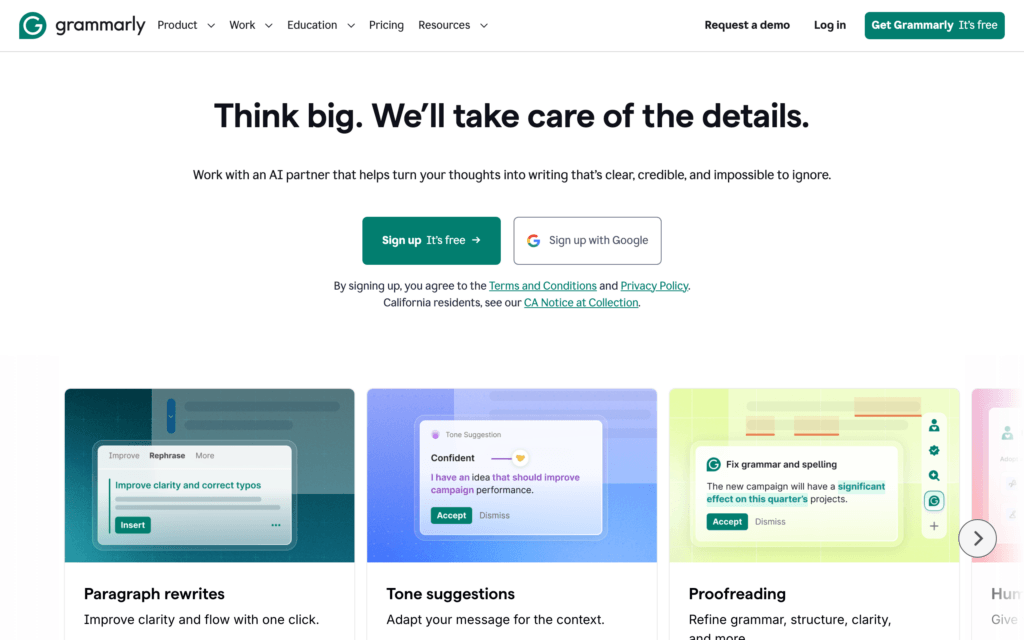
- Paid writing features include full-sentence rewrites and tone adjustments.
- Free includes 100 AI prompts per month; the regional Plus plan lists 2,000 per member per month.
- Plus availability is country-specific. Grammarly says it includes Pro’s advanced writing features, so the name and offer shown in your account matter.
A replacement should solve a specific problem with your current setup. You don’t need to leave Grammarly just because another tool can also rewrite a paragraph. The Grammarly review covers the product separately; the useful comparison here is which editing job you need to replace.
Everyday Proofreading
An inline checker catches mistakes where you’re already writing. That is generally the first thing to replace if Grammarly’s main job in your day is underlining errors, rather than helping you rethink a draft.
Harper
Harper is my starting recommendation for someone who wants free English grammar checking with local processing. Its privacy benefit comes from where the checking happens, rather than from a promise about what a hosted service does with uploaded text.
- Checks run on your device. Harper is open source and doesn’t require a generative model or GPU.
- Integrations include browsers, Obsidian and code editors.
- It supports English varieties including American, British and Indian English.
- It doesn’t provide multilingual proofreading or the open-ended editorial discussion you get from a chatbot.
For WordPress, follow Harper’s current integration guidance: the Chrome extension supersedes its older plugin, which no longer receives regular updates. A local grammar checker also cannot keep a cloud-based document private from the service hosting that document.
LanguageTool
LanguageTool suits writers who need proofreading across languages and want an integrated correction workflow. The important choice is between its website, hosted integrations and a separately operated local engine.
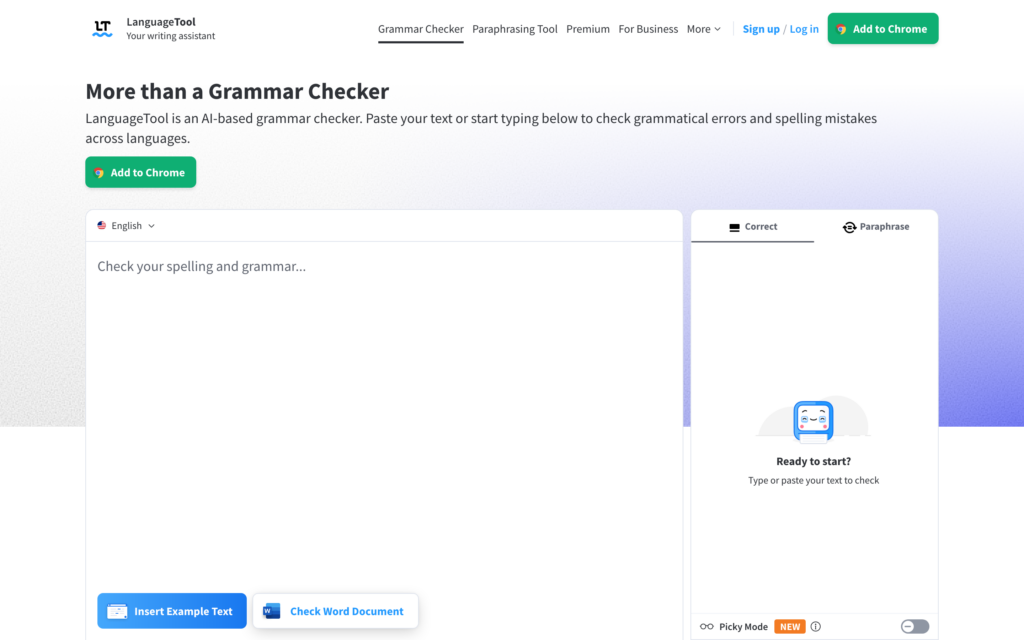
- Free web use: grammar checking and paraphrasing remain available with limits.
- Hosted browser extension: Premium is required.
- Language coverage: Premium documents correction support for more than 20 languages; features differ across languages.
- Self-hosting: the basic server excludes cloud-only AI rules and requires technical setup.
LanguageTool makes more sense than Harper when language coverage is the deciding factor. Harper is the simpler starting point when the requirement is local English correction without running a server. Self-hosting LanguageTool should not be treated as a local copy of everything in Premium.
ProWritingAid
ProWritingAid is worth considering when you’re editing a long manuscript and want to inspect recurring patterns, rather than receive another replacement sentence.
- Premium lists 25+ writing analysis reports, including readability and overused-word analysis.
- Its free plan allows 2 runs per line-editing report per day, excluding Story Critiques.
- Premium includes a custom style guide and dictionary.
- Some manuscript-level services use separately purchased Story Credits.
The reports give you different questions to ask about a draft. That is useful when repetition or uneven pacing is the problem, but working through reports takes attention. For short messages, a simpler inline checker may be enough.
The pricing comparison includes monthly, annual and lifetime options. The cost section below keeps the Indian prices and their billing terms together; a lifetime license shouldn’t be read as unlimited access to every extra service.
Antidote
Antidote suits writers who want to understand a correction through dictionaries and language guides. That reference material is particularly useful when you keep asking why a phrase works, not just which sentence to paste back.
- The desktop product combines a corrector with dictionaries and guides.
- English and French are available; the language modules in your purchase matter.
- Desktop correction and reference tools can work offline.
- Connected features, including reformulation, require internet access.
Antidote deserves consideration for sustained English or French editing. Someone who only needs an occasional typo check has less reason to buy a reference suite.
AI Editing and Rewriting
An AI editor is useful when you can describe the problem: a sentence is awkward, an explanation repeats itself or a conclusion goes beyond the evidence. Giving it that specific job makes its suggestions easier to judge.
DeepL Write
DeepL Write is a focused option for improving a sentence or short passage. It offers alternative wording alongside grammar and punctuation corrections, without requiring you to start a long conversation.
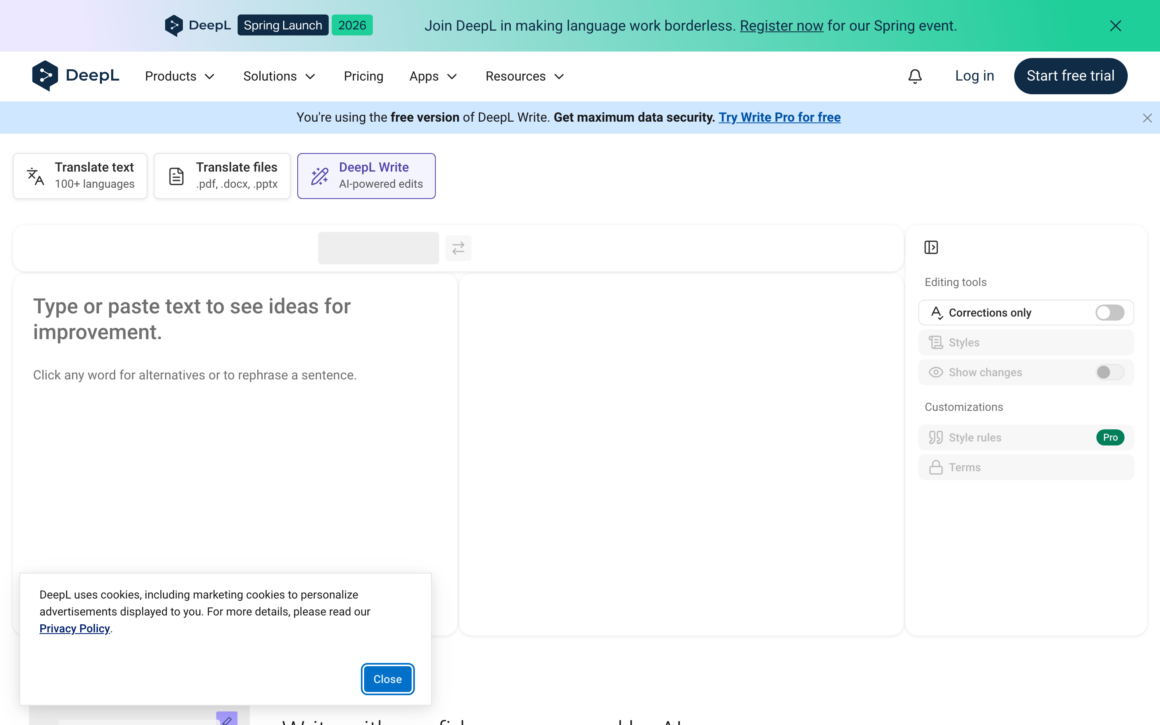
- Without an account, the limit is 1,500 characters at a time.
- Its supported-language list contains 9 languages, with English and Portuguese variants. Hindi isn’t listed.
- A DeepL Translator Pro subscription does not automatically include Write Pro.
- Available integrations include desktop apps and selected browser or document workflows.
It is a better fit for a troublesome passage than for reviewing whether an entire article answers the reader’s question. For Hindi-English writing, the language limitation changes the recommendation immediately.
Hemingway Editor
Hemingway is useful when you want to see which passages may be difficult to read. The classic editor’s highlights invite you to examine the sentence yourself.
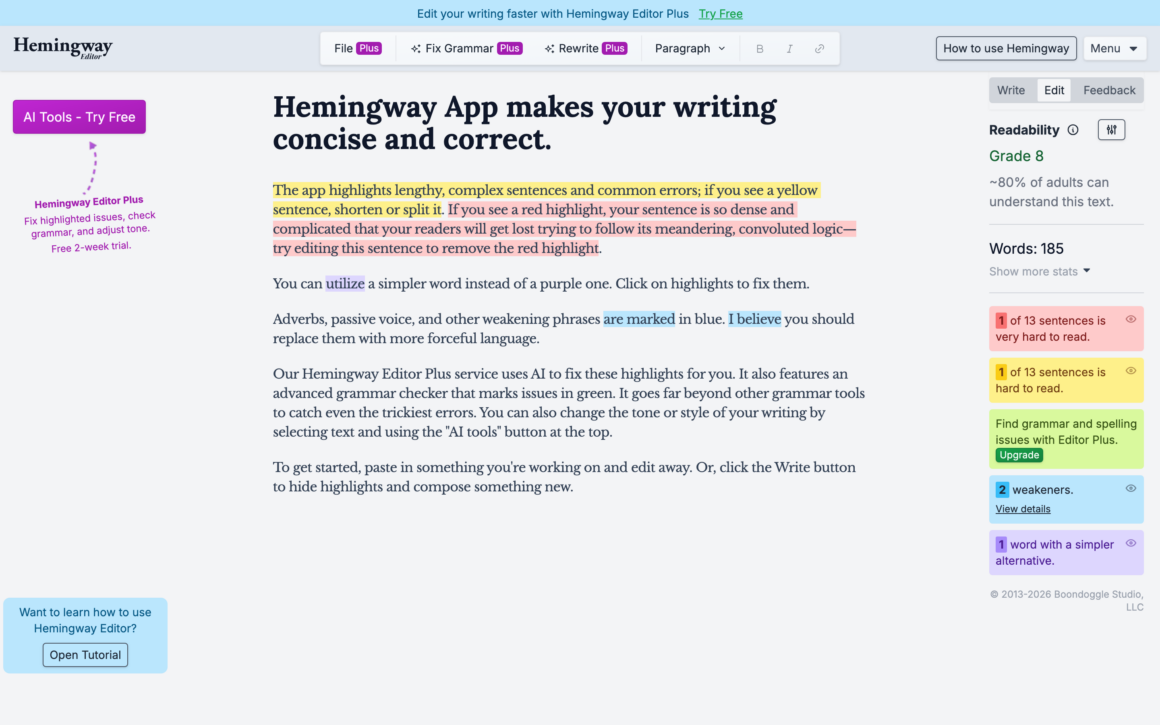
- The classic editor highlights readability issues, including dense sentences and passive constructions.
- Hemingway Editor Plus adds AI rewriting, grammar fixes, tone changes and document feedback.
- Plus Individual 5K includes 5,000 AI sentence rewrites per month; its annual option costs US$100.
- The classic desktop product and Plus subscription are separate offers.
The highlights are prompts for judgment. A technical explanation doesn’t improve merely because you shorten every sentence or push its reading grade down. Sometimes the longer sentence is the one that keeps the condition attached to the claim.
QuillBot
QuillBot is useful for comparing different ways to express a passage. Its paraphrasing modes make it a more focused choice than a general chatbot when wording is the immediate problem.
- Free paraphrasing supports up to 125 words per attempt, in Standard and Fluency modes.
- Premium lists 9 built-in modes plus custom modes.
- Grammar, paraphrasing and translation have different language coverage and limits.
- Plan prices and offers vary; compare the total annual charge with the monthly payment option at checkout.
Paraphrasing still needs a meaning check. Changing the wording of someone else’s idea also doesn’t remove the need to cite the source. A synonym swap is a particularly poor substitute for understanding the passage.
ChatGPT
ChatGPT fits deliberate editing: you give it a passage, explain the reader’s problem and discuss possible changes. A useful first request is to identify what needs fixing before it rewrites anything.
- Free access has usage limits.
- ChatGPT Plus lists a US$20 monthly price; limits still apply and local pricing may differ.
- API usage is billed separately from Plus.
- Its data controls can control training use. They don’t turn the hosted service into local processing.
It can help you examine an argument, but a fluent answer doesn’t establish that the argument is true. Ask it to separate writing problems from claims needing external verification, then verify those claims against their sources.
Claude
Claude is another option for discussing a draft and requesting bounded changes. The reason to choose it here is whether its suggestions fit your writing and review process, not an unsupported claim that it always preserves voice better.
- A free plan is available with limits.
- Claude Pro lists US$20 monthly or US$200 annually; paid access still has usage limits.
- Longer inputs and the features you use can affect the available allowance.
If you already pay for Claude or ChatGPT, try the editing prompts below before adding another AI subscription. You can compare the same passage in both, but you don’t need to keep both subscriptions merely to proofread it.
editGPT
editGPT puts visible changes at the center of the editing workflow. That makes it worth considering when your main difficulty with AI is reviewing what changed between the original and the rewrite.
- Its product centers on proofreading, editing and tracking changes.
- Visible changes make omissions and substitutions easier to inspect.
- Plan allowances and document-format support need to match the files you actually work with.
A tracked change is easier to review; it isn’t automatically a correct change. This is a workflow advantage, not evidence of superior grammar accuracy.
Raycast AI
Raycast is worth considering when you repeatedly apply the same editing instruction to selected text. Saving a minimal-copyedit command can remove the repeated work of opening a chat and explaining the task again.
- AI Commands support selected-text workflows and configurable output behavior.
- Opening the response in Raycast gives you a chance to review it before replacing the selection.
- AI requires a paid plan; it isn’t included in ordinary Raycast Free.
- Pro’s standard allowance is 500 monthly AI credits. Models consume credits at different rates.
This is an intentional editing action, so someone seeking continuous underlines should start with an inline checker. The convenience of a keyboard command doesn’t remove the need to inspect the result.
Apple Writing Tools
Apple Writing Tools is worth checking before buying another editor if you already use a supported Apple device. Selected-text proofreading and rewriting can cover occasional edits inside the applications where you work.
- Availability depends on the device, software, language and region.
- Supported actions include proofreading, rewriting and summarizing.
- Processing depends on the feature. Connected intelligence services and optional ChatGPT use mean you shouldn’t assume every request stays on the device.
This option is attractive because it may already be available in your setup. It is less useful when you need the same editing behavior across unsupported devices or applications.
Tools Already in Your Editor
The cheapest useful replacement may be the one you already have. Before installing another checker, see what your document editor catches and whether the remaining errors justify another tool.
Google Docs
Google Docs proofreading is a sensible first pass for documents you already write and share there. You can accept or ignore spelling and grammar suggestions without moving the text elsewhere.
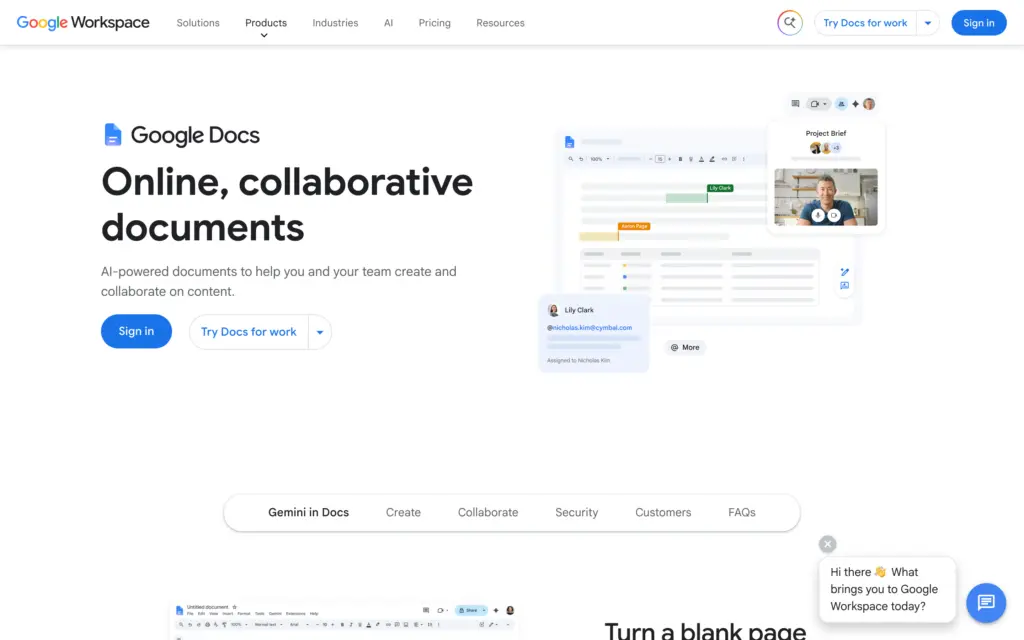
- Ordinary proofreading and Gemini-assisted writing are different features.
- Gemini in Docs requires an eligible Google Workspace or Google AI plan, apart from applicable experimental access.
- Feature availability varies by language and platform.
The main reason to add a specialist is a specific problem Docs isn’t solving, such as manuscript analysis or consistent technical terminology. A new editor creates migration work, so the writing-app comparison is useful if you’re considering changing the drafting environment too.
Microsoft Editor
Microsoft users should start with the supported proofing tools in their current applications and browser. Installing the old Editor extension is no longer the right route.
- Microsoft retired the Chrome and Edge extensions on October 31, 2025.
- Microsoft directs browser users toward Edge’s built-in proofing tools.
- Application-specific features and account entitlements still need checking; a browser feature doesn’t establish what your Word or Outlook plan includes.
Someone who wants to remain in Chrome should choose a currently supported extension. Someone already using Edge may have less to replace.
Specialist Editing Tools
A general checker can leave you with a grammatically correct document that still uses inconsistent terminology or changes the meaning of a research finding. These tools address narrower problems, so each should earn its place through that particular job.
Paperpal
Paperpal is worth considering for research manuscripts when you want academic writing assistance in the document workflow.
- It provides a Word add-in and browser support for Google Docs and Overleaf.
- Its academic focus makes it relevant to manuscript language and revision.
- You still need to verify references and preserve the exact finding; language assistance doesn’t establish research validity.
An occasional business email doesn’t justify switching to an academic tool. A manuscript with terminology and citation conventions may.
Trinka
Trinka is another specialist for academic and technical writing, particularly when file proofreading and style requirements matter.
- Its plans include grammar assistance, consistency checks and document workflows.
- File allowances, credits and features vary across plans.
- The Confidential Data offering includes distinct privacy and offline capabilities; those shouldn’t be attributed to every account.
The relevant comparison with Paperpal is your actual document and required integration. A broad claim that either one is better for all academic writing would hide the differences you need to check.
PerfectIt
PerfectIt addresses consistency in long documents. It becomes useful when different sections disagree about capitalization or abbreviations even though the individual sentences read correctly.
- Checks include capitalization inconsistencies, missing acronym definitions and common misspellings.
- The goal is to find discrepancies across the document and let you resolve them.
- It doesn’t replace factual review or decisions about the argument.
Someone polishing a report assembled from several contributors has more reason to evaluate PerfectIt than someone rewriting a short social post.
Vale
Vale is a style linter: it checks writing against rules you configure. It suits documentation teams that need repeatable terminology and style checks in their publishing process.
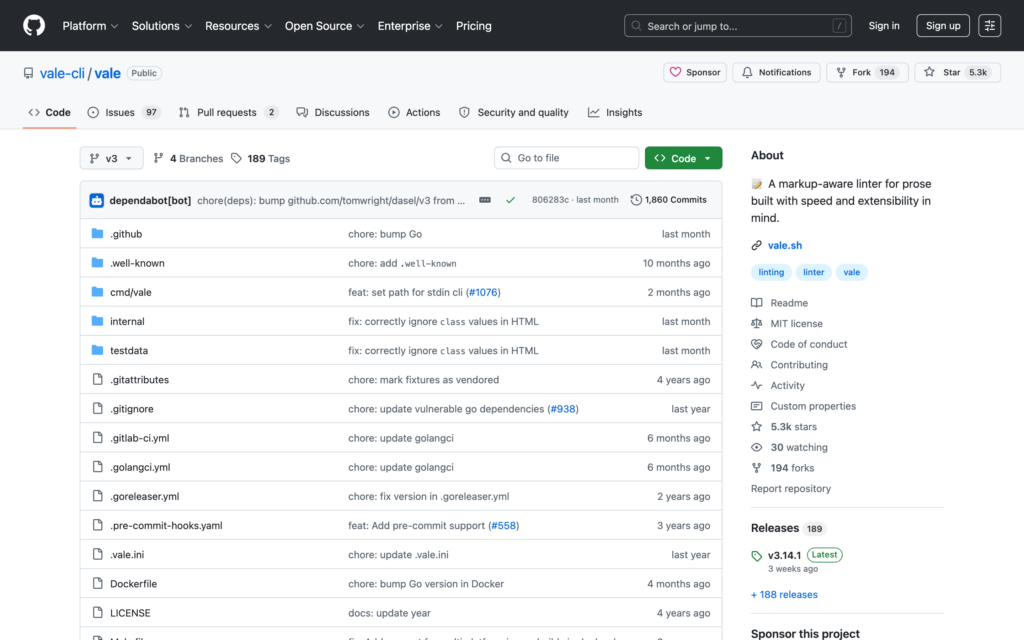
- Rules can enforce a shared style across files and authors.
- Configuration is part of the work; Vale doesn’t supply a universal editorial judgment of its own.
- It is closer to a code linter than a general grammar assistant.
Vale can flag a forbidden product spelling every time it appears. It can’t decide whether the tutorial explains the feature well enough for a new user.
Grazie
Grazie makes sense for technical writers who want proofreading around their existing browser or development tools.
- JetBrains provides both a browser extension and an IDE plugin.
- Both are free, with a limited allowance for AI-powered features.
- Instant proofreading supports English, German, Russian and Ukrainian. Translation and other AI features have different coverage.
It deserves consideration beyond IDE comments, but a broad language count shouldn’t substitute for checking the exact proofreading feature you need.
Lex
Lex combines a writing editor with AI feedback and collaboration. It suits someone willing to move the draft into a different workspace so discussion and composition happen together.
- Feedback sits alongside the writing environment.
- Moving editors changes your collaboration and export workflow.
- Its product page labels Track Changes as coming soon; don’t choose it on the assumption that feature is already available.
For teams assessing a wider AI platform, WRITER is a separate evaluation. Its plans revolve around agents and team workflows, which is a much larger purchasing decision than replacing a personal grammar checker.

Private and Bilingual Editing
Privacy and language support need their own checks. A tool can be good at English correction and unsuitable for a confidential bilingual document.
Local Editing
Harper covers local English correction. For prompted generative editing, LM Studio can run a downloaded model offline once the required files are available. These are different tools for different jobs: one proposes grammar corrections; the other runs a model you instruct.
The practical boundaries matter:
- Local model quality and speed depend on the model and your hardware.
- Downloading models and updates requires a connection, even when later editing can happen offline.
- Cloud-connected tools or integrations can change where a request goes.
- Your document editor, sync service and backups have their own data handling.
“Not used for training,” “not retained” and “processed locally” describe different conditions. The right privacy choice depends on the text you’re handling and the actual route it takes.
Bilingual Writing
An English correction tool shouldn’t silently translate the rest of your passage. For Hindi-English material, DeepL Write’s lack of Hindi support is a clear limit; its separate translation product doesn’t change that.
A useful editing brief names what must stay:
- The English variety and intended audience.
- Deliberate Hindi-English switching and regional expressions.
- Names, quotations and specialist terms.
- Whether you want correction, translation or an explanation of an uncertain phrase.
You can ask an AI assistant to propose changes without applying them. A fluent bilingual reviewer still needs to judge the result; fluency of the output alone doesn’t establish that the wording fits the audience.
Practical Editing Workflows
The useful setup is generally small: one place to write, one way to catch routine mistakes and a separate review step when the draft needs it. Adding more checkers can create competing suggestions without solving another problem.
A Free-First Workflow
For everyday English writing, start with a representative document rather than a subscription comparison.
- Draft in your existing editor. If you dictate your first draft, check names and technical terms before editing the prose.
- Run its built-in proofreading or try Harper in a supported integration.
- Review each necessary correction. Leave deliberate wording alone.
- For a difficult passage, use a free AI allowance or limited web tool only if its data handling fits the text.
- Read the final version against the original and stop when further changes are just preferences.
This gives you a way to discover the gap before you pay to fill it. Tools for drafting and content production solve a broader problem than proofreading, so they don’t all belong in this setup.
A WordPress Workflow
WordPress content contains things a general rewrite must leave alone. A shortcode that looks unusual to an editor can be working code on the site.
- Keep the original document or saved revision.
- Correct prose inside individual blocks, or copy out only the passage needing review.
- Keep URLs and code out of automatic rewrites. Treat
[[year]]and[[monthyear]]as protected shortcode examples, not words to replace. - Compare names, numbers and qualifiers before accepting changes.
- Check the blocks and links after putting edited text back.
An instruction to preserve markup reduces ambiguity, but it isn’t a guarantee. Reviewing a small passage is easier than diagnosing a rewritten page with damaged block structure.
An Academic Workflow
Academic editing needs to preserve the finding even when the original sentence is awkward. Paperpal or Trinka may fit the document environment, but the author remains responsible for what the revised sentence claims.
- Check the institution’s or publisher’s rules for permitted assistance.
- Request language correction with explanations.
- Preserve statistical notation and comparison groups exactly.
- Compare qualifiers and negative findings with the original.
- Verify citations against the actual sources, separately from proofreading.
For example, “was associated with” cannot become “caused” merely because the second phrase sounds clearer. That edit changes the finding.
Minimal Copyediting Prompt
This prompt gives an AI editor a narrow job. Change the language instruction when your document uses a different spelling convention.
Copyedit the passage using American spelling. Make only the changes
needed to correct genuine grammar, spelling and punctuation errors.

Preserve the writer's voice, regional idiom, paragraph order,
contractions and intended meaning. Don't make the text more formal
or promotional by default.

Keep names, numbers, prices, dates, quotations, citations, URLs,
code and shortcodes unchanged. Preserve uncertainty and scope:
may, might, some, usually, only and similar qualifiers.

Return:
1. The minimally corrected passage.
2. Necessary corrections with brief reasons.
3. Optional style suggestions, separately and not applied.

Flag ambiguity instead of guessing. Don't add facts or examples.

PASSAGE:
[Paste your text]
Separating optional suggestions prevents a personal style preference from arriving disguised as an error correction.
Editorial Review Prompt
When the problem is the argument or structure, a correction-only instruction is too narrow. The next prompt asks for a diagnosis before a rewrite.
Review this draft for the intended reader: [describe the reader].
The reader should be able to: [describe the desired outcome].

Identify unclear reasoning, repeated ideas, missing steps,
weak comparisons and conclusions unsupported by the supplied evidence.

Separate writing problems from claims that need external verification.
Don't invent sources or declare facts verified from memory.

Return the 5 most useful changes, each with:
- The exact passage.
- The reader's problem.
- The proposed change and reason.

Don't rewrite the full draft. If fewer than 5 changes are warranted,
return fewer.

DRAFT:
[Paste your draft]
The response gives you edits to consider while leaving the original structure under your control.
Download the editing prompts and evaluation worksheet as a plain-text file. It includes 8 prompts you can adapt and the test cases to use when comparing tools.
How to Protect Your Meaning
The first review question is whether the edited sentence still makes the same claim. An edit can fix the grammar while changing the evidence the reader thinks you have.
Here is an illustration, not an output attributed to any product:
| Version | Sentence |
|---|---|
| Original | The plugin may reduce database queries on some sites. |
| Unacceptable rewrite | The plugin reduces database queries and speeds up every website. |
| Optional edit that preserves the claim | On some sites, the plugin may reduce database queries. |
The unacceptable rewrite removes uncertainty, broadens the claim to every site and adds a speed benefit. None of those changes is a grammar correction.
The same review should catch less obvious changes:
- Negative findings: “did not improve” must keep the negative.
- Billing: “US$100 billed annually” must not become “US$8.33 billed monthly.”
- Technical tokens:
wp_optionsis an identifier, not a spelling mistake. - Attribution: a quotation must retain its wording and its source.
A smooth paragraph can make these changes harder to notice. Keep the original beside the revision, and review the differences before judging how polished it sounds.
What Grammarly Alternatives Cost
The useful price is the amount you must pay for the workflow you need. A monthly equivalent on an annual plan isn’t a monthly cancellation option.
These public plan examples retain the displayed currencies and billing terms. Taxes, regional offers and checkout pricing can differ.
| Product and Plan | Payment Option | What to Check Before Paying |
|---|---|---|
| ProWritingAid Premium | ₹1,650 monthly; ₹6,600 annually; ₹21,945 lifetime | Story Credits and other separately metered services |
| Hemingway Plus Individual 5K | US$100 annually, displayed as US$8.33/month | 5,000 AI sentence rewrites monthly; separate from classic desktop |
| ChatGPT Plus | US$20 monthly | Usage limits; API billing is separate |
| Claude Pro | US$20 monthly or US$200 annually | Usage limits and any optional extra usage |
| Raycast Pro | US$10 monthly or US$96 annually | Standard 500 monthly AI credits; model consumption varies |
Annual billing is sensible after the tool proves useful. It isn’t the best starting point just because the pricing page displays a smaller monthly equivalent.
Using the ProWritingAid figures above, ₹21,945 divided by ₹6,600 is about 3.33 years. That is a simple break-even comparison with an unchanged annual price, not a forecast or a reason to buy lifetime before testing the workflow.
For other tools, compare the current plan page with your actual workload. The relevant allowance might be characters per passage, files per year or model credits, and those measures aren’t interchangeable.
How to Evaluate a Grammar Checker
The best test is a sample of your own writing with the original kept beside it. Include passages the tool should correct and passages it should leave alone; otherwise, you’re only measuring how willing it is to change things.
These constructed cases give you a starting checklist:
| Test Case | Example or Material | What a Useful Result Preserves |
|---|---|---|
| Genuine error | “These plugin is useful.” | Corrects the agreement, such as “This plugin is useful.” |
| Factual qualifier | “The plugin may help some sites.” | Keeps “may” and “some” |
| Technical token | wp_options, a URL and a product name |
Exact tokens and destinations |
| WordPress placeholder | A passage with the protected shortcodes above | Literal shortcode syntax |
| Language variety | Your usual English variety and regional idiom | Consistency without unwanted translation |
| Deliberate voice | A conversational paragraph with contractions | Voice without automatic formalization |
| Academic uncertainty | “The study found no significant difference.” | The negative finding and its qualification |
| Billing language | “US$100 billed annually” | Annual commitment and amount |
Passing these cases doesn’t prove general accuracy, but a failed qualifier or token check tells you where closer review is necessary.
For each candidate, record:
- The application, plan and language setting.
- The prompt, if one was used.
- Genuine errors corrected and errors left behind.
- False positives, meaning changes and protected-token changes.
- Total time spent applying and reviewing edits.
One tool may find more errors and still cost more time to review. That is why I would choose on the complete editing process, rather than the first impressive rewrite.
The Limits of Writing Assistants
Proofreading, similarity checking and citation verification are separate jobs. A grammatically correct passage can still contain a false statement, a misrepresented source or an unsupported conclusion.
- A similarity report identifies overlap; you still need to judge quotation and attribution.
- A citation tool can help format a reference without establishing that the source supports your sentence.
- An AI detector score doesn’t establish authorship or compliance with an institution’s rules. GPTZero offers additional context through Authorship & Writing Replay, which can help examine how a piece of writing was produced. Turnitin warns that its detector can misidentify text and shouldn’t be the sole basis for adverse action against a student.
- Local processing describes a data route, not the accuracy of the edit.
The writer supplies the evidence and accepts responsibility for the final claim. Editing software can help expose a problem, but it cannot take that responsibility away.
Editing Habits That Create More Work
Accepting every suggestion turns optional style choices into automatic changes. A tool may prefer formal wording even when the reader needs a direct, conversational explanation.
Running a paragraph through several rewriters can make the original meaning harder to recover. Each new version becomes the next tool’s source, including any mistake the previous tool introduced.
Chasing a readability score can remove a necessary technical term or separate a condition from the sentence it qualifies. The intended reader should decide how much explanation the passage needs.
Buying a second subscription before identifying the gap creates overlap. A specific requirement, such as local processing or manuscript consistency, is a better reason to add one.
Frequently Asked Questions
Some decisions depend on what happens around the edit, rather than on which tool suggests the sentence.
Can I run two grammar extensions at once?
It is better to start with one active checker in each editor. Overlapping extensions can create competing highlights or suggestions. If you add a second tool for a particular job, check its compatibility instructions and compare the result with the original passage.
Does a writing subscription include API access for other apps?
Check the specific subscription and integration. ChatGPT Plus does not include API usage; OpenAI bills that separately. A third-party app that asks for your own API key may therefore add a second bill. An app that includes its own AI allowance follows that app’s limits.
Will a browser checker work in every text field?
Do not assume that it will. A supported browser does not guarantee support for every application or editing field. Try the actual document editor, email composer or publishing screen you use before paying for the integration.
Should I use an AI humanizer instead of proofreading?
A humanizer is not a substitute for accurate claims and clear writing. Rewriting to chase a detector score can alter meaning. Follow the rules that apply to your work, keep your sources and revision history, and judge changes by what they help the reader understand.
Final Remarks
You don’t need to replace every Grammarly feature at once. The useful starting point is the part of your editing process that currently costs you attention, then a tool that improves that part without adding more review work elsewhere.
Keep the test checklist and try a representative draft before committing to an annual plan. If your existing editor catches the routine errors and an assistant you already use handles the occasional difficult passage, another subscription may add very little.
Give the revised passage one final read in its original context.
Tell Google you want more of this.
Add Gaurav Tiwari as a preferred sourceOne tap, and this site shows up more often in your own Top Stories, AI Overviews and AI Mode. Remove it any time.
Disclaimer: This site is reader-supported. If you buy through some links, I may earn a small commission at no extra cost to you. I only recommend tools I trust and would use myself. Your support helps keep gauravtiwari.org free and focused on real-world advice. Thanks. - Gaurav Tiwari