
Best Physics, Chemistry & Biology Books for NEET 2026
Your NEET score depends more on which books you study than how many hours you put in. I’ve seen students spend 14-hour days with the wrong material and score less than someone who studied 6 hours daily with the right books. NEET doesn’t test how much you’ve memorized. It tests how well you understand concepts and how quickly you can apply them.
NEET has 200 questions across Physics (50), Chemistry (50), and Biology (100, split equally between Botany and Zoology). Biology carries 50% of the total marks, which means it’s not just important, it’s the section that decides whether you get into a government medical college or not. The total marks are 720, and you need 600+ to be competitive for top medical colleges in India.
Here’s the honest truth about NEET prep books: NCERT is your primary textbook for all three subjects. Over 90% of Biology questions and 60-70% of Chemistry questions come directly from NCERT. Reference books are supplements, not replacements. Start with NCERT, master it, then add one reference book per subject. That’s the formula every NEET topper follows.
Start with NCERT (Non-Negotiable)
Before you buy any reference book, make sure you have the NCERT textbooks for Physics, Chemistry, and Biology for both Class 11 and Class 12. These are your primary study material. Every NEET topper will tell you the same thing: NCERT books form the foundation.
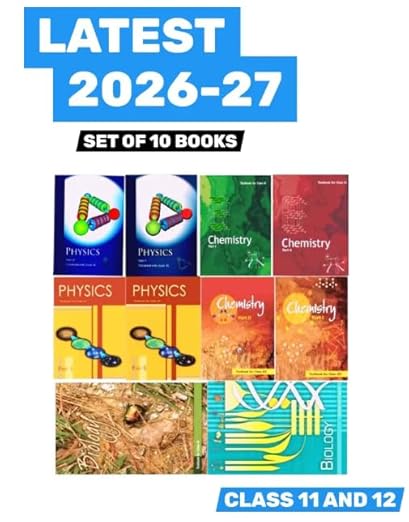
NCERT Physics, Chemistry & Biology Textbooks (Class 11 & 12 Complete Set)
- 90%+ of Biology and 60-70% of Chemistry NEET questions come directly from NCERT
- Every NEET topper recommends mastering NCERT before touching any reference book
- Covers the complete NEET syllabus as defined by NTA
- Free official PDF versions available on ncert.nic.in for immediate access
- Biology diagrams and flowcharts in NCERT are directly tested in NEET questions
- Exemplar problems included in newer editions provide NEET-style MCQ practice
- Line-by-line reading of NCERT Biology alone can secure 340+ out of 360 in Biology
- Chemistry inorganic sections from NCERT are tested almost verbatim in NEET
Read NCERT line by line. Not skimming, not highlighting. Actual reading where you understand every sentence. For Biology, memorize the diagrams and flowcharts. For Chemistry, focus on inorganic reactions and named reactions. For Physics, work through every solved example. Once you’ve done two complete reads of NCERT, you’re ready for reference books.
Best Books for NEET Physics
Physics is the section where most NEET aspirants lose marks. It carries 180 marks (50 questions), and unlike Biology where NCERT is almost sufficient, Physics requires additional practice with numerical problems and concept application. You need one reference book that builds conceptual clarity and gives you enough practice problems.
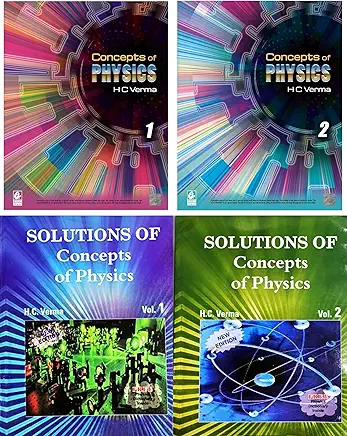
Concepts of Physics by H.C. Verma (Vol 1 & 2)
- The gold standard for physics conceptual understanding in India
- Excellent worked examples that teach you to think about problems
- Problems range from basic to advanced, covering all NEET topics
- Conceptual problems build deep understanding of mechanics, optics, and electrodynamics
- Objective questions section in each chapter is directly relevant for NEET Physics
- Covers entire Class 11 and 12 Physics syllabus with clear theoretical explanations
- Problems range from NCERT-level to JEE-advanced, with NEET-relevant ones clearly identifiable
- Used by 95%+ of serious Physics students preparing for competitive exams in India
H.C. Verma’s Concepts of Physics is the single best physics reference book for NEET. It’s been the go-to for 20+ years for a reason: it teaches you to think about physics, not just memorize formulas. The worked examples are exceptional, and the exercise problems range from straightforward to challenging. For NEET, you don’t need to solve every problem. Focus on the objective-type questions and the easier numerical sets.
A common mistake: students try to solve the toughest H.C. Verma problems thinking it’ll help for NEET. It won’t. NEET physics is about speed and conceptual clarity, not solving JEE-Advanced-level numericals. Stick to Level 1 problems and objective questions.
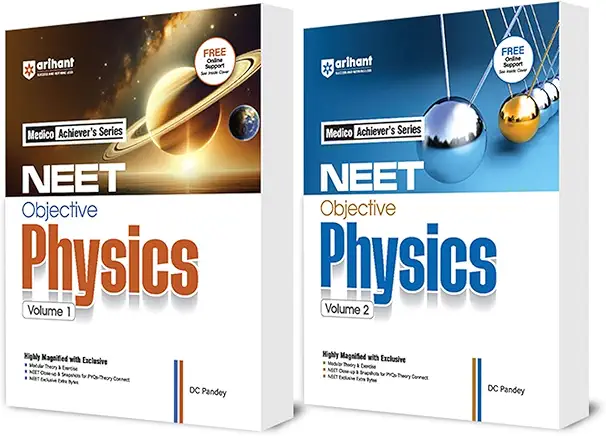
Objective Physics for NEET by DC Pandey
- NEET-specific objective problems organized by topic and difficulty
- Includes previous year NEET questions with detailed solutions
- Good alternative if HC Verma feels too JEE-oriented
- MCQ format matches NEET question pattern with single correct answer options
- Topic-wise organization aligned with NTA NEET syllabus structure
- Includes previous year NEET Physics questions sorted by chapter
- Difficulty level closer to actual NEET compared to JEE-focused alternatives
- Answer explanations include shortcut methods for faster problem solving
DC Pandey’s Objective Physics is a NEET-specific alternative to H.C. Verma. If you find Verma too JEE-oriented (which some students do), DC Pandey gives you objective-type problems specifically designed for medical entrance exams. It includes previous year NEET questions with solutions, which is extremely useful for understanding the exam pattern.
Pick either H.C. Verma or DC Pandey. Don’t buy both. One reference book for physics is enough alongside NCERT.
Best Books for NEET Chemistry
Chemistry is the most scoring subject in NEET if you prepare smartly. It has three sub-sections: Physical, Organic, and Inorganic Chemistry. Inorganic is the easiest to score in because it’s mostly memorization-based. Physical chemistry needs practice with numerical problems. Organic chemistry requires understanding reaction mechanisms.
NCERT is non-negotiable. Read your Biology NCERT textbook line by line at least 3 times before touching any reference book. Over 90% of NEET Biology questions come directly from NCERT content, diagrams, and examples.
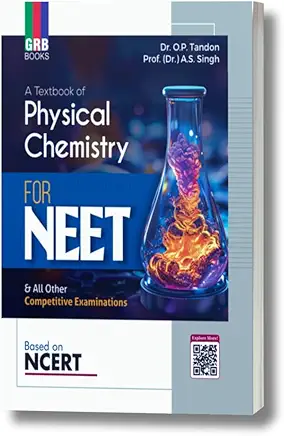
Physical Chemistry by OP Tandon
- Covers all physical chemistry topics tested in NEET with clear explanations
- Includes solved numerical problems at NEET difficulty level
- Good balance between theory and practice for medical entrance exams
- Covers physical, organic, and inorganic chemistry for NEET-level preparation
- Reaction mechanisms explained with visual diagrams and electron flow arrows
- Numerical problems in physical chemistry match NEET calculation complexity
- Periodic table trends and chemical bonding covered in exceptional detail
- Practice problems at chapter end include previous NEET chemistry questions
OP Tandon covers physical chemistry with a good balance of theory and numerical practice. The explanations are clearer than most alternatives, and the problems match NEET difficulty. For the physical chemistry portion, you need to be fast with calculations involving mole concept, equilibrium, and electrochemistry. OP Tandon builds that speed.
For Organic Chemistry, MS Chouhan’s Elementary Problems in Organic Chemistry (check price on Amazon) is excellent for reaction mechanism practice. And for Inorganic Chemistry, NCERT is honestly sufficient for 90%+ of the questions. Read NCERT Inorganic Chemistry chapters 3-4 times, and you’ll cover almost everything NEET asks.
If you want one comprehensive chemistry book instead of separate ones, Modern’s ABC of Chemistry for Class 11 & 12 (check price on Amazon) covers all three sub-sections at NEET level. For deeper study, check out my guides on physical chemistry books and inorganic chemistry books.
Best Books for NEET Biology
Biology is where NEET is won or lost. 100 questions, 360 marks, 50% of the total paper. And the best part? NCERT is almost sufficient. Over 90% of Biology questions come directly from NCERT textbooks. Your job is to memorize NCERT Biology so thoroughly that you can recall specific diagrams, flowcharts, and even exact phrases from the text.
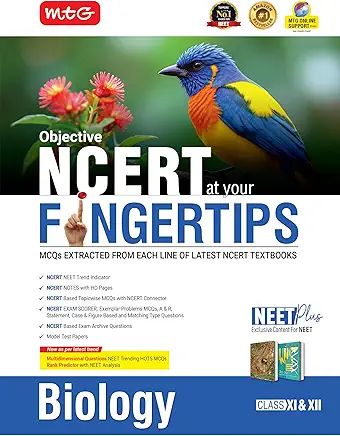
MTG Objective NCERT at Your Fingertips for NEET Biology
- NCERT-based MCQs organized chapter-wise for targeted practice
- Includes previous year NEET questions mapped to NCERT chapters
- The best companion book for NCERT Biology revision
- Organized chapter-wise matching NCERT Biology structure for easy cross-reference
- Assertion-Reason and statement-based questions mirror current NEET pattern
- Includes NEET previous year questions from 2010 onwards sorted by topic
- Quick revision points at the start of each chapter for last-minute preparation
- Over 4,000+ MCQs covering both Botany and Zoology for comprehensive practice
MTG’s “Objective NCERT at Your Fingertips” is the perfect companion to NCERT Biology. It converts every NCERT concept into MCQ format, organized chapter-wise. After reading an NCERT chapter, solve the corresponding MTG section immediately. This active recall approach is far more effective than just re-reading NCERT passively. The book also maps previous year NEET questions to specific NCERT chapters, showing you exactly which topics are high-yield.
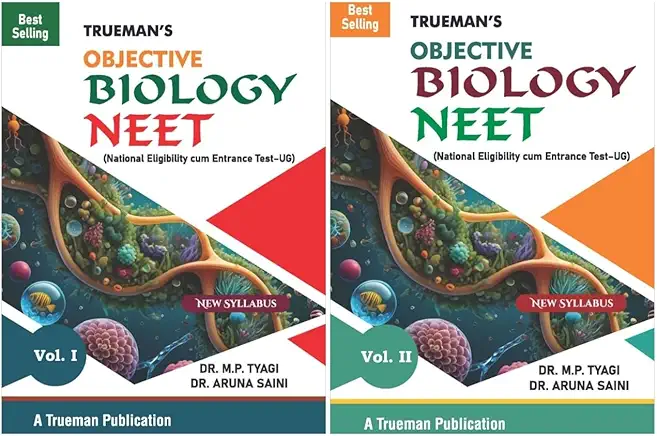
Trueman's Objective Biology for NEET (Vol I & II)
- Comprehensive biology reference with detailed explanations beyond NCERT
- Covers Botany and Zoology with extensive MCQ practice sets
- Helpful for the 10% of Biology questions that go beyond NCERT
- Comprehensive coverage of both Botany and Zoology in two volumes
- Diagrams and illustrations match the quality needed for NEET Biology sections
- Practice questions include AIIMS and JIPMER patterns alongside NEET
- Detailed explanations for every answer help identify conceptual gaps
- Updated annually with latest NEET Biology question trends and patterns
Trueman’s Objective Biology is a solid secondary reference for Biology. It goes slightly beyond NCERT, which helps with the 10% of questions that test concepts not explicitly in the textbook. The two-volume set covers both Botany and Zoology with detailed explanations and practice MCQs. Use this after you’ve completed NCERT, not before.
NEET Study Strategy That Actually Works
Having the right books is only useful if you study them the right way. Here’s the strategy that produces 600+ scores consistently.
Phase 1 (Months 1-4): NCERT Foundation. Read all NCERT textbooks cover to cover. Don’t touch reference books yet. After each chapter, solve the in-text questions and back exercises. For Biology, make handwritten notes of diagrams and flowcharts. You’ll use these for quick revision later.
Phase 2 (Months 4-8): Reference Book Practice. Now add one reference book per subject. Solve topic-wise problems after each NCERT chapter revision. Track your accuracy. If you’re getting less than 70% correct in any topic, go back to NCERT and re-read that chapter before attempting more problems.
Phase 3 (Months 8-12): Mock Tests & Previous Years. Start taking full-length NEET mock tests. Solve the last 10 years of NEET previous year papers under timed conditions. Analyze every wrong answer. The Pomodoro technique works well during this phase for focused revision sessions.
For the complete preparation roadmap, read my guide on how to prepare for NEET. I’ve covered the detailed study plan, time management, and common mistakes to avoid.
My Recommended Book Combinations
Here’s exactly what I’d buy for NEET preparation:
Don’t spread yourself thin across too many reference books. One solid reference book per subject, combined with thorough NCERT mastery, is the formula every NEET topper follows.
Essential Set (Every NEET Aspirant):
- NCERT Physics, Chemistry, Biology (Class 11 + 12) – Your primary textbooks
- MTG Objective NCERT at Your Fingertips (Physics + Chemistry + Biology) – For MCQ practice
- H.C. Verma Concepts of Physics OR DC Pandey Objective Physics – For Physics numericals
Extended Set (If You Want Extra Practice):
- Everything in the Essential Set, plus:
- OP Tandon for Physical Chemistry
- Trueman’s Objective Biology (Vol I & II)
- MS Chouhan for Organic Chemistry practice
The golden rule: one book per subject, mastered completely. A student who finishes 100% of one book will always outscore someone who reads 40% of three books. Don’t hoard books. Master them.
For more study tools and resources, check out my separate guide. And if you’re also looking at coaching options, read my guides on best NEET coaching in Kota and best NEET coaching in Delhi.
Frequently Asked Questions
Is NCERT enough for NEET Biology?
Yes, for 90%+ of Biology questions. NEET Biology questions are taken almost directly from NCERT textbooks. Read NCERT Biology 3-4 times, memorize diagrams and flowcharts, and you’ll cover the vast majority of what’s tested. Add MTG Fingertips or Trueman’s for the remaining 10% and for MCQ practice.
Which is better for NEET Physics: HC Verma or DC Pandey?
HC Verma is better for building deep conceptual understanding, but some of its problems are JEE-level difficulty. DC Pandey’s Objective Physics is more NEET-specific with MCQ-format questions. If you’re only preparing for NEET, DC Pandey is the more targeted choice. If you want stronger physics fundamentals, go with HC Verma but stick to objective questions and Level 1 problems.
How many books do I need for NEET preparation?
You need NCERT textbooks for all three subjects (6 books total), plus one reference book per subject. That’s 9 books maximum. Adding MTG Fingertips for MCQ practice makes it 10-12. Anything beyond that is too many. The students who score 650+ typically use fewer books but study them more thoroughly.
Can I crack NEET without coaching using only books?
Yes. Many NEET toppers have cracked the exam through self-study with books and online mock tests. The key is having NCERT as your foundation, one good reference book per subject, regular mock tests, and disciplined revision. Coaching helps with structure and doubt-clearing, but the actual learning comes from solving problems yourself. Books plus a mock test series is enough.
How long should I prepare for NEET?
Most successful NEET aspirants prepare for 10-12 months with focused, daily study of 6-8 hours. If you start in Class 11, you have the luxury of building a strong foundation over two years. Students starting after Class 12 boards need at least 6-8 months of intensive preparation. Consistency matters more than marathon study sessions.
What score do I need for a government medical college?
For general category students, you typically need 600+ out of 720 for top government medical colleges. For newer government colleges, 550+ may be sufficient depending on your state and category. OBC, SC, and ST candidates qualify at lower cutoffs. The competition varies each year, but aiming for 600+ gives you a comfortable margin for most government MBBS seats.
Should I solve previous year NEET papers?
Absolutely. Solving the last 10-15 years of NEET previous year papers is one of the most effective preparation strategies. Many questions in NEET are repeated in modified form. Previous year papers also help you understand the exam pattern, identify high-frequency topics, and build time management skills. Start solving them 3-4 months before the exam under timed conditions.
Which subject should I focus on most for NEET?
Biology, without question. It carries 360 out of 720 marks (50% of the total paper), and it’s the most scoring subject because NCERT-based questions have definite answers. A strong Biology score can compensate for average Physics performance. Allocate at least 40% of your study time to Biology, 30% to Chemistry, and 30% to Physics.
The right books combined with the right strategy will get you into a government medical college. Start with NCERT, add one reference book per subject, take regular mock tests, and revise consistently. That’s the formula. It’s not complicated. It just requires discipline.
For the complete NEET preparation guide including syllabus, exam pattern, and study timeline, read my detailed article on NEET 2026 notification and preparation.
Hey Ishita Bhatt & Gaurav tiwari,
Excellent and well-written post. I truly appreciate your hard-work.
Glad to say that you have done a fantastic work and suggested the best books for NEET preparation. Every time you comes up with an idea that are truly important in every aspect. I really like the book of HC-Verma for Concepts of physics, as this book provided me in-depth knowledge and helped me in clearing the concepts. Following and going through your suggested books will helps a lot during NEET preparation.
Eventually thanks for sharing your knowledge and such a helpful post.
Thanks for Sharing..https://www.abcxon.com – This is a platform wherein customers can find all kinds of Books. The platform enables customers to buy these items online from anywhere in India at a very reasonable price.