
 by
by
I opened my first Zerodha account in 2020. I’m still using Kite in 2026, after testing Groww, Upstox, Angel One, Dhan, and ICICI Direct on the side. This Zerodha Kite review is the honest version — what works, what still annoys me, what changed in the last six years, and whether the Kite trading app is the right discount broker for you in 2026.
Short answer: Kite is still the cleanest trading interface in India. The ₹20 flat brokerage hasn’t moved. The order placement is faster than every competitor I’ve benchmarked. The charts are good enough for 95% of retail traders. But Zerodha is no longer the only sensible choice — and there are three specific situations where I’d point you somewhere else.
What is Zerodha Kite, and why does it matter in 2026?
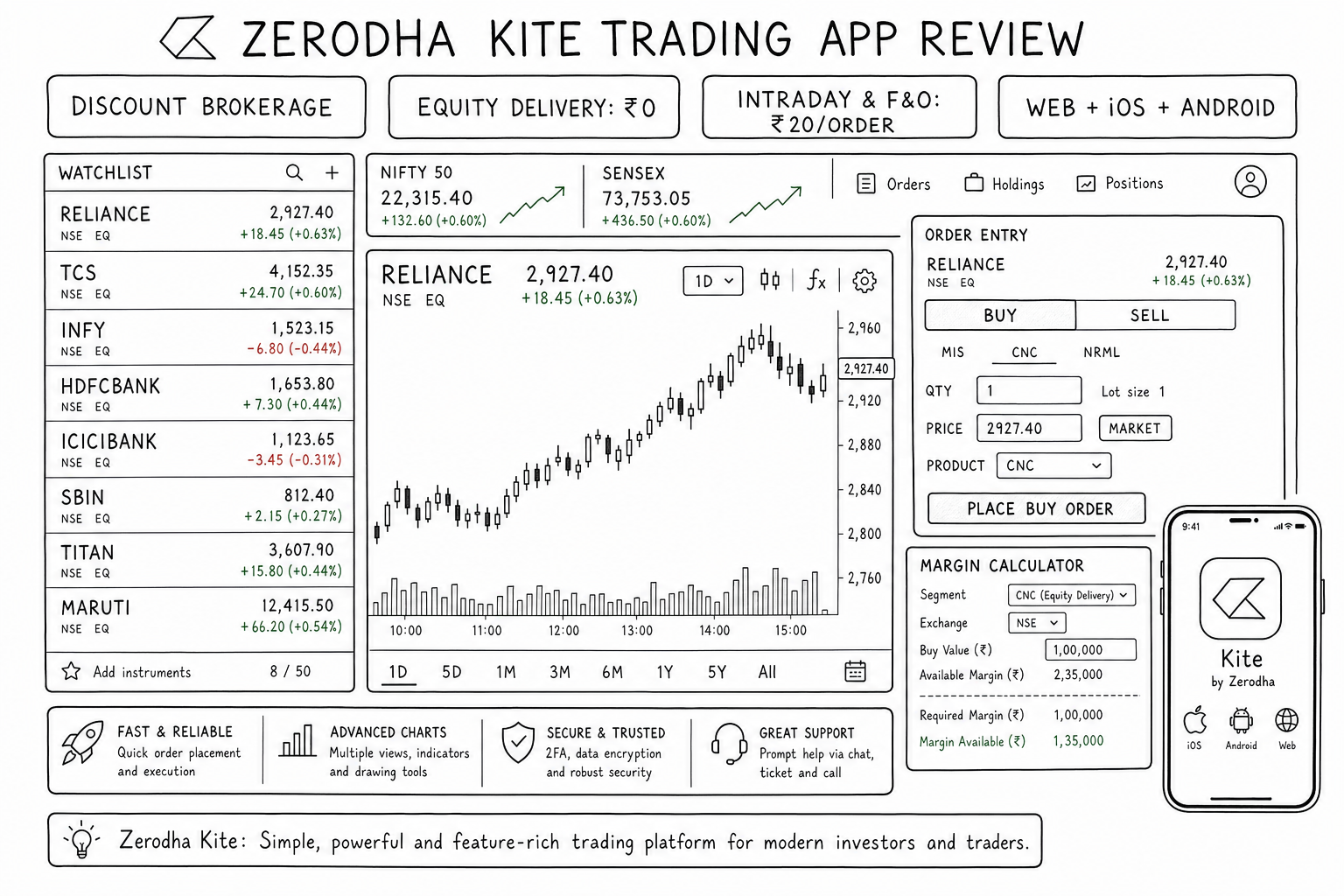
Zerodha Kite is the trading platform built by Zerodha — India’s largest stockbroker by active client count, with roughly 75 lakh active investors and a sustained 17–19% market share on NSE through early 2026. Kite is what you actually use to place orders, watch prices, draw charts, and manage your demat holdings. It runs in any browser at kite.zerodha.com and as a native app on Android and iOS.
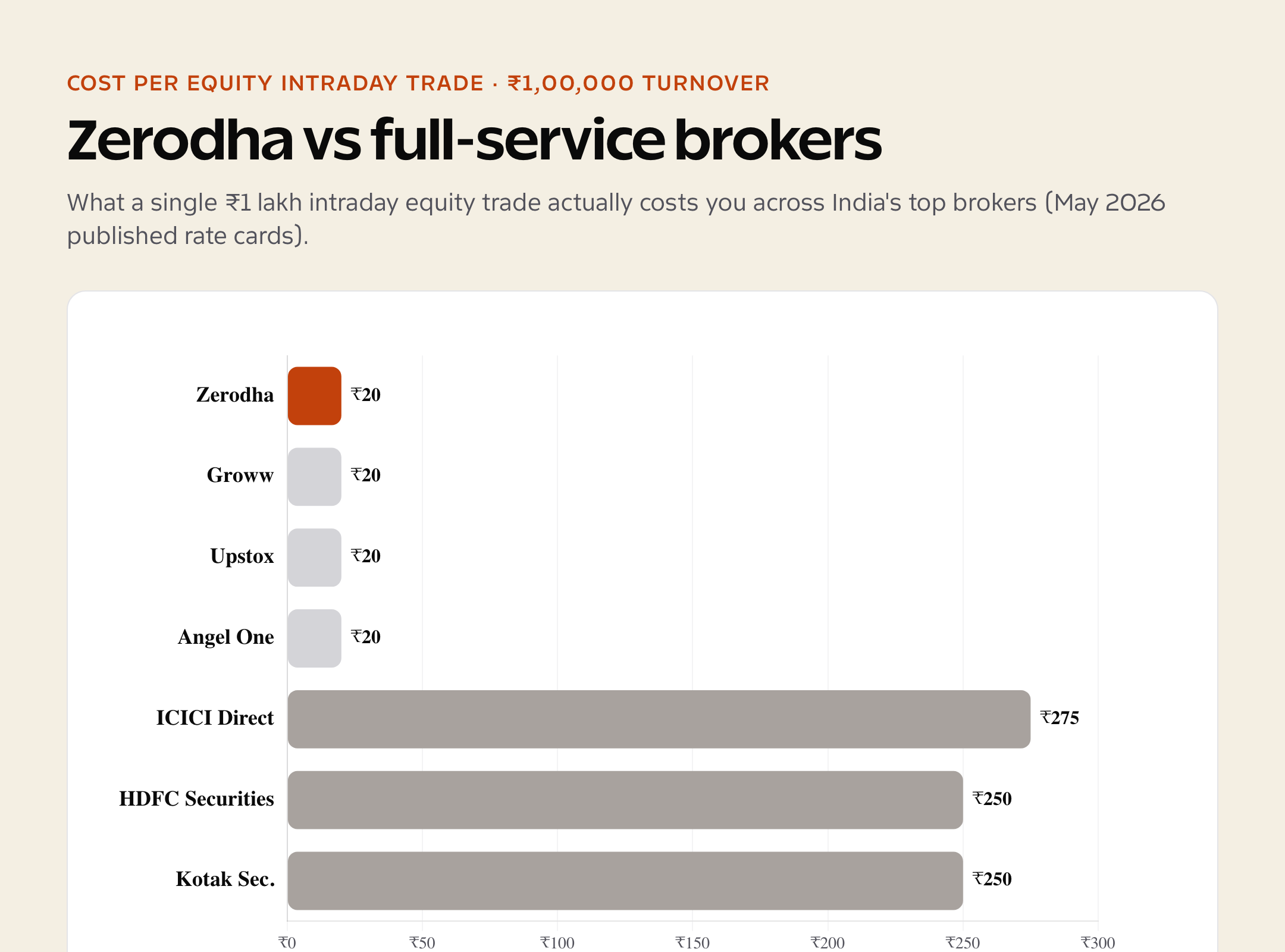
The reason Kite matters: Zerodha invented the ₹20-flat-brokerage model in India in 2015 and forced the entire industry to copy it. Before Zerodha, a single ₹1 lakh intraday trade on ICICI Direct cost ₹275–₹500 in brokerage alone. Today, the same trade costs ₹20 on Kite, Groww, Upstox, Dhan, and Angel One — because Zerodha forced the floor.
What you get with the Kite trading app in 2026:
- ₹0 brokerage on equity delivery (long-term holdings)
- ₹20 flat or 0.03% (whichever is lower) per executed order on intraday, F&O, and currency
- NSE, BSE, MCX — equity, F&O, currency, commodities, and government bonds
- TradingView and ChartIQ charts with 100+ indicators and 6 chart types
- Direct mutual funds via Coin (no commission, ever)
- GTT orders (Good Till Triggered) for set-and-forget entries
- Console — the back-office for P&L, taxes, and downloadable reports
- Free integrations with Sentinel (price alerts), Streak (algo trading), Smallcase (theme baskets), and Varsity (education)
Zerodha brokerage charges — what you actually pay in 2026
Most Zerodha Kite review articles bury the cost section. I’m putting it first because it’s the only line that matters for 90% of retail traders. Here’s what a single executed order costs on Kite in May 2026, compared with the brokers I get asked about most:
Below is the full Zerodha Kite charge schedule for a retail equity trader. The ₹20 brokerage is the headline, but DP charges, STT, and stamp duty are real costs that nobody mentions until your contract note arrives:
| Segment | Brokerage | Other charges you’ll see |
|---|---|---|
| Equity delivery (CNC) | ₹0 | STT 0.1% (buy & sell), DP charge ₹15.34 + GST per scrip per day on sell |
| Equity intraday (MIS) | ₹20 or 0.03% (lower) | STT 0.025% on sell, exchange txn 0.00322% (NSE) |
| Equity F&O — Futures | ₹20 or 0.03% (lower) | STT 0.02% on sell, exchange txn 0.00188% |
| Equity F&O — Options | ₹20 flat per executed order | STT 0.1% on sell premium, exchange txn 0.03503% |
| Currency F&O | ₹20 or 0.03% (lower) | Exchange txn 0.00035% futures, 0.0311% options |
| Commodity (MCX) | ₹20 or 0.03% (lower) | CTT 0.01% on sell non-agri, varies by contract |
| Direct mutual funds (Coin) | ₹0 | Zero commission, zero account-maintenance fee |
| Account opening (online) | ₹200 + ₹100 | One-time: equity + F&O segments. Commodity is ₹100 extra. |
| AMC (annual) | ₹300 + GST | Charged quarterly at ₹75. Free for the first year on online accounts. |
The numbers I see people get wrong:
- DP charges sting on small portfolios. Sell five different stocks in one day, you’ve paid ₹76.70 in DP charges — on top of ₹0 brokerage. For a ₹5,000 sell, that’s a 1.5% drag.
- Options STT bites on expiry day. If you let an in-the-money option expire instead of selling it, STT jumps from 0.1% on premium to 0.125% on the full settlement value. That’s a five-figure mistake on a 50-lot Nifty trade.
- Auto square-off charges ₹50 per position if you don’t close intraday positions before 3:20 PM (equity) / 25 minutes before close (F&O). Set an alert.
I run the math through Zerodha’s own brokerage calculator before placing any large F&O position — what looks like a ₹20 trade often clocks in at ₹60–100 once GST, STT, and exchange charges are added.
Zerodha account opening in 2026 — what changed
Account opening on the Kite app used to take 24–48 hours and a video KYC call. As of 2026, a fully digital Zerodha account opens in 15–25 minutes end-to-end if you have your Aadhaar linked to your mobile number and a PAN handy. The actual flow:
- Go to zerodha.com/open-account and enter your mobile number. You’ll get an OTP.
- Enter your PAN and date of birth. The system pulls your name and address from CKYC if you’re already in the registry.
- Pay ₹200 (equity only) or ₹300 (equity + F&O). Commodity is ₹100 extra. Pay via UPI — net banking adds 5–10 minutes.
- Complete Aadhaar e-KYC — OTP to your Aadhaar-linked mobile, no document upload needed.
- Upload bank proof (cancelled cheque or bank statement) and a signature on a blank A4. Your phone camera does the rest.
- In-Person Verification (IPV) via a 30-second video selfie reading a code shown on screen.
- e-Sign the account opening form using Aadhaar OTP.
I helped my brother-in-law open his Zerodha account last month — from “click sign up” to UCC code in his email took 22 minutes. Funds were tradeable the next morning after a small ₹100 test transfer cleared. If you’re brand new to investing, read my guide to start trading stocks in India before you fund the account — it’ll save you the first ₹5,000 mistake every new trader makes.
Documents you’ll need handy:
- PAN card (mandatory)
- Aadhaar with mobile number linked
- Cancelled cheque OR latest bank statement OR passbook front page (one of these)
- Signature on white paper (photographed clearly)
- For F&O activation: 6-month bank statement OR salary slip OR latest ITR — income proof is mandatory by SEBI rule, not Zerodha policy
Kite trading app features that actually move my workflow
I’ve spent enough hours inside the Kite trading app to know which features I open daily versus which ones are marketing copy. Below is the honest split.
Charts — TradingView built right in
Kite ships with both ChartIQ (the default) and TradingView (toggle in the chart toolbar) charts. TradingView gives you 100+ indicators, 20+ drawing tools, multi-timeframe analysis, and 6 chart types — candlestick, bar, line, area, hollow candle, and Heikin Ashi. You can save chart layouts, drop trendlines that persist across sessions, and place orders directly from the chart with right-click. For most retail traders this is a complete charting solution — you don’t need a separate paid TradingView subscription unless you trade global markets.
The one limitation: you can’t view more than one chart at a time on the mobile app. On desktop, you can split the workspace and watch up to 4 charts side by side — useful when scanning Bank Nifty against its top three constituents during a breakout.
Order placement — the speed Zerodha is known for
Order types on Kite, in plain English:
- Market (MKT) — buy or sell at the best available price. Use it for liquid large-caps. Don’t use it on illiquid stocks — you’ll get filled 2–5% away from the quote.
- Limit (LMT) — specify the price you’ll accept. Order sits in the queue until matched. My default for everything except urgent exits.
- SL (Stop-Loss Limit) — trigger price activates a limit order. Safer in choppy markets; you control the worst fill.
- SL-M (Stop-Loss Market) — trigger price activates a market order. Guaranteed exit, unpredictable price. Use only on liquid scrips.
- GTT (Good Till Triggered) — the underrated one. A standing order that sits dormant for up to one year and fires when a trigger is hit. I use it for laddered SIP-style entries on stocks I want to accumulate.
- Iceberg — splits a large order into smaller chunks (up to 10 legs). Useful for stocks where a big single order would move the price against you.
Zerodha removed Bracket Orders (BO) and Cover Orders (CO) in 2020 after a SEBI circular. Dhan and a few competitors still offer them in modified form — if BO is critical to your strategy, that’s one reason to look elsewhere.
Watchlist, market depth, and the keyboard shortcuts that save hours
You can build up to 5 watchlists with 250 instruments each on Kite web (mobile is capped at 100 per list). Press F1–F5 to flip between them, type a ticker symbol to jump to it, hit B to buy, S to sell, Shift + H to view holdings. The full shortcut list is one of the things that makes the desktop Kite trading app meaningfully faster than Groww or Upstox — you can place an order without ever lifting your hand from the keyboard.
Market depth (the 5-level order book) opens with a single click on any ticker — you can read it in three seconds and decide whether the spread is too wide to use a market order. This is the kind of detail that separates a usable trading platform from a glorified order pad.
Console — the back-office most people never open
Console (console.zerodha.com) is where Zerodha hides the real value. P&L breakdown by stock, by segment, by financial year. Tax P&L reports formatted exactly the way your CA needs them — short-term, long-term, intraday speculative, F&O non-speculative business income, all separated. Tradebook downloads. Funds statements. Capital gains reports that integrate with ClearTax and Quicko. If you do anything beyond CNC delivery, Console is what makes Zerodha actually usable at tax time. I’ve yet to see another Indian broker do this as cleanly.
Coin, Sentinel, Streak, Smallcase — the ecosystem that compounds
Zerodha’s secondary tools are bundled with your Kite login — no separate signup, no separate KYC. Worth knowing what each one does:
- Coin — direct mutual funds (no commission), bonds, and government securities. The lowest-friction way to run a SIP if you’re already using Kite. See my best mutual funds in India guide for what to actually buy.
- Sentinel — price alerts via app push, email, and SMS. Free up to 100 active triggers.
- Streak — no-code algo trading and backtesting. Free tier is enough for a beginner; paid plans start at ₹560/month.
- Smallcase — theme-based baskets of stocks (e.g., “EV revolution,” “All Weather Investing”). Buy a whole basket in one click, rebalance when the manager updates it. Free baskets cost only the underlying brokerage; paid baskets add a subscription.
- Varsity — Zerodha’s free education platform. Genuinely the best free trading curriculum in India. Read the Markets and Taxation module before your first F&O trade.
Zerodha Kite mobile app vs Kite web — what to use when
Both versions sync in real time — place an order on mobile, it shows up on web before you tab over. But the Zerodha Kite mobile app and Kite web are not the same product. Use them for different jobs.
| Job | Kite web | Kite mobile (Android & iOS) |
|---|---|---|
| Multi-chart layouts | Up to 4 simultaneous charts | One chart at a time |
| Watchlists | 5 lists × 250 scrips | 5 lists × 100 scrips |
| Keyboard shortcuts | Full set (F1–F5, B, S, etc.) | Not applicable |
| Biometric login | Not available | Fingerprint + Face ID |
| Quick order entry | Hotkeys are fastest | One-tap buy/sell from watchlist |
| Holdings & P&L view | Detailed Console links | Quick swipe-to-see snapshot |
| Best for | Active intraday + F&O sessions | Monitoring positions on the move |
My personal setup: web during market hours on a second monitor, mobile for everything outside the cash session and for the occasional alert-triggered exit. The Kite trading app on iOS got Face ID login in 2022 and dark mode in 2023 — both small but daily-use upgrades.
Zerodha vs Groww, Upstox, Dhan, Angel One — honest comparison
The Indian discount broker space is no longer a one-horse race. Here’s how Zerodha Kite stacks up against the four brokers I’ve personally opened accounts with and traded on in 2026:
| Broker | Active clients (NSE) | Equity intraday | What they do better than Zerodha |
|---|---|---|---|
| Zerodha | ~75 lakh | ₹20 / 0.03% | Console (taxes), Varsity, ecosystem maturity |
| Groww | ~1.3 crore | ₹20 flat | Cleanest mobile UX for first-time investors |
| Angel One | ~75 lakh | ₹20 flat | Smart API, in-house research, faster F&O |
| Upstox | ~30 lakh | ₹20 flat | Pre-market analysis, options strategy builder |
| Dhan | ~15 lakh | ₹20 flat | Bracket orders, options trader pro tools, faster app |
The brokerage is identical — the differentiation is in the workflow. Zerodha wins if you care about tax reporting, want a single broker for the next 10 years, and don’t want to manage multiple platforms. Groww wins if it’s your first demat account and you mainly want to start a SIP and buy a few stocks. Dhan wins for active options traders who miss bracket orders. I cover all five in detail in my best stock trading apps in India roundup.
Who should skip Zerodha Kite (and why I’d point you elsewhere)
I’ve recommended Zerodha to maybe 200 people over six years. I’ve also told a fair number to use someone else. The three situations where Kite is the wrong fit:
- You need bracket orders for your strategy. Zerodha removed BO/CO in 2020 and hasn’t brought them back. If your day-trading playbook depends on auto-stop-loss and target legs firing on entry, look at Dhan.
- You want hand-holding research and stock recommendations. Zerodha has Varsity for education but doesn’t push research calls. If you want broker-issued buy/sell recommendations, Angel One or HDFC Securities have that built into their workflow.
- You only invest in mutual funds and never trade stocks. If you’ll never buy a single share, Groww or Kuvera have a friendlier mutual fund flow than Zerodha Coin — they’re built mutual-fund-first instead of broker-first.
The downtime conversation: Zerodha has had four notable trading-day outages in the last six years — the worst was August 2020 during the SBI Cards listing. Each time it happens, X is full of complaints. The reality, after running the math against the numbers Zerodha publishes in its monthly transparency reports: 99.7%+ uptime during market hours, in line with industry. But if you’re a leveraged F&O trader, no broker is uptime-proof — keep a backup demat account funded enough to square off positions if your primary goes down. I keep Dhan as my backup.
Kite Connect API — for the algorithmic crowd
Kite Connect is Zerodha’s official trading API. It costs ₹2,000/month per app and gives you programmatic access to place orders, fetch positions, stream live ticks via WebSocket, and pull historical data going back 60 days for intraday and decades for daily. The Python client is mature and well-documented at kite.trade/docs. If you’ve thought about building a quant strategy, Kite Connect is the cheapest production-grade Indian markets API I know of — cheaper than Upstox Pro by ₹500/month and a year ahead in client library quality.
The brutal honest part: most retail algo traders lose money. Before you spend ₹24,000/year on the API, paper-trade your strategy through Streak (no-code, free tier) for at least three months. If it works on paper across both bull and sideways markets, then graduate to the API. The mathematics of risk assessment is brutal — backtests overfit, slippage eats edge, and the only number that survives the transition to live trading is your max drawdown.
My verdict on the Zerodha Kite trading app in 2026
Zerodha Kite is the trading platform I’d put a brand-new investor on, and the one I’m still using six years later. The combination of ₹20 flat brokerage, the Coin direct-mutual-fund flow, the Console tax reports, and the Varsity learning library is a complete retail-investor stack. Nothing else in India bundles all four cleanly.
Where it falls short is on the active-trader edge cases — no bracket orders, no in-house research, occasional outage panic. None of those are dealbreakers for the 95% of users who place 1–10 orders a month. They might be dealbreakers if you’re scalping options for a living.
If you’re starting today, my recommended path: open the Zerodha account, fund ₹5,000, do five small CNC delivery trades to learn the interface, watch the first 10 Varsity videos, then graduate to your real allocation. If you’re brand new to investing entirely, read my investing basics guide first — the broker matters less than the philosophy.
Open your Zerodha account at zerodha.com →
Is Zerodha Kite safe to use in 2026?
Yes. Zerodha is a SEBI-registered stockbroker (INZ000031633) and a depository participant with CDSL. Your shares sit in your own demat account at CDSL, not with Zerodha — even in the unlikely event of broker failure, your holdings are safe. Funds in your trading ledger are SEBI-protected up to settlement; never leave more in the trading account than you need for the next 2–3 days of trading.
What is the minimum amount to open a Zerodha account?
₹200 for equity-only, ₹300 for equity + F&O, plus ₹100 if you want commodity. There is no minimum balance to maintain the account itself. To actually trade, you need enough margin in the trading ledger for whatever position you want to open — for a single Nifty option lot, that’s roughly ₹15,000–₹25,000 depending on the strike.
Is Zerodha Kite better than Groww?
Both charge ₹20 flat brokerage. Groww has a cleaner mobile-first interface for first-time investors and a friendlier mutual-fund flow. Zerodha has a more powerful desktop platform, the Console tax-report engine, the Coin direct-mutual-fund product, and the Varsity learning library. If you’ll trade more than mutual funds and intend to stay with one broker for 10+ years, Zerodha. If you only want a SIP plus occasional stock purchases on your phone, Groww.
Does Zerodha Kite charge for delivery trades?
No brokerage on equity delivery (CNC) — that’s the ₹0 you’ve heard about. You will still pay STT (0.1% buy + 0.1% sell), DP charges (₹15.34 + GST per scrip per day on sell), GST, stamp duty, and SEBI/exchange charges. For a ₹1 lakh CNC trade, total non-brokerage costs land around ₹220–250.
Can I use Zerodha Kite without an Indian bank account?
No. Zerodha requires an Indian savings account in your name to fund the trading ledger and receive payouts. NRIs can open a Zerodha NRI account using an NRE/NRO bank account — the process is offline (forms posted to Bangalore) and takes 7–10 working days. Zerodha currently doesn’t accept clients from the US or Canada due to FATCA reporting overhead.
What happens if Zerodha Kite is down during market hours?
Zerodha publishes a status page at status.zerodha.com and an emergency call-and-trade desk (number on the support page). If a full outage hits and you’re stuck with open intraday or F&O positions, the call-and-trade desk can place exit orders manually — expect a 5–15 minute wait during a real outage. The defensive move: keep a small backup account at Dhan or Upstox funded with enough margin to square off your largest single position.
Zerodha Kite
Pros
- ₹20 flat brokerage on intraday and F&O, ₹0 on equity delivery — cheapest at scale once you cross 10 trades a month.
- Console gives you ready-to-file tax P&L reports separated by short-term, long-term, intraday and F&O — saves a CA bill at year-end.
- Direct mutual funds via Coin with zero commission and zero AMC — one of two free direct MF platforms in India.
- TradingView and ChartIQ both built into Kite — no separate paid charting subscription needed for Indian markets.
- Mature Kite Connect API at ₹2,000/month — cheapest production-grade Indian markets API for algo traders.
- Varsity is the best free trading curriculum in India — bundled free with the account.
Cons
- Bracket Orders and Cover Orders removed in 2020 — active intraday traders may prefer Dhan.
- DP charges of ₹15.34 + GST per scrip per day on delivery sells eat into small portfolio returns.
- Occasional outages during high-volume sessions — keep a backup broker funded if you trade leveraged F&O.
- No in-house research or buy/sell recommendations — you're on your own for stock picking.
- Not available to US or Canadian residents due to FATCA reporting overhead.
Summary
Zerodha Kite is the trading platform I’d put a brand-new Indian investor on, and the one I’m still using six years later. ₹20 flat brokerage, ₹0 on equity delivery, ChartIQ + TradingView charts, Console for tax reports, and Coin for direct mutual funds. Falls short on bracket orders and in-house research, but for 95% of retail traders it’s the cleanest discount-broker stack in India. The ecosystem (Coin, Sentinel, Streak, Smallcase, Varsity) is what compounds the value over years.
Price: INR 200 one-time account opening
Open a Zerodha AccountTell Google you want more of this.
Add Gaurav Tiwari as a preferred sourceOne tap, and this site shows up more often in your own Top Stories, AI Overviews and AI Mode. Remove it any time.