
What Advantages Does Aerodynamic Grain Drying Technology Provide?
 by
byModern agribusiness constantly faces a challenge: not only how to grow a large harvest but also how to deliver it to market in the best quality. Grain price on both domestic and international markets directly depends on moisture content, nutrient preservation, and overall appearance. That is why drying is a critically important stage of post-harvest processing. While traditional dryers are now considered outdated due to high costs and risks of spoilage, aerodynamic technologies from Metra represent a fundamentally new level of efficiency and profitability.
Here’s the short version. Aerodynamic grain drying technology moves grain through a fast, even airflow instead of blasting it with high heat, so you spend far less energy, crack far fewer kernels, and keep more of your harvest at sellable grade. The biggest advantages land for high-volume producers and seed growers, the people for whom a one or two percentage point quality downgrade quietly erases a season’s margin. If you dry a few hundred bushels a year, a simpler setup may be enough. If you dry thousands and chase export contracts, this is the technology to look at first.
Why this matters: Roughly a third of global food production is lost after harvest, about 1.3 billion tonnes a year, and bad drying is a primary cause. In developing countries, 10 to 20 percent of cereals are lost in storage versus just 1 to 2 percent in developed ones. Grain harvested at 18 to 26 percent moisture starts deteriorating if it isn’t dried within 24 hours. Aerodynamic drying targets exactly that window, pulling grain down to the 13 to 14 percent safe-storage range without the thermal stress that traditional dryers inflict.
Operating Principle and Differences from Traditional Methods
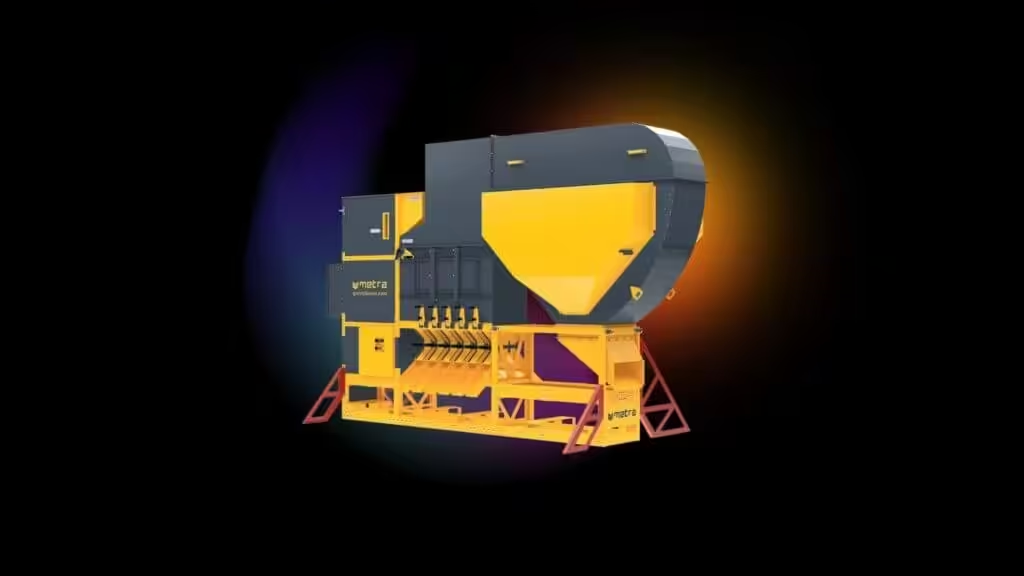
Traditional dryers use the method of direct air heating, which passes through the grain and gradually evaporates moisture. This process often causes issues: overdrying, overheating, and cracks in the grain. Such defects reduce quality and, consequently, the selling price. The problem is structural, not operator error. In a conventional crossflow column dryer, the grain mass nearest the heat plenum wall gets far hotter than grain at the outer edge. That uneven exposure shows up as stress cracks, and stress cracks are exactly what a buyer’s grading test penalizes.
Aerodynamic technology applies an accelerated airflow that evenly surrounds the grain mass, lowering moisture without extreme temperatures. The grain is effectively suspended and tumbled in a moving air stream, so every kernel sees roughly the same conditions instead of a hot face and a cool one. This method minimizes mechanical damage and allows processing of a wide range of crops, from wheat and corn to oilseeds, on the same machine. Because the airflow does the work that heat used to do, you can hit your moisture target with a gentler thermal profile and far less risk of cooking the batch.
One honest caveat worth stating up front. With any high-airflow dryer, pushing the temperature too hard still causes thermal stress, and some early fluidized-bed trials on freshly harvested rice reported a drop in head rice yield when settings ran aggressive. The advantage isn’t that aerodynamic drying makes temperature irrelevant. It’s that the even airflow gives you a far wider safe operating window, so hitting good quality is the default rather than a tightrope.
Energy Efficiency, an Unmatched Source of Savings
Conventional dryers mostly operate on gas or diesel, leading to significant expenses. For large harvest volumes, fuel costs can reach tens of thousands of dollars per season. In addition, they contain numerous mechanical parts, burners, blades, and ventilation systems, that require frequent repairs and replacements. Every one of those parts is a line item and a potential breakdown during the few weeks a year when you can least afford downtime.
The efficiency gap is measurable, not marketing. Research on combination and hybrid drying approaches has documented efficiency improvements of roughly 24 to 26 percent over conventional crossflow drying, with some hybrid configurations cutting energy consumption by as much as 80 percent. In practice, aerodynamic dryers:
- consume 2 to 3 times less electricity,
- require no gas or liquid fuel,
- have no complex units, which minimizes repair costs.
Financially, this means an agricultural enterprise can reduce the cost of drying one bushel of grain several times over. When processing thousands of bushels, the savings become substantial, turning into additional profit or a reserve for reinvestment. Cutting fuel out of the equation also removes your exposure to volatile gas and diesel prices, which is its own quiet form of risk management. If you’ve ever worked through how to reduce operating costs in a business, you’ll recognize the pattern: the biggest wins come from removing a recurring expense entirely, not trimming it.
Quick reference, the numbers that matter. Cereal grains store safely at roughly 13 to 14 percent moisture; oilseeds need 8 to 10 percent. Above 16 percent, rice keeps for only a few weeks. Continuous fluidized-bed and aerodynamic systems run from a few hundred pounds per hour up to 30 to 40 tonnes per hour, and continuous designs deliver 5 to 10 times the capacity of batch units. Those throughput figures are why the technology scales from a mid-size farm to a commercial elevator.
Grain Quality and Market Price
Another major advantage of aerodynamic drying is the preservation of grain structure and nutrients. While traditional systems often lead to brittleness or gluten damage, in modern units the grain remains “alive”. The difference comes back to that even airflow. Without a scorching plenum wall, you avoid the stress cracks and yellowing that drag a batch down a grade, and you keep more of the protein and germination quality that buyers actually pay for. The role of better processing technology in protecting product value mirrors what happens in other industries, including how technology reshapes outcomes in modern healthcare: the tool quietly raises the quality floor.
The financial effect is twofold:
- Grain does not downgrade in class, allowing it to be sold at higher prices.
- Seed material retains germination capacity, making it possible to sell at premium rates.
- The output of higher-grade grain provides farmers with a direct opportunity to earn more, even without increasing yield.
Aerodynamic Grain Drying vs. Traditional Drying, Side by Side
Put the two approaches next to each other and the trade-offs get concrete. The table below sums up how aerodynamic grain drying technology compares with a conventional column or crossflow dryer across the factors that actually move your bottom line.
| Factor | Aerodynamic Dryer | Traditional Dryer |
|---|---|---|
| Energy source | Electric airflow, no gas or diesel | Gas or diesel burners |
| Energy efficiency | 24 to 26% higher; up to 80% less energy in hybrid setups | Baseline crossflow efficiency |
| Heat exposure | Even, low-temperature airflow around each kernel | Hot plenum wall, uneven exposure |
| Grain damage | Minimal stress cracking, structure preserved | Overheating, cracks, downgrades |
| Moisture target | 13 to 14% cereals, 8 to 10% oilseeds, gently | Same target, higher quality risk |
| Throughput | Up to 30 to 40 t/h; 5 to 10x batch capacity | Limited by column size and heat |
| Moving parts | Few; low maintenance | Burners, blades, fans to service |
| Service life | 25 to 30 years with care | Shorter, fuel and repair heavy |
Durability and Fast Payback of Equipment
Traditional dryers demand ongoing spending on fuel and maintenance, which cuts into profits. Aerodynamic units are designed for long-term operation, over 25 to 30 years with proper care. The absence of moving parts reduces breakdown risks, and the simple construction makes them easy to use even for smaller farms. Fewer parts also means fewer suppliers, fewer service calls, and fewer points where a failure can stall your harvest window.
Thanks to low operating costs and the high quality of the final product, such machines pay for themselves several times faster than classical alternatives. The payback math is the part worth running on your own numbers before you buy: take your current annual fuel bill, add your typical grading downgrades, and compare that against the unit’s price and electricity draw. For most high-volume operations the gap is large enough that the question shifts from “is it worth it” to “how soon can it run a full season”.
Entering International Markets Through Modern Technology
Grain dried in aerodynamic units meets international standards for moisture, cleanliness, and safety. This provides producers with clear advantages:
- easier contract negotiations with European and Asian traders,
- access to premium market segments,
- minimized risk of rejection during product certification.
In other words, investing in aerodynamic dryers means not only cost savings but also the opportunity to achieve higher margins and attract new foreign partners. Consistent moisture and low damage rates are exactly the specifications export contracts are written around, so meeting them reliably turns drying from a cost center into a door opener.
Who Benefits Most, and Who Can Wait
The technology isn’t a fit for everyone in equal measure, and pretending otherwise helps no one. Aerodynamic drying pays off fastest for high-volume grain producers, seed growers who live or die on germination rates, and operations chasing export-grade contracts where a downgrade wipes out the premium. For those producers, the energy savings and quality gains compound across thousands of bushels.
If you’re a smaller farm drying a few hundred bushels for local sale, the math is tighter, and a simpler or shared facility may serve you for now. The good news is that the low maintenance and long service life make aerodynamic units approachable even at modest scale once volume grows. The same instinct that pushes farmers toward automation in small businesses applies here: invest in the tool that removes a recurring cost and a recurring risk at the same time, and let it earn its keep over years rather than weeks. If you’re building an agribusiness from the ground up, it’s also worth folding this into the broader equipment plan when you start a new business.
Why Consider This Option?
Aerodynamic grain drying technology changes the approach to post-harvest processing. It provides agribusiness with:
- significant reductions in maintenance costs,
- improved grain quality,
- preservation of a larger share of the harvest without losses,
- fast return on investment,
- long-term financial benefits.
Compared to traditional methods used by producers in the past, aerodynamic grain drying stands out as a strategic solution that allows your company to enter new markets, generate additional profit, and actively grow. Run the payback numbers against your own fuel bill and grading history, and for most high-volume operations the case makes itself.
Tell Google you want more of this.
Add Gaurav Tiwari as a preferred sourceOne tap, and this site shows up more often in your own Top Stories, AI Overviews and AI Mode. Remove it any time.