
Best Legal Textsheet Alternatives for Students in 2026
The best Textsheet alternatives in 2026 are Chegg Study ($14.95/mo for step-by-step solutions), Khan Academy (completely free), Wolfram Alpha (best for math), and Quizlet (which absorbed Slader’s textbook solutions). Textsheet was permanently shut down after Chegg filed a DMCA takedown for scraping its paid content.
But here’s what most “Textsheet alternative” articles won’t tell you: Textsheet was a problem, not a solution. And blindly jumping to the next free answer site puts you in the same boat. I want to give you a proper breakdown of what happened, why it matters, and which alternatives are actually worth your time in 2026.
Quick Summary: 11 Best Textsheet Alternatives
- Chegg Study — $14.95/mo, step-by-step textbook solutions (the original source Textsheet scraped)
- Quizlet — Free + Plus $7.99/mo, flashcards and active recall study tools
- Khan Academy — 100% free, video lessons covering math, science, economics, and more
- Course Hero — $9.95/mo, course-specific study documents and tutor access
- SparkNotes — Free, literature summaries, chapter analysis, and character guides
- Coursera — Free to audit, university courses from Stanford, MIT, and others
- Wolfram Alpha — Free + Pro $7.25/mo, computational engine for math and science
- Mathway — Free answers + Premium $9.99/mo for step-by-step solutions
- Symbolab — Free + Premium $2.49/mo, step-by-step math solver with practice problems
- Photomath — Free, scan handwritten math problems with your phone camera
- Brainly — Free + Plus $4.99/mo, peer-to-peer homework help community
What Was Textsheet and Why Did It Get Shut Down?
Textsheet was a website that provided free answers to homework and assignment questions. On the surface, it looked like a study resource. Under the hood, it was something else entirely.
Textsheet worked by pulling answers directly from Chegg’s database using their API. Students would search a question on Textsheet, and it would scrape Chegg’s paid content and display it for free. Chegg charges $14.95/month for those answers. Textsheet gave them away at zero cost.
This wasn’t a gray area. Textsheet was redistributing copyrighted content without permission, profiting from ad revenue on stolen material. Chegg filed a DMCA (Digital Millennium Copyright Act) takedown, won the legal battle, and Textsheet was permanently shut down.
The site hasn’t returned and won’t. If you see any site claiming to be “the new Textsheet,” it’s either a scam, a phishing site, or another service doing the same thing that got Textsheet killed.
Why Textsheet Was Bad for Students (Not Just Legally)
The legal issue is obvious. But Textsheet had deeper problems that most students didn’t think about.
It encouraged copy-paste learning. Textsheet gave you the answer but not the understanding. Students would copy solutions without learning the methodology. That works fine until the exam, where there’s no Textsheet to pull from. I’ve talked to students who aced their homework but failed their finals. Same subject, same material. The difference was they never actually learned it.
The answers weren’t always right. Textsheet scraped Chegg, and Chegg’s answers are user-submitted. Some are from qualified tutors. Many are from other students who may or may not know what they’re doing. Copying a wrong answer is worse than submitting nothing, because it shows you didn’t even check the work.
It created dependency. When answers are free and instant, why would you struggle through a problem? But struggling through problems is how learning works. Your brain doesn’t retain information it didn’t work for. Students who relied on Textsheet for two years found themselves unable to handle coursework once it disappeared.
Academic integrity risks. Many universities now use plagiarism detection tools that can match submitted work against known answer databases. If your “original” homework matches Chegg’s answer word-for-word, that’s an academic misconduct flag. Several universities have already partnered with Chegg to identify students who copy answers directly.
So when I recommend alternatives below, I’m recommending tools that actually help you learn, not just copy. That’s a feature, not a limitation.
Best Legal Textsheet Alternatives
These alternatives are legitimate, currently active, and actually useful for learning. I’ve organized them by what they’re best at.
Chegg Study: The Original Source
Chegg Study is where Textsheet was stealing content from. If you want those same answers legally, go to the actual source.
Chegg covers 80+ subjects with step-by-step textbook solutions, expert Q&A, and on-demand tutoring. The subscription starts at $14.95/month for Chegg Study, or $19.95/month bundled with writing and math tools.
What makes it worth paying for: Unlike Textsheet’s scraped answers, Chegg’s platform shows you the methodology behind each solution. You can see how the expert arrived at the answer, which is what you actually need for exams. They also offer live tutoring if you’re stuck on a concept.
The honest take: Chegg is useful for understanding methodology. But treat it as a study guide, not an answer sheet. Copying Chegg answers verbatim is how students get caught for academic dishonesty. Universities have flagged this enough times that Chegg now cooperates with academic integrity investigations.
Quizlet: Best for Flashcards and Active Study
Quizlet has 50+ million users across 130 countries with over 300 million study sets. It started as a flashcard app and has grown into a full study platform with AI-powered learning tools.
In 2023, Quizlet acquired Slader (another popular Textsheet alternative that offered free textbook solutions). Those resources are now integrated into Quizlet’s platform. If you used Slader before, Quizlet is where that content lives now.
What makes it stand out: Quizlet’s strength is active recall. Instead of passively reading answers, you test yourself with flashcards, practice tests, and spaced repetition. This is the study method with the most scientific backing for long-term retention. The free tier is generous. Quizlet Plus ($35.99/year) removes ads and adds AI-powered study tools.
Best for: vocabulary, definitions, concept review, exam prep. Less useful for complex math or engineering problem-solving.
Khan Academy: Best Free Learning Resource
Khan Academy is completely free and always has been. No subscription, no premium tier, no ads. It’s a nonprofit funded by donations.
They cover math (from basic arithmetic through calculus and linear algebra), science (biology, chemistry, physics), economics, computer science, and SAT/AP prep. Every topic includes video explanations, practice problems, and progress tracking.
Why it’s better than Textsheet: Khan Academy teaches you the concept before giving you practice problems. Instead of copying an answer you don’t understand, you watch a 10-minute video that actually explains the material. Then you work through practice problems with hints if you get stuck. You end up knowing the subject, not just having a completed assignment.
Best for: math, science, economics, and standardized test prep. If you’re struggling with a subject at the foundational level, start here before paying for anything.
Course Hero: Best for Course-Specific Materials
Course Hero has 30+ million course-specific study resources uploaded by students and educators. This includes lecture notes, study guides, practice problems, and detailed explanations organized by university and course.
The freemium model gives you limited access when you upload your own study materials. Paid plans run $9.95/month (annual) to $39.95/month (monthly). That’s steep, but the course-specific content is hard to find elsewhere.
What makes it different: Course Hero’s value is specificity. You can find study guides and past exams for your exact course at your exact university. That level of relevance is useful for exam prep. They also offer 24/7 tutoring through their homework help feature.
Best for: finding course-specific notes and study guides, especially for popular courses at large universities.
SparkNotes: Best for Literature and Humanities
SparkNotes has been around since 1999 and is still one of the best resources for literature analysis, summaries, and study guides. If you need to understand a novel, play, or poem for a class, SparkNotes breaks it down chapter by chapter with themes, character analysis, and key quotes.
It’s completely free and covers hundreds of literary works, plus subjects like history, philosophy, and social sciences. They also have SAT prep materials.
Best for: English literature courses, reading comprehension, essay prep for humanities classes. Not useful for STEM subjects.
Coursera: Best for Deep Subject Learning
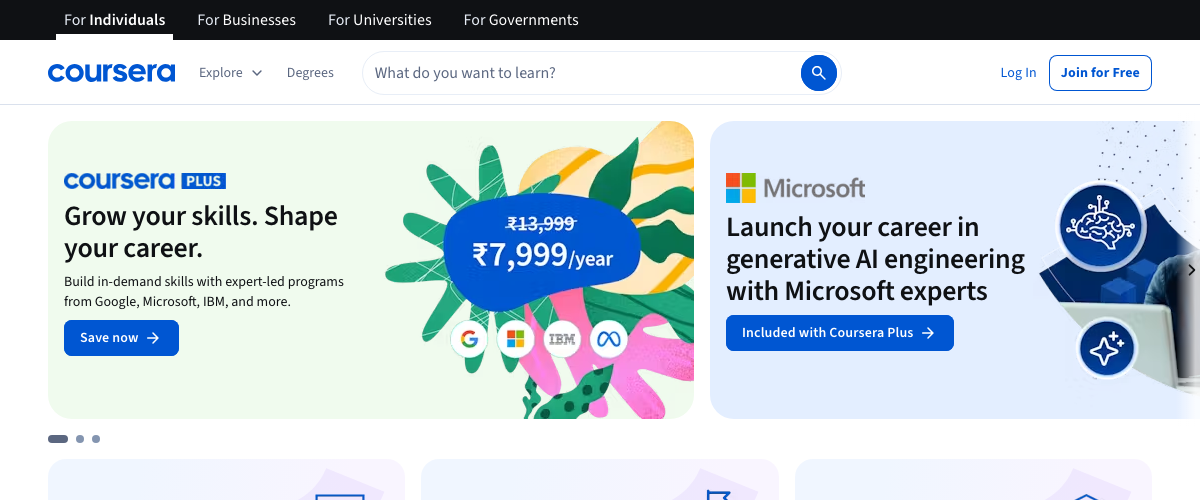
Coursera isn’t a homework answer site. It’s an online learning platform with 3,600+ courses from universities like Stanford, MIT, and Yale. This is for students who want to actually understand a subject they’re struggling with.
Most courses are free to audit (watch lectures and access materials). Certificates cost $39-79 per course, and Coursera Plus ($59/month) gives unlimited access to most courses.
Why it belongs on this list: If you’re constantly searching for answers in a specific subject, the problem might be that you don’t understand the fundamentals. A 4-week Coursera course in that subject can fill knowledge gaps that no amount of answer-copying will fix. I’ve recommended Coursera to students who were failing organic chemistry. After a focused 3-week course alongside their classes, their grades turned around.
Best for: students struggling with an entire subject (not just one assignment) who want to build real understanding.
Wolfram Alpha: Best for Math and Science Calculations
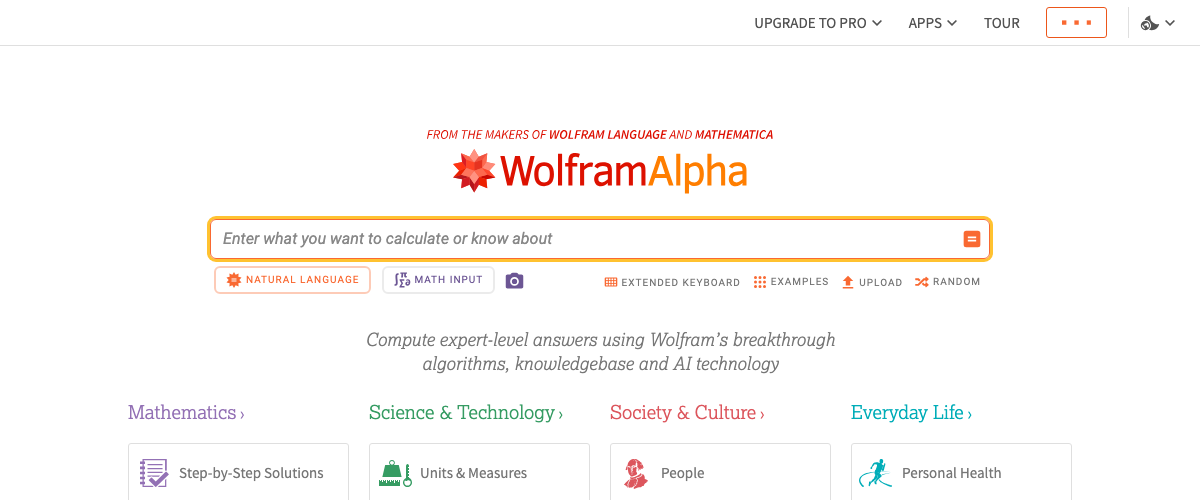
Wolfram Alpha is a computational knowledge engine. Type in a math problem, and it doesn’t just give you the answer. It shows you every step of the solution with explanations.
The free version handles most queries. Wolfram Alpha Pro ($7.25/month for students) adds step-by-step solutions for more complex problems, extended computation time, and image input (photograph a handwritten equation and it solves it).
Why it’s better than copying answers: Wolfram Alpha shows the work. You can trace through each step and understand why the answer is what it is. For calculus, algebra, statistics, chemistry, and physics calculations, it’s the single most useful tool available.
Best for: math (all levels), physics calculations, chemistry equations, statistics, and data analysis.
Mathway: Best Mobile Math Solver
Mathway is a math problem solver that handles basic math, algebra, trigonometry, calculus, statistics, and more. You can type or photograph a problem, and it provides the solution with steps.
The free version shows answers without steps. The paid version ($9.99/month) shows full step-by-step solutions. Available as both a website and mobile app.
Best for: quick math help on mobile, especially for homework problems where you need to check your work or understand where you went wrong.
Symbolab: Best for Step-by-Step Math Solutions
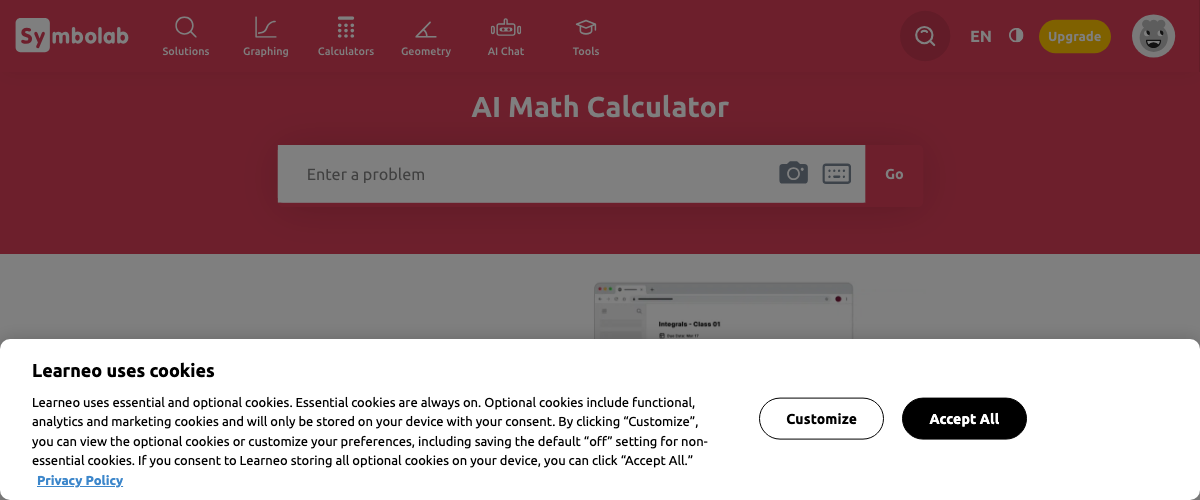
Symbolab is a math solver that specializes in showing detailed step-by-step solutions for algebra, calculus, trigonometry, and more. It was acquired by Chegg in 2022 but still operates as a separate platform with its own free tier.
The free version shows solutions with limited steps. Symbolab Pro ($2.49/month for students) unlocks full step-by-step breakdowns, practice problems, and a graphing calculator. The interface is cleaner than Wolfram Alpha for pure math, and it handles things like integrals, derivatives, and matrix operations well.
Best for: algebra, calculus, and trigonometry where you need to see every step of the solution process. More affordable than Chegg if math is your only subject.
Photomath: Best for Scanning Handwritten Problems
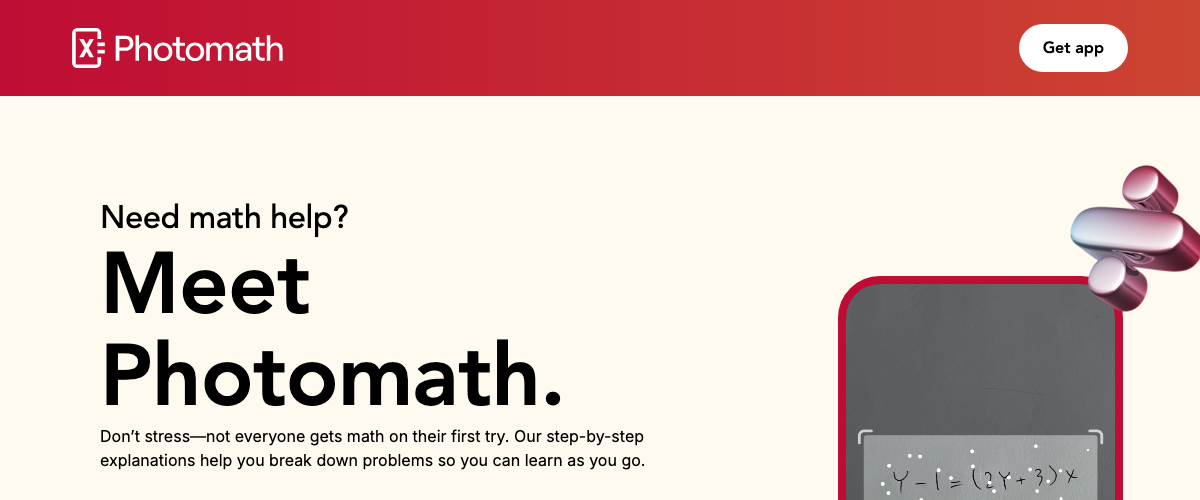
Photomath lets you point your phone camera at a math problem (printed or handwritten) and get an instant solution with steps. It was acquired by Google in 2023 and has over 220 million downloads.
The free version solves problems and shows basic steps. Photomath Plus ($9.99/month) adds detailed explanations, animated tutorials, and custom-generated solutions for word problems. Available on iOS and Android.
Best for: students who need quick help with specific math problems and prefer scanning over typing. The camera input is genuinely useful for handwritten equations.
Brainly: Best for Peer-to-Peer Help
Brainly is a community Q&A platform with over 350 million users across 35 countries. Students post questions and other students (plus verified experts) answer them. Think of it as a homework-focused version of Quora.
The platform is free with ads. Brainly Plus ($24/year) removes ads and gives priority access to expert answers. The quality of answers varies since they’re community-submitted, but popular questions usually have multiple verified answers.
Best for: getting quick answers to specific homework questions across any subject. Best used alongside other resources to verify accuracy.
Free vs. Paid: What’s Actually Worth Your Money
You don’t need to pay for everything. Here’s a practical breakdown.
Start free: Khan Academy (always free), SparkNotes (free), Quizlet (free tier), Wolfram Alpha (free tier), Brainly (free tier), Photomath (free tier), and Coursera (free to audit). These cover a huge range of subjects without spending anything.
Pay if you need it: Chegg Study ($14.95/month) if you need textbook solutions and expert Q&A. Symbolab Pro ($2.49/month) or Wolfram Alpha Pro ($7.25/month) if math is your primary struggle. Quizlet Plus ($35.99/year) if you study primarily with flashcards.
Skip unless absolutely necessary: Course Hero’s monthly plan ($39.95/month) is expensive. Only worth it during finals season when you need course-specific materials. Cancel immediately after. Photomath Plus ($9.99/month) is also overkill for most students since the free version handles basic problems fine.
Study Strategies That Reduce Your Need for Answer Sites
The best alternative to any answer site is understanding the material well enough that you don’t need one. I’ve written detailed guides on the most effective study methods.
Active recall is the most evidence-backed study technique. Instead of re-reading notes, test yourself on the material. Close your notebook and try to write down everything you remember. The retrieval process itself strengthens memory.
The Feynman Technique works by forcing you to explain concepts in simple language. If you can’t explain it simply, you don’t understand it. This method exposes gaps in your knowledge that you can then fill with targeted study.
Spaced repetition (the method behind Quizlet and Anki) distributes your review sessions over time. Studying for 30 minutes across five days beats cramming for 2.5 hours the night before. Your brain consolidates memories during sleep, and spaced repetition gives it more opportunities to do so.
I’ve put together a full list of study tools that top students use if you want specific app and tool recommendations.
Frequently Asked Questions
Is Textsheet coming back?
No. Textsheet was permanently shut down after Chegg’s DMCA claim. The domain is dead, and there is no indication it will return. Any site claiming to be the new Textsheet is either a scam or another service doing the same illegal content scraping that got Textsheet shut down in the first place.
Was Textsheet legal?
No. Textsheet scraped copyrighted content from Chegg’s paid database and redistributed it for free. This violated the Digital Millennium Copyright Act (DMCA). Beyond the copyright issue, many US states consider distributing academic answers for profit (even through ad revenue) to be legally questionable when the content is knowingly used for academic submissions.
What happened to Slader?
Quizlet acquired Slader in 2020 and integrated its textbook solution content into the Quizlet platform. If you used Slader for free textbook answers, that content is now available through Quizlet. The standalone Slader website no longer exists.
Can I get Chegg answers for free?
Not legally. Sites that claim to unlock Chegg answers for free are either scraping content illegally (like Textsheet did) or are phishing scams that steal your personal information. Chegg costs $14.95 per month for their Study plan. If that is too expensive, use free alternatives like Khan Academy, Wolfram Alpha, or Quizlet instead.
Which free alternative is best for math homework?
Wolfram Alpha (free tier) and Khan Academy are the best free options for math. Wolfram Alpha solves problems and shows steps. Khan Academy teaches the underlying concepts with video lessons and practice problems. For pure calculation help, Wolfram Alpha is faster. For building understanding, Khan Academy is more thorough.
Is using Chegg considered cheating?
It depends on how you use it. Using Chegg to understand methodology and check your work is fine at most universities. Copying Chegg answers and submitting them as your own is academic dishonesty. Multiple universities have partnered with Chegg to identify students who copy solutions directly. Use it as a learning tool, not an answer sheet.
What is the best completely free study platform?
Khan Academy. It is 100% free with no premium tier, no ads, and no hidden costs. It covers math, science, economics, computing, SAT prep, and AP courses. Every topic includes video lessons, practice problems, and progress tracking. For literature and humanities, SparkNotes is the best free option.
Are there AI tools that can help with homework legally?
AI tools like ChatGPT, Claude, and Quizlet’s AI features can help you understand concepts and work through problems. The key is using them as tutors, not as answer generators. Ask the AI to explain a concept, walk you through a methodology, or check your reasoning. Do not ask it to write your assignment for you. Many universities now have specific policies about AI use, so check your school’s guidelines.
What is the best free Textsheet alternative in 2026?
Khan Academy is the best completely free alternative. For math specifically, Wolfram Alpha’s free tier and Photomath’s free version are excellent. Quizlet offers a generous free tier for flashcard-based study. Brainly is free for community Q and A help. None of these scrape paid content illegally like Textsheet did.
Is Textsheet the same as Litanswers?
Litanswers was a similar site to Textsheet that also scraped Chegg answers and displayed them for free. Like Textsheet, Litanswers was shut down after DMCA takedowns. Both sites operated illegally and neither is coming back. Use legitimate alternatives like Chegg Study, Khan Academy, or Wolfram Alpha instead.
Stop looking for the next Textsheet. The sites that replace it by doing the same thing will get shut down the same way. Instead, build your study skills with the right tools, use legitimate resources like Khan Academy and Chegg for understanding (not copying), and invest in learning techniques like active recall that make homework easier over time.
The students who succeed aren’t the ones who find the best cheat codes. They’re the ones who build systems that make the work manageable.
Disclaimer: This site is reader-supported. If you buy through some links, I may earn a small commission at no extra cost to you. I only recommend tools I trust and would use myself. Your support helps keep gauravtiwari.org free and focused on real-world advice. Thanks. - Gaurav Tiwari