
The Doppler effect is the apparent change in wave frequency caused by relative motion between source and observer. This study note covers what’s happening physically, the equation for sound, worked examples (ambulance siren), the relativistic version for light, cosmological redshift and Hubble’s law, applications (police radar, weather, ultrasound, exoplanet detection), and the sonic boom.
Physics

A black hole is a region of spacetime where gravity is so intense that nothing — not even light — can escape once it crosses the event horizon. This study note covers formation, structure (singularity, event horizon, photon sphere), the Schwarzschild radius, Hawking radiation, types of black holes, detection, and open questions in 2026.
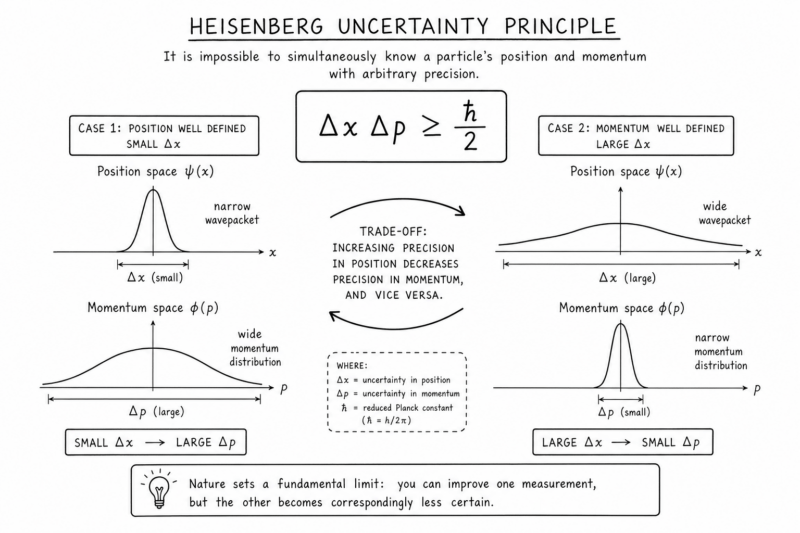
Heisenberg’s uncertainty principle bounds the precision of paired quantum measurements. Full study note: position-momentum and energy-time relations, derivation, and modern applications.
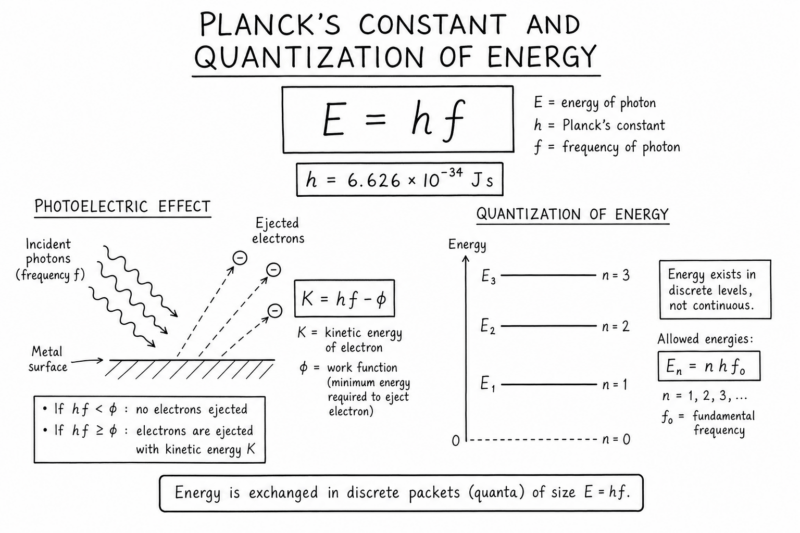
Planck’s constant h is the fundamental quantum of action. Full study note: history, the photoelectric effect, quantization, energy-frequency relation, and modern applications.
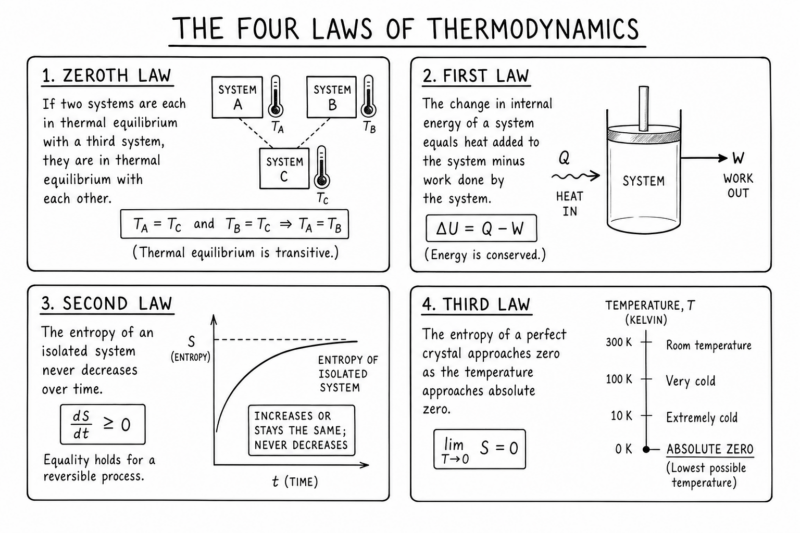
The Laws of Thermodynamics govern energy, temperature, and entropy. Full study note: zeroth, first, second, and third laws, examples, applications, and what each law forbids.
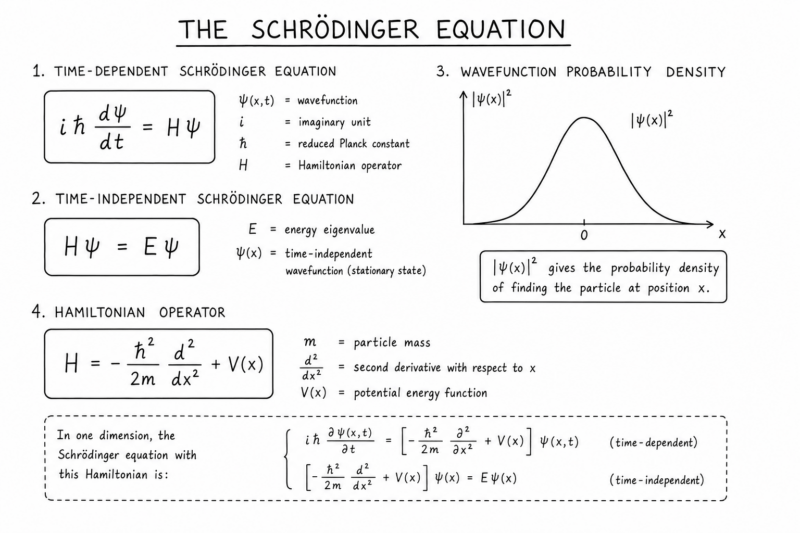
The Schrödinger equation governs how quantum wavefunctions evolve in time. Full study note: time-dependent and time-independent forms, examples, interpretation, and modern applications.
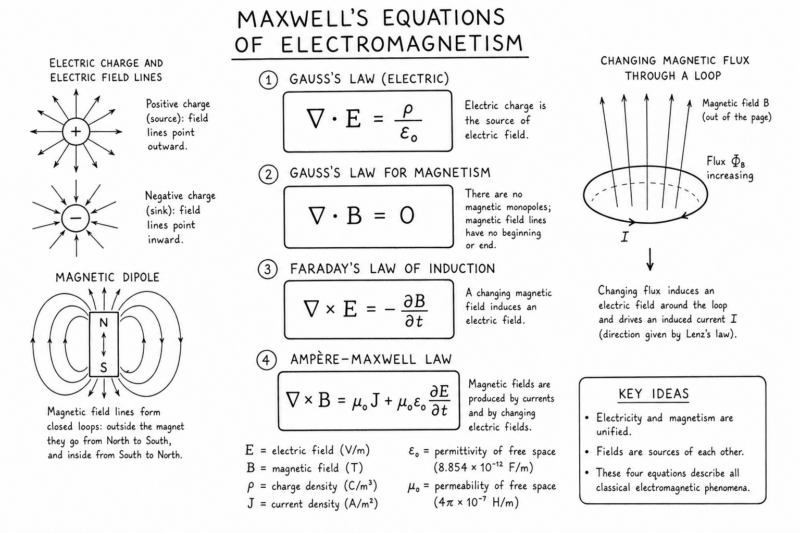
Maxwell’s Equations describe all of classical electromagnetism in four short equations. Full study note: each equation, integral and differential forms, the EM spectrum, and applications.
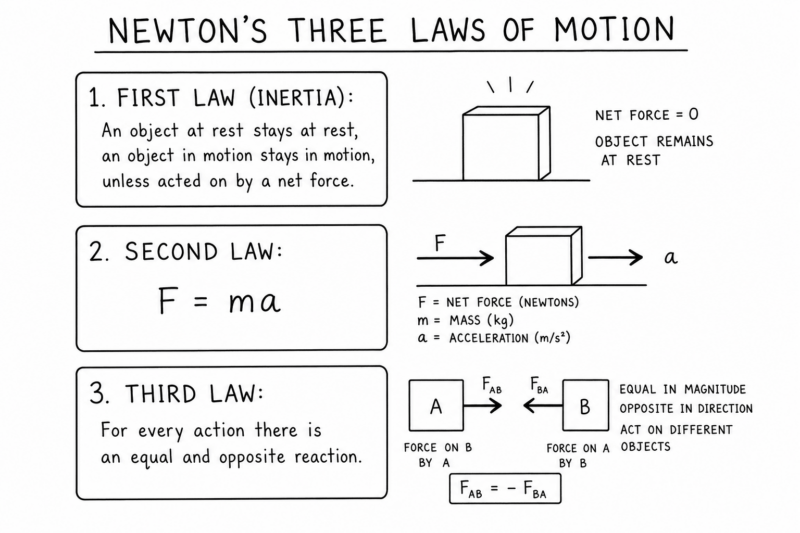
Newton’s Laws of Motion describe how forces produce acceleration. Full study note: the three laws, F = ma, momentum, applications, limits, and where Newtonian mechanics breaks down.

Quantum computing explained properly for students: qubits and the Bloch sphere, quantum gates with their matrices, Bell states and entanglement, Grover’s and Shor’s algorithms, real hardware platforms, error correction, and a free LaTeX-typeset PDF of the full lesson. Everything you need in one reference guide.
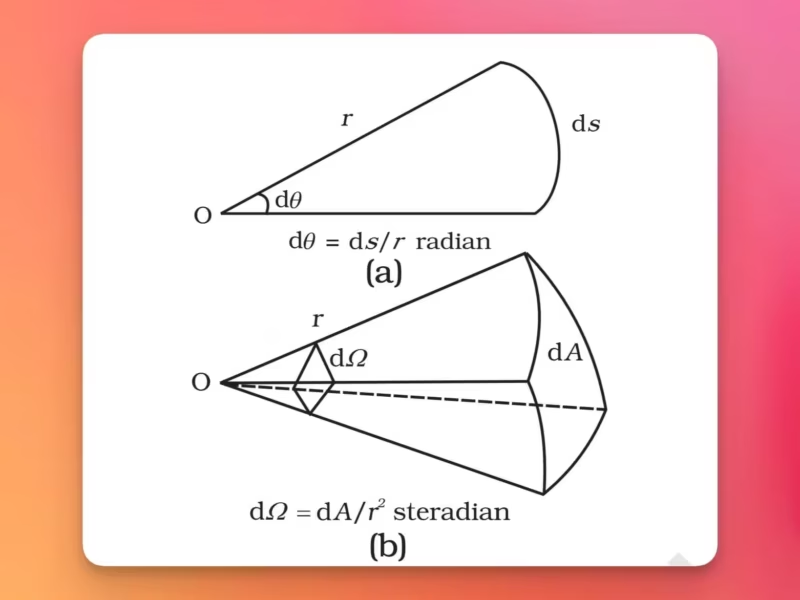
The International System of Units (SI) is the globally accepted standard for scientific measurement. It defines seven base units: meter, kilogram, second, ampere, kelvin, mole, and candela. This reference covers all SI units, derived units, prefixes, and conversion factors that students need for physics, chemistry, and engineering coursework.

Einstein’s field equations are the mathematical heart of general relativity, describing how matter and energy curve spacetime. These ten coupled nonlinear partial differential equations are among the most elegant and complex in all of physics. This reference covers the equations’ formulation, key components like the stress-energy tensor, and their physical significance.

A complete student reference for significant figures: the five counting rules with worked examples, precision vs accuracy, scientific notation, rounding, and the sig-fig rules for multiplication, division, addition, and subtraction. Includes a decision flowchart, an upgraded calculator that counts and rounds, and a free PDF.