
The Role of a SaaS Consultant in Choosing the Right Technology Stack
 by
by

A SaaS consultant should not choose your technology stack for you. The useful role is to turn product, tenant, security, recovery, team, and budget constraints into decisions your team can test and own. If the deliverable is only a diagram and a list of tools, you bought an opinion rather than an architecture review.
The best review leaves evidence: assumptions, alternatives, a small prototype, measured results, failure behavior, cost inputs, upgrade obligations, and a rollback path. This guide shows what that work should contain, including a reproducible one-process versus split-service test and an economic threshold for deciding whether outside help can pay back.
Quick verdict: Hire a SaaS consultant for a bounded, expensive-to-reverse decision when the needed experience is missing in-house. Skip the engagement when the team can define the constraints, run the tests, and own the consequences. Either way, require evidence and handoff.
Why the Technology Stack Matters in SaaS
A SaaS technology stack is an operating commitment, not a shopping list. It determines how tenants are isolated, how data moves, how failures spread, who can deploy, what must be patched, and how quickly a customer can be restored.
The AWS SaaS Lens frames architecture as a set of business-impact tradeoffs rather than a universal recipe. That is the right starting point. A stack choice is only defensible when it maps to a requirement and a test.
| Constraint | Question to answer | Evidence before commitment |
|---|---|---|
| Tenant model | Pool, silo, bridge, or a mix by workload? | Isolation test plus tenant-aware logs and metering |
| Data | What consistency, residency, recovery, and deletion rules apply? | Schema prototype, restore drill, migration and erasure test |
| Load | Which path is hot, bursty, or exposed to a noisy tenant? | Representative load profile with per-tenant limits |
| Security | Which controls and assurance level are actually required? | Threat model, verification requirements, security test |
| Operations | Who owns deployment, incidents, upgrades, and on-call? | Runbook, alert test, support matrix, rollback exercise |
| Economics | What drives spend now and at the next usage threshold? | Priced inputs, usage units, sensitivity, exit cost |
For the broader design argument, my guide on how architecture matters in custom software development explains why boundaries and ownership outlast framework fashion.
What a SaaS Consultant Actually Does
The consultant’s job is to make an important decision legible. That means exposing assumptions, proving the riskiest ones, and leaving the team with records it can maintain.
- Define: audience, tenant types, data classes, traffic, availability, recovery, compliance, budget, runway, team skill, and deadline.
- Reduce: remove options that fail a hard constraint before running benchmarks.
- Record: write an architecture decision record for the chosen option and every serious alternative.
- Prototype: build the smallest vertical slice that exercises tenancy, data, deployment, observability, and the highest-risk integration.
- Measure: establish a baseline, test the same workload, record versions and environment, and retain raw data.
- Break: test dependency failure, tenant escape, bad deployment, restore, and rollback.
- Cost: model current usage, threshold usage, people cost, support, licences, migration, and exit.
- Hand off: name owners, open risks, upgrade dates, rollback triggers, and the next review point.
The role should be explicitly bounded. If you are still deciding whether the need is architecture advice, delivery capacity, or a long-term hire, read my guide to getting outside help for business software development before writing the statement of work.
The SaaS Technology Stack, Layer by Layer
Do not let the review jump straight to frontend framework or cloud provider. Work from the business and tenant boundary down to the runtime. The order prevents an attractive tool from silently deciding your isolation, recovery, and staffing model.
| Layer | Decision evidence | Common premature choice |
|---|---|---|
| Tenant experience | Identity, onboarding, entitlement, metering, support | Treating multi-tenancy as a database filter |
| Isolation | Pool/silo/bridge tests by data and workload | One architecture for every tenant tier |
| Application shape | Bounded contexts, change coupling, deployment needs | Microservices because the product may grow |
| Runtime and framework | Support window, team skill, performance profile | Selecting from popularity alone |
| Data and messaging | Consistency, transactions, retention, restore, throughput | Several databases before one fails a test |
| Delivery | Repeatable build, test, deploy, rollback, provenance | Orchestration before operational capacity |
| Security | Threat model and verifiable requirements | Assuming a cloud or framework makes the app secure |
| Observability | Tenant-aware logs, metrics, traces, alert ownership | Adding dashboards after the first incident |
Languages and frameworks
Choose a runtime after testing team competence, library maturity, deployment constraints, workload behavior, security response, and support policy. The Node.js release schedule is an example of the check teams must repeat. A language can fit the workload and still be the wrong operational choice if the selected release is outside the support state your organisation accepts.
Databases
Start with invariants and failure recovery. Model transactions, tenant keys, uniqueness, retention, erasure, backup, point-in-time recovery, and migration. If PostgreSQL is a candidate, the PostgreSQL versioning policy belongs in the decision record because a database choice creates an upgrade calendar as well as a schema.
Cloud providers
Price the actual resource units and managed-service boundaries, then test portability only where exit is a credible risk. Cloud breadth is not a requirement. Tenant-aware operations, recovery, cost attribution, region support, and staff competence are.
DevOps and delivery
A container does not create a delivery system. The useful baseline is a repeatable build, automated tests, dependency and provenance records, a controlled deployment, observable health, and a practised rollback. Kubernetes is valuable when orchestration solves a measured deployment or scaling problem and somebody owns its failure modes.
What Changed in 2026
The useful change is not a new universal stack. It is the quality of the questions official guidance now expects teams to answer. The AWS SaaS design principles says SaaS has no one-size-fits-all architecture and that decomposition should follow multi-tenant load and isolation profiles.
Microsoft’s microservices architecture guidance describes genuine benefits such as independent deployment, independent scaling, and fault isolation. It also names the corresponding obligations:
- System complexity: service discovery, transactions, data consistency, and interservice communication.
- Development and testing: dependent services need different test and refactoring practices.
- Network cost: granular synchronous calls can add latency and congestion.
- Operations: correlated logs, distributed tracing, rollout coordination, and mature incident response.
- Versioning and skill: contracts must evolve without breaking consumers, and the team must understand distributed systems.
Security is also a lifecycle requirement. The NIST Secure Software Development Framework gives software producers a common set of secure-development practices, while the OWASP Application Security Verification Standard provides testable application-security requirements. Neither framework certifies a stack. They help you specify and verify work that the stack still has to implement.
What a SaaS Consultant Costs in 2026
There is no honest universal hourly rate or project fee. Scope, jurisdiction, seniority, regulated-domain knowledge, evidence required, and liability all change the quote. The useful question is whether a specific review fee is rational against a defined decision exposure.
- Rework cost = people × weeks × productive hours per week × loaded contribution cost per hour.
- Delay cost = contribution margin lost during the avoidable delay.
- Decision exposure = rework cost + delay cost + migration, contract, and incident costs you can support.
- Break-even prevention probability = review fee ÷ decision exposure.
| Illustrative case | Rework + delay exposure | Review quote | Break-even probability |
|---|---|---|---|
| Low | 2 × 2 weeks × 25h × $60 + $5,000 = $11,000 | $3,000 | 27.3% |
| Base | 4 × 4 weeks × 30h × $80 + $20,000 = $58,400 | $7,500 | 12.8% |
| High | 6 × 8 weeks × 30h × $110 + $60,000 = $218,400 | $15,000 | 6.9% |
The base example does not claim that the consultant has a 12.8% chance of preventing failure. It says the $7,500 review breaks even only if you believe its probability of avoiding the $58,400 exposure is at least 12.8%. Challenge the exposure and probability before signing.
When You Do NOT Need a SaaS Consultant
Outside advice is not automatically safer. It can add delay, split ownership, and create a document nobody maintains. Skip it when the decision is cheap to reverse or the capability already exists inside the team.
- Low exposure: a small experiment uses a supported default and can be deleted without migration.
- Existing owner: a senior technical lead has relevant SaaS, tenant, security, and operating experience.
- No handoff capacity: the team cannot maintain the proposed architecture after the consultant leaves.
- Undefined product: customer, workflow, data, and tenancy assumptions are still moving daily.
- Vendor pitch: the advisor is paid to recommend one platform and will not document alternatives or exit cost.
If you need to understand the delivery model before paying for architecture advice, start with SaaS and the benefits of SaaS development. A clearer product boundary often removes several stack options without a consultant.
Case Example: A Reproducible Stack Test
I ran a narrow test to show what evidence should replace a generic claim such as ‘microservices cost more.’ The same Node.js script served one pro-plan quote for seven seats in two shapes.
- Environment: Node.js v26.0.0, Darwin 27.0.0, arm64, 18 logical CPUs.
- Baseline: one process, one port, catalog and billing functions in a modular monolith.
- Alternative: gateway, catalog, and billing in three processes and three ports, with two synchronous HTTP hops per quote.
- Response: both returned plan
pro, seven seats, 4,900 cents per seat, and 34,300 cents total. - Workload: 500 warm-up requests, then five runs of 4,000 requests at concurrency 40 for each architecture.
- Transport: HTTP over
127.0.0.1with keep-alive; no cloud network.
| Measured result | Modular monolith | Three split services |
|---|---|---|
| Processes / ports / internal hops | 1 / 1 / 0 | 3 / 3 / 2 |
| Median throughput | 38,528.3 req/s | 15,007.1 req/s |
| Median p50 latency | 0.946 ms | 2.555 ms |
| Median p95 latency | 1.646 ms | 3.554 ms |
| Total measured errors | 0 | 0 |
| Resident memory | 76.5 MiB | 249.7 MiB |
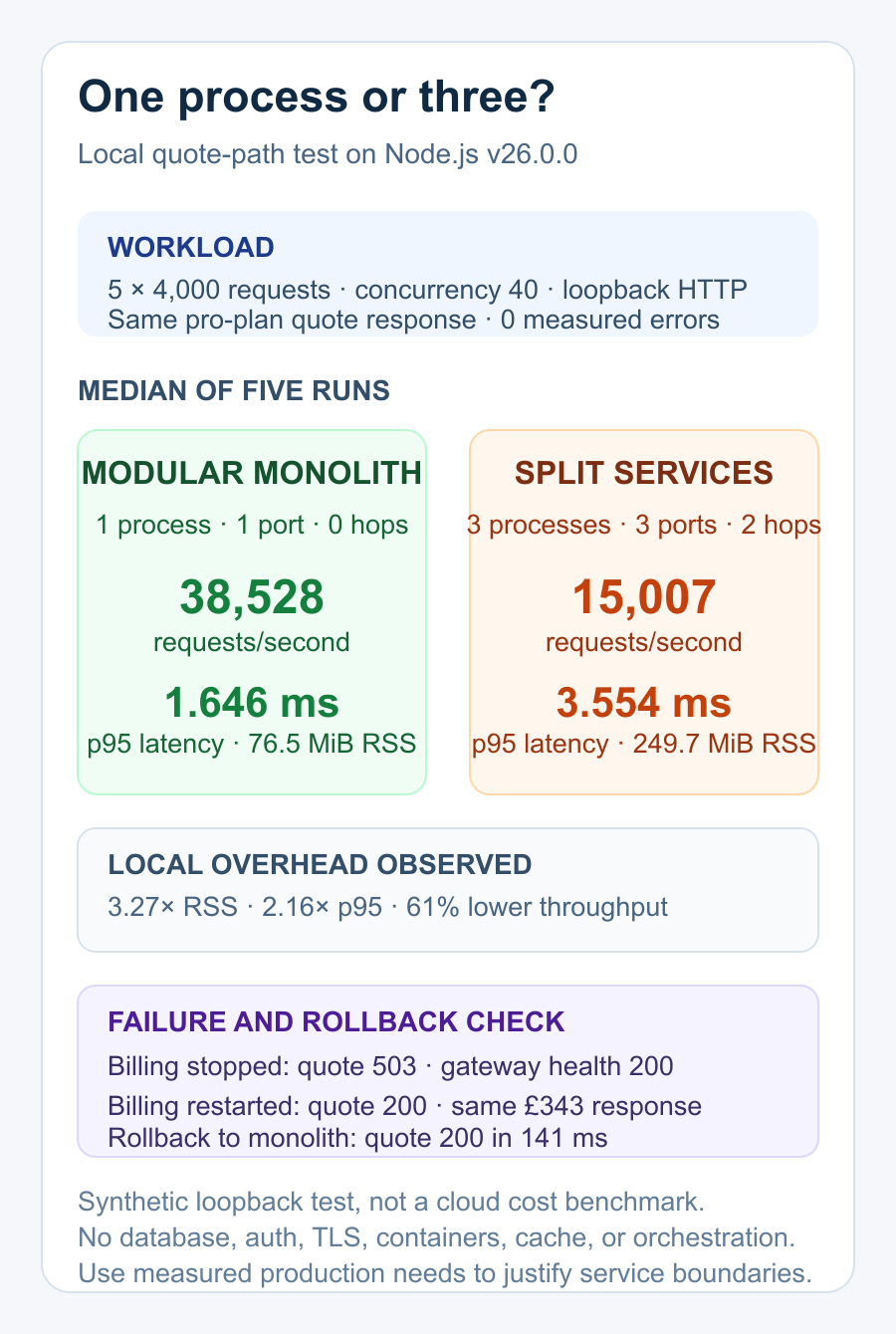
In this environment, the split version used 3.27 times the resident memory, had 2.16 times the median p95 latency, and recorded 61% lower median throughput. That is evidence about this implementation’s local operational floor. It is not a cloud-cost estimate and not proof that a monolith is always the right architecture.
Failure mode, recovery, and rollback
I stopped the billing process while leaving the gateway and catalog running. The failure and recovery checks recorded:
- Partial failure: gateway health returned 200 and catalog health returned 200, while the quote returned 503.
- Dependency recovery: after restarting billing, the quote returned 200 with the same 34,300-cent result.
- Rollback: after stopping the split services and restoring the known-good monolith, the quote returned 200 in 141 ms.
The split did demonstrate a real benefit: billing could fail while the gateway and catalog health endpoints remained available. But the quote path still failed because the synchronous dependency was required. Fault isolation only becomes user value when the product defines degradation, timeouts, retry safety, or asynchronous work.
Limits: no database, authentication, TLS, container, cache, queue, service mesh, trace collection, autoscaling, deployment platform, or independent team was involved. All processes ran on one Mac over loopback. The test should inform a prototype plan, not settle an architecture debate.
Benefits of Working With a SaaS Consultant
A useful consultant improves decision quality and transfer, not only the diagram. The benefits should be visible in artifacts the team can inspect and repeat.
- Fewer hidden assumptions: requirements, unknowns, and exclusions are written before commitment.
- Comparable options: alternatives face the same workload, pass/fail criteria, and cost units.
- Safer delivery: failure, restore, and rollback are tested before production pressure.
- Better ownership: the in-house team receives editable records, raw results, and named responsibilities.
- Controlled complexity: every moving part has a measured reason, an operator, and a removal path.
Once the architecture is owned and operating, distribution is a different problem. My SaaS marketing guide covers acquisition and retention without pretending that a sound stack creates demand by itself.
The Bottom Line
The right SaaS technology stack is the smallest supported system that passes the product’s tenant, data, security, recovery, load, cost, and ownership tests. Start there. Add complexity only when a measured boundary earns it.
Hire a SaaS consultant when the decision exposure is material, the needed experience is absent, and the engagement ends with evidence your team can own. Do not pay for certainty nobody can prove. Pay for better questions, comparable tests, clear failure behavior, and a rollback you have already rehearsed.
Frequently Asked Questions
What does a SaaS consultant do during a technology stack review?
A SaaS consultant turns business and tenant requirements into testable architecture decisions. The deliverables should include constraints, options, an architecture decision record, a narrow prototype, measured results, security and isolation requirements, cost assumptions, failure behavior, rollback, and an ownership handoff. A list of fashionable tools is not a useful review.
When should a startup hire a SaaS consultant?
Hire one for a bounded decision when the cost of being wrong is material and the team lacks the relevant experience. Examples include tenancy isolation, regulated data, database boundaries, migration design, and a platform commitment with expensive exit costs. Set the decision, evidence, budget, deadline, and handoff before the engagement starts.
What is the best technology stack for a SaaS product?
There is no universal best stack. Start with workload, tenant isolation, data, recovery, security, support windows, team skill, and budget. Prefer the smallest supported architecture that passes those tests. Add a service, database, cache, queue, or orchestrator only when a measured requirement justifies its operating cost.
Should a new SaaS product start with microservices?
Not by default. Microservices can support independent deployment, scaling, technology choice, and fault isolation, but they also add network calls, versioned contracts, distributed data, deployment coordination, tracing, and partial-failure handling. Use them when a real boundary needs those benefits and the team can operate the result.
How can I tell whether a SaaS consultant is worth the fee?
Estimate the economic exposure of the decision, including rework and delay contribution margin. Divide the review fee by that exposure. The result is the minimum probability of preventing the failure needed to break even. This is an illustrative decision threshold, not proof that a consultant will save the money.
What should I receive at the end of a SaaS architecture review?
Require editable records: the decision and rejected alternatives, assumptions, test code, raw results, threat and tenant-isolation requirements, cost model, support and upgrade matrix, failure and recovery runbook, rollback trigger, unresolved risks, and named owners. Your team should be able to repeat the test without the consultant.
Tell Google you want more of this.
Add Gaurav Tiwari as a preferred sourceOne tap, and this site shows up more often in your own Top Stories, AI Overviews and AI Mode. Remove it any time.