
MCAT Preparation Guide 2026: Basics, Eligibility and the Best Ways to Prepare
Nearly half of all students who sit for the MCAT end up retaking it. I’ve seen this pattern play out with dozens of pre-med readers over the years, and the common thread isn’t lack of intelligence. It’s lack of preparation strategy. The Medical College Admissions Test is a 7.5-hour marathon that tests your reasoning, your endurance, and your ability to stay sharp under pressure. You can’t brute-force your way through it.
I’ve spent years curating study resources for competitive exams, and the MCAT is one of the toughest I’ve encountered. It’s not just a science test. It covers critical analysis, reasoning skills, psychology, sociology, and biochemistry, all in a single sitting. The students who score well aren’t necessarily the smartest. They’re the ones who used the right materials, followed a structured plan, and practiced relentlessly.
In this guide, I’ll walk you through everything you need to know about the MCAT in 2026, from eligibility and exam format to the best books and prep resources I’d actually recommend. If you’re serious about getting into medical school, bookmark this page. You’ll come back to it.
What Is the MCAT?
The Medical College Admission Test (MCAT) is a standardized exam required for admission to medical schools across the United States and Canada. It’s administered by the Association of American Medical Colleges (AAMC), the same organization that accredits medical schools in the US. You can’t get into an MD or DO program without it.
The AAMC administers the exam multiple times a year, typically from January through September. Test dates fill up quickly, especially during the spring and summer months, so I’d recommend registering at least 2-3 months in advance. The exam costs $330 (with additional fees for international test-takers), and there are limits on how many times you can attempt it: 3 times in a single year, 4 times over two consecutive years, and 7 times total in your lifetime.
Those attempt limits matter more than most students realize. Every retake shows up on your application, and admissions committees can see all your scores. That’s why getting your preparation right the first time around is so important.
MCAT Exam Format and Structure
The MCAT is a computer-based exam that takes about 7 hours and 33 minutes including breaks. It’s entirely multiple-choice, but don’t let that fool you. These aren’t straightforward recall questions. The MCAT tests your ability to apply concepts, analyze passages, and reason through unfamiliar scenarios under time pressure.
Here’s the breakdown of each section:
- Chemical and Physical Foundations of Biological Systems: 59 questions, 95 minutes. Covers general chemistry, organic chemistry, physics, and biochemistry in a biological context.
- Critical Analysis and Reasoning Skills (CARS): 53 questions, 90 minutes. Passage-based section covering humanities and social sciences. No prior knowledge required, but you need strong reading comprehension.
- Biological and Biochemical Foundations of Living Systems: 59 questions, 95 minutes. Heavy on biology, biochemistry, and organic chemistry.
- Psychological, Social, and Biological Foundations of Behavior: 59 questions, 95 minutes. Covers psychology, sociology, and their intersection with biology.
Between sections, you get scheduled breaks: 10 minutes after the first section, a 30-minute mid-exam break after the second, and another 10 minutes after the third. You’ll also have an optional 10-minute tutorial at the start and a brief survey at the end. Total seat time is roughly 7.5 hours. That’s why I tell students: the MCAT isn’t just a knowledge test. It’s an endurance test.
Each section is scored from 118 to 132, for a total score range of 472 to 528. The median score is 500. Competitive scores for top medical schools typically fall in the 515-520 range, which means you need to perform well across all four sections, not just the science ones.
Who Can Take the MCAT?
Eligibility for the MCAT is more straightforward than most people think, but there are some nuances worth knowing:
- US and Canadian students need to have completed (or be currently enrolled in) an undergraduate degree. Most students take the MCAT after completing their sophomore or junior year of college, once they’ve finished the prerequisite science courses.
- International students must submit a statement of intention confirming they plan to apply to a health professional program in the US or Canada. If you already hold an MBBS degree, you don’t need special permission to sit for the exam.
- Non-applicants (people who don’t plan to apply to any health program) need special permission from the AAMC to take the exam. This is rare and typically only applies to researchers or educators.
One important note for international students: the AAMC doesn’t accept international transcripts directly. You’ll need to submit your credentials through a recognized evaluation service before you can register.
MCAT Test Centers and Fees
There are hundreds of test centers across the United States and Canada. Internationally, the options are more limited. There are no MCAT test centers in India, so Indian students planning to take the exam will need to travel to nearby countries like Thailand, Malaysia, or Singapore.
The registration fee for the MCAT is $330. International students pay an additional surcharge, bringing the total to around $430. Late registration adds $55 more. The AAMC does offer a Fee Assistance Program (FAP) for students who demonstrate financial need, which reduces the registration fee and provides free access to official practice materials. If you’re preparing for the MCAT on a budget, the FAP is worth looking into before anything else.
Careers the MCAT Opens Up
Most students associate the MCAT with allopathic (MD) medical schools, but the exam is accepted by several types of health programs:
- Allopathic Medicine (MD) – Traditional medical schools
- Osteopathic Medicine (DO) – Osteopathic medical schools, which also produce fully licensed physicians
- Podiatric Medicine (DPM) – Podiatry schools
- Veterinary Medicine – Some veterinary programs accept MCAT scores in addition to or instead of the GRE
If you’re not sure which path to pursue, the MCAT keeps your options open across multiple medical and health professional fields.
How to Prepare for the MCAT
Here’s where most students go wrong: they either start studying too late, use too many resources without focus, or skip practice tests entirely. I’ve seen all three mistakes, and they’re all avoidable.
The general recommendation is 300-350 hours of total study time, spread over 3-6 months. That’s roughly 2-4 hours a day if you start 4 months before your test date. Here’s the framework I’d suggest:
The AAMC’s own practice materials are non-negotiable. Their official question packs, section bank, and full-length practice tests are the closest thing to the real exam. Start with the free sample test, then purchase scored practice exams once you’re deeper into your study plan.
- Months 1-2: Content review. Work through a comprehensive subject review set (Kaplan or Princeton Review). Take notes. Don’t rush through it.
- Month 3: Practice problems. Switch from passive reading to active practice. Use question banks, passage-based problems, and section-specific drills.
- Month 4: Full-length practice tests. Take at least 5-7 full-length exams under real conditions. Review every wrong answer thoroughly.
The Pomodoro technique works well for MCAT study sessions. Set a timer for 25 minutes, study with full focus, take a 5-minute break, and repeat. After 4 cycles, take a longer break. It prevents burnout and keeps your retention high. I’ve covered this technique in detail if you want to build it into your routine.
For other exam-focused study tools and resources, I’ve put together a separate guide that covers flashcard apps, note-taking systems, and scheduling tools that work well for standardized test prep.
Online Prep Courses
While books form the backbone of your content review, structured online prep courses can give you the guidance and accountability that self-study alone can’t. The advantage of a good prep course is clear: it’s curated by people who understand the MCAT inside and out, so you’re not wasting time on low-yield material.
Kaplan and Princeton Review are the two biggest names in MCAT prep courses. Both offer self-paced and live online options, with prices ranging from $1,500 to $3,000+. If that’s out of your budget, look into Khan Academy’s free MCAT prep content, which was developed in partnership with the AAMC. It covers all four sections and includes practice passages. It’s not as comprehensive as a paid course, but it’s genuinely good for a free resource.
I’d also suggest using the AAMC’s own practice materials alongside any course you take. Their official question packs, section bank, and full-length practice tests are the closest thing you’ll get to the real exam. Start with the free sample test to gauge where you stand, then purchase the scored practice exams once you’re deeper into your study plan.
Best MCAT Prep Books and Guides
I’ve carefully selected these books based on how well they cover the MCAT syllabus, the quality of their practice questions, and how useful they are for students at different stages of preparation. Some are comprehensive review sets that take months to work through. Others are targeted practice books for the final stretch. I’d recommend picking one comprehensive set and supplementing with 1-2 practice-focused books.
The Official Guide to the MCAT Exam
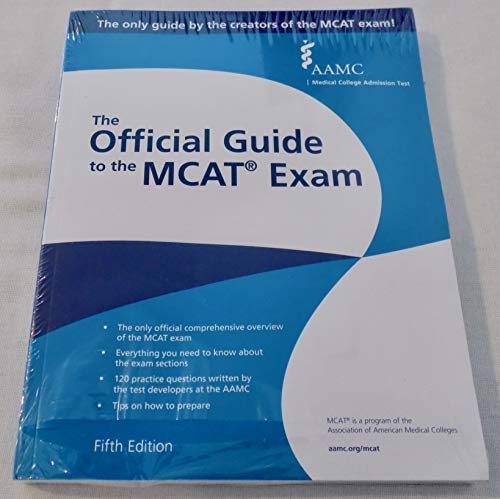
MCAT: The Official Guide to the MCAT Exam (Fifth Edition)
- Published by AAMC, the organization that creates and administers the MCAT
- Includes 120 practice questions with detailed explanations and scoring guidance
- Created by AAMC, the only official source for authentic MCAT content and scoring guidance
- Works best when combined with full-length AAMC practice tests
This is the one book every MCAT test-taker should own, no exceptions. It’s published directly by the AAMC, the organization that designs and administers the exam. That means the practice questions, the content outline, and the scoring guidance all come straight from the source. No third-party interpretation or guesswork.
The guide walks you through the exam structure, what each section tests, and how scores are calculated. It also includes 120 practice questions with detailed explanations. At $30, it’s the cheapest and most authoritative starting point for your MCAT prep. I’d buy this before anything else and use it to build your study plan around the AAMC’s own content outline.
Kaplan MCAT Complete 7-Book Subject Review
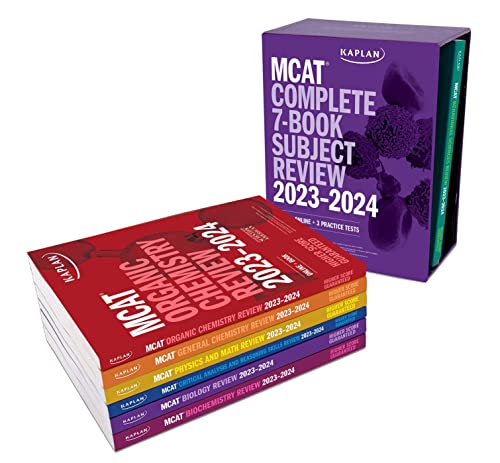
Kaplan MCAT Complete 7-Book Subject Review: Books + Online Prep + 3 Practice Tests
- Comprehensive 7-book set covering every MCAT subject with 3D illustrations and labeled diagrams
- Includes online access to additional practice questions and 3 full-length practice tests
- Features 24 quick sheets for rapid review before test day
- Updated annually to reflect the latest MCAT blueprint and content changes
If I had to pick one comprehensive review set, this is the one I’d recommend. Kaplan’s 7-book series covers every subject on the MCAT in serious depth, from biochemistry to psychology. Each book features 3D illustrations, well-labeled diagrams, and structured study plans that keep you on track. It’s not light reading, but that’s the point. You’re not cramming for a quiz; you’re preparing for one of the hardest standardized tests in the country.
The set also comes with online access to additional practice questions and 3 full-length practice exams. The 24 “quick sheets” are a standout feature. They condense major concepts into a concise format that’s perfect for last-minute review before test day. At the current discounted price of around $134 (down from $280), this set is excellent value for the sheer volume of content you get.
Princeton Review MCAT Subject Review Complete Box Set
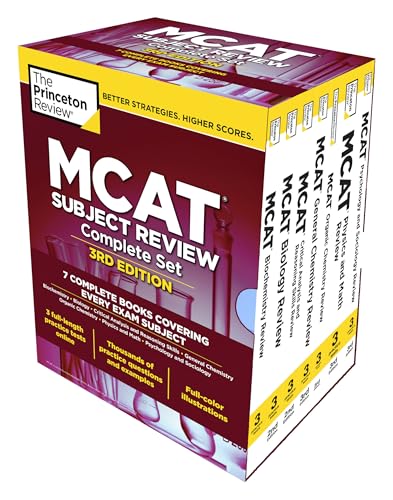
The Princeton Review MCAT Subject Review Complete Box Set: 7 Books + 3 Online Practice Tests
- 7 complete books covering all MCAT subjects with color-coded illustrations and detailed explanations
- Includes 3 online full-length practice tests that simulate the real exam experience
- Comprehensive glossaries and concise chapter reviews for efficient revision
- Color-coded subject organization makes cross-referencing between books efficient
Princeton Review’s box set is the other heavyweight contender in MCAT prep, and it’s a strong alternative if Kaplan’s style doesn’t click with you. Like Kaplan, it includes 7 subject-specific books and 3 online practice tests. The key difference is in the presentation: Princeton Review tends to use more accessible language and includes widespread glossaries that help you navigate dense scientific material without feeling overwhelmed.
Each book includes concise chapter reviews that work well as quick references when you’re revisiting topics during your final weeks of study. The practice tests closely mirror the real MCAT format, which is critical for building test-day familiarity. At $150, it’s slightly more expensive than the Kaplan set, but the quality is comparable. I’d say pick whichever brand you’ve had better experiences with in the past. You can’t go wrong with either one.
Mometrix MCAT Prep Books
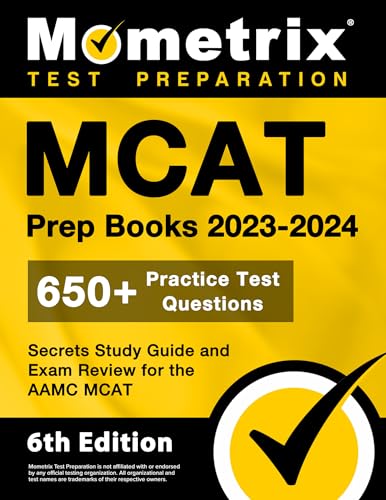
Mometrix MCAT Prep Books: 650+ Practice Test Questions, Secrets Study Guide and Exam Review
- 650+ practice questions covering all four MCAT sections with detailed answer explanations
- Well-organized content that flows logically between sections for easier comprehension
- Includes test-taking strategies and tips specific to the MCAT format
- Budget-friendly single-volume alternative to expensive multi-book sets
Mometrix takes a different approach from the big two-book sets above. Instead of 7 separate volumes, you get a single comprehensive guide with 650+ practice questions. If you don’t want to commit to a multi-month deep dive through 7 books, Mometrix offers a more condensed path through the material. The content is well-organized, with each section flowing logically from the one before it.
What I appreciate about this guide is that it doesn’t just test you on content. It includes specific test-taking strategies for the MCAT format, which is something the bigger review sets often gloss over. At $55.99, it’s also significantly more affordable than the Kaplan or Princeton Review sets. I’d recommend this as a solid companion book alongside one of the comprehensive sets, or as a standalone option if you’ve already completed your science coursework and just need practice and strategy.
MCAT AudioLearn (Audiobook)
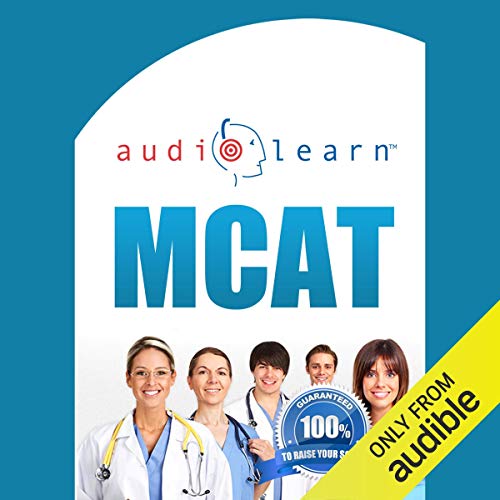
MCAT AudioLearn: Complete Audio Review for the Medical College Admission Test
- Complete audio review covering all MCAT subjects narrated by qualified medical professionals
- Covers key equations, formulae, facts, and theories across all four test sections
- Listen while commuting, exercising, or during any downtime to maximize study hours
- Ideal for kinesthetic learners who retain information better through audio review
Not everyone learns best by reading, and if you’re the type who retains information better through listening, this audiobook is a smart addition to your study stack. MCAT AudioLearn features two qualified medical professionals walking you through every major topic on the MCAT, covering facts, theories, equations, and key formulae across all four sections.
The real advantage here is time utilization. You can listen during your commute, at the gym, or while doing chores. That’s study time you wouldn’t get from a textbook. At $17.46, it’s practically a no-brainer as a supplement. I wouldn’t rely on it as your only study resource, but it’s excellent for reinforcing what you’ve already learned from your books and for keeping content fresh in your mind during passive hours of the day.
The Premed Playbook: Guide to the MCAT
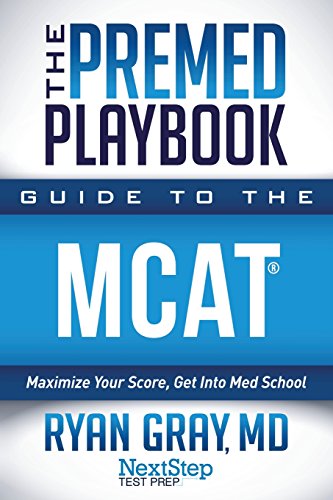
The Premed Playbook: Guide to the MCAT – Maximize Your Score, Get Into Med School
- Written by Dr. Ryan Gray, a trusted voice in pre-med guidance and admissions strategy
- Covers registration details, study planning, and choosing the right prep resources
- Budget-friendly alternative to expensive MCAT tutoring at just $9.99
- Pairs well with any content review book as a strategy and planning companion
This is the book I’d recommend to students who feel overwhelmed by the sheer volume of MCAT prep resources and don’t know where to start. Written by Dr. Ryan Gray, a well-known figure in the pre-med community, the Premed Playbook doesn’t try to teach you organic chemistry. Instead, it teaches you how to approach MCAT preparation strategically: when to register, how to build a study schedule, which resources to invest in, and how to stay accountable without spending thousands on a tutor.
At $9.99, this is the cheapest book on this list, and it punches well above its price. Think of it as your MCAT roadmap. Pair it with a comprehensive subject review set (like Kaplan or Princeton Review above) and you’ll have both the strategic framework and the content depth you need. I especially recommend this for first-generation medical students who don’t have family or mentors to guide them through the process.
7 Full-Length MCAT Practice Tests
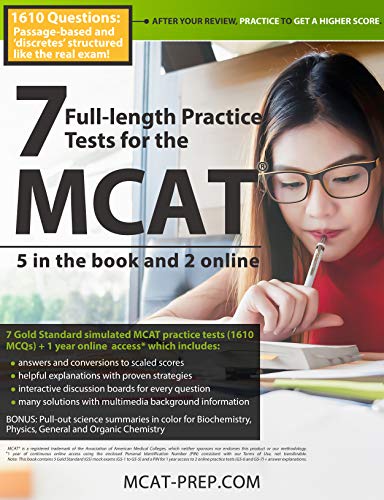
7 Full-Length MCAT Practice Tests: 1,610 Questions Based on the AAMC Format
- 7 complete practice tests (5 in book, 2 online) with 1,610 total questions
- Designed to match the official AAMC structure in question count, passages, and timing
- Detailed answer explanations help you learn from every mistake
- Best value practice test collection at under $10 for 1,610 questions
Practice tests are where MCAT prep gets real. This collection from MCAT-prep.com gives you 7 full-length practice exams (5 in the physical book, 2 online) totaling 1,610 questions. Every test follows the official AAMC structure in terms of question count, passage distribution, and timing. That matters because the MCAT is as much about pacing and endurance as it is about knowledge.
Each question comes with a detailed explanation, so you can learn from your mistakes rather than just seeing a score. At the current price of around $8, this is absurdly good value. I’d use these practice tests during your final 4-6 weeks of preparation. Take one test per week under real conditions (timed, no breaks outside the scheduled ones), then spend the next few days reviewing every question you got wrong. That review process is where the real learning happens.
Kaplan MCAT 528 Advanced Prep
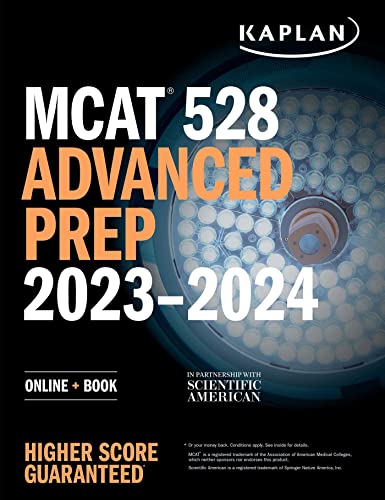
Kaplan MCAT 528 Advanced Prep: Online + Book
- 500+ highest-yield questions designed for students aiming for top MCAT scores (520+)
- Includes online access to a full-length practice test in the computer-based format
- Expert commentary and advanced strategies from a panel of MCAT specialists
- Targeted specifically at high-achievers aiming for 95th percentile scores
This book is specifically for students who are already scoring well on practice tests and want to push into the 520+ range. If you’re still building your foundation, skip this and come back later. But if you’ve completed your content review, you’re consistently scoring above 510 on practice exams, and you want to squeeze out every last point, Kaplan’s 528 Advanced Prep is designed for exactly that.
The 500+ questions in this book are the hardest you’ll find in any commercial MCAT prep resource. They focus on the kind of multi-step reasoning and passage interpretation that separates good scores from elite ones. You also get online access to a full-length practice test in the same computer-based format you’ll face on exam day. At $29.83 (down from $54.99), it’s a worthwhile investment for your final stretch of preparation.
Princeton Review MCAT Workout
Princeton Review MCAT Workout: 780 Practice Questions and Passages for MCAT Scoring Success
- 780 practice questions including 310 passage-based and 370 freestanding questions
- 55+ MCAT-style passages covering every area of the syllabus
- Step-by-step problem-solving approach with comprehensive solutions
- Excellent for the final 4-6 weeks of prep as a practice-intensive supplement
Princeton Review’s MCAT Workout is exactly what the name suggests: a focused practice book designed to build your test-taking muscle. It contains 780 practice questions across 55+ MCAT-style passages, with 310 passage-based questions and 370 freestanding ones. The balance between passage-based and standalone questions is smart because you need to be strong at both formats on test day.
What sets this apart from a generic question bank is the step-by-step problem-solving approach. Instead of just giving you an answer, the solutions walk you through the reasoning process. That teaches you how to think about MCAT questions rather than just memorize answers. At $46.99, it’s a solid investment for your practice phase. I’d use it alongside the 7 Full-Length Practice Tests above to give yourself the most realistic and varied practice experience possible.
Khan Academy’s free MCAT prep content was developed in partnership with the AAMC and covers all four sections. If a paid course isn’t in your budget, Khan Academy plus AAMC official materials is a legitimate prep strategy.
Which MCAT Books Should You Buy?
If your budget allows, here’s the combination I’d recommend:
- The Official AAMC Guide ($30) – Start here. It’s from the test makers themselves.
- Kaplan 7-Book Subject Review ($134) – Your comprehensive content review for months 1-2.
- The Premed Playbook ($9.99) – Strategic guidance on building your study plan.
- 7 Full-Length Practice Tests ($8.14) – For your final 4-6 weeks of timed practice.
- MCAT AudioLearn ($17.46) – Passive study during commutes and downtime.
That’s about $200 total for a complete, well-rounded MCAT prep library. If you’re on a tighter budget, the AAMC Guide + Mometrix ($86 combined) will get you through the basics. If you’re aiming for 520+, add the Kaplan 528 Advanced Prep once you’re in your practice phase.
For students looking at other standardized test resources, I’ve also put together a guide on the best ACT prep books and guides that follows a similar approach.
MCAT Test Day Tips
You’ve studied for months. Don’t let test day logistics trip you up. Here’s what I tell every student:
- Arrive early. You’ll need to check in, verify your ID, and get settled. Arriving stressed is a guaranteed way to underperform on the first section.
- Eat during breaks. You’re going to be sitting for 7+ hours. Bring high-protein snacks (nuts, protein bars) and water. Your brain burns glucose fast under pressure.
- Don’t change your routine. Test day is not the time to try a new coffee brand or wake up 3 hours earlier than usual. Stick with what your body knows.
- Use the tutorial time wisely. The 10-minute tutorial at the start is optional. If you’ve done practice tests, you already know the interface. Use those 10 minutes to settle your nerves and mentally prepare.
- Flag and move on. If a question is taking more than 2 minutes, flag it and come back. Time management is a scored skill on the MCAT, even if the rubric doesn’t explicitly say so.
The total seat time breaks down like this: 10-minute Examinee Agreement, 10-minute optional tutorial, then four sections of 90-95 minutes each with three breaks (10 min, 30 min, 10 min) in between, plus a short void/survey section at the end. The gross time comes out to about 7 hours and 33 minutes. Plan your day around it.
Using Online Calendars for MCAT Study Planning
Three to six months of daily studying is a lot to keep track of in your head. I’ve seen students lose entire weeks because they forgot to revisit a subject or didn’t realize how much time they had left before their test date. An online calendar fixes this.
Google Calendar or Notion works well for MCAT planning. Block out your study sessions in advance, assign subjects to specific days, and schedule your practice tests on weekends when you can commit the full 7+ hours. The advantage of a digital calendar over a paper one is obvious: you can access it from any device, set reminders, and adjust your plan as you go without crossing out half the page.
I’d also suggest scheduling rest days. Burnout is real, especially during month 3 of MCAT prep. One full day off per week keeps you sharp and prevents the kind of mental fatigue that leads to diminishing returns. The students who try to study every single day for 4 months straight often perform worse than those who build in strategic breaks.
Final Thoughts
The MCAT is a beast of an exam, but it’s a predictable one. The content doesn’t change dramatically from year to year, the format is well-documented, and there are more quality prep resources available in 2026 than ever before. The students who succeed aren’t the ones with photographic memories. They’re the ones who start early, follow a structured plan, and practice relentlessly under timed conditions.
Don’t overthink which books to buy or which prep course to take. Pick your resources (I’ve given you my recommendations above), set a realistic timeline, and stick with it. Consistency beats intensity every time when it comes to standardized test prep. And if you need additional study tools beyond MCAT-specific books, check out my guide on study tools for college students for apps and systems that complement your prep.
You’ve got this. Now go study.
How long should I study for the MCAT?
Most students need 300-350 hours of total study time, spread over 3-6 months. If you start 4 months before your test date, that works out to about 2-4 hours of focused study per day. I’d recommend spending the first 2 months on content review, month 3 on practice problems, and month 4 on full-length timed practice tests.
What is a good MCAT score for medical school?
The median MCAT score is 500 out of 528. For most MD medical schools, a competitive score falls between 510-515. For top-tier schools like Harvard, Johns Hopkins, or Stanford, you’ll typically need 517-522. For DO schools, 504-510 is generally competitive. Your target score should depend on the schools you’re applying to.
How many times can I take the MCAT?
You can take the MCAT up to 3 times in a single testing year, 4 times across two consecutive calendar years, and 7 times total in your lifetime. All scores are visible to admissions committees, so it’s best to be well-prepared before your first attempt rather than planning to retake it.
Is Kaplan or Princeton Review better for MCAT prep?
Both are excellent and cover the same material comprehensively. Kaplan tends to be more detail-heavy with stronger visual aids and quick-reference sheets. Princeton Review uses slightly more accessible language and includes better glossaries. I’d recommend Kaplan if you want maximum depth and Princeton Review if you prefer a more readable style. You can’t go wrong with either one.
Can I prepare for the MCAT for free?
Yes, partially. Khan Academy offers free MCAT prep content developed in partnership with the AAMC that covers all four sections. The AAMC also provides a free unscored practice test. However, you’ll likely need to invest in at least one comprehensive review book and some practice tests for thorough preparation. The AAMC’s Fee Assistance Program can also reduce costs significantly for qualifying students.
When should I take the MCAT?
Most students take the MCAT in the spring or summer before the year they plan to apply to medical school. January through March test dates give you time to retake if needed. May through July dates are the most popular but fill up fastest. I’d recommend taking it as early as you feel prepared, so you have a retake window if your score isn’t where you want it.
Do I need to take the MCAT if I have an MBBS degree?
If you hold an MBBS degree and want to practice medicine in the United States, you don’t need special permission to take the MCAT, but you may still need to take it depending on the program you’re applying to. Some residency pathways for international medical graduates don’t require the MCAT, while others do. Check with the specific programs you’re interested in.
Are there MCAT test centers outside the United States?
Yes, but options are limited. There are MCAT test centers in several countries including Canada, Australia, the UK, and parts of Asia. However, there are no test centers in India. Indian students planning to take the MCAT will need to travel to nearby countries like Thailand, Malaysia, or Singapore. International test-takers also pay an additional surcharge of about $100 on top of the standard $330 registration fee.
Hey Gaurav Tiwari ,
Excellent post with Fab-work. I truly appreciate your hard-work.
Glad to say that you have suggested helpful guide especially for those aspirants who are preparing for MCAT. You have explained very nicely along with all the crucial & every necessary details, information that is true enough to understand. I really like your MCAT test day conducting schedule and it will helps a lot in understanding the MCAT test process.
After going through this post i really got helpful ideas and according to me this is a perfect guide to know about MCAT.
Eventually thanks for sharing your knowledge and such an informative post.
Hi Gaurav
thanks for Share all Details about MACT Its relay Good to Read your all the Details for MACT
Animation Notes