7 Skills Every Entrepreneur Must Have (Learned the Hard Way)
After 850+ clients, here are the 7 entrepreneur skills that actually decide who survives: selling, cash flow, fast decisions, resilience, delegation, clear communication, and faster learning. The skill that matters most is selling, and every one is learnable.
 by
by
Nobody hands you a skills checklist when you start a business. You find out what you’re missing the expensive way, usually right after a deal falls through, a hire quits, or your bank balance does something you didn’t plan for. I’ve run Gatilab for years and worked with 850+ clients, and almost every painful lesson traced back to one thing: a skill I hadn’t built yet.
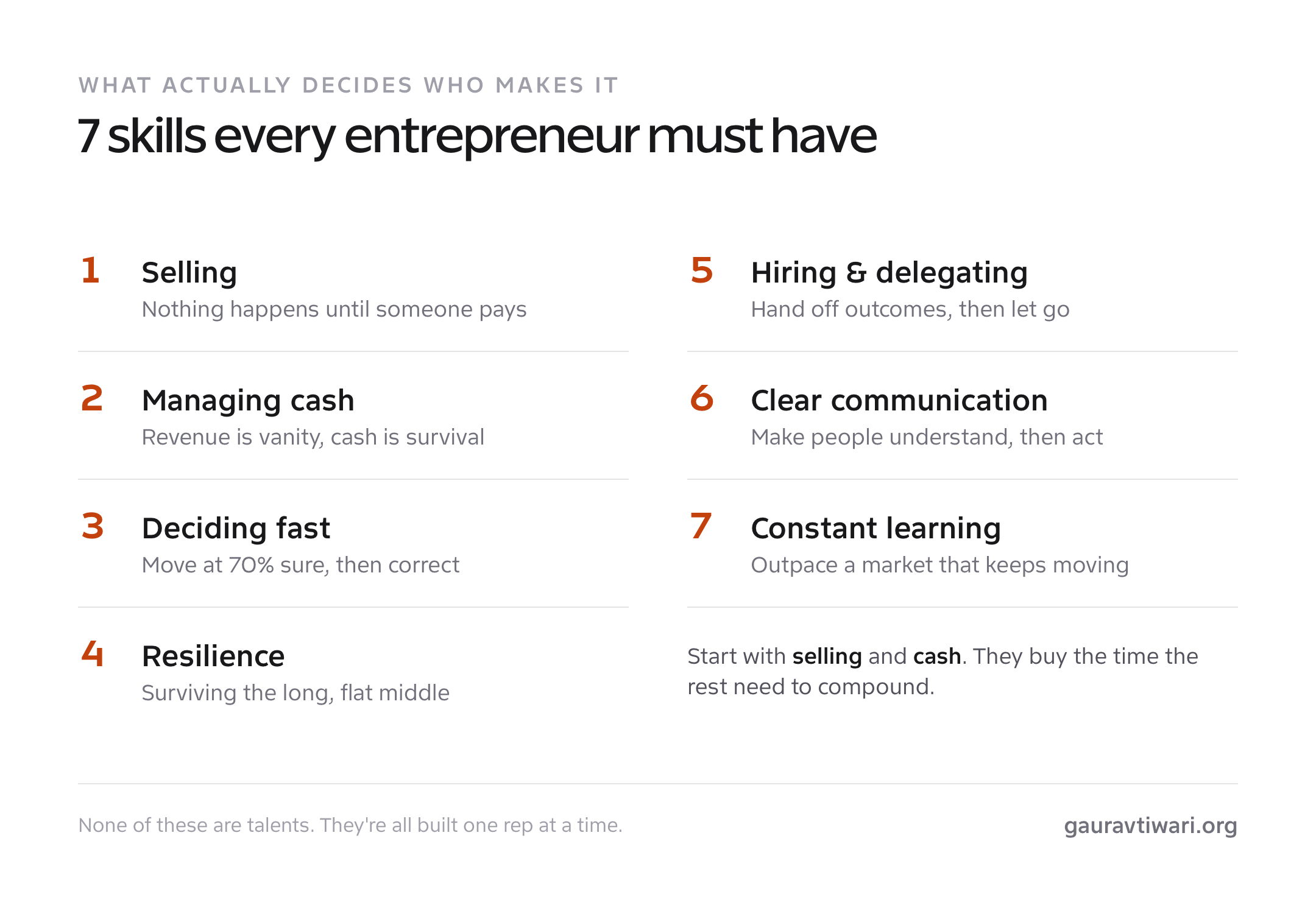
So forget the polished “visionary leader” lists. Here are the seven entrepreneur skills that actually matter in the real world, ranked by how often I’ve watched their absence sink someone. These aren’t the skills for entrepreneurs that sound good on a podcast. They’re the ones that quietly decide whether you’re still in business in three years. If you only remember one thing: the skill that matters most is selling, because nothing else gets a chance to compound until money is coming in.
The short version: If you only build two skills first, make them selling and managing cash. A founder who can sell and who knows exactly where the money is survives almost anything. Everything else on this list makes you more effective, but those two buy you time, and time is the only thing that lets the rest compound.
1. Selling, even when it makes you uncomfortable
Selling is the business skill most founders avoid, and it’s the one that pays the rent. Of all the startup skills you can build early, this is the one nothing else works without. Nothing happens in your business until someone says yes and hands over money. Not your product, not your funding, not your first hire. You sell to customers, you sell to investors, you sell a vision to the person you’re trying to recruit who already has a comfortable job.
Here’s the part nobody likes hearing: selling well isn’t about being slick. The best salespeople I know are the ones who shut up and listen, figure out what the other person actually needs, and only then explain how they help. My early client calls were a mess because I talked too much, pitched features nobody asked about, and tried to close before I understood the problem. The fix wasn’t a script. It was learning to ask one more question before I opened my mouth to sell.
You build this by doing it badly, a lot. Take the sales calls yourself in the early days, even if you’d rather hide behind email. Track which conversations convert and which don’t, and you’ll spot the pattern fast. If selling feels gross to you, that usually means you’re thinking about your need instead of their problem. Flip that, and it stops feeling like selling.
2. Managing cash, not just chasing revenue
Revenue is vanity. Cash flow is survival. Plenty of “successful” businesses with big top-line numbers die because the money going out moved faster than the money coming in. SCORE data cited across 2026 small-business reports pins roughly 82% of failures on cash flow problems, and a 2026 survey found 51% of small businesses still wrestling with uneven cash flow. You don’t need to be an accountant, but you do need to know, at any moment, how much cash you have and how many weeks that buys you.
I spent my first few years thinking my freelance income was healthy. Then I tracked expenses properly and realized I’d been quietly subsidizing the business with savings. That was an uncomfortable spreadsheet to look at, and it changed how I price and invoice to this day. The lesson stuck harder than any course could have taught it.
Start simple. Know your runway in weeks, invoice the day a job is done instead of “end of month,” and keep your business and personal money in separate accounts so you can actually see what’s happening. That last one isn’t about taxes, it’s about knowing whether your business is genuinely profitable. I broke down the full system in my guide to balancing personal and business finances, and it’s the post I wish I’d read at the start.
3. Making decisions before you feel ready
Of all the entrepreneur skills on this list, this one is the quiet engine: entrepreneurship is a long string of decisions made with incomplete information. Wait until you’re certain and you’ll lose to someone who moved at 70% sure. The skill isn’t being right every time. It’s making a good-enough call quickly, then correcting fast when reality disagrees.
The trap that catches smart people is analysis paralysis. They research the perfect CRM for three weeks while the imperfect one would have worked fine on day one. So I split decisions into two buckets. If a choice is cheap and reversible, like which tool to try, I decide in minutes and move on. If it’s expensive and hard to undo, like a hire or a big contract, I slow down and do the homework. Most decisions are the first kind, and treating them like the second is how founders waste months.
One honest caveat: speed without learning is just recklessness. The point of deciding fast is to get to the feedback faster. Make the call, watch what happens, adjust. That loop, run a hundred times, beats one perfect plan made in a vacuum.
4. Resilience: surviving the long, flat middle
Every business has a long, flat middle where nothing seems to be working and the excitement of starting has worn off. Resilience is what gets you through it. Not toxic “hustle harder” energy, but the quieter ability to keep showing up on the days the numbers are flat and nobody’s clapping.
I’ve had projects fail, clients leave, and stretches where I genuinely wondered if I’d picked the wrong path. What kept me going wasn’t motivation, because motivation is unreliable. It was systems and small wins. A routine that didn’t depend on how I felt, and the discipline to ship one more thing even when the mood was gone. The old advice to just have a “strong work ethic” is true but useless. The real skill is building a process that carries you when the work ethic runs dry.
Protect your energy like a business asset, because it is one. Burnout isn’t a badge, it’s a founder taking themselves offline. The entrepreneurs who last aren’t the ones who sprint hardest. They’re the ones who set a pace they can hold for years.
5. Hiring well, then actually letting go
At some point you stop being the person who does everything and become the person who builds the team that does it. This is two skills wearing one coat: sourcing good people, and then delegating to them without hovering. Most founders are decent at the first and terrible at the second.
Hiring well means looking past the resume to how someone thinks and whether they own their mistakes. I’d take a curious, reliable person who’s still learning over a polished one who needs constant managing, almost every time. But hiring is only half of it. If you hand someone a task and then redo it your way, you didn’t delegate, you just added a step. Letting go is genuinely hard when the business has your name on it, and it’s the only way the business grows past your own hours in the day.
Delegate outcomes, not keystrokes. Tell people what good looks like and why it matters, then get out of the way and let them find their own path to it. You’ll be wrong about how they’d do it, and right about more important things, like having your time back to work on the business instead of in it.
6. Communicating so people actually act
Interpersonal skill gets listed on every entrepreneur article, and it’s usually described so vaguely it means nothing. Here’s the concrete version: communication is the ability to make a person understand something and then do something about it. A clear brief that a developer can build from. A pitch an investor remembers. A piece of feedback that makes an employee better instead of defensive.
I came to business from teaching, so explaining hard things in plain language is my native register, and it turned out to be one of the most useful skills I had. The founders who struggle here aren’t unfriendly. They’re unclear. They assume everyone has the context in their own head. Slow down, say the thing plainly, check that it landed. Half of “leadership” is just communicating well enough that people know what you actually want.
Practice ruthless plainness. If a smart person outside your industry can’t follow your explanation, the problem is the explanation, not them. This is the same skill whether you’re writing a sales page, briefing a contractor, or calming a worried client, and it compounds across every other item on this list.
7. Learning faster than your market moves
The market you start in is not the market you’ll be operating in three years later. Tools change, platforms shift the rules overnight, and what worked last year quietly stops working. The entrepreneurs who last are the ones who treat learning as a permanent job, not a phase they graduate from.
I’ve rebuilt my own skill set more than once, because I had to. The web work I started with in 2008 looks nothing like what I do now, and the people who refused to adapt mostly aren’t around anymore. This is also where the old “Six Sigma certificate” school of thinking falls down. A framework you memorized once is worth far less than the habit of constantly noticing what’s changing and adjusting before you’re forced to.
What changed in 2026: AI raised the stakes on this one. The World Economic Forum now puts the average lifespan of a job skill at under three years and falling, which means the entrepreneur skills you lean on today expire faster than ever. The edge has shifted from what you already know to how fast you can learn the next thing, and the founders treating AI as a learning multiplier are pulling away from the ones waiting for it to settle down.
Build a small learning loop into your week. Follow the people who are one step ahead of you, run cheap experiments, and stay genuinely curious about the parts of your business you find boring, because that’s usually where the next problem hides. The right software helps too, and I keep a current list of the best apps and software for business productivity that I actually use to stay on top of it all.
Which entrepreneur skills should you build first?
Don’t try to build all seven at once. That’s a recipe for doing everything badly. Pick the one whose absence is hurting you most right now, and work on it until it’s no longer your weakest link. If you can’t get customers, it’s selling. If you’re always anxious about money, it’s cash management. If you’re drowning in work, it’s delegation, and the same instincts show up in the qualities that separate great business managers from busy ones.
And remember that none of these entrepreneur skills are talents you’re born with or without. Every one of them is a skill, which means it’s built through reps, feedback, and time. I was bad at most of these when I started, including the ones I now teach. If you’re early and you feel underprepared, that’s not a sign you shouldn’t be doing this. It’s just the part before the skills show up. If you’re still deciding what to build, my list of online business ideas you can start from home is a low-risk place to practice all seven at once.
Frequently asked questions
What is the most important skill for an entrepreneur?
Selling. Nothing in a business happens until someone says yes and pays, so the ability to understand a person’s problem and show how you solve it is the skill that funds everything else. A close second is cash management, because it’s what keeps you alive long enough for the rest to matter.
Are entrepreneurial skills something you’re born with?
No. Every skill on this list is built through practice, feedback, and time, not inherited. Most successful founders were bad at several of these when they started. The trait that matters isn’t natural talent, it’s the willingness to keep building the skill you’re currently worst at.
How long does it take to develop entrepreneur skills?
There’s no finish line, but you’ll see real improvement in any single skill within a few months of deliberate practice. The fastest way is to run a real business, even a tiny one, because nothing teaches selling, cash flow, or decision-making faster than having actual money on the line.
Do I need a business degree to be an entrepreneur?
No. A degree can teach theory, but the skills that decide whether a business survives are learned by doing. Selling, managing cash, hiring, and adapting are reps-based skills. Plenty of successful founders have no business degree, and plenty of degree holders never build a thing.
What skill do most entrepreneurs lack?
Delegation. Most founders are capable enough to do everything themselves early on, which becomes the exact habit that caps their growth later. Learning to hand off outcomes and trust the team to deliver is the skill that separates a busy self-employed person from an actual business owner.
The bottom line
The entrepreneur skills that actually matter aren’t the glamorous ones. They’re selling, managing money, deciding fast, staying in the game, building a team, communicating clearly, and never stopping learning. No successful entrepreneur was handed all seven at once. None of them are magic, and none of them are fixed. You build them one rep at a time, usually by getting them wrong first.
So don’t wait until you feel ready, because that feeling never quite arrives. Pick your weakest skill, work on it this month, and let the business teach you the rest the way it taught me: one expensive, unforgettable lesson at a time. That’s not the comfortable answer. It’s the real one.
Tell Google you want more of this.
Add Gaurav Tiwari as a preferred sourceOne tap, and this site shows up more often in your own Top Stories, AI Overviews and AI Mode. Remove it any time.