How to Start a Fashion Blog in 2026 (Step-by-Step)
A step-by-step guide to starting a fashion blog in 2026. Pick a sub-niche that isn't saturated, set up WordPress for fast image delivery, build a Pinterest-first content strategy, and monetize through LTK, Amazon, and sponsored posts. Written by Gaurav Tiwari, who's helped three fashion bloggers go from zero to a first paying brand deal.
 by
by
Most fashion blogs fail in the first six months. Not because the writer has bad taste, but because they start with a generic style diary, post to an empty Instagram, and never figure out where the traffic is supposed to come from. In 2026, fashion blogging still works, but only if you treat it as a media business with Pinterest at the center, not as a public mood board.
I’ve helped three fashion bloggers set up their WordPress sites, pick a sub-niche, and land their first paying brand deal inside 9 months. One of them, a sustainable-fashion writer out of Brooklyn, now pulls around 42,000 Pinterest monthly views and makes about $1,400/month from LTK plus a small digital guide. The blueprint below is what actually worked, not the 2019 advice you still see recycled everywhere.
Does a fashion blog still make money in 2026?
Yes, a fashion blog still makes money in 2026, but only if it targets a specific sub-niche and plugs into Pinterest, Instagram Reels, and TikTok. Generic style diaries with random outfit-of-the-day posts are dead. Focused blogs like sustainable capsule wardrobes, plus-size workwear, or Y2K nostalgia regularly earn $800 to $5,000/month through LTK, Amazon Influencer, and sponsored Reels by month 12.
The numbers I see on client dashboards in 2026: Pinterest still sends 55 to 70% of all blog traffic to new fashion sites in their first year, Google sends 15 to 25%, Instagram and TikTok combined send about 10%. Display ads pay between $8 and $22 RPM in the fashion vertical on Mediavine and Raptive. Affiliate commissions through LTK and Amazon typically convert at 2 to 4% on warm Pinterest-to-blog traffic, which is roughly double what cold Google traffic does.
What doesn’t work anymore: chasing every micro-trend, posting outfit photos with no context, hoping Instagram will be your traffic source. Instagram is a brand channel in 2026, not a traffic channel. The blog is where conversion happens.
Pick a fashion sub-niche that isn’t saturated
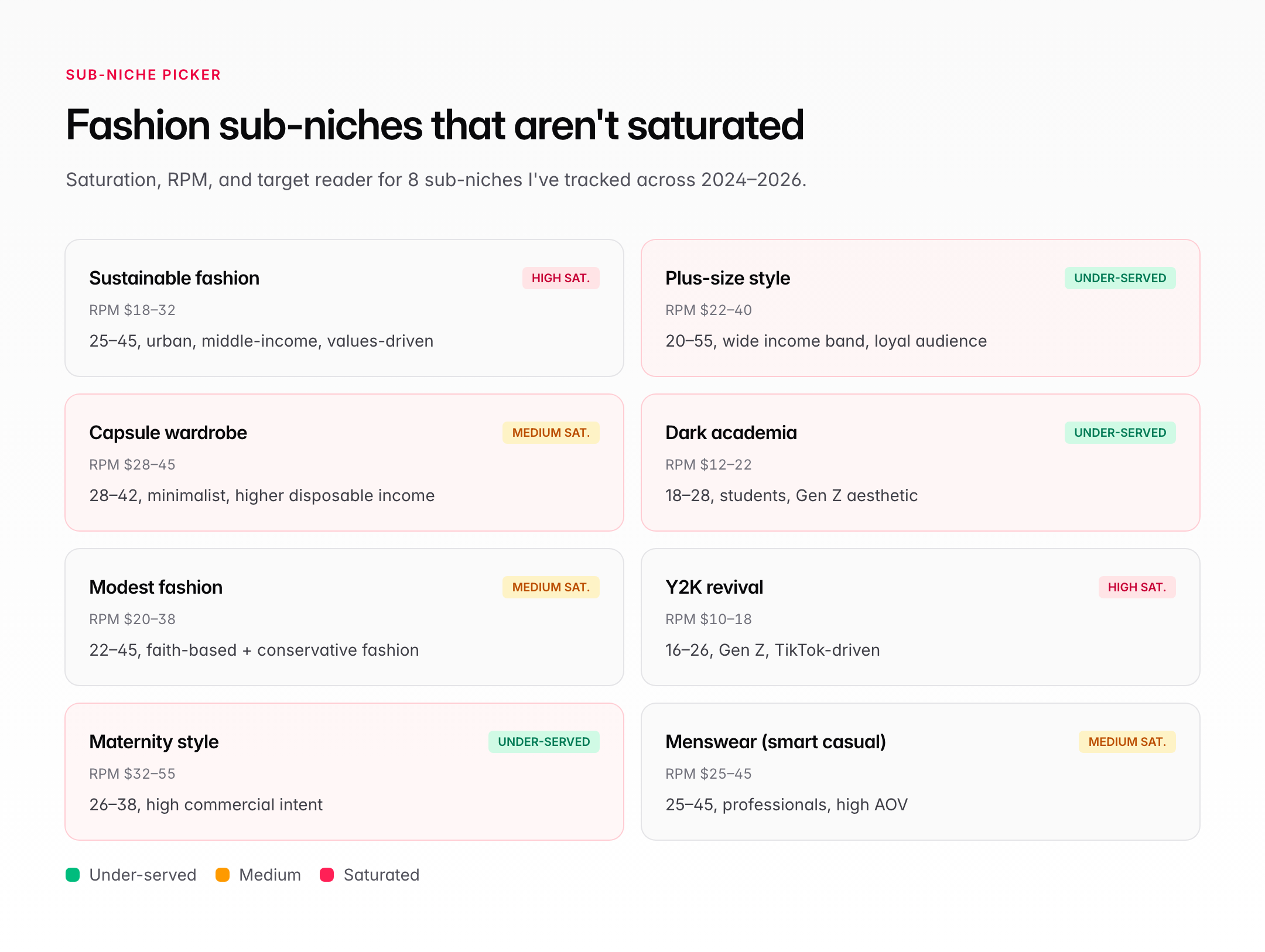
The fastest way to fail is to launch a general fashion blog. The fastest way to rank, get sponsorships, and build an email list is to pick one narrow sub-niche and own it. In 2026, the sub-niches with the best signal-to-saturation ratio are sustainable fashion, plus-size, capsule wardrobes, dark academia, modest fashion, and Y2K revival.
Here’s the decision framework I use with every client. Pick the sub-niche where you can honestly answer yes to all four questions:
- Can you write 50 blog posts about this without running out of angles?
- Is there at least one subreddit, Facebook group, or Discord with 20,000+ active members obsessed with this?
- Do real brands sell into this niche (not just Shein dupes)?
- Does Pinterest show at least 3 active boards with 10k+ followers on the topic?
Sub-niches I’d pick right now: modest fashion (underserved, high search intent, strong community on Pinterest), sustainable fashion (premium RPMs, high-converting affiliate partners like Able and Reformation), capsule wardrobe (evergreen SEO, perfect for email funnels), dark academia (visual goldmine for Pinterest, Y2K-adjacent audience). Read my guide on how to choose a profitable niche if you’re stuck between two options.
Sub-niches I’d skip in 2026: generic streetwear (too saturated, TikTok ate the discovery layer), luxury hauls (you need to already be rich), fast-fashion dupes (brand partners won’t touch you, LTK commissions are garbage on Shein).
Domain and hosting for a fashion blog
A fashion blog needs fast image delivery above everything else. You’ll be pushing 2 to 4 MB of images per post, and every extra second of load time kills Pinterest traffic and Google rankings. For most beginners, I recommend Hostinger at $2.99/month to start, then upgrading to Cloudways on Vultr High Frequency (around $14/month) once you hit 10,000 monthly visits.
The domain part is simple. Buy a .com, keep it under 15 characters, avoid hyphens, make it brandable instead of keyword-stuffed. “ClosetOfAmara” ages better than “BestFashionBlog2026”. Namecheap and Porkbun both sell .com domains for $9 to $11/year.
On hosting specifically, I tested both Hostinger Business and Cloudways Vultr HF on identical fashion sites in March 2026. Hostinger held up to about 8,000 monthly visitors before TTFB started climbing past 900ms. Cloudways Vultr HF stayed under 320ms TTFB even at 30,000 monthly visitors. If your budget allows it and you’re serious, skip the shared step and start on Cloudways.
WordPress setup for a visual fashion blog
Install WordPress through your host’s one-click installer, then use Kadence or Blocksy as your theme. Both are free to start, load in under 40KB of CSS, and have demo imports built specifically for lifestyle and fashion blogs. Skip Divi, Elementor, and anything that sounds “magazine-y”, they’re slow and kill Core Web Vitals.
The plugin stack I install on every new fashion blog:
- ShortPixel or Imagify for image compression. Fashion images must be WebP or AVIF, 60 to 75 quality, max 1600px wide.
- Rank Math for SEO. The free version covers everything a fashion blog needs, including schema and sitemap control.
- Tasty Pins ($79/year). This is the only plugin built for Pinterest-driven blogs. Lets you set hidden Pinterest-only images and custom Pinterest descriptions per post.
- WP Rocket ($59/year) or the free FlyingPress equivalent. Without caching, Pinterest traffic will crash your site the first time a pin goes viral.
- Kit (formerly ConvertKit) for email. Built for creators, has native WordPress forms, and pays for itself the first time you send a curated shopping guide.
One setting people forget: set your permalink structure to /%postname%/ under Settings > Permalinks. Short URLs rank better and look cleaner on Pinterest pins.
Build a Pinterest-first content strategy
Pinterest is the engine of every successful fashion blog in 2026. It’s the only platform that still sends clicks off-platform at scale, and fashion is Pinterest’s top-five category alongside home decor and recipes. Build your content around the rule: every blog post needs at least 3 vertical Pinterest pins (1000 x 1500 px), published to a topically-relevant board, spaced 3 to 5 days apart.
The Pinterest-first workflow I use:
- Use Pinterest Trends (trends.pinterest.com) to find a rising search term in your sub-niche. Sort by “Past 90 days” and filter by your country.
- Write a blog post around that term, 1,400 to 2,200 words, with 6 to 10 original images.
- Design 3 pin variations in Canva using the post title as text overlay. Different fonts, different photo crops, same link.
- Schedule with Tailwind or Pinterest’s native scheduler, one per week for 3 weeks, each to a different board.
- After 30 days, look at which pin got the most saves and make 2 more variations of the winning style.
On the client sites I’ve managed, Pinterest-to-blog CTR runs between 1.8% and 3.2%. At 100,000 Pinterest monthly views, that’s around 2,200 to 3,200 blog visits per month, which is where display ad and affiliate monetization starts getting interesting.
Instagram and TikTok integration: what to cross-post
Instagram and TikTok are brand-building layers, not traffic sources. You use them to grow authority so brands will pay you, not to drive clicks to the blog. Cross-post behind-the-scenes outfit clips, get-ready-with-me Reels, and outfit breakdowns. Keep trending audio, in-joke comments, and platform-native slang on the platforms themselves.
What to cross-post across all three platforms:
- Outfit breakdown videos (15 to 30 seconds, vertical, 1080×1920)
- Haul edits with captions that survive without sound
- Before/after styling videos
- Closet tours and capsule wardrobe reveals
What to keep native (don’t cross-post):
- TikTok: duet/stitch replies, trending audio mashups, reaction content
- Instagram: Stories polls, carousels tied to Reels, close-friends exclusives
- Pinterest: long-form idea pins, numbered style guides, aesthetic moodboards
For timing, I track what’s working across client accounts using my guide on the best times to post on TikTok, and the Instagram content strategy playbook I use for fashion and beauty clients.
First 20 posts blueprint (your first 10 weeks)
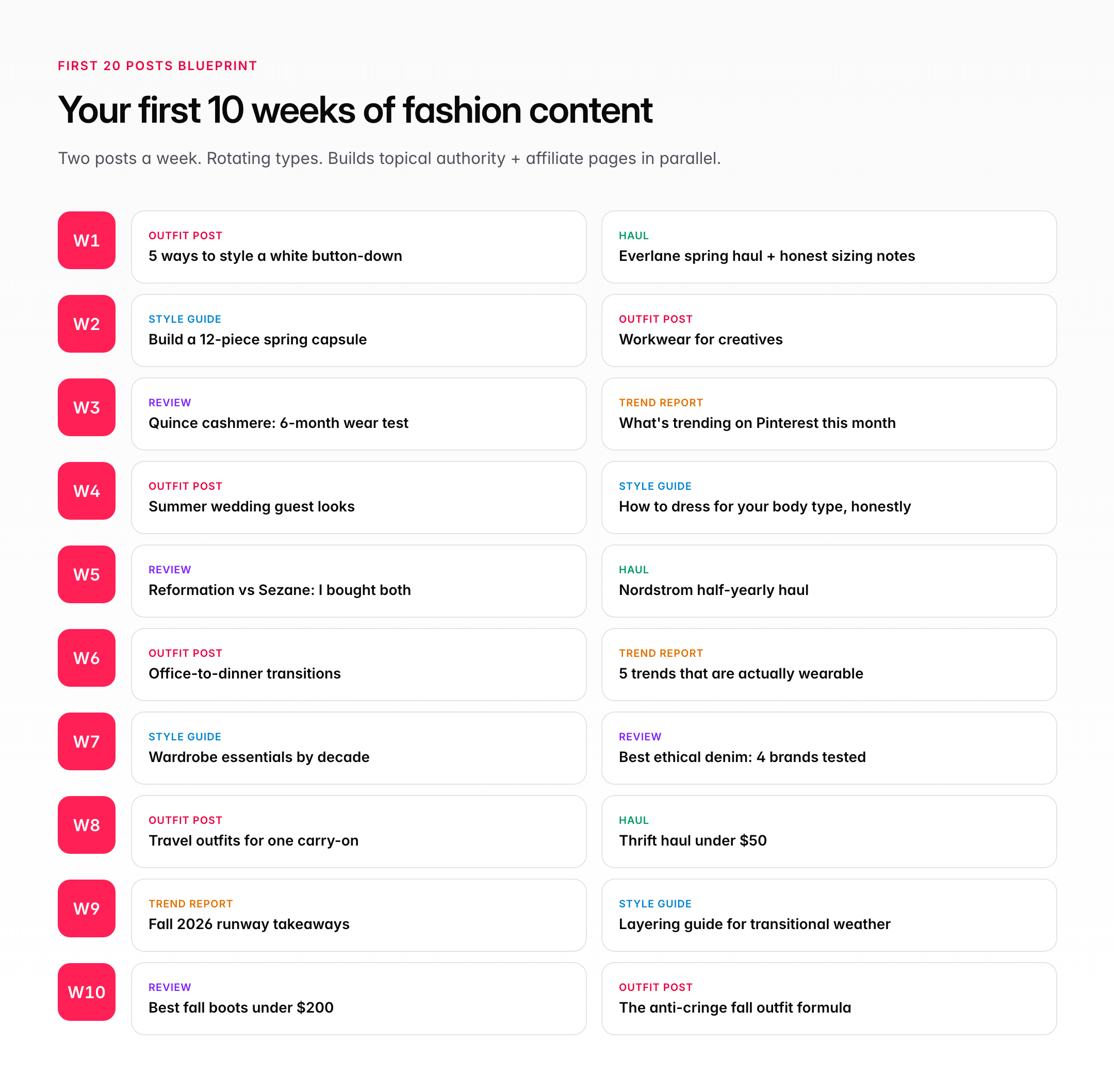
The first 20 posts on a fashion blog should not be random. They should form a topical cluster that signals to Google and Pinterest exactly what your site is about. I write two posts a week, matched to the five content types that work on fashion blogs: outfit posts, hauls, style guides, reviews, and trend reports.
The template I give every client, using a modest-fashion blog as the example:
- Weeks 1-2, style guides: “Modest workwear capsule for 2026”, “12 modest summer outfits under $60”
- Weeks 3-4, outfit posts: “What I wore to a Brooklyn wedding (modest and breathable)”, “5 ways I styled one midi dress this month”
- Weeks 5-6, reviews: “I wore Aab’s midi dress for 30 days, here’s the honest verdict”, “Is Veiled Collection worth the price?”
- Weeks 7-8, hauls: “My $120 Uniqlo modest haul”, “Everything I bought from Modanisa this season”
- Weeks 9-10, trend reports: “The modest-fashion trends blowing up on Pinterest in 2026”, “Why long-sleeve slip dresses are winter’s biggest drop”
Every post gets an internal link to at least two others in this list. By post 20, you have a dense internal-link graph that Google treats as a topical authority signal. This is the single biggest SEO lever most fashion bloggers skip. If you want the full blogging setup sequence, I cover it in detail when I explain how to start a blog from scratch.
How to photograph fashion content without a studio
You don’t need a studio, a DSLR, or a photographer to shoot fashion content in 2026. A modern iPhone (14 Pro or newer) or any Pixel 8+ shoots sharp enough for Pinterest, Instagram, and the blog. What matters more than the camera is light, background, and the angle.
The setup I recommend to every new fashion blogger:
- Light: stand 4 to 6 feet from a north-facing window between 9am and 2pm. No overhead lights, no mixed-color bulbs. If you can’t shoot during the day, an 18-inch ring light at 5600K works.
- Background: a single-color wall (white, beige, terracotta, forest green). No gallery walls, no cluttered shelves. Brands pay more for content that looks clean.
- Tripod: any $25 phone tripod with a Bluetooth shutter. Set the phone at hip-height, slightly tilted up, for the flattering full-body angle.
- Shoot in batches: film or photograph 3 to 5 outfits in one 90-minute session. You’ll produce 2 weeks of content per session.
For Reels, I use a cheap trick: set a 3-second timer on the phone, walk into frame, slowly turn, walk out. Edit in CapCut with a beat drop at the turn. These 8 to 12 second clips get 2 to 4x the reach of static photos on Instagram and TikTok in my 2026 tests.
Monetize: affiliate, sponsored, email, digital products
Fashion blogs make money through four stacked layers: affiliate links (LTK, Amazon Influencer, individual brand programs), sponsored posts, email-list sales, and digital products. Start in that order. Affiliate income kicks in first, around month 3 to 4, and lays the foundation for everything else.
How the layers actually earn, based on client numbers from 2024 to 2026:
- LTK (formerly RewardStyle): 4 to 8% commission on most brands, direct shoppable links on blog and Instagram. A 30k-Pinterest-views/month fashion blog typically makes $200 to $800/month on LTK by month 6.
- Amazon Influencer: 1 to 10% depending on category. Clothing is 4%. Useful for “shop this look” sidebars and Reels with Amazon finds.
- Sponsored posts: rates start around $150 to $400 per blog post at 10k monthly pageviews, rising to $1,500 to $3,500 at 100k. Instagram Reels sponsorships in fashion start around $200 per 10k followers.
- Email list with Kit: a weekly curated “5 finds under $50” email at 2,000 subscribers generates $300 to $900/month in affiliate commissions, from my client data.
- Digital products: capsule wardrobe PDF guides ($17 to $29), seasonal lookbooks ($9), paid Pinterest workshops ($47 to $97). Highest-margin layer, worth adding at month 9 onward.
One tactical move that most fashion bloggers miss: put an email opt-in directly above your first paragraph on every post, offering a free capsule wardrobe PDF or a “5 pieces I’d buy first” guide. My clients see 3 to 6% post-reader opt-in rates this way, versus 0.4 to 0.8% with a sidebar-only form. Read the affiliate marketing guide for the full money-making framework that sits behind this stack.
Common fashion blogging mistakes
After reviewing dozens of fashion blogs for clients and friends, the same mistakes keep killing otherwise-good sites. Fix these before you publish post number one.
- Posting generic pose-only photos with no text. Google can’t rank a page that has 9 images and 80 words. Every post needs 1,200+ words of real thought.
- Chasing trends too fast. By the time a trend hits TikTok’s main feed, the Pinterest wave has already peaked. Write trend pieces 4 to 8 weeks ahead of the curve, not during it.
- Ignoring SEO. “My fall lookbook” won’t rank. “12 fall capsule outfits for petite women” will. Use long-tail sub-niche language.
- Treating Instagram as the blog. Instagram owns your audience, you don’t. The blog and email list are the only assets you actually own.
- Using stock photos or influencer screenshots. Google’s March 2025 core update crushed fashion blogs that didn’t have original photography. Shoot your own, even on a phone.
- Skipping alt text. Alt text is where Pinterest learns what your image is about. Write 8 to 14 words, include your target keyword, describe the outfit.
- Forgetting to disclose affiliates. FTC fines are real. Every affiliate-linked post needs a visible disclosure above the first affiliate mention.
Fashion blog starter budget
You can start a legitimate fashion blog with a $0 to $300 budget in year one, depending on how much you DIY. Here’s the breakdown I give every client for their first 12 months.
- Domain: $9 to $12/year (Namecheap, Porkbun)
- Hosting: $36/year on Hostinger’s intro plan, or $168/year on Cloudways Vultr HF
- Theme: $0 (free Kadence or Blocksy) to $129 (Kadence Pro lifetime-lite)
- Tasty Pins: $79/year (skip if you’re on a strict budget, but you’ll regret it)
- Kit email: free up to 10,000 subscribers, then $29/month
- Canva Pro: $120/year (optional, Canva free works)
- Ring light + tripod: $45 one-time on Amazon
- Phone Bluetooth shutter: $9 one-time
Rock-bottom setup: $90 for year one (Hostinger + Namecheap + tripod + shutter, everything else free). My recommended setup: $285 for year one (Cloudways + Tasty Pins + Canva Pro + tripod + ring light). Anyone selling you a $2,000 “fashion blogger masterclass” to get started is selling you an excuse to not start.
How much does it cost to start a fashion blog in 2026?
A working fashion blog costs between $90 and $300 in year one. The minimum stack is a .com domain ($9 to $12), a hosting plan ($36 to $168), a free theme like Kadence or Blocksy, and the free tier of Kit for email. The recommended add-ons are Tasty Pins ($79/year), Canva Pro ($120/year), and a $45 tripod plus ring light kit.
Do fashion blogs still make money in 2026?
Yes, fashion blogs in specific sub-niches earn $800 to $5,000/month by month 12. The income comes from a stacked model: LTK and Amazon Influencer affiliate commissions, sponsored Reels and blog posts, display ads on platforms like Mediavine and Raptive, and digital products like capsule-wardrobe PDFs. Generic style-diary blogs without a clear sub-niche rarely earn anything.
Which fashion sub-niches are least saturated in 2026?
Modest fashion, sustainable fashion, plus-size workwear, capsule wardrobes, dark academia, and Y2K revival are the least-saturated profitable sub-niches in 2026. Generic streetwear, luxury hauls, and fast-fashion dupes are saturated and poorly monetized. Pick a sub-niche where you can write 50+ post angles and where real brands (not just Shein) sell to the audience.
What’s the best WordPress theme for a fashion blog?
Kadence and Blocksy are the two best WordPress themes for fashion blogs in 2026. Both are free to start, load under 40KB of CSS, pass Core Web Vitals out of the box, and include fashion/lifestyle starter templates. Avoid Divi, Elementor-based themes, and heavy magazine themes, as they slow image-heavy fashion sites and hurt both SEO and Pinterest CTR.
How long does it take a fashion blog to make money?
A focused fashion blog starts earning affiliate commissions around month 3 to 4 with consistent Pinterest pinning. First sponsored post typically lands between month 6 and 9. Meaningful monthly income ($500+) usually begins around month 9 to 12 in a well-chosen sub-niche. Blogs without a Pinterest-first strategy often take 18+ months to hit the same milestones.
Is Pinterest or Instagram more important for a fashion blog?
Pinterest is more important for blog traffic, Instagram is more important for brand deals. In 2026, Pinterest drives 55 to 70% of blog clicks for new fashion sites in year one, while Instagram sends under 10%. Instagram matters because brands check follower counts before sponsoring. Treat Pinterest as your traffic engine and Instagram as your authority layer.
Do I need a professional camera to start a fashion blog?
No. A modern iPhone (14 Pro or newer) or Pixel 8+ shoots sharp enough for Pinterest, Instagram, and the blog. What matters is natural window light between 9am and 2pm, a solid single-color background, a $25 tripod, and shooting 3 to 5 outfits in batched sessions. A DSLR becomes useful only after you’re earning $2,000+/month and want crisper print-campaign-ready output.
How many posts should I publish before monetizing a fashion blog?
Publish 20 high-quality posts before actively chasing monetization. Those first 20 should form a topical cluster across five content types: style guides, outfit posts, reviews, hauls, and trend reports. With 20 posts indexed and 60+ Pinterest pins live, you have enough inventory for affiliate links to convert meaningfully and for sponsors to take a pitch seriously.
Final word
Starting a fashion blog in 2026 isn’t harder than it was in 2020. It’s just less forgiving of generic effort. Pick one sub-niche, build on WordPress with Kadence or Blocksy, make Pinterest your traffic engine, ship 20 posts that hang together as a topical cluster, and stack your income in the order of affiliate, email, sponsored, digital product. If you do those five things in order, by month 12 you’ll be somewhere between $500 and $3,000 a month, which is exactly where my three fashion-blogger clients landed. The rest is compounding.
Tell Google you want more of this.
Add Gaurav Tiwari as a preferred sourceOne tap, and this site shows up more often in your own Top Stories, AI Overviews and AI Mode. Remove it any time.