
Full Stack Marketer: What It Actually Takes (From Someone Who Is One)
Nobody puts “full stack marketer” on their resume and immediately gets hired. It’s not a job title you earn through a certification. It’s a capability set you develop after years of doing the work across enough channels that you stop needing to look up how things work.
I’ve been doing this for a while now. SEO, content strategy, paid ads, email marketing, analytics, web development, conversion optimization. 800+ clients. WordPress Core Contributor. I don’t call myself a full stack marketer because it sounds good. I call myself one because I’ve spent a decade and a half learning the hard way that marketing channels don’t work in isolation.
But here’s the problem with how most articles define this role: they list 30 skills and imply you need to master all of them. You don’t. What you need is the T-shaped model: deep expertise in 2-3 channels, functional knowledge in the rest, and the ability to connect them into a system that drives revenue. Not traffic. Revenue.
In 2026, full stack marketing has changed. 91% of marketers report using AI in their daily work. 65% of teams now have designated AI roles. The full stack marketer isn’t a “jack of all trades” anymore. They’re an orchestrator who uses AI tools to execute across channels while focusing on strategy, creative direction, and quality control.
What “Full Stack Marketer” Really Means
The term comes from software development, where a “full stack developer” works on both front-end (what users see) and back-end (server, database, logic). A full stack marketer works across both the creative side (content, copy, design, brand) and the analytical side (data, attribution, testing, automation).
It doesn’t mean you’re equally skilled at everything. Nobody is. It means you understand how all the pieces fit together and can execute at a functional level across channels while going deep on a few.
A full stack marketer can:
- Run a Google Ads campaign AND write the landing page copy AND track conversions in GA4 AND email the leads that don’t convert
- Audit a site’s technical SEO AND create the content strategy to fix it AND measure the results
- Set up an email automation sequence AND design the templates AND A/B test subject lines AND calculate the revenue impact
The connective tissue matters more than any single skill. A specialist who only does SEO creates rankings. A full stack marketer who does SEO creates rankings that feed email lists that nurture leads that close deals. That’s the difference.
The T-Shaped Skill Model (Deep + Wide)
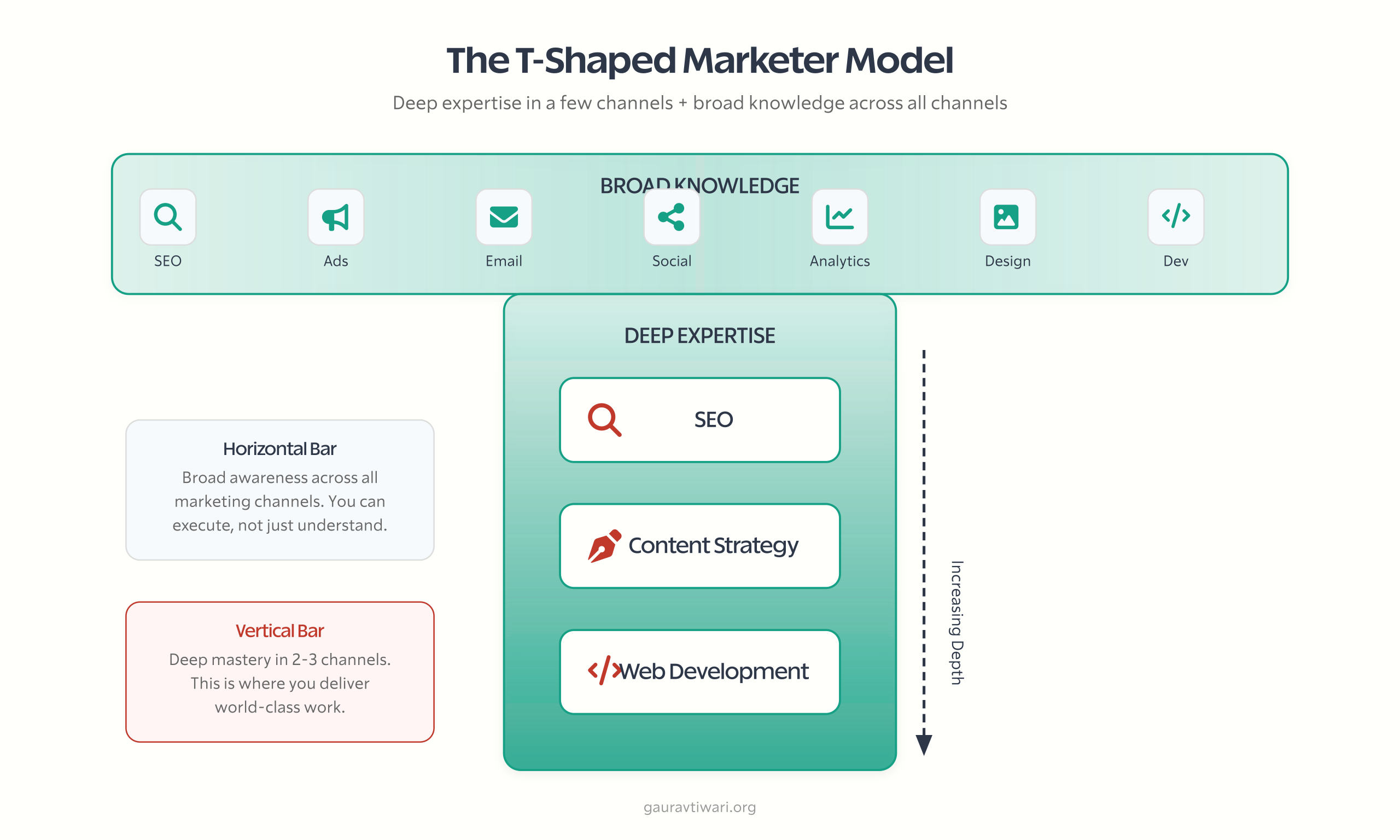
The T-shaped marketer concept is the most practical framework for building full stack capability. Picture a T:
- The horizontal bar is your broad knowledge across all marketing channels. You understand how they work, when to use them, and how they connect. You don’t need to be an expert.
- The vertical bar is your deep expertise in 2-3 specific channels. This is where you deliver world-class work.
My vertical bar: SEO + content strategy + web development (WordPress). These are the skills I’ve spent 16 years sharpening. Everything else (paid ads, email, social, analytics) I can execute at a professional level, but I’m not the best in any of those individual channels.
The highest-value skill combinations in 2026:
| Combination | Why It Pays | Typical Role | Salary Range |
|---|---|---|---|
| SEO + Content + Analytics | Organic growth engine with measurement | Growth Marketing Manager | $80K-$120K |
| Paid Ads + CRO + Analytics | Revenue machine with optimization loop | Performance Marketing Lead | $85K-$130K |
| Email + Automation + CRM | Lifecycle revenue from existing customers | Demand Generation Manager | $75K-$110K |
| Content + Social + Brand | Audience building and thought leadership | Brand Marketing Manager | $70K-$100K |
| AI + Strategy + Analytics | Emerging: AI orchestration across channels | Head of Growth / AI Marketing Lead | $100K-$150K+ |
The best combination for you depends on your market. For B2B SaaS, SEO + content + analytics dominates. For e-commerce, paid ads + CRO + email is the money stack. For startups without budget, content + social + community is the bootstrap path.
Core Skills Every Full Stack Marketer Needs
These are the skills that show up in every full stack marketing role, whether you’re at a startup, an agency, or running your own consultancy. You don’t need to master all of them at once, but you need working knowledge of each.
SEO and Organic Growth
This is the foundation. If you can drive organic traffic, you can reduce paid ad dependency and build compounding returns. Full stack SEO means: keyword research (using Semrush or Ahrefs), on-page optimization, technical audits (site speed, crawlability, schema markup), link building strategy, and content optimization.
In 2026, add GEO (Generative Engine Optimization) to that list. AI search engines are citing content differently than Google. Full stack marketers who understand both SEO and GEO will outperform those who only optimize for one.
Paid Acquisition (Google + Meta)
Even if organic is your strength, you need to understand paid channels. Google Ads (Search, Display, Shopping, YouTube) and Meta Ads (Facebook, Instagram) cover 80% of paid acquisition for most businesses. Know how to set up campaigns, manage budgets, create audiences, and read performance reports.
You don’t need to be a media buyer. You need to be literate enough to evaluate one, manage one, or run basic campaigns yourself.
Content Strategy and Creation
Content isn’t just blog posts. It’s emails, landing pages, ad copy, video scripts, social posts, case studies, whitepapers, and product descriptions. A full stack marketer doesn’t write all of these personally. They understand which content types drive results at each funnel stage and can create or direct the creation of each.
Copywriting is the single most transferable marketing skill. Good copy improves ads, emails, landing pages, and SEO content simultaneously.
Email Marketing and Automation
Email is the highest-ROI channel in marketing. Period. Full stack email skills include: sequence design (welcome, nurture, abandoned cart, re-engagement), segmentation, A/B testing, deliverability management, and CRM integration.
Tools: HubSpot for enterprise, ActiveCampaign for mid-market, ConvertKit for creators. The tool matters less than the strategy.
Analytics and Data
If you can’t measure it, you can’t improve it. GA4 (Google Analytics 4) is the baseline. Every full stack marketer needs to set up event tracking, build conversion funnels, create dashboards in Looker Studio, and calculate ROI by channel.
The advanced skill: attribution. Understanding which touchpoints actually drive conversions and which are just along for the ride. Multi-touch attribution separates full stack marketers from generalists who just look at last-click data.
Basic Web Development
You don’t need to code from scratch. You need to modify a WordPress site, edit landing pages, implement tracking pixels, add schema markup, and debug basic HTML/CSS issues without calling a developer every time.
For WordPress specifically: understand themes, plugins, page builders, custom fields, and WP-CLI. This saves hours per week and eliminates dependency on developers for routine marketing tasks.
How AI Changed Full Stack Marketing
91% of marketers now use AI daily. This fundamentally changed what “full stack” means.
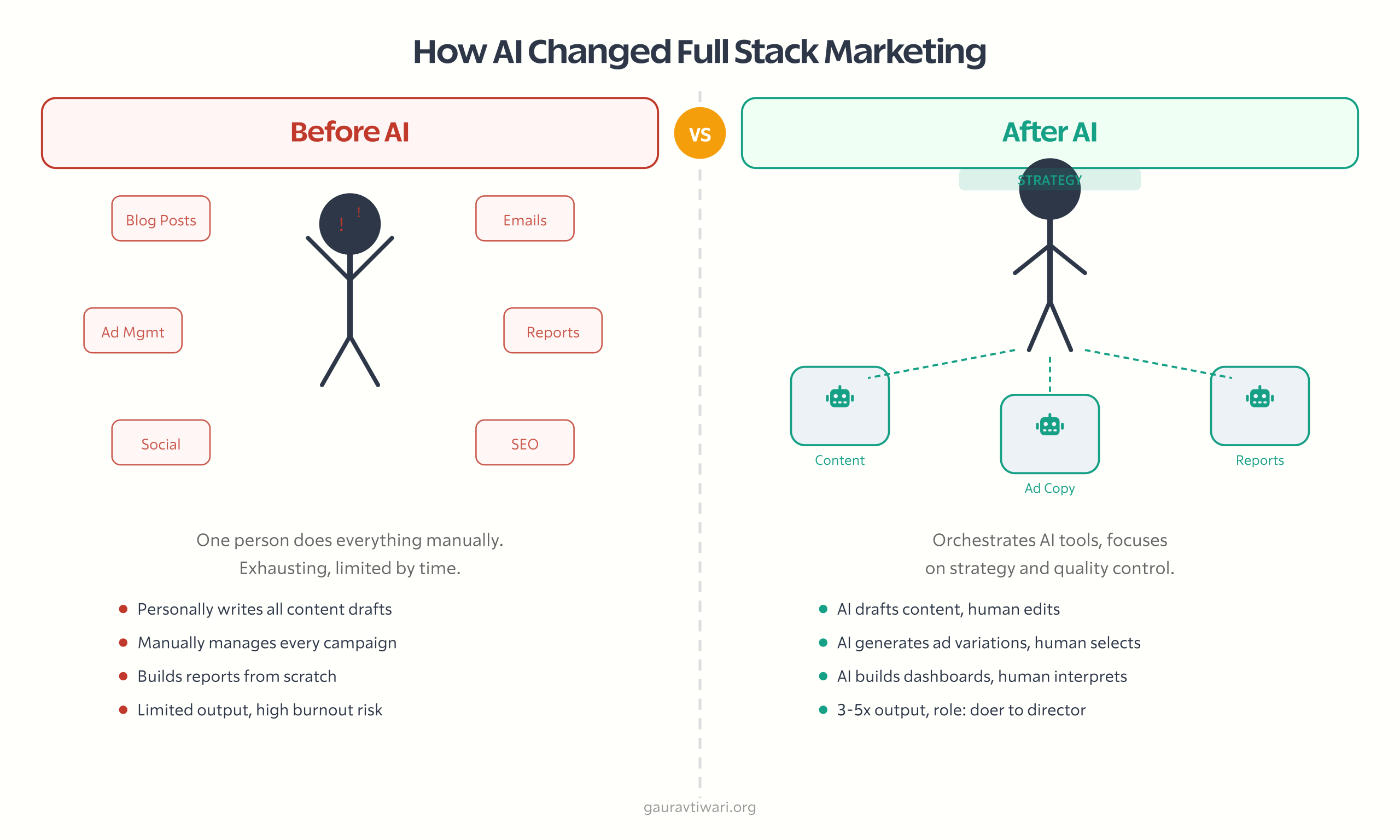
Before AI: A full stack marketer personally executed across channels. They wrote blog posts, set up email sequences, managed ad campaigns, and analyzed data. This was exhausting and limited by time.
After AI: A full stack marketer orchestrates AI tools across channels. They use AI to draft content (then edit), generate ad variations (then select), build dashboards (then interpret), and automate workflows (then optimize). The role shifted from doer to director.
Skills AI replaces (80%+ automated):
- Content first drafts
- Basic keyword research
- Ad copy variations
- Social media post generation
- Report generation
- Email subject line generation
Skills AI amplifies (faster with AI, still human-led):
- Content strategy and editorial direction
- Campaign planning and budget allocation
- Data interpretation and insight generation
- A/B test design and analysis
- Technical SEO implementation
Skills AI can’t touch (100% human):
- Brand positioning and differentiation
- Strategic judgment (which channels, which markets)
- Relationship building (partnerships, PR, influencers)
- Creative direction and brand voice
- Understanding customer psychology and motivation
- Ethical judgment and risk assessment
The full stack marketer of 2026 spends less time in spreadsheets and more time making decisions. AI handles the execution grunt work. Humans handle the thinking.
The Learning Path (What to Learn First)
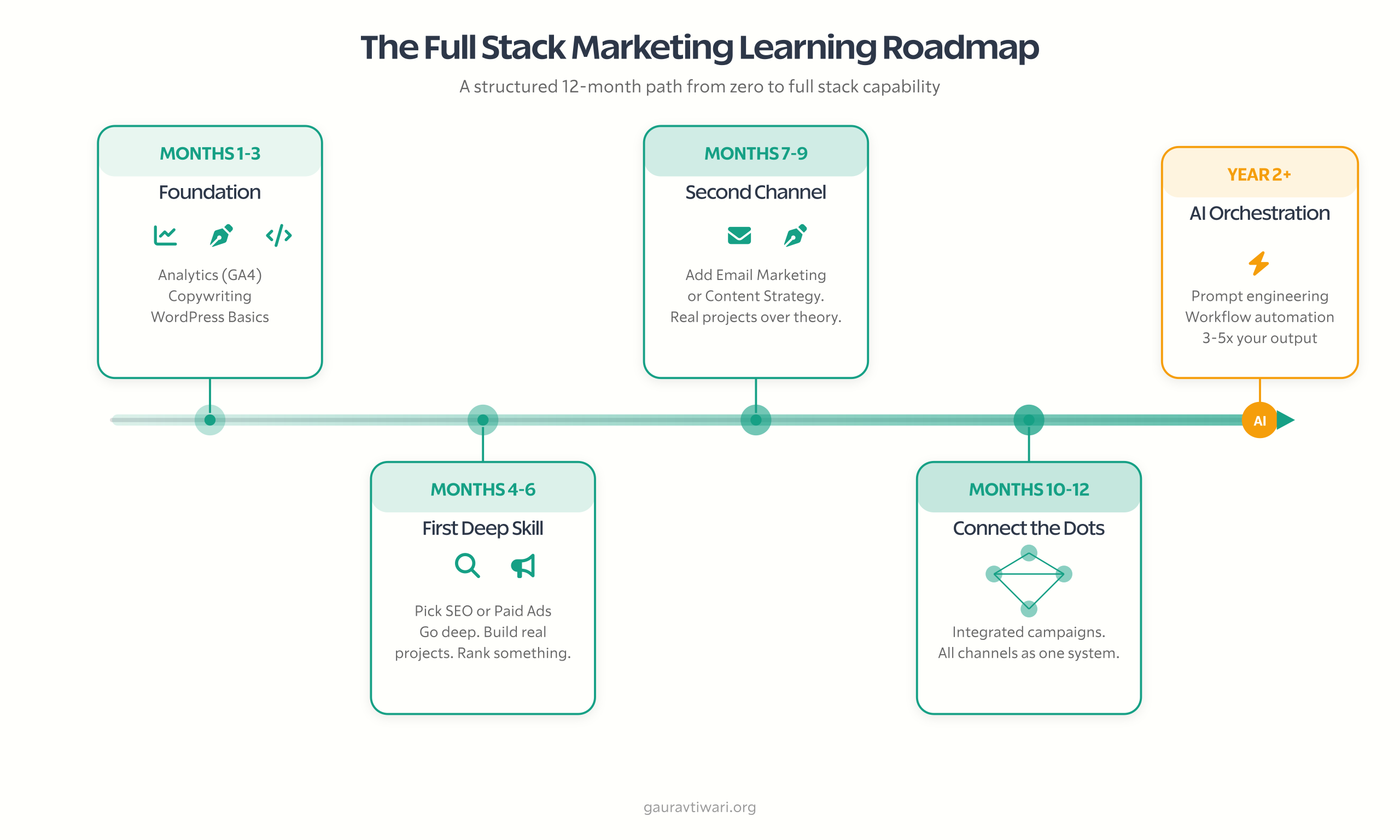
Don’t try to learn everything at once. That’s how you burn out and learn nothing deeply. Here’s the sequence I’d follow if I were starting over:
- Months 1-3: Foundation layer. Learn analytics (GA4 setup, basic reporting), copywriting (headlines, CTAs, email), and WordPress basics. These three skills apply to every channel. Free resources: Google Analytics Academy, HubSpot Academy Inbound Marketing certification, WordPress.org documentation.
- Months 4-6: First deep skill. Pick SEO or paid ads. Go deep. Take Semrush Academy courses. Build a project. Rank for something. Run a campaign with your own money. You learn more from one real project than ten courses.
- Months 7-9: Second channel. Add email marketing or content strategy. Set up an automation sequence. Build a content calendar. Again, real projects over theoretical knowledge.
- Months 10-12: Connect the dots. Build a campaign that uses all your skills together. SEO drives traffic, content captures attention, email nurtures leads, analytics measures everything. This integration is the full stack moment.
- Year 2+: AI orchestration. Learn to use AI tools across every channel you’ve mastered. Prompt engineering, workflow automation, AI content editing, AI-assisted analytics. This is where you 3-5x your output without working more hours.
What I’d skip: Social media management (unless it’s your deep skill), graphic design beyond Canva, programmatic advertising (too specialized), and any certification that costs over $500 (the free ones from Google, HubSpot, and Semrush are better).
Full Stack Marketer vs. Specialist: When Each Wins
| Scenario | Hire a Full Stack Marketer | Hire a Specialist |
|---|---|---|
| Startup, first marketing hire | Yes. One person needs to cover everything. | No. Too narrow for the first hire. |
| Scaling from 10 to 50 employees | Yes, as marketing lead. | Yes, reporting to the full stack lead. |
| Enterprise with established teams | Maybe, for cross-functional projects. | Yes. Each channel needs depth. |
| Agency managing client accounts | Yes, as account strategist. | Yes, for channel execution. |
| Freelancer/solopreneur | You ARE the full stack marketer. | Can’t afford specialists yet. |
The honest salary comparison: Full stack marketers earn $69,766-$93,950 on average, with top earners reaching $112,187 (ZipRecruiter, Glassdoor, Salary.com 2026 data). High-demand markets like Los Angeles average $116,051. Specialists in high-value channels (performance marketing, demand generation) can earn more, but they’re locked into that channel. Full stack marketers have more career flexibility and are harder to replace.
The startup reality: In startups, you don’t choose to be full stack. You’re forced into it. The founder who handles marketing, the first marketing hire who does everything, the freelancer who can’t afford to specialize. Full stack marketing is a startup survival skill, not a career title.
The Tool Stack (What It Actually Costs)
Nobody talks about this. Every article lists tools. Nobody calculates the monthly cost.
| Tier | Monthly Cost | Tools |
|---|---|---|
| Bootstrap ($0) | Free | Google Analytics, Search Console, Canva Free, Mailchimp Free, WordPress, Google Ads Editor, Meta Business Suite |
| Professional | ~$200/mo | Above + Semrush ($130) or Ahrefs ($99), ConvertKit ($29), Canva Pro ($13) |
| Agency-Grade | ~$500+/mo | Above + HubSpot ($90+), Hotjar ($39), Slack Pro ($8), Notion ($10), additional ad spend tools |
Start at $0. The free tier is genuinely functional. Google’s free tools (Analytics, Search Console, Ads Editor, Looker Studio) cover analytics and SEO basics. Canva Free handles 90% of design needs. Mailchimp’s free tier sends 1,000 emails/month. WordPress is free. You can run a full marketing stack for zero dollars until you have revenue to invest.
Upgrade when you have revenue. Semrush at $130/month is worth every penny once you’re managing SEO professionally. It replaces 5-6 separate tools. The best SEO tools pay for themselves in the insights they surface.
Career Progression: Where Full Stack Marketing Takes You
Most full stack marketers don’t start as one. They start as specialists who keep getting pulled into adjacent work.
The typical career path looks like this:
- Marketing Coordinator/Assistant ($40K-$50K). You’re executing someone else’s plan. Scheduling social posts, formatting email newsletters, updating website content, pulling reports. You’re touching every channel but not owning any. This is where you discover which channels interest you.
- Marketing Specialist ($50K-$70K). You own one channel. Maybe SEO, maybe email, maybe paid ads. You go deep. You get good enough that people ask your opinion. But you start noticing how your channel connects to others. The SEO traffic feeds the email list. The email list feeds the retargeting audience. You start thinking in systems.
- Full Stack Marketer / Growth Marketer ($70K-$95K). You own multiple channels and the connections between them. You’re building campaigns that span organic, paid, email, and analytics. At startups, this is often the first marketing hire. At agencies, this is the account strategist who understands the whole picture.
- Marketing Manager / Head of Growth ($90K-$120K). You’re managing both channels and people. You’re setting strategy, allocating budgets across channels, and hiring specialists for areas that need depth. Your full stack knowledge lets you evaluate specialist work in any channel.
- Director of Marketing / VP ($120K-$160K+). You’re setting the marketing vision. Your full stack background means you can speak fluently with every team: SEO, content, demand gen, brand, analytics. You don’t get snowed by specialists because you’ve done their jobs.
- CMO ($150K-$250K+). The endgame. Few full stack marketers reach this. But the ones who do have an unfair advantage: they’ve done the work at every level. They understand both creative and analytical. They’ve touched every channel. A CMO who came up through full stack marketing makes better decisions than one who only knows brand or only knows performance.
The key insight: you don’t need to climb this ladder linearly. I went from specialist to running my own agency (Gatilab) to consulting for enterprise brands. Full stack skills gave me that flexibility. You can go the corporate route, the agency route, the freelance route, or the founder route. The skills transfer across all of them.
What matters more than titles: The 253 full stack marketer jobs currently listed on Glassdoor don’t all use that exact title. They’re listed as “Growth Marketing Manager,” “Digital Marketing Manager,” “Performance Marketer,” “Demand Generation Manager,” and “Marketing Strategist.” The skill set is in demand. The title varies.
The Freelancer’s Full Stack Reality
Here’s something the career-focused articles miss: a huge percentage of full stack marketers aren’t employees. They’re freelancers, solopreneurs, and agency owners who can’t afford to specialize.
When you’re running a one-person consultancy, you ARE the full stack. You write the proposals. You run the SEO audits. You set up the email sequences. You build the landing pages. You pull the analytics reports. You present to the client. There’s no team to delegate to.
This is where I lived for years. And here’s what I learned about making it work:
Focus your services, not your skills. I know email marketing, paid ads, analytics, and content strategy. But I sell WordPress development + SEO + content. That’s my positioning. The other skills make me better at what I sell, but I don’t sell them directly. Full stack skills with focused services is the freelancer’s winning formula.
Charge for the system, not the hours. Clients don’t pay a premium for “I can do SEO.” They pay a premium for “I can build you an organic growth system that connects your blog to your email list to your sales pipeline.” That’s full stack thinking applied to pricing.
Build templates and SOPs for everything. I have WordPress templates, client onboarding sequences, content calendars, SEO audit checklists, and email automation workflows that I reuse across clients. You can’t scale full stack services without systems. I’ve done 800+ client projects. That’s only possible because of systemization.
Use AI to cover your gaps. The channels where you’re weakest? AI closes the gap. I use AI to draft social media content (not my strength), generate ad copy variations (I’m good but slow), and build initial analytics dashboards (tedious manual work). The full stack freelancer of 2026 is really a two-person team: you and your AI toolkit.
The burnout risk is real. Covering every channel for multiple clients is mentally exhausting. The fix: productize your services. Instead of custom everything, offer defined packages with clear scopes. “WordPress site + SEO setup + 3-month content plan” is a productized service. “Whatever marketing you need” is a burnout sentence.
The freelance path isn’t easier than the corporate one. But full stack skills give you more options. You can take on clients that a specialist can’t serve. You can charge more because you deliver complete solutions, not channel fragments. And you never worry about your one skill becoming obsolete because you have fifteen others to fall back on.
See: Best CRM Software for Small Business in 2026
The Full Stack Advantage
The marketing world keeps getting more fragmented. More channels, more tools, more data, more AI. Specialists go deeper into narrower holes. Full stack marketers connect the dots.
You don’t become full stack by taking courses. You become full stack by running real campaigns across real channels for real clients. Start with a foundation. Go deep on what excites you. Add channels as your career demands it. Use AI to multiply your output.
After 16 years and 800+ projects, the most valuable marketing skill I’ve developed isn’t SEO. It isn’t content. It isn’t analytics. It’s the ability to see how all three connect and build systems where each channel reinforces the others. That’s what full stack marketing actually is. Not a list of 30 skills. A way of thinking about marketing as a system, not a collection of channels.
Frequently Asked Questions
What is a full stack marketer?
A full stack marketer is a marketing professional with functional skills across multiple channels including SEO, paid ads, content, email, analytics, and web development, combined with deep expertise in 2-3 specific areas. The term parallels full stack developer in software engineering. They understand how all marketing channels connect and can orchestrate integrated campaigns that drive revenue, not just traffic.
How much does a full stack marketer earn?
Average salaries range from $69,766 on Glassdoor to $93,950 on Salary.com with top earners at the 90th percentile reaching $112,187 according to ZipRecruiter data. High-demand markets like Los Angeles average $116,051. Career progression from Marketing Coordinator at $40K-$50K through Director of Marketing at $120K-$160K to CMO at $150K-$250K+ is common for experienced full stack marketers.
How do I become a full stack marketer?
Start with foundation skills like Google Analytics 4, copywriting, and WordPress basics in months 1-3 using free certifications from Google and HubSpot Academy. Go deep on SEO or paid ads in months 4-6 through Semrush Academy courses. Add email or content strategy in months 7-9. Connect everything with an integrated campaign by month 12. Add AI orchestration skills in year two to multiply your output.
What is the T-shaped marketer model?
The T-shaped model has a horizontal bar representing broad knowledge across all marketing channels where you understand how they work and when to use them. The vertical bar represents deep expertise in 2-3 specific channels where you deliver world-class work. All full stack marketers are T-shaped but not all T-shaped marketers are full stack since the difference is execution capability versus mere awareness.
Is full stack marketing a good career in 2026?
Yes, especially in startups, agencies, and small to mid-size businesses where one person needs to cover multiple channels. With 91% of marketers now using AI tools daily, one full stack marketer can accomplish what previously required a 3-4 person team. There are 253 full stack marketer jobs currently on Glassdoor under titles like Growth Marketing Manager and Demand Generation Manager.
What tools do full stack marketers use?
Core tools include Google Analytics 4 and Search Console for analytics, Semrush or Ahrefs for SEO, WordPress for CMS, Canva for design, Mailchimp or ConvertKit for email, Google Ads and Meta Ads Manager for paid acquisition, and AI tools like ChatGPT and Claude. A functional free stack costs $0 per month using Google and Canva free tiers. A professional stack runs about $200 per month.
Full stack marketer vs growth marketer: what is the difference?
Growth marketers focus specifically on acquisition, activation, retention, and revenue metrics using experimentation and data-driven analysis. Full stack marketers have broader scope including brand, content, community, and web development alongside growth channels. Growth marketing is a specialization within the full stack skill set. Many growth marketers become full stack by necessity since growth requires touching multiple channels.
Do you need a degree to be a full stack marketer?
No. There is no formal degree for full stack marketing. Most successful practitioners are self-taught through free certifications from Google Analytics Academy, HubSpot Academy, and Semrush Academy combined with hands-on project experience. A portfolio of real campaign results demonstrating cross-channel expertise matters significantly more than any marketing degree or paid certification program.
Disclaimer: This site is reader-supported. If you buy through some links, I may earn a small commission at no extra cost to you. I only recommend tools I trust and would use myself. Your support helps keep gauravtiwari.org free and focused on real-world advice. Thanks. - Gaurav Tiwari