
The Economic Impact of Online Gambling: How the Industry is Shaping Global Markets
Compare the economic impact of online gambling across New Jersey, Great Britain, Ontario, and Brazil with regulator-defined revenue, tax, licensing, and harm data.
 by
by
The economic impact of online gambling is real, but it is easy to misstate. Revenue, wagers, gross gaming yield, gaming win, taxes, regulatory fees, jobs, and harm prevalence measure different things. Put them in one market-size sentence and the result looks impressive while explaining very little.
My conclusion is deliberately less dramatic. A regulated online gambling market can create taxable revenue, software and compliance work, and a legal route for consumer disputes. It can also shift household money away from essentials and concentrate a large share of losses among people experiencing harm. Good policy has to price both sides of that ledger.
The short answer. The strongest economic case is not that online gambling creates money from nowhere. It moves consumer losses into operator revenue, supplier spending, wages, and public receipts. The public-interest test is whether a jurisdiction captures enough tax, reduces illegal supply, protects customers, and funds independent prevention, research, and treatment.
Four checks before trusting any market number: confirm the unit, the legal scope, the reporting period, and whether the figure is an actual result or a forecast. I do not convert the four markets below into one global total because their currencies and definitions are not directly comparable.
How does the economic impact of online gambling reach world economies?
The economic impact reaches an economy through direct tax and licensing receipts, operator and supplier spending, employment, payment and compliance infrastructure, and household losses. The balance changes with the tax design, legal channelization, product mix, advertising rules, and the strength of consumer protection.

Here is the jurisdiction snapshot as of July 29, 2026. Every row uses a government or regulator publication, except the US national context that the AGA compiles from state regulators. The values stay in their source currency and keep their source definition.
| Jurisdiction | Dated official scope | Market signal | Tax, licence, or protection signal | Do not misread it as |
|---|---|---|---|---|
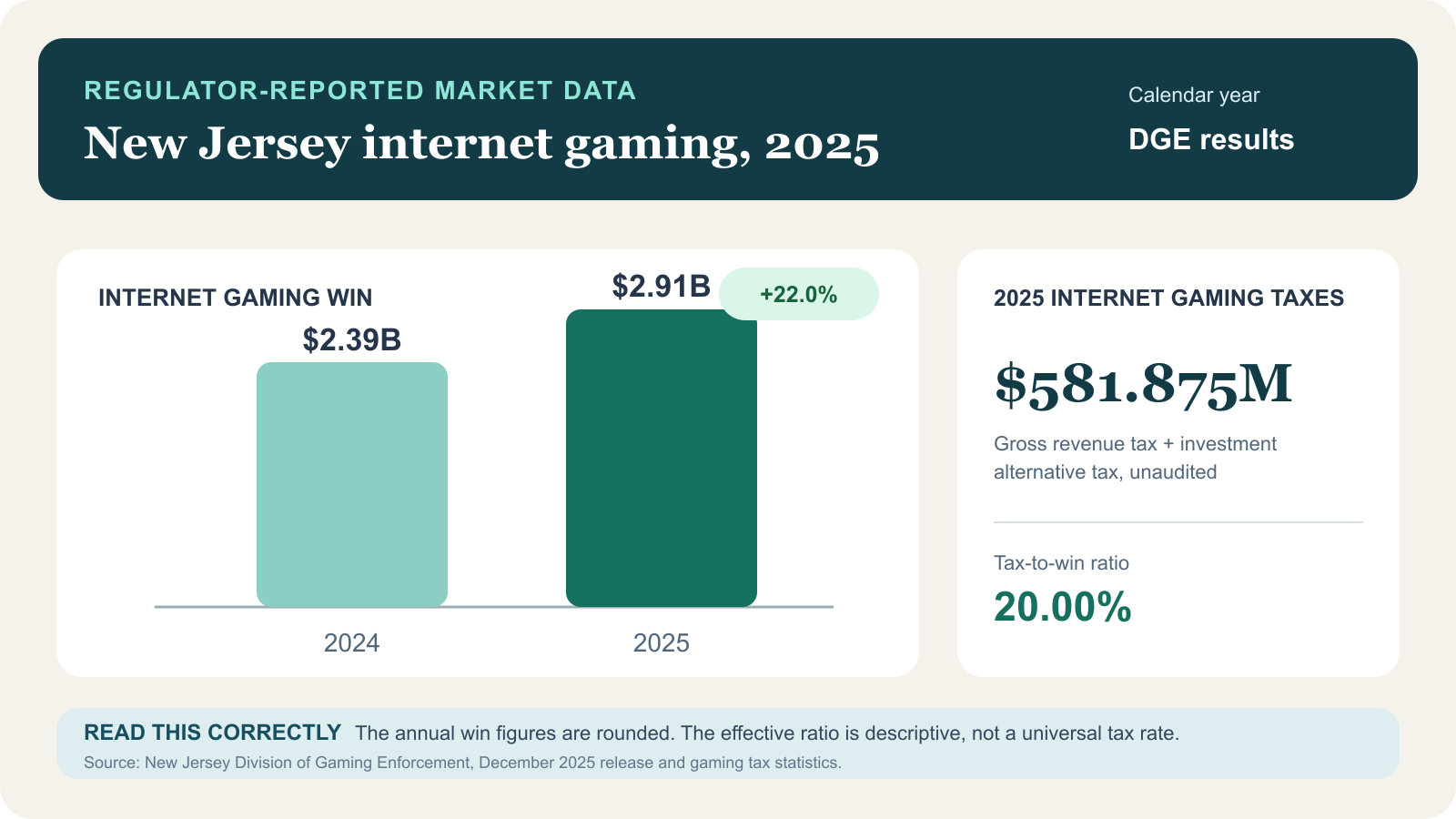
| New Jersey | Calendar 2025, casino licensees and internet partners | $2.91B Internet Gaming Win, up 22.0% from a rounded $2.39B | $581.875M internet gaming taxes; tax rate changed during 2025 | Net operator profit or national US revenue |
| Great Britain | April 2024 to March 2025, Gambling Commission licensees | £7.8B remote casino, betting, and bingo GGY, up 13.1% | 2,179 operators in the whole licensed market at March 31, 2025 | Remote casino revenue alone or tax collected |
| Ontario | Directory dated July 22, 2026 | 48 regulated operators and 82 gaming websites | C$3.8B FY2025-26 adjusted GGR is a business-plan estimate | An audited actual or proof that every player uses the legal market |
| Brazil | Calendar 2025 federal fixed-odds authorization | 79 authorized companies, 183 brands, 25.2M reported participants | About R$2.46B in regulatory fees | Every form of online gambling or operator GGR |
The New Jersey row comes from New Jersey Division of Gaming Enforcement’s December 2025 release and New Jersey’s 2025 gaming tax statistics. Internet Gaming Win grew by a rounded $520 million. Dividing the $581.875 million tax total by the rounded $2.91 billion win produces a descriptive 20.00% tax-to-win ratio. It is not the statutory rate: the gross revenue tax moved from 15% to 19.75% on July 1, 2025, and the tax total also includes a 2.5% investment alternative tax.
For national context, AGA’s May 2026 State of the States report reports $78.62 billion in 2025 US commercial gaming revenue, $17.86 billion in direct gaming taxes, $16.89 billion in sports-betting revenue, and $10.73 billion in iGaming revenue across seven states with lawful online casinos. The tax figure excludes income, sales, payroll, and federal sports-betting excise taxes, which is exactly why the definition matters.
Great Britain’s official industry statistics reports £16.8 billion total GGY and £7.8 billion from remote casino, betting, and bingo. The remote figure includes £5.0 billion in online casino games, £2.6 billion in remote betting, and £165.6 million in remote bingo. It is a licensed-market measure, not a household-welfare score.
iGaming Ontario’s operator directory lists 48 operators and 82 websites as of July 22, 2026. iGaming Ontario’s 2026-2029 business plan estimates FY2025-26 adjusted GGR at C$3.8 billion, but labels its financial outlook as forward-looking. That estimate belongs in planning, not in a table of audited actuals.
Brazil’s Ministry of Finance 2025 management report records 79 authorized companies, 183 commercial brands, 25.2 million reported participants, and roughly R$2.46 billion in regulatory fees during 2025. This is the federal fixed-odds regime. It should not be presented as a count or revenue total for every online casino product.
A consumer directory such as https://www.gambleonline.ca/ may help a reader discover brand names, but it is not regulatory evidence. Verify the exact domain against the regulator’s current register. A familiar logo, HTTPS, or an affiliate list cannot prove that a site is authorized in your location.
The good: where gambling tax revenue and jobs come from
The clearest benefit is fiscal visibility. A legal market can publish operator-level results, enforce reporting definitions, collect taxes, and give customers a complaint path. The economic spillover is real, but it should be described with measured outputs rather than broad claims about innovation.
- Direct public receipts: gaming taxes, revenue share, licence fees, regulatory fees, and ordinary business taxes where applicable.
- Direct employment: operator roles in engineering, support, finance, legal, risk, compliance, and safer-gambling operations.
- Supplier demand: payments, identity verification, fraud controls, geolocation, testing, cloud infrastructure, data, and security.
- Regulatory capacity: public-sector work in licensing, audits, investigations, enforcement, data analysis, and policy.
- Consumer recourse: defined rules for balances, withdrawals, complaints, marketing, identity, and player protection.
I would not count every supplier sale as a new social benefit. Some spending replaces activity that previously happened offshore or in another entertainment sector. Some roles are imported. Some tax receipts fund ordinary budgets rather than new services. Economic impact studies should disclose direct, indirect, and induced effects without adding them twice.
The supply chain also explains why commentary aimed at potential investors can overstate the upside. Regulation increases demand for compliance technology, but it also adds taxes, capital needs, reporting costs, enforcement exposure, and marketing restrictions. Growth and investability are not the same thing.
Technology can reshape industries, as it has on the relationship between commerce and production, but the infrastructure of online gambling is not automatically a public good. A faster payment rail or more accurate risk model creates value only when its incentives and outcomes are controlled.
Revenue still begins with player losses. The mechanics behind how much money casinos really make when you play should sit beside every tax-benefit claim. Gross gaming revenue is broadly the amount retained after payouts, before operating costs and tax. It is not the same as wagers, deposits, profit, GDP, or household benefit.
The social cost side: the real problem gambling cost
The cost side is harder to monetize and easier to omit. It includes financial distress, diverted household spending, relationship and health consequences, workplace effects, fraud and crime, treatment, and harm experienced by family members. A clean global dollar total does not exist with one standardized method.
- Global health context: World Health Organization’s gambling fact sheet says standardized global estimates are limited, while available evidence suggests 1.2% of the adult population has gambling disorder.
- Revenue concentration: WHO reports that people gambling at harmful levels generate about 60% of gambling losses, which are industry revenue.
- Great Britain: 2025 Gambling Survey for Great Britain reports 2.4% of all 2025 participants scoring 8 or more on the PGSI, with a 95% confidence interval of 1.9% to 2.8%.
- Age gradient: among people who gambled in the previous 12 months, the same survey reports PGSI 8+ for 10.4% of ages 18 to 24 versus 0.8% of ages 75 and over.
- Method warning: Gambling Commission’s survey-mode research shows that self-completion and face-to-face survey designs can produce materially different prevalence estimates.
Those percentages are not a social-cost invoice. PGSI is a screening measure, not a direct measure of tax, lost productivity, healthcare use, or household poverty. A national cost estimate is only useful when its geography, year, cost categories, counterfactual, and uncertainty are stated together.
The commercial mechanism matters too. The ways marketing influences the number of casino players matter because campaigns often target attention, urgency, social proof, and repeat play rather than expected loss. The psychology behind casino ads matters for the same reason: a market can be legal and taxable while still using product design that increases harmful exposure.
Ontario’s player-risk guidance requires registered operators to identify and support players who may be experiencing harm. Useful regulatory evidence is not a responsible-gambling slogan in the footer. It is a documented system for risk indicators, intervention, staff training, records, evaluation, limits, and exclusion.
How 2026 regulation is trying to balance the gambling economy
The best 2026 policy changes treat gambling revenue and gambling harm as connected cash flows. Tax captures part of the private return. A levy can reserve funding for independent research, prevention, and treatment. Register and enforcement systems make the legal boundary visible.
| Policy tool | Current dated example | Economic purpose | Key limitation |
|---|---|---|---|
| Higher remote duty | Great Britain raised Remote Gaming Duty from 21% to 40% on April 1, 2026 | Capture more public revenue from remote gaming profits | A higher rate can affect prices, margins, and incentives to serve the legal market |
| Statutory harm levy | Great Britain says the first levy year raised just under £120M | Ring-fence 50% treatment, 30% prevention, and 20% research | Funding alone does not prove prevention or treatment outcomes |
| Public operator register | Ontario listed 48 operators and 82 gaming websites on July 22, 2026 | Let users and suppliers verify the regulated channel | A count does not show market share, enforcement quality, or harm |
| Authorization and domain controls | Brazil reported 79 companies and 183 brands in 2025 | Move fixed-odds activity into a supervised, taxable system | Regulated supply can coexist with illegal or offshore activity |
HMRC’s gambling-duty changes confirms the 40% Remote Gaming Duty rate from April 1, 2026. UK statutory gambling levy guidance says the levy began in April 2025 and raised just under £120 million in its first year. The money is allocated 50% to treatment, 30% to prevention, and 20% to research.
The success test should be outcome-based. Track legal-market share, tax collected, operator failures, complaint resolution, withdrawal times, excluded-player breaches, underage access, marketing violations, risk interventions, treatment access, and prevalence with consistent methods. Revenue growth on its own is not a regulatory score.
The rise of digital betting as a leisure activity in India shows why national context matters. Payment controls, consumer law, state and central powers, taxation, and offshore enforcement can point in different directions. Copying Ontario or New Jersey’s numbers into an India forecast without matching legal scope would be analysis by analogy, not evidence.
The verdict
Online gambling can expand a tax base and a specialized digital supply chain. New Jersey, Great Britain, Ontario, and Brazil all show that regulated markets can produce measurable public receipts and visible operator registers. They do not prove that every dollar of GGR is a net gain to society.
The honest test of the economic impact of online gambling is stricter: compare public receipts and real local value with enforcement costs, displaced household spending, illegal-market leakage, and health and social consequences. Keep currencies and reporting units separate. Mark forecasts as forecasts. Treat prevalence estimates with their methodology and confidence intervals.
My position is that legalization is defensible only when the legal market is easier to verify, meaningfully safer, properly taxed, and willing to fund the response to the harm tied to its revenue. If those conditions are missing, growth is not evidence of good policy. It is merely evidence that more money is moving through the system.
Responsible-gambling note. Gambling is not an investment or income plan. Set limits before play, never chase losses, and use the exclusion and support options available through the licensed operator or regulator in your jurisdiction. If it stops feeling voluntary, stop and seek local professional support.
Tell Google you want more of this.
Add Gaurav Tiwari as a preferred sourceOne tap, and this site shows up more often in your own Top Stories, AI Overviews and AI Mode. Remove it any time.
Disclaimer: This article is for information only, not legal or financial advice. Online betting and iGaming are regulated, and rules vary by location. Make sure you are allowed to play where you live. Gambling involves real financial risk and can be addictive. Only play with money you can afford to lose, and get help if it stops being fun.