
How Much Money Do Casinos Really Make When You Play?
 by
by
How casinos make money is simple in theory: they apply a positive mathematical expectation to repeated wagers, but the amount a casino wins from players is not the same as profit. The useful calculation starts with total action, not the cash you carried through the door.
That distinction fixes most bad explanations of casino economics. House edge estimates the average loss built into a wager. Hold measures an observed result against a product-specific denominator. Gaming win or gross gambling yield is revenue before many costs. Net income is what remains after expenses under a stated accounting rule.

The probability model is the same on a casino floor and on an ice casino online platform. The delivery changes, but a 5.26% double-zero roulette edge is still 5.26%. What changes online is speed, data collection, bonus design, and how easily one bankroll can be recycled into much larger total action.
- Expected loss = total action x house edge. A $100 deposit is not the denominator if you wager it repeatedly.
- RTP = 100% minus house edge for a fixed-paytable game, but it is a long-run setting, not a session refund.
- Hold needs a denominator. Slot amount played, table drop, and sportsbook handle are different measures.
- Gaming win is not net profit. Payroll, tax, comps, property, technology, marketing, and finance still matter.
- Regulator totals are not a league table. Periods, currencies, products, and reporting populations differ.
Table of Contents
The Core Concept: Understanding the House Edge
The house edge is the expected casino advantage per unit wagered under a defined set of rules. If a wager has a 2% edge, $100 of action carries a $2 theoretical expected loss. That does not mean the player will lose $2. It means $2 is the average of the probability distribution before the wager is resolved.
The word expected matters. A player can win $500, lose $100, or finish flat. A casino can also lose on a table, during a shift, or across a month. As the number of independent or weakly dependent wagers grows, average results usually become less volatile around the underlying expectation. It does not guarantee a result for a player, table, casino, or accounting period.
The bankroll trap is confusing cash on hand with action. Suppose you start with $100 and make 300 bets of $5. You generated $1,500 of action even though you never had $1,500 in your pocket. At a 4% edge, the theoretical expected loss is $60. Re-wagering winnings is how a modest deposit creates a large exposure.
| Input | Calculation | Meaning |
|---|---|---|
| 300 spins x $5 | $1,500 action | Total amount wagered |
| 96% RTP | 4% house edge | Long-run game setting |
| $1,500 x 4% | $60 expected loss | Average model result, not a session forecast |
House Edge by Game: Best and Worst Casino Odds for Players
There is no universal blackjack edge, slot edge, or craps edge. Rules, paytables, strategy, and bet selection change the number. Roulette is cleaner because the wheel layout and payout define the edge directly.
| Game or bet | House edge | Scope that makes the number valid |
|---|---|---|
| Blackjack illustration | 0.50% | Favorable rules plus correct basic strategy; not universal |
| Baccarat banker | 1.0579% | Standard game with 5% commission |
| Craps pass line | 1.414% | Initial pass-line wager; odds bet itself has zero edge |
| European roulette | 2.7027% | Single-zero wheel: one losing zero among 37 pockets |
| 96% RTP slot | 4.00% | Published paytable and RTP setting |
| American roulette | 5.2632% | Zero and double zero among 38 pockets |
| Baccarat tie at 8:1 | About 14.36% | Standard commission-game tie payout |
The old shorthand that blackjack played with perfect basic strategy always has a 0.5% edge is too loose. A 6:5 blackjack payout, fewer doubling options, dealer hits soft 17, side bets, and strategy errors can move the player much farther from that illustrative number.
Equal action makes the cost difference visible. On $1,500 of action, a 0.5% blackjack illustration carries $7.50 in expected loss; a standard banker bet, $15.87; European roulette, $40.54; a 96% RTP slot, $60; and American roulette, $78.95. Those are calculated averages. Volatility controls how widely an actual session can land around them.
Slots and RTP: A Different Side of the Coin
RTP describes the share of eligible wagers a game is designed to return over a very large sample. A 96% RTP corresponds to a 4% mathematical edge. It does not promise a player $96 back from a $100 deposit, because a session is too small and the deposit may be wagered more than once.
Two slots can advertise the same RTP and feel completely different. A lower-volatility game pays smaller amounts more often. A high-volatility game may concentrate more of its return in rare features or jackpots. RTP measures the average. Volatility shapes the path, bankroll swings, and risk of ruin during a finite session.
Nevada’s April 2026 Gaming Revenue Report gives a real denominator. For the 12 months through April 30, 2026, all nonrestricted locations reported $10.821 billion in slot win at a 7.07% win percentage. Table, counter, and card games reported $5.119 billion in win at 14.44%. The regulator says slot win percent is win divided by the total dollar amount played. Its table-game ratio is adjusted for credit play and is drop-based, so it is not the theoretical edge of the games.
Articles about how much does crown casino make a day can make casino earnings sound like one cash register. In practice, a resort combines gaming, rooms, food, beverage, retail, entertainment, and loyalty economics. The psychology behind casino ads also affects how quickly players create action, but it does not change the underlying roulette wheel or paytable.
Hold Percentage vs. House Edge: What the Casino Actually Keeps
Hold is useful only after you name the denominator. For slots it is commonly gaming win divided by amount played. For table games it is commonly win divided by drop, the cash and markers exchanged for chips. A player can recycle those chips through many wagers, so table hold can be far above the game’s house edge without the rules becoming worse.
- House edge: theoretical advantage on a defined wager.
- Amount played or handle: total wager volume.
- Drop: cash and credit exchanged for chips at table games.
- Gaming win or GGR: wagers retained after player payouts under the regulator’s definition.
- Net income: what remains after specified expenses under an accounting definition.
The Nevada Gaming Abstract 2025 provides the cleanest correction to the phrase casino profit. For FY2025, its cohort of 305 nonrestricted casinos with at least $1 million in gaming revenue reported:
- $30.818 billion in total revenue from gaming, rooms, food, beverage, and other attractions.
- $11.216 billion in gaming revenue, equal to 36.4% of total revenue for that cohort.
- $1.698 billion in net income after expenses but before federal income tax and extraordinary expenses.
- 5.51% net income relative to total revenue in this specific regulator dataset.
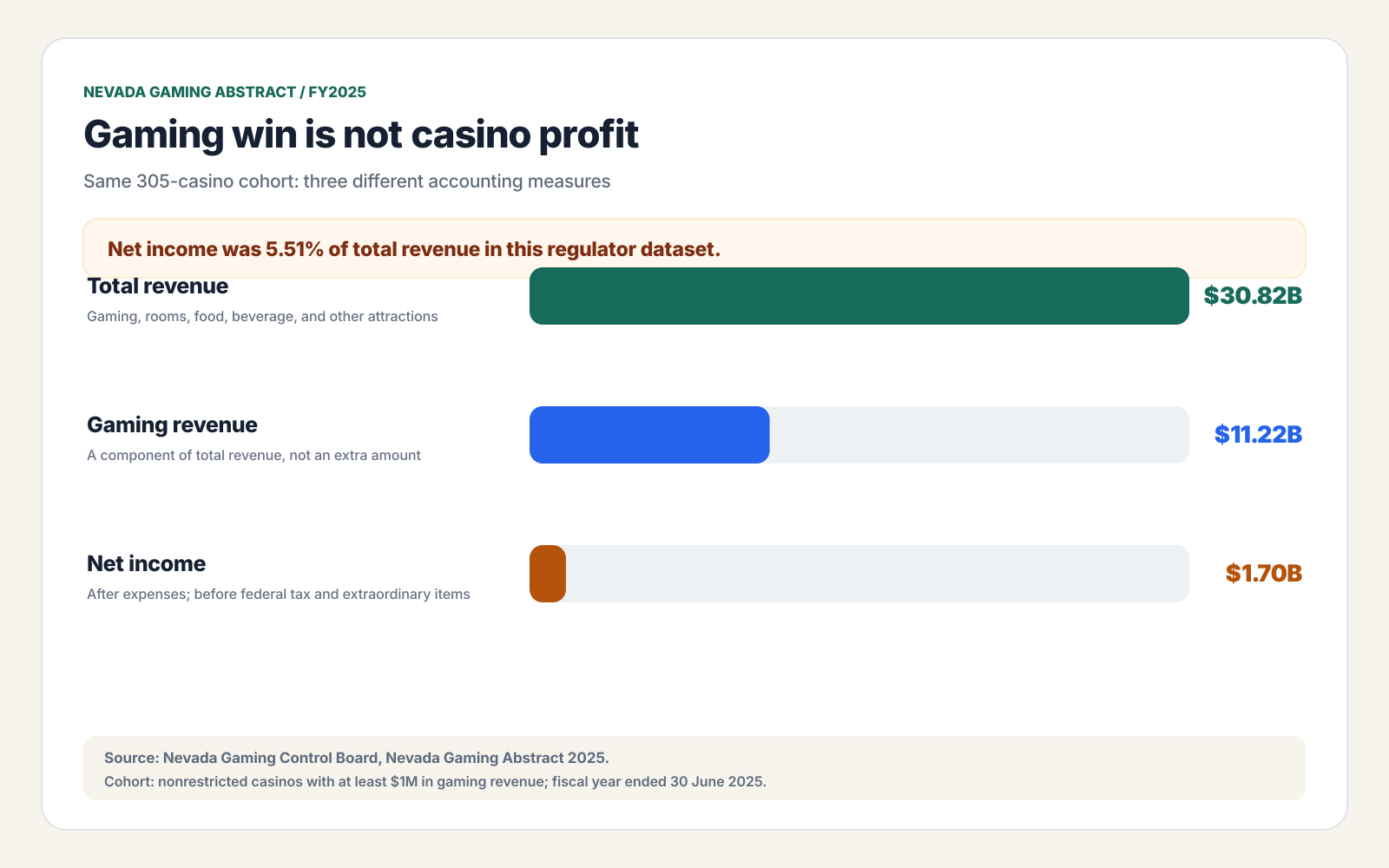
Do not subtract the gaming revenue bar from total revenue. Gaming is included in total revenue. Do not apply the 5.51% result to a different state, an online operator, or every Nevada licensee. The cohort and accounting definition are part of the statistic.
This distinction is also central to the economic impact of online gambling. A jurisdiction may report large gaming win, tax receipts, and jobs while an individual operator still produces thin income or a loss after property, marketing, compliance, and finance costs.
Why the House Always Wins Over Time
The house does not always win, but a positive expected value gives it an advantage as action accumulates. The popular slogan skips variance, operating risk, customer acquisition cost, bad debt, game protection, taxes, and capital structure.
The statistical mechanism is straightforward: total expected win rises roughly in proportion to action, while random fluctuation grows more slowly under ordinary assumptions. That is why a large portfolio of wagers is more predictable as a percentage than one roulette spin. It is also why a betting progression cannot erase a negative expectation. Changing stake size changes volatility and possible loss, not the wheel probabilities.
Poker and sports betting need separate treatment. Poker rooms usually earn rake or fees while players compete against one another. Sportsbooks price markets and face model, trading, and concentration risk. If you compare prices, American, decimal, and fractional odds help expose the implied probability and bookmaker margin behind the display format.
For a player, the practical controls are simple:
- Set a fixed loss limit before the first wager.
- Track total action if you want to understand theoretical cost.
- Use a time limit because speed increases action.
- Never treat a bonus as free cash without reading wagering terms.
- Do not chase losses or increase stakes to recover a target.
- Use the operator or regulator’s account controls and self-exclusion process if gambling stops feeling voluntary.
The same scrutiny belongs on promotions. My guide to the truth about casino bonuses shows why wagering requirements, eligible games, maximum-bet rules, and withdrawal conditions can matter more than the headline amount.
A Look at the Bigger Picture
Regulators do not publish one universal casino revenue metric. A number is meaningful only with its period, currency, included products, reporting population, and definition.
| Jurisdiction and period | Reported scale | What the number is |
|---|---|---|
| Nevada, FY ended June 30, 2025 | $30.818B total revenue; $11.216B gaming revenue; $1.698B net income | Financial cohort of 305 casinos with at least $1M gaming revenue |
| New Jersey, calendar 2025 | $6.983B total gaming revenue | $2.894B casino win + $2.911B internet win + $1.177B sports revenue |
| Great Britain, Apr 2024 to Mar 2025 | GBP16.8B total GGY | Customer-facing industry including reported lotteries |
| Ontario regulated iGaming, FY ended Mar 31, 2025 | CAD82.744B wagers; CAD2.902B gaming revenue | Eligible private-operator market; excludes OLG iGaming and horse racing |
New Jersey’s 2025 results show why product mix matters: $2.894 billion in casino win, $2.911 billion in internet gaming win, and $1.177 billion in sports wagering revenue summed to $6.983 billion. Internet gaming alone was 41.69% of the total, but the figure still does not reveal operator profit.
Great Britain’s 2024-25 industry statistics use gross gambling yield and report GBP16.8 billion for the customer-facing industry, including lotteries. The regulator separately reports GBP7.8 billion for remote casino, betting, and bingo and GBP4.8 billion for land-based sectors. That scope is different from a U.S. casino-win release.
iGaming Ontario’s audited financial statements connect action to revenue most directly. In FY2024-25, CAD82.744 billion in wagers produced CAD2.902 billion in gaming revenue, or 3.51% of wagers. Casino products accounted for CAD69.670 billion in wagers and CAD2.189 billion in gaming revenue, or 3.14%. The statements then deduct operator payments and agency expenses, proving again that gross gaming revenue is not profit.
So how much does a casino make when you play? The defensible estimate is your total action multiplied by the house edge for the exact rules you played. That estimates gross theoretical win from your action, not the operator’s net profit. If either input is unknown, a precise dollar answer is invented.
Frequently asked questions
How do casinos make money if players sometimes win?
Casino games give the operator a positive expected value over total action. A player can win any session, and a casino can have a losing day, but repeated wagers make the average result more likely to approach the game rules. The resulting gaming win is revenue before many operating costs, not automatic profit.
Does a house edge guarantee casino profit?
No. House edge describes the theoretical average on a defined wager. It does not guarantee a result for a player, session, casino, or year. Profit also depends on payroll, taxes, property, technology, marketing, compliance, financing, and non-gaming operations.
How do I calculate my theoretical expected loss?
Multiply total action by the house edge. If you make 300 five-dollar slot spins, your action is $1,500. At 96% RTP, the edge is 4%, so theoretical expected loss is $60. Your actual result can be far above or below that figure.
What is the difference between house edge and hold?
House edge applies to the rules of a wager. Hold is an observed ratio, but its denominator changes by product. Nevada reports slot win divided by amount played, while table-game win percent uses a drop-based ratio adjusted for credit play. Those numbers should not be compared as if they were the same measure.
Which common casino games have the lowest house edge?
A standard-commission baccarat banker bet is about 1.06%, and a craps pass-line bet is about 1.41%. Blackjack can be lower, but only under favorable rules and correct strategy. Roulette is 2.70% on a single-zero wheel and 5.26% on a double-zero wheel.
Is casino gaming revenue the same as casino profit?
No. In Nevada’s FY2025 financial cohort, 305 casinos reported $30.82 billion in total revenue, $11.22 billion in gaming revenue, and $1.70 billion in net income. The regulator defines net income after expenses but before federal income tax and extraordinary items.
Tell Google you want more of this.
Add Gaurav Tiwari as a preferred sourceOne tap, and this site shows up more often in your own Top Stories, AI Overviews and AI Mode. Remove it any time.