American vs. Decimal vs. Fractional: A Translator for Sports Betting Odds
 by
by

Sports betting odds use three common formats, but the format never changes the underlying price. American +150, decimal 2.50, and fractional 3/2 all mean the same thing: a $100 stake returns $250 if the selection wins, including the original stake. The useful skill is translation, not chasing whichever number looks largest.
My practical recommendation is decimal as the working format. It makes total return and implied probability visible with one multiplication and one reciprocal. Convert everything to decimal, compare the same market and rules, then separate the quoted overround from the operator’s realized hold. Those are related measures, not synonyms.
The 30-second version: positive American odds show profit on a $100 stake; negative American odds show the stake required for $100 profit. Decimal odds multiply the stake into total return. Fractional odds multiply the stake into profit. None of these conversions creates an edge, removes the margin, or predicts a result.
Table of Contents
Odds Formats Explained: American, Decimal, and Fractional
American, decimal, and fractional notation are display conventions. Legality, settlement rules, market definitions, and consumer protections come from the jurisdiction and operator licence, not the notation on the screen.
| Format | Example | What the number shows | Same $100 winning return |
|---|---|---|---|
| American | +150 | $150 profit per $100 staked | $250 |
| Decimal | 2.50 | Total return per $1 staked | $250 |
| Fractional | 3/2 | $3 profit per $2 staked | $250 |
Before using any platform, check the regulator’s live register. A domain being accessible is not evidence that it is licensed. For example, https://fortunica3.com/en-au should not be treated as an endorsed or verified service. Australia’s ACMA investigation register names Fortunica among services investigated in connection with prohibited interactive gambling.
The legal checks differ sharply by place:
| Jurisdiction | What to verify | Important current boundary |
|---|---|---|
| Great Britain | Search the operator or domain in the Gambling Commission register | A remote operator serving players in Great Britain must hold the relevant UKGC licence and disclose its licensed status. |
| New Jersey | Use New Jersey Division of Gaming Enforcement records and house rules | Sports wagering is state-regulated and the minimum age is 21 under Chapter 69N. |
| Arizona | Use the ADG approved-operator list | The legal gambling age is 21; approved mobile and retail operators can change, so check the live list. |
| Australia | Use the ACMA licensed-provider register | Unlicensed wagering and online in-play sports betting are prohibited; credit cards and digital currency cannot be used for online wagering from 11 June 2024. |
Read: Mathematics of Betting Odds
How to Read Each Odds Format
Each format answers the same two questions: what is the total return if the selection wins, and what probability is embedded in that price?
- Positive American odds: +150 means $150 profit on a $100 stake. Total return is $250.
- Negative American odds: -120 means stake $120 for $100 profit. Total return is $220. With a different stake, scale proportionally.
- Decimal odds: 2.50 means every $1 stake returns $2.50 in total. Profit is decimal minus 1, multiplied by the stake.
- Fractional odds: 3/2 means $3 profit for each $2 stake. Add the original stake to get total return.
The common error is comparing profit notation with total-return notation. Decimal includes the stake; American and fractional conventionally describe profit. That is why 2.50 and 3/2 look different while paying identically.
Converting Odds Formats: How to Switch and Compare
Decimal is the clean intermediate format. Convert American or fractional odds into decimal, then derive total return and implied probability from the same number.
- Positive American to decimal: 1 + American / 100. So +150 becomes 1 + 150 / 100 = 2.50.
- Negative American to decimal: 1 + 100 / absolute American. So -120 becomes 1 + 100 / 120 = 1.8333.
- Fractional to decimal: numerator / denominator + 1. So 3/2 becomes 1.5 + 1 = 2.50.
- Decimal to fractional: subtract 1 and convert the result to a reduced fraction. So 2.50 – 1 = 1.5 = 3/2.
- Decimal to implied probability: 1 / decimal. So 2.50 implies 40% before removing the bookmaker margin.
| American | Decimal | Fractional | Raw implied probability |
|---|---|---|---|
| +200 | 3.0000 | 2/1 | 33.33% |
| +150 | 2.5000 | 3/2 | 40.00% |
| +100 | 2.0000 | 1/1 | 50.00% |
| -110 | 1.9091 | 10/11 | 52.38% |
| -120 | 1.8333 | 5/6 | 54.55% |
| -150 | 1.6667 | 2/3 | 60.00% |
| -200 | 1.5000 | 1/2 | 66.67% |
Calculating Payouts Made Simple
Use a fixed $40 stake to verify that +150, 2.50, and 3/2 are equivalent:
- American +150: $40 x 150 / 100 = $60 profit; add the $40 stake for $100 total return.
- Decimal 2.50: $40 x 2.50 = $100 total return; subtract the stake for $60 profit.
- Fractional 3/2: $40 x 3 / 2 = $60 profit; add the stake for $100 total return.
Settlement rules still matter. Overtime, dead heats, pushes, voids, abandoned events, player participation, and cash-out terms can change the settlement even when the displayed odds match. Compare the exact market and house rule, not only the headline price.
Implied Probability: What the Odds Really Mean
Implied probability is a translation of price, not an objective forecast. Decimal 2.50 translates to 40%, but a two-sided market normally adds to more than 100% because both displayed prices include margin.
- Positive American: 100 / (odds + 100). At +150, that is 100 / 250 = 40%.
- Negative American: absolute odds / (absolute odds + 100). At -120, that is 120 / 220 = 54.55%.
- Decimal: 1 / decimal. At 1.8333, that is about 54.55%.
- Normalize a two-outcome market: divide each raw implied probability by the sum of both raw probabilities. This removes the proportional overround but does not prove the resulting estimate is accurate.
At +150, calling a wager “value” requires an evidence-based probability estimate above 40% after accounting for uncertainty and market rules. A hunch is not a measured edge. My what separates a good sportsbook from a bad one guide explains why transparent rules and licensing matter alongside price.
The Vig: Why the House Almost Always Wins
At -110 on both sides, each side has a raw implied probability of 52.38%, for a 104.76% total and 4.76% quoted overround. That does not mean the operator is guaranteed to retain exactly 4.76% of money staked. Real hold changes with the distribution of wagers, results, parlays, promotions, voids, and withdrawals.
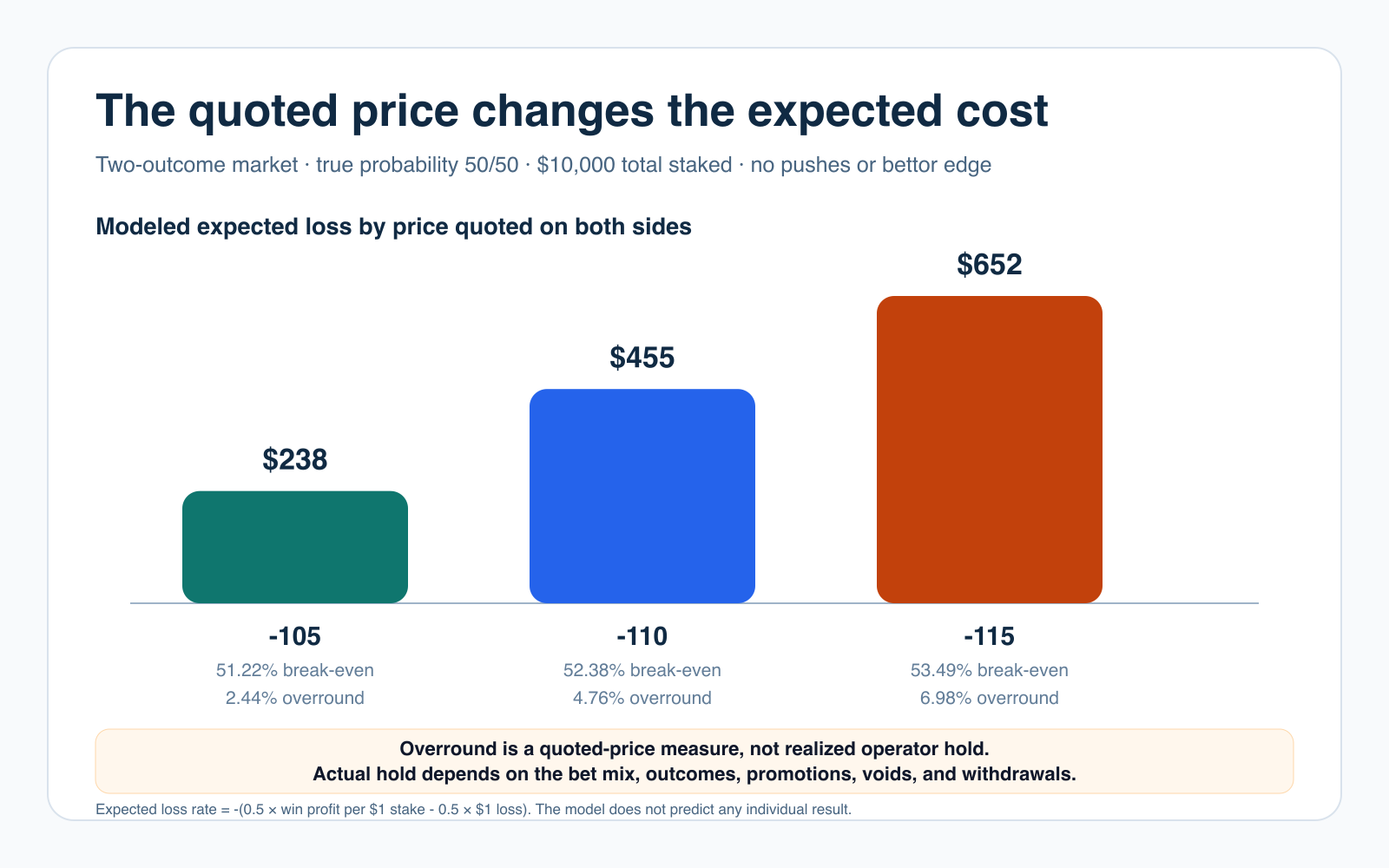
The deterministic model below asks a narrower question: if the true outcomes are 50/50, the same price is quoted on both sides, and $10,000 is staked without pushes, bonuses, or bettor edge, what is the expected loss?
| Price on both sides | Break-even win rate | Two-way overround | Modeled expected loss per $10,000 |
|---|---|---|---|
| -105 | 51.22% | 2.44% | $238 |
| -110 | 52.38% | 4.76% | $455 |
| -115 | 53.49% | 6.98% | $652 |
Regulator data shows why realized hold must be kept separate from quoted vig:
- New Jersey 2025: the Division of Gaming Enforcement’s December report lists $12.246 billion in completed-event handle and $1.163 billion in win, or 9.5%. The category figures range from 3.8% for basketball to 19.2% for parlays. The report says the data are unaudited and subject to adjustment.
- Arizona 2025: the Arizona Department of Gaming report lists $9.128 billion in calendar-year gross event-wagering receipts and $53.533 million in privilege fees. Those operator-reported figures are subject to audit adjustment.
- Great Britain 2024-25: the Gambling Commission’s 2025 industry statistics report GBP 16.8 billion in total gross gambling yield and GBP 7.8 billion online. That is whole-market context, not a sports-betting hold rate.
The figures use different jurisdictions, definitions, periods, taxes, and product mixes. Do not rank operators or infer an individual’s expected result from them. For a wider explanation of operator economics, see how much casinos actually make when you play.
Three Common Questions New Bettors Ask
- Which side is the favorite? Negative American odds, lower decimal odds, or a smaller fractional price indicate the outcome assigned the higher raw implied probability.
- Do decimal odds include the stake? Yes. Decimal shows total return. American and fractional conventionally show profit relative to stake.
- Is one format better? No format changes the price. Decimal is easier for arithmetic, but market rules, licensing, and the underlying price matter more.
Essential Tips for Navigating Sports Betting Odds
Use this as a control checklist, not a betting strategy:
- Confirm legal age, location, operator licence, and current regulatory status.
- Match the event, market, settlement rules, and currency before comparing prices.
- Convert to decimal, calculate total return, then translate to raw implied probability.
- Calculate the full market overround; do not mistake a low-looking number for a positive expectation.
- Keep a fixed entertainment limit, never borrow, and never increase stake to recover a loss.
- Stop when a predetermined money or time limit is reached. Conversion skill does not control outcomes.
- Where law or access is uncertain, verify the exact rule you need to follow rather than relying on a platform’s marketing.
Bet Smarter by Speaking the Odds Language
The correct translation is mechanical: convert the format, calculate return, calculate raw implied probability, and inspect the whole market. The judgment comes later, and it needs better evidence than the price itself.
The biggest upgrade is knowing what the numbers cannot tell you. Odds do not establish legality, accurate probability, fair settlement, or a positive expected return. Treat them as a price with uncertainty and cost. The mathematics of betting odds goes deeper into probability, while the guide to legal sports betting shows why the jurisdiction check comes first.
Tell Google you want more of this.
Add Gaurav Tiwari as a preferred sourceOne tap, and this site shows up more often in your own Top Stories, AI Overviews and AI Mode. Remove it any time.