What Makes a Good Sportsbook? 9 Features to Look For
 by
by

A good sportsbook is legal where you are physically betting, prices your markets competitively, explains withdrawals clearly, protects the account, and gives you usable limits. A famous brand or a large welcome offer cannot substitute for any of those checks.
My rule is simple: verify the operator before judging the product. Then compare the same odds, read the withdrawal and promotion terms, test support, and set limits before the first deposit. If a book makes a basic check difficult, I treat the friction as evidence.
- License: match the brand, domain, or trading name to the regulator for your location.
- Price: compare overround on the same market at the same time, not screenshots from different games.
- Money movement: confirm supported withdrawal methods, verification, fees, limits, and stated processing rules.
- Account control: look for strong sign-in security, alerts, limits, time-outs, and self-exclusion.
- Evidence: treat revenue, market share, and app polish as context, not proof that a sportsbook is better for you.
Table of Contents
1. A Real, Verifiable License
The only useful sportsbook license is one that applies to the place where you are betting. A badge or license number on a homepage is a claim. The regulator’s own record is the check.
Search by the legal business name, trading name, and domain where the directory allows it. Make sure the record covers online sports wagering, not a different gambling product. A license issued in another country or state does not create the same complaint route or legal recourse in your location.
| Jurisdiction | Minimum age | Where to verify the operator |
|---|---|---|
| Great Britain | 18 for most online betting | Gambling Commission public register |
| Ontario | 19 | iGaming Ontario regulated-operator directory |
| New York | 21 | New York sports-wagering page |
| Massachusetts | 21 | Massachusetts licensee list |
The age difference matters. A blanket claim that every regulated sportsbook is 21+ is wrong: the examples above range from 18 to 21. Ontario’s directory listed 48 operators and 82 gaming websites on July 22, 2026, while the Massachusetts page listed seven Category 3 online operators when checked. Counts change, so use the live directory rather than an old listicle.
The same principle applies in state-specific markets. My guide to Arizona sports betting explains the local context, but the regulator remains the authority for the operator you are about to use.
What regulator revenue data can and cannot tell you
Revenue data can show market concentration, but it cannot grade a sportsbook. The Massachusetts Gaming Commission’s Massachusetts Gaming Commission assessment table reported $726,618,473.25 in adjusted gross sports wagering revenue through April 30, 2026.
- DraftKings: $380.97 million, or 52.43% of the assessment total.
- FanDuel: $199.27 million, or 27.42%.
- Top two combined: $580.24 million, or 79.85%.
- All eight other licensees combined: 20.15%.
- Boundary: this is adjusted gross revenue, not customer handle, and the table is cumulative through April 30 rather than a full fiscal-year result.
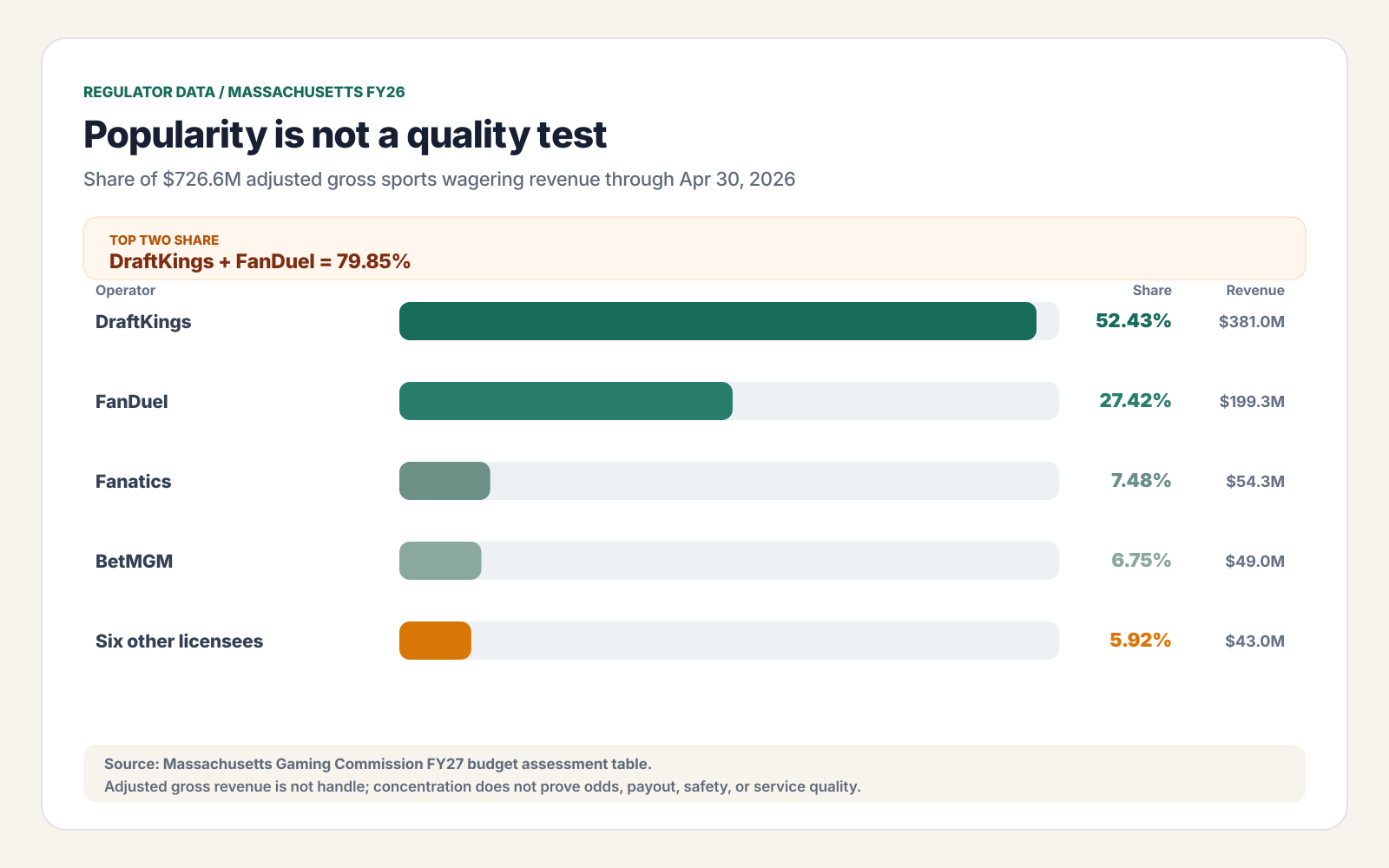
That 79.85% figure tells you two operators dominated the assessment base. It does not tell you which one had the best price on your market, resolved your complaint fairly, processed your withdrawal fastest, or gave you the right account controls. Popularity is not a quality test.
2. Fair Odds and a Thin Margin
Compare the market overround, not the sportsbook’s claim that its odds are competitive. Convert every selection to implied probability and add the results. The total above 100% is the overround embedded in that set of prices.
For negative American odds, implied probability is the absolute odds divided by the absolute odds plus 100. On a symmetric two-way market, multiply that probability by two and subtract 100%. If the notation is unfamiliar, start with American, decimal, and fractional odds formats.
| Two-way price | Implied probability per side | Overround |
|---|---|---|
| -105 / -105 | 51.22% | 2.44% |
| -110 / -110 | 52.38% | 4.76% |
| -115 / -115 | 53.49% | 6.98% |
| -120 / -120 | 54.55% | 9.09% |
Overround is not the same as realized hold. Overround describes the price book for a market. Hold is the operator’s realized revenue relative to handle over a period and depends on results, bet mix, promotions, and customer behavior.
Line shopping only works when the comparison is controlled. Check the same event, selection, rules, start time, and timestamp. A better price reduces the margin you give away; it does not turn betting into a reliable investment or guarantee a profitable season.
3. Variety of Sports and Betting Markets
A useful sportsbook covers the sports and bet types you actually understand, within the markets its regulator permits. A huge menu is operational breadth, not automatic value.
- Start with settlement rules: check overtime, postponement, retirement, dead-heat, and stat-correction policies.
- Compare market depth: moneyline, spread, total, player propositions, futures, and live markets serve different needs.
- Check limits and availability: a visible market can have low limits or close earlier than expected.
- Avoid the soft-line myth: an obscure competition is not automatically mispriced, and information quality may be worse.
A live page such as NBA Championship odds can show how one operator presents a futures market, but the prices will move. Record the timestamp and compare the same contract elsewhere instead of copying a number into a long-lived guide.
4. Fast and Flexible Payouts
Do not accept a payout-speed promise until you understand the conditions behind it. Identity checks, the withdrawal method, banking rails, account reviews, weekends, limits, and source-of-funds requests can all change the timeline.
- Before depositing: confirm that your preferred withdrawal method is supported and read its minimum, maximum, fee, and stated processing rules.
- Before the first bet: complete identity checks and make sure your account details match the payment account.
- Before scaling: test a small withdrawal and save the confirmation, timestamps, and support ticket.
- During a delay: answer legitimate verification requests through the operator’s authenticated channel, never a link from an unsolicited message.
My guide to payment methods in secure online gambling transactions explains the tradeoffs among cards, bank transfers, wallets, and other rails. The practical choice is the method with clear ownership, fees, reversibility rules, and withdrawal support in your jurisdiction.
5. User Interface and App Experience (UI/UX)
A good betting interface reduces preventable mistakes. It should show the event, market, selection, odds, stake, potential return, and any changed-price confirmation before a wager is accepted.
The useful lesson in well-functional design is functional clarity. On a sportsbook, that means readable bet slips, explicit odds changes, clear suspended-market states, reliable live-bet status, accessible account controls, and a complete wager history.
- Test a price change: the app should ask whether you accept changed odds instead of silently changing the ticket.
- Test navigation: you should reach account security, limits, withdrawals, rules, and support without search tricks.
- Test receipts: every accepted wager needs a stable reference and readable settlement status.
- Test accessibility: zoom, contrast, focus states, and screen-reader labels matter when money is involved.
6. Security and Privacy
HTTPS is necessary, but it is not a sportsbook trust certificate. It protects the connection. It does not prove licensing, governance, solvency, fair settlement, or competent complaint handling.
- Use a unique credential: prefer a passkey where supported, otherwise use a password manager and a unique password.
- Enable multi-factor authentication: never share a one-time code with support or anyone who contacts you first.
- Turn on alerts: deposits, withdrawals, profile changes, and new-device sign-ins should be visible quickly.
- Review privacy terms: check what identity, location, device, banking, and marketing data is collected and shared.
- Secure recovery: verify that account recovery does not rely on information that is easy to discover publicly.
If a site lacks HTTPS, leave. If it has HTTPS, continue checking. The padlock is the beginning of the security review, not the end.
7. Customer Support and Responsiveness
Support quality is measured by traceable resolution, not the number of channel icons in the footer. A chat that cannot produce a ticket or escalation route is less useful than a slower channel with a complete record.
Good FAQ sections can resolve routine questions, but they do not replace a dispute process. Before depositing, ask one precise question about withdrawal verification or market settlement and save the answer.
- Keep evidence: wager ID, market rules, odds, timestamps, transaction records, and the complete support thread.
- Escalate in order: use the operator’s complaint process before the regulator or approved dispute body.
- Know the limit: the Gambling Commission complaint process explains that the operator is the first step and that eligible disputes may proceed to an approved alternative dispute resolution provider.
- Separate service from outcome: a lost bet is not a support failure, but unexplained settlement against the published rules deserves a documented review.
8. Promotions and Fair Terms
A promotion is worth its expected cash value after every restriction, not its headline amount. Read the qualifying odds, playthrough, expiry, maximum stake, excluded markets, stake-return rule, withdrawal conditions, and whether the reward is cash or a non-withdrawable bonus bet.
A $100 reward with 10x playthrough can require $1,000 in qualifying wagers. That does not make it worth $100. Your expected cost depends on the qualifying market margin and the chance that the reward or winnings expire before the conditions are completed.
The mechanics in the truth about casino bonuses are a useful warning: a large number can distract from restrictive terms. My preference is a smaller, comprehensible offer over a larger one whose value depends on perfect execution.
9. Responsible-Gambling Tools
Account controls should be easy to find before you need them and difficult to reverse impulsively. Check for deposit, wager, loss, and time limits where applicable, plus time-outs and self-exclusion.
- Great Britain: Great Britain’s national self-exclusion guidance explains multi-operator schemes and identifies GAMSTOP for online gambling.
- Ontario: Ontario’s BetGuard program launched in May 2026 to block existing and new accounts across regulated Ontario iGaming sites.
- New York: the New York voluntary self-exclusion program covers sports wagering and other Commission-regulated gambling.
- Massachusetts: the Massachusetts voluntary self-exclusion program covers every sports-wagering operator licensed in the state.
A jurisdiction-wide program is broader than closing one account. Read the scope and duration before enrolling because exclusion can apply across multiple operators and products. Set ordinary limits when the account is opened, not after a loss.
Sportsbook controls do not change the underlying economics. My analysis of how much money casinos really make when you play explains why operator advantage survives individual winning tickets and why a betting budget should be money you can lose without changing essential plans.
The Good Sportsbook Checklist
Use this checklist before funding an account. A failure on licensing, withdrawal clarity, account security, or responsible-gambling controls should stop the review.
| Check | Evidence to collect | Decision rule |
|---|---|---|
| License | Matching legal entity, brand or domain in the local regulator’s current record | No verified local authorization, no deposit |
| Odds | Same market, rules, selection, and timestamp across operators | Prefer the lower overround or better price |
| Markets | Published settlement rules, limits, and availability | Choose useful depth, not the longest menu |
| Withdrawal | Method, KYC, fees, limits, processing rules, small test | Reject vague or contradictory terms |
| Interface | Clear bet slip, odds-change consent, receipt, history | Reject flows that make errors easy |
| Security | HTTPS, unique login, MFA, alerts, session controls | HTTPS alone does not pass |
| Support | Ticket ID, written answer, escalation route | Require a traceable process |
| Promotion | Full terms and expected value after restrictions | Ignore the headline amount |
| Controls | Limits, time-out, self-exclusion, jurisdiction-wide scheme | Set limits before the first deposit |
Red Flags of a Bad Sportsbook
One serious red flag is enough to leave. You do not need to prove that an operator is fraudulent before deciding that its evidence is too weak for your money and identity data.
- The operator, trading name, or domain cannot be matched to the regulator for your physical location.
- The site accepts money while hiding identity, age, location, withdrawal, or source-of-funds rules.
- The same market is consistently priced worse and the operator makes direct comparison difficult.
- Withdrawal terms are vague, contradictory, or materially different from the deposit path.
- Promotion terms omit qualifying odds, expiry, stake treatment, maximum stake, or withdrawal conditions.
- Support will not issue a ticket, provide a written decision, or identify an escalation process.
- Account limits, time-outs, and self-exclusion are hidden or cannot be activated through a documented process.
- Someone claiming to be support asks for your password, one-time code, remote-device access, or payment outside the official account.
The Bottom Line
A good sportsbook is a chain of verifiable controls, not a brand impression. Start with local authorization. Then compare pricing, settlement rules, withdrawals, account security, support, promotion economics, and responsible-gambling tools.
The largest operator can still offer the worse price on a specific market. The prettiest app can still make withdrawals confusing. The biggest bonus can still have poor expected value. Check the evidence in that order, set a hard budget, and remember that no sportsbook feature removes the risk of loss.
What is the first sign of a good sportsbook?
A good sportsbook is licensed for the jurisdiction where you are physically betting, and the operator or trading name appears in the regulator’s own directory. A badge in the site footer is not enough. Verify the domain or brand against the official record before depositing.
How can I tell whether sportsbook odds are competitive?
Compare the same market, selection, rules, and timestamp across several legal operators. Convert each price to implied probability and add the probabilities. The amount above 100% is the market overround. Lower overround generally means a better price, but it is not the same as the operator’s realized hold.
Does a fast advertised payout make a sportsbook trustworthy?
No. Payout speed depends on identity checks, payment method, banking rails, limits, account review, and the operator’s terms. Complete verification early, read the withdrawal rules before depositing, and test a small withdrawal rather than trusting a speed claim on a banner.
Is HTTPS enough to make a betting site secure?
No. HTTPS protects data in transit, but it does not prove that an operator is licensed, solvent, well governed, or good at handling accounts. Use a unique password or passkey, enable multi-factor authentication when offered, review active sessions, and turn on deposit and withdrawal alerts.
What responsible-gambling tools should a sportsbook provide?
Look for deposit, loss, wager, and time limits where the regulator requires them, plus time-outs and self-exclusion. The controls should be easy to find, apply across the account, and explain when a limit increase takes effect. Jurisdiction-wide exclusion programs provide broader coverage than closing one account.
Does the biggest sportsbook offer the best product?
Not necessarily. Massachusetts regulator data showed that DraftKings and FanDuel accounted for 79.85% of adjusted gross sports wagering revenue through April 30, 2026. That measures revenue concentration, not odds quality, payout speed, security, complaint handling, or suitability for you.
Tell Google you want more of this.
Add Gaurav Tiwari as a preferred sourceOne tap, and this site shows up more often in your own Top Stories, AI Overviews and AI Mode. Remove it any time.