by
by
Content marketing benefits a business in 1 way that ads never will: the demand it creates keeps arriving after you stop paying for it. A page that answers the question a buyer types before purchasing works every day for years. An ad works until the budget runs out. That’s the whole case, and it only holds when the content answers a question someone is already asking.
Most businesses that “do content marketing” land in 1 of 2 places. The first publishes 3 posts a week about whatever the team thought of on Monday, and wonders why 2 years of effort produced 200 pages and 11 visits a day. The second reads that outcome, decides content doesn’t work, and spends the money on ads that stop the day the card declines.
The difference between the 2 isn’t effort. It’s whether each piece was pointed at a buyer’s question and measured against an action.
Content Marketing Benefits That Hold Up
Strip away the agency language and content marketing does 5 jobs for a business. Each one has a mechanism behind it, which is how you know whether it’s working for you or just producing pages.
| Benefit | How it works | How you’d know it’s working |
|---|---|---|
| Demand you own | A page ranks for a buyer’s question and keeps sending visitors without spend | Search Console shows clicks rising month over month on pages you haven’t touched |
| Trust before the call | Prospects read how you think before they speak to you, so the sales call starts warmer | Inquiries mention the article, and leads who read first close at a higher rate |
| Cheaper leads over time | Cost per lead falls as the page ages, while ad cost per lead only rises | Blended cost per lead drops each quarter as the organic share grows |
| Sales enablement | Reps send the comparison page instead of re-explaining it on every call | Fewer discovery calls per closed deal |
| An audience you can reach again | Readers join an email list you control, not an algorithm you rent | The list grows from content, and the sends convert |
If you can’t point at the third column for a benefit, you’re not getting that benefit yet, whatever the publishing calendar says.
What the Content Marketing Data Shows
The denominator is the part most content advice leaves out. Ahrefs’ December 2023 study of about 14 billion pages found 96.55% of them get zero Google traffic, with a further 1.94% getting 1 to 10 visits a month. Publishing is not a channel. Publishing something a person is searching for is a channel, and the gap between those 2 sentences is where most content budgets disappear.
Against that, the Content Marketing Institute’s 2026 B2B research, fielded to 1,015 marketers between June and August 2025, shows what the businesses doing this actually report.
| What they report | Share | What it tells you |
|---|---|---|
| Have a documented content strategy | 97% | A strategy is now table stakes, so it can’t be the differentiator |
| Use AI-powered applications | 95% | Your competitors have the same speed advantage you do |
| Use AI to generate marketing copy | 89% | The supply of competent-sounding content went vertical |
| Say AI improved their productivity | 87% | The speed gain is real and widely felt |
| Say AI improved their content quality | 58% | The quality gain is not, and that 29-point gap is the opportunity |
| Rate themselves highly effective | 12% | Nearly everyone is producing; almost nobody is winning |
Read the last 3 rows together and the strategy writes itself. Everyone got faster. Most did not get better. The 12% who call themselves highly effective are competing against a flood of content that its own authors don’t rate.
The challenges those marketers name line up with the same story: 40% struggle to create content that drives conversions, 39% run short on time, people, or budget, 33% can’t measure effectiveness, and 28% can’t produce enough quality work. Conversion and measurement sit at the top, and both are judgment problems that no amount of generation speed solves.
Speed is solved. Judgment isn’t.
Why Most Content Never Pays
The gap between the businesses that get those 5 benefits and the ones that get a bill comes down to 3 failures. They’re all fixable, and none of them are about writing talent.
Nobody Searched for It
Owned demand requires demand to exist. A post titled “Our 5 core values” has no reader outside the office. A post titled “How much does a kitchen renovation cost in Pune” has thousands a month, and every one of them is closer to buying than anyone who’d read the values post.
The fix is cheap and boring. Before writing anything, find the question in a keyword tool or in your own sales inbox. If neither shows anyone asking it, don’t write it.
It Reads Like Everyone Else
The Content Marketing Institute’s 2026 B2B research, a survey of 1,015 marketers, found that 95% of organizations now use AI tools and 89% use them to generate marketing copy. Among those users, 87% said productivity improved, but only 58% said quality did. Read those 2 numbers together. The industry got faster at producing the kind of content that doesn’t work.
The same survey named the top challenge as creating content that drives conversions, at 40%. Not volume. Not ideas. Conversions. Which is the benefit everyone wanted and the one generic content can’t deliver, because a buyer comparing 3 vendors skips the page that could have been written by any of them.
Faster is not better here.
Nothing Is Measured
A third of marketers in that survey said they struggle to measure content effectiveness. So a third of content budgets are defended on faith. The business that measures gets to keep the pages that work and kill the ones that don’t.
That’s the only way the compounding ever compounds.
Measurement doesn’t need a dashboard. It needs 1 question per page: what action should a reader take, and how many did. A quote request, a trial signup, an email subscribe. Pick 1, track it, and the pages sort themselves.
What Good Content Marketing Looks Like
The businesses getting all 5 benefits share a shape, and it isn’t a big one. A small library of pages, each pointed at a question a buyer asks on the way to a purchase, each ending in 1 next step. The full system is in my content marketing strategy guide, but the shape fits on a card.
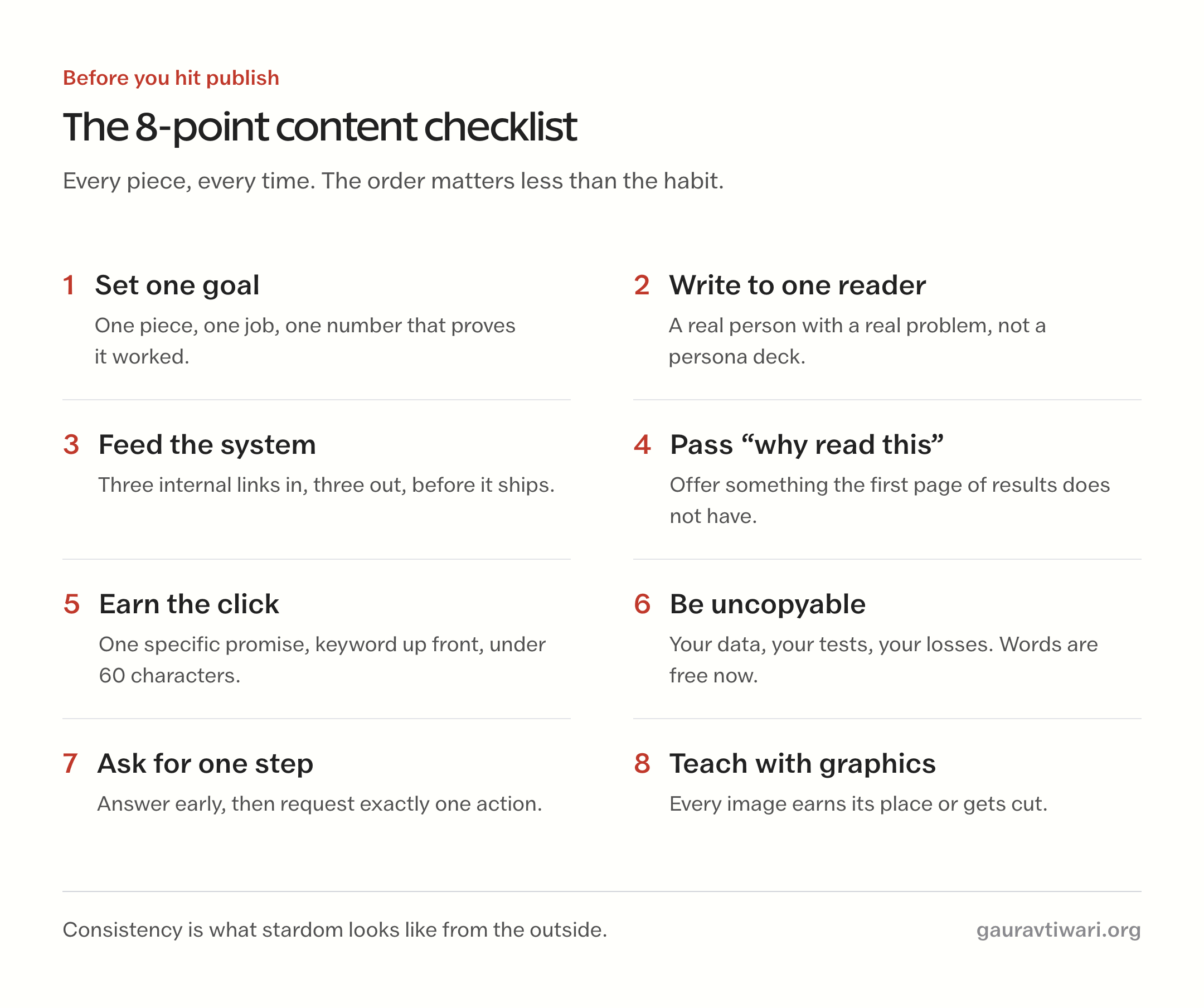
The kinds of page that earn their keep are predictable:
- Buyer questions. “How much does X cost,” “X vs Y,” “is X worth it.” These convert because the reader is already deciding.
- Comparisons. Your product against the alternatives, with the cases where the alternative wins. Owning the loss cases is what makes the win cases believable.
- Proof. A case study with a number in it. 1 measured result outranks 10 claims.
- Expectations. What happens after someone buys, how long it takes, what could go wrong. This page closes deals by removing the fear that stalls them.
For a service business, 12 pages of that kind will outperform 120 pages of news and opinion. If you’re starting from nothing, my small business blogging guide walks through the first dozen.
Content Marketing and AI Search
Assistants like ChatGPT and Google’s AI Overviews now answer many questions without sending a click anywhere. That changes the first benefit, owned demand, in a way worth being plain about. Informational pages lose some traffic. Pages that an assistant cites gain a new kind of visibility, where your name appears in the answer even when the click doesn’t follow.
What gets cited is specific, consistent, and attributable: named products, specific numbers, clear claims with a source. Generic content doesn’t get cited because there’s nothing in it to cite. So the same discipline that makes content convert also makes it visible in AI answers. My guide on how SEO content builds brand identity covers the consistency side of that.
The Limits
Content marketing can’t produce leads this month. A page published today reaches its ranking somewhere between 3 and 9 months later, so a business that needs revenue by Friday needs ads or outreach, not a blog. It can’t sell a product people don’t search for, which includes most products that are new. And it can’t fix a weak offer, because the pages that convert are comparisons, and a worse deal loses the comparison.
It also needs a writer who knows the subject. Outsourcing to someone who has to research your industry from scratch produces the content that 58% figure describes. The knowledge has to come from inside the business, even if the typing doesn’t.
What Quietly Ruins It
Publishing on a schedule instead of on demand. The calendar fills with topics nobody searched for, and the 1 page that could have ranked gets the same 2 hours as the 9 that couldn’t.
Writing about yourself. Company news, awards, and culture posts have an audience of employees and their parents. Buyers want their problem solved.
Ending without an ask. A reader who finishes a useful page and finds nothing to do next closes the tab. The cost of that page was real. The benefit evaporated in the last paragraph.
Never updating. A 2023 comparison with 2023 prices loses its ranking to a competitor’s 2026 version, and with it every benefit it was producing.
Measuring traffic. Traffic is the input. The benefit is the quote request, the trial, the subscriber. A page with 50 visits and 4 inquiries beats a page with 5,000 visits and none.
Final Remarks
Content marketing didn’t stop working when AI made writing cheap. The easy version stopped working, the one where volume stood in for relevance and nobody checked whether a page produced a customer. What’s left is the version that always worked: answer the question a buyer is asking, better than the other 9 results, and ask for 1 thing at the end.
The trade is patience. You spend months before the first benefit shows, and the payoff arrives in a form that’s hard to put on a slide: a lead that says “I read your comparison.” Ads give you a number tomorrow. Content gives you a customer who already trusts you, 6 months from now, at a price that keeps falling.
Write the 12 pages your buyers are searching for. Then measure which 3 bring the customers, and write the next 12 like those.
Tell Google you want more of this.
Add Gaurav Tiwari as a preferred sourceOne tap, and this site shows up more often in your own Top Stories, AI Overviews and AI Mode. Remove it any time.