
10 Reasons Why Startups Love Graphic Designs (And You Should, Too!)
Your startup’s first impression isn’t your pitch deck or your product demo. It’s your visual identity. The logo on your website, the colors on your social media, the consistency of your marketing materials. I’ve worked with startups that blew their entire first quarter trying to fix a DIY logo that looked like it was made in Microsoft Paint circa 2004. Don’t be that founder.
Graphic design isn’t a luxury for startups. It’s a survival tool. The companies that treat design as an afterthought end up spending 3x more down the road to fix their branding disasters. The ones that invest early, even modestly, build recognition faster, convert more leads, and look credible from day one.
I’ve built websites and brands for hundreds of businesses over the past decade and a half. Here are 10 reasons why startups that prioritize graphic design consistently outperform those that don’t, plus practical advice on how to get professional-quality design without burning through your seed funding.
Design Consistency Builds Trust Fast
Using the same colors, fonts, and visual style across every touchpoint, your website, business cards, email signatures, social media profiles, creates a cohesive brand that people remember. Consistency isn’t just about looking nice. It’s about building trust. When a potential customer sees the same polished look on your Instagram, your homepage, and your invoice, they think: “This company has its act together.”
The first step is creating a brand color palette. Pick 2-3 primary colors and 1-2 accent colors. Stick with them everywhere. A professional designer (or a tool like Canva) will help you find the palette that fits your industry and personality. A fintech startup shouldn’t use the same colors as a children’s toy brand. Sounds obvious, but you’d be surprised how many founders pick colors based on personal preference instead of audience psychology.
I recommend creating a simple brand guidelines document even if it’s just a single page. List your colors (with hex codes), fonts, logo usage rules, and tone. This document saves you hours of back-and-forth every time you create new marketing material.
Brand Recognition Compounds Over Time
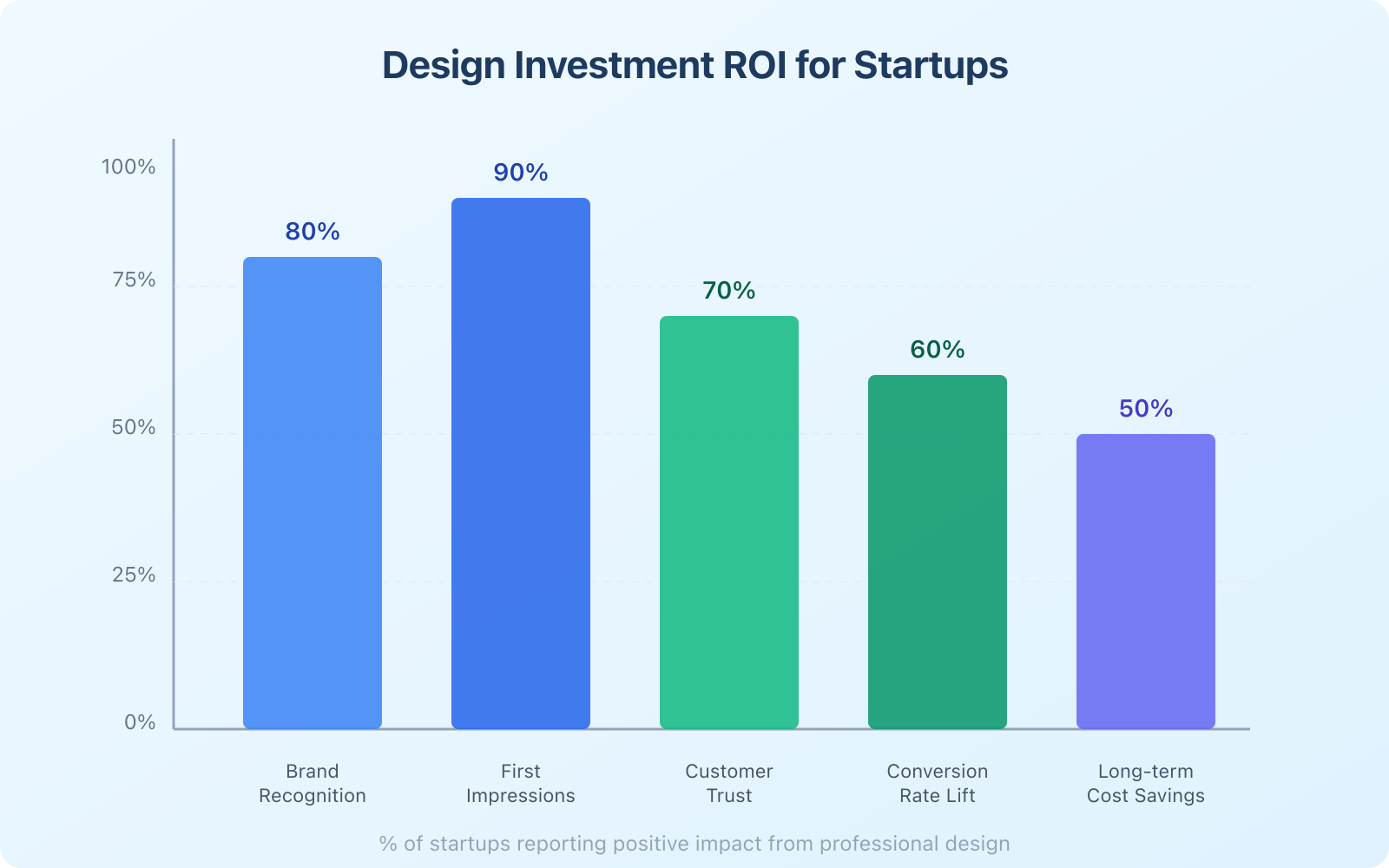
Think about the brands you recognize instantly. Apple. Nike. Stripe. You don’t need to read their name to know it’s them. That’s the power of consistent visual identity, and it starts with design.
For startups, brand recognition is a form of marketing that works while you sleep. Every time someone sees your consistent branding on social media, in their inbox, or on your packaging, it reinforces who you are. Research from Lucidpress found that consistent brand presentation across all platforms can increase revenue by up to 23%. That’s not a rounding error. That’s real money.
The key is repetition with consistency. Your loyal customers should always know what to look for when they see your brand among competitors. A well-designed visual system makes this automatic. A sloppy one makes it impossible.
Professional Design Makes You Look Legitimate
Here’s a hard truth: people judge your startup by how it looks before they ever try your product. A Stanford study found that 75% of users judge a company’s credibility based on its website design alone. Not the product. Not the pricing. The design.
When you’re a startup competing against established players, looking professional is half the battle. Nobody wants to enter their credit card on a website that looks like it was built during a lunch break. Professional design, from your logo to your checkout page, signals that you’re serious, reliable, and worth the risk.
You don’t need a $10,000 design agency to look professional. Canva Pro at $120/year gives you access to brand kits, thousands of templates, and a drag-and-drop editor that can produce agency-quality social posts, presentations, and marketing materials in minutes.
Good Design Saves Time and Money
Getting design right the first time means you won’t spend weeks fixing mistakes. I’ve seen founders waste entire sprints trying to salvage a DIY logo that looked fine on their laptop but terrible on a business card. By the time they hired a professional, they’d already printed 500 cards, ordered signage, and built a website around the wrong visual identity.
Professional design eliminates damage control. It gets things right from the start, which means no reprints, no redesigns, and no embarrassing “we’ve updated our look” emails to your first 100 customers. The upfront cost pays for itself within the first quarter.
A rebranding exercise for an established startup costs anywhere from $5,000 to $50,000 depending on how deep the redesign goes. Compare that to spending $500-$2,000 on solid branding from the start. The math is simple.
Design Frees You to Focus on Your Product
Every hour you spend fighting with design tools is an hour you’re not building your product, talking to customers, or closing deals. Founders wear many hats already. Adding “graphic designer” to your job title when you don’t have the skills leads to frustration and mediocre results.
I’ve talked to dozens of startup founders who spent 10+ hours a week creating social media graphics, pitch deck slides, and marketing emails from scratch. Once they either hired a designer or invested in Canva‘s template system, that time dropped to 2 hours or less. That’s 8 hours a week back, 32 hours a month. What could you do with an extra 32 hours every month?
Expert Knowledge Keeps Your Brand Timeless
Professional designers know why some visual choices work and others fall flat. They understand color theory, typography hierarchy, whitespace, and visual rhythm. More importantly, they know which trends are worth following and which ones will date your brand within 18 months.
Remember the glossy, 3D logo trend from the early 2010s? Or the excessive use of gradients in the mid-2000s? Companies that followed those trends had to rebrand within 3-5 years. The ones that chose clean, timeless designs (think Stripe, Notion, Linear) still look fresh today.
Access to this expert knowledge, whether from a designer or from well-designed templates, saves you from the dreaded fifth-year rebrand. It keeps your visual identity relevant as your startup grows from 10 customers to 10,000.
Design Is the Most Affordable Marketing Investment
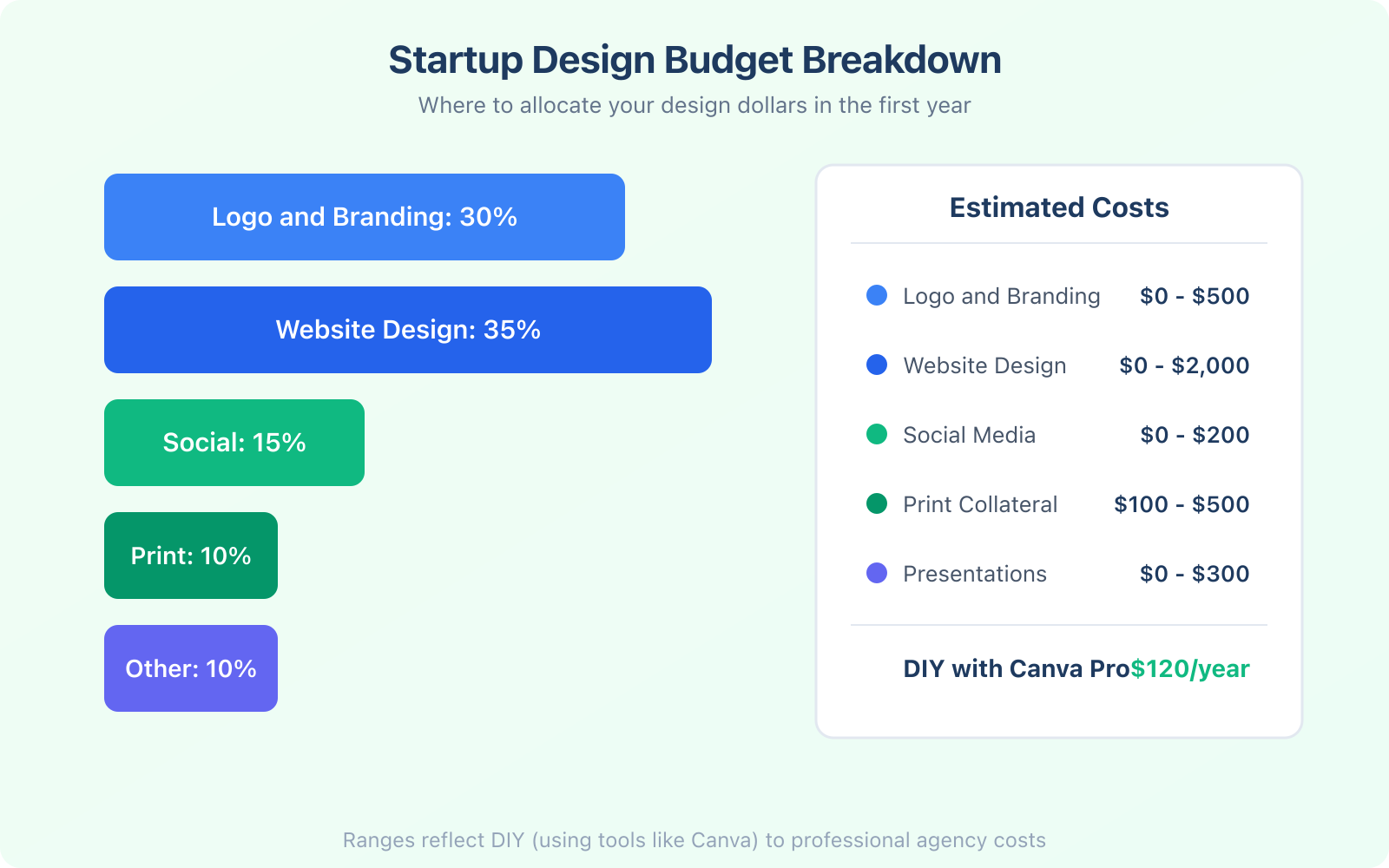
Getting your logo and brand identity right the first time means no wasted money on reprints, no losing customers to a poor first impression, and no expensive rebranding exercise down the road. Compare the costs:
- DIY with Canva Pro: $120/year for logo, social templates, presentations, and marketing materials
- Freelance designer: $500-$3,000 for a complete brand identity package
- Design agency: $5,000-$25,000 for comprehensive branding
- Rebranding after a failed DIY attempt: $10,000-$50,000 (plus lost credibility)
For most startups, the sweet spot is somewhere between DIY and freelance. Use Canva for day-to-day graphics and hire a freelancer for your core brand assets (logo, brand guidelines, website design). This hybrid approach gives you professional results at bootstrap-friendly prices.
Better Design Generates More Leads
Professional design doesn’t just make you look good. It actively drives leads to your business. A well-designed website guides visitors to the right pages. Clear visual hierarchy tells people where to click. Consistent branding across your marketing funnel builds the familiarity that converts cold prospects into warm leads.
Here’s what actually happens when startups invest in design:
- Landing pages with professional design convert 2-3x better than generic templates
- Social media posts with custom graphics get 94% more views than text-only posts
- Email campaigns with branded design elements see 20-30% higher click-through rates
- Consistent brand presentation increases trust, which shortens the sales cycle
Design is the silent salesperson that works 24/7. Every pixel on your website, every graphic on your social feed, every slide in your pitch deck is either attracting leads or pushing them toward your competitors.
Design Drives Conversions, Not Just Clicks
Visitors who stick around are the ones who convert. A well-designed user experience reduces bounce rates, increases time on page, and guides users through your conversion funnel naturally. Every design decision, button colors, form layouts, image placement, typography, affects whether someone completes a purchase or leaves your site.
Small design improvements compound into significant revenue. Changing a CTA button color from gray to a contrasting brand color can lift conversions by 20-35%. Simplifying a checkout form from 7 fields to 4 can reduce cart abandonment by 15-20%. These aren’t hypothetical numbers. I’ve seen these results across real client projects.
Professional Design Boosts Founder Confidence
This one surprises people, but it’s real. When your brand looks professional, you feel more confident pitching to investors, meeting potential partners, and presenting at conferences. You hand over a business card that looks sharp. You pull up a website that screams credibility. You share a pitch deck that tells a compelling visual story.
Confidence isn’t just a feeling. It affects your performance. Founders who feel proud of their brand identity are more likely to network actively, pursue bigger opportunities, and close deals. Bad design creates a nagging self-doubt: “Is my brand holding me back?” Good design removes that doubt entirely.
AI Design Tools Changed the Game for Startups
The biggest shift in startup design over the past few years is the rise of AI-powered design tools. You no longer need a $5,000 budget or a design degree to create professional marketing materials. Tools like Canva now include AI features that generate designs, remove backgrounds, resize for multiple platforms, and even write copy suggestions.
Here’s what I recommend for startups at different stages:
Pre-revenue startups ($0 budget): Use Canva’s free tier. You get access to thousands of templates, a drag-and-drop editor, and basic brand tools. It’s more than enough to create a logo, social posts, and a simple pitch deck.
Early-stage startups ($100-$500 budget): Upgrade to Canva Pro at $120/year. This unlocks Brand Kit (store your colors, fonts, and logos), Magic Resize (create one design and resize for every platform), background remover, and 100+ million stock photos. This is the sweet spot for most bootstrapped startups.
Funded startups ($1,000+ budget): Use Canva for day-to-day materials and hire a freelance designer for your core identity assets. Get a professional logo, brand guidelines document, and website design. Then use the brand kit in Canva to maintain consistency across everything else.
AI image generators like DALL-E and Midjourney can create unique illustrations and graphics for your brand. But don’t use them for your logo. Logos need to be vector-based, scalable, and legally ownable. AI-generated logos often can’t be trademarked and may have copyright complications.
How to Build a Brand Kit on a Startup Budget
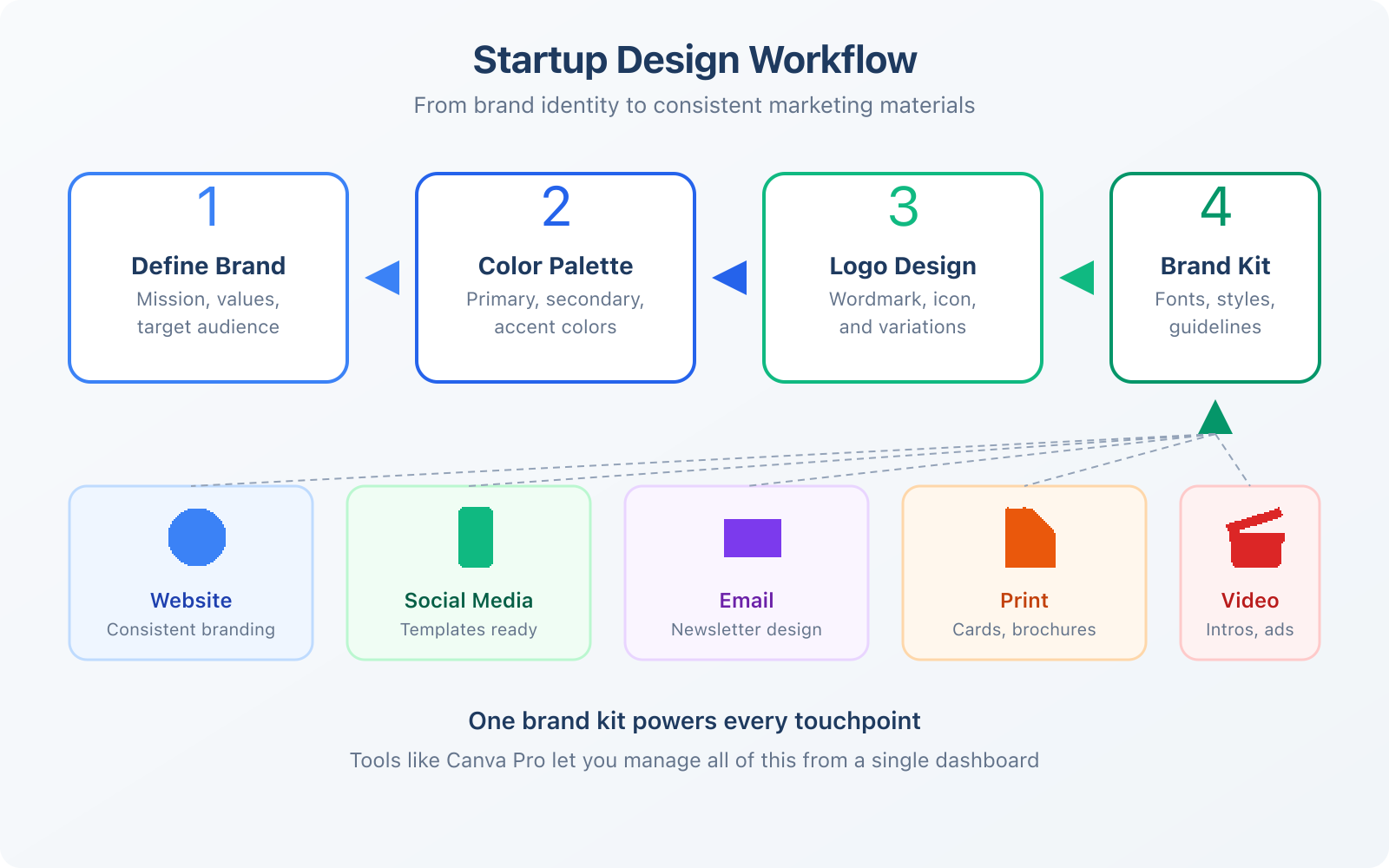
Here’s the practical playbook I give to every startup I work with. You don’t need everything at once. Build your visual identity in layers, starting with the essentials and expanding as you grow.
Week 1: Foundation. Choose your brand colors (2-3 primary, 1-2 accent). Pick two fonts, one for headings and one for body text. Write a one-paragraph brand positioning statement.
Week 2: Logo. Create your logo using Canva’s Logo Maker or hire a freelancer on Fiverr for $50-$200. Get it in multiple formats: full color, black and white, icon-only, and horizontal layout. Export as SVG, PNG, and PDF.
Week 3: Templates. Build templates for your most-used materials: social media posts, email headers, presentation slides, and invoice/proposal documents. Canva‘s Brand Kit feature lets you save all of this and apply your branding to any template with one click.
Week 4: Website. Apply your brand identity to your website design. Make sure your colors, fonts, logo placement, and imagery are consistent with everything else you’ve created. Don’t forget your favicon (the little icon in the browser tab).
That’s it. Four weeks. Under $500 total if you’re scrappy. And you’ll have a brand identity that looks like you spent 10x that amount.
Design Mistakes That Kill Startup Credibility
I’ve seen every design mistake in the book. Here are the ones that hurt the most:
- Too many fonts. Stick to 2, maximum 3. Using 5 different fonts on your website looks like a ransom note.
- Inconsistent colors. Your Instagram uses blue, your website uses green, and your pitch deck uses red. Pick your palette and stick with it.
- Low-resolution logo. If your logo gets blurry when you zoom in, you need a vector version. Always export your logo as SVG for web and PDF for print.
- Stock photo overload. Using generic stock photos of people shaking hands or pointing at laptops destroys authenticity. Use custom graphics or at least choose stock photos that feel real.
- Ignoring mobile. More than 60% of web traffic comes from phones. If your design doesn’t work on a 375px wide screen, you’re losing the majority of your visitors.
Frequently Asked Questions
How much should a startup spend on graphic design in its first year?
Most bootstrapped startups can get professional-quality design for $200-$1,000 in the first year. Use Canva Pro ($120/year) for daily graphics, templates, and social media. Spend $100-$500 on a freelance logo if the free tools don’t cut it. Funded startups should budget $2,000-$5,000 for a complete brand identity package including logo, brand guidelines, and website design.
Can I design my startup’s logo myself with no design experience?
Yes, tools like Canva’s Logo Maker make it possible to create a decent logo without design skills. Choose a simple wordmark or letter-based logo rather than a complex icon. Keep it clean, use no more than 2 colors, and make sure it looks good in both large and small sizes. If your startup is investor-facing or in a competitive market, consider spending $200-$500 on a freelance designer for a more polished result.
What’s the best design tool for startups on a tight budget?
Canva Pro is the best value for startups. At $120/year, you get brand kit management, thousands of professional templates, AI-powered design features, Magic Resize for multi-platform posting, background removal, and access to 100+ million stock photos. No other tool offers this much at this price point.
Should I hire a design agency or use a freelancer for my startup’s branding?
For most startups, a freelancer is the better choice. Agencies charge $5,000-$25,000 for branding packages that include extensive research, multiple rounds of revision, and comprehensive brand guidelines. A skilled freelancer can deliver a professional logo and basic brand guidelines for $500-$2,000. Save the agency budget for when you’ve found product-market fit and need a complete brand overhaul.
How do I maintain design consistency across my team as we grow?
Create a brand guidelines document that includes your color palette (with hex codes), approved fonts, logo usage rules, and examples of correct and incorrect usage. Store it somewhere every team member can access it. Then use a tool like Canva’s Brand Kit to lock in your brand elements so anyone on your team can create on-brand materials without guessing. As you scale, consider a more detailed brand book with voice and tone guidelines too.
Design isn’t the most glamorous part of building a startup. It doesn’t get the same attention as product development, fundraising, or growth hacking. But it quietly influences every one of those things. Investors judge your pitch deck design. Customers judge your website design. Partners judge your brand consistency. Get it right early, even on a minimal budget, and you’ll build a foundation that scales with you. Start with Canva, create your brand kit, and stop treating design as an afterthought. Your future self will thank you.