
 by
by
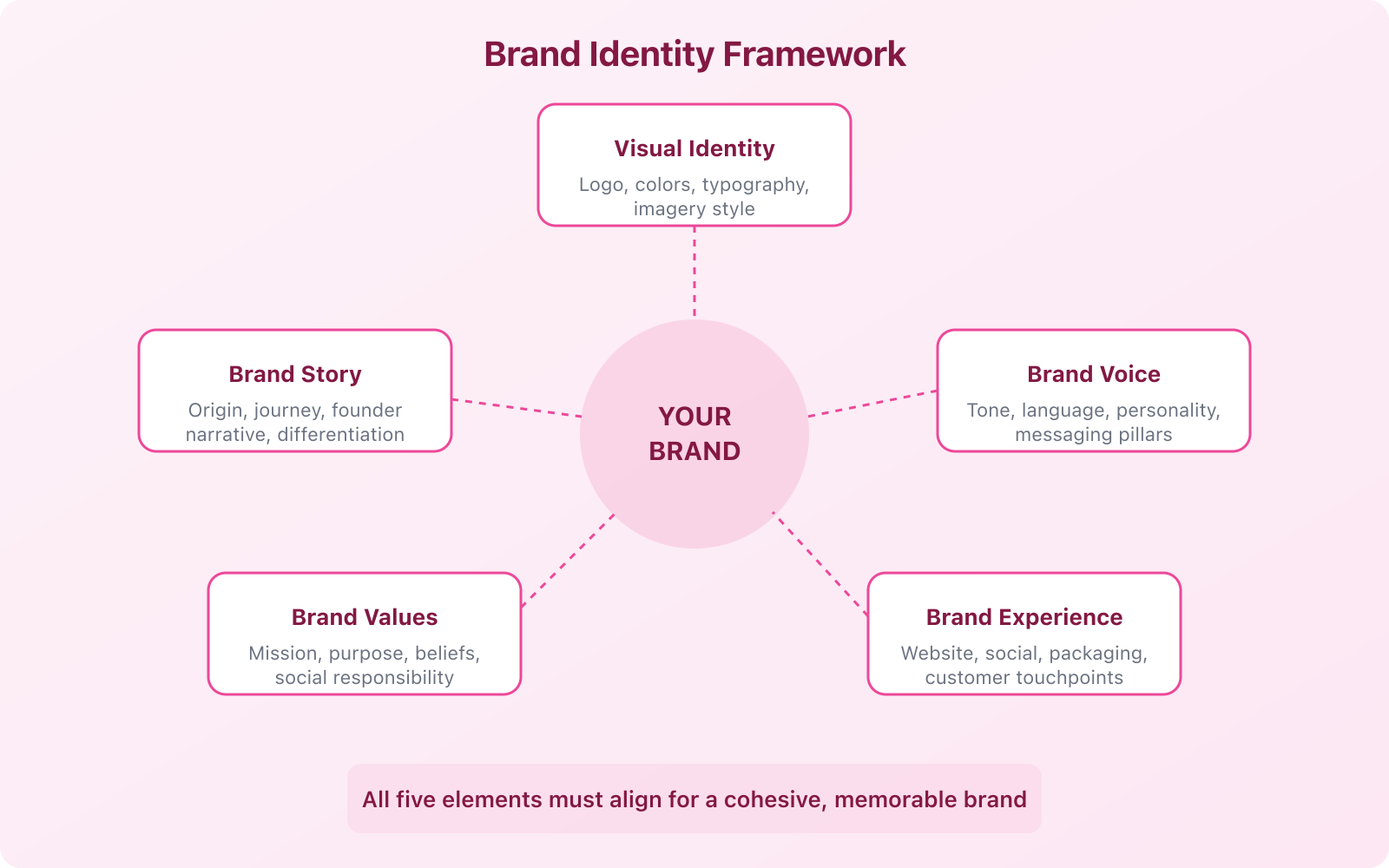
You can publish for years and still be hard to remember. Your website says “digital marketing consultant,” LinkedIn says “growth strategist,” and Instagram says you help businesses grow. A prospect cross-checks the three profiles and cannot tell what you actually sell.
The branding strategies that fix this are positioning, proof, and repetition. Start with one sentence that names the buyer and outcome. Back it with work a stranger can inspect. Then repeat the same identity across search, social, email, proposals, and the client experience.
Logos and colors still matter, but they come third. This playbook is for solopreneurs, consultants, coaches, and bloggers who sell expertise. It covers the positioning statement, the visual system you can maintain with Canva, the voice document that prevents generic copy, and the awareness channels worth measuring.
Evidence, not decoration: in a 90-day Google Search Console sample from this site, non-operator branded queries earned a 2.55% CTR at average position 6.9. Non-branded queries earned 0.77% at position 31.8. The sample is observational and small on the branded side, but it shows why recognition deserves its own measurement.
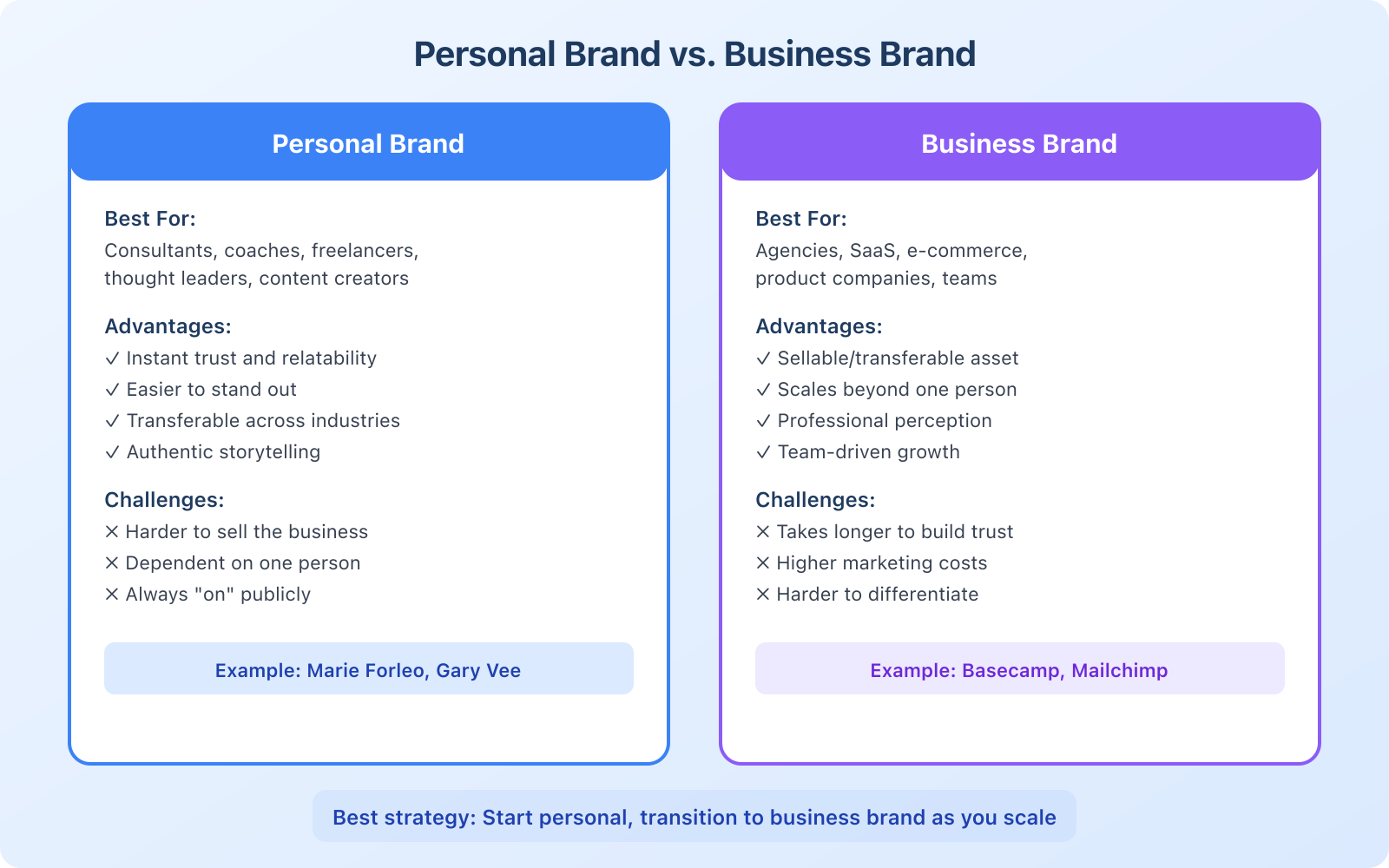
A personal brand is not automatically the right answer. If the company must be sold, outlive the founder, or let several experts speak with equal weight, build the business entity first. For a solo operator who needs trust now, leading with a real name usually shortens the distance between content and contact.
A personal brand centers your identity around you. A business brand centers it around a company name, a logo, an entity that exists outside of any one person. For solopreneurs, bloggers, and consultants, the choice is almost always personal brand first.
Here’s why. People hire people, not logos. When a small business owner needs a WordPress developer, they don’t Google “XYZ Digital Solutions.” They search for someone who’s written about their exact problem, shown up on a podcast they listen to, or been recommended by a colleague. That’s a personal brand at work.
I started with gauravtiwari.org as a personal brand and later created a business entity for agency work. The personal brand drove the initial trust. Clients came because they read my articles, saw my work, and connected with my perspective. The business brand came later as the team grew. If I’d started with a generic company name, I’d have spent years building recognition that my name already carried.
The practical upside of personal branding: your domain name is your name (easy to remember), your face is your logo (instant recognition), your writing style is your brand voice (no committee approvals), and every piece of content you create builds equity in an asset you’ll never lose. Even if you pivot industries, your personal brand follows you.
The downside: it’s harder to sell a business built on your name, and you can’t fully step away without losing momentum. But for 90% of solopreneurs reading this, that’s a problem for 5 years from now. Right now, you need clients and recognition. Personal branding delivers both faster than any business brand can. For more on creating a unified business identity, read my detailed guide.
The Brand Positioning Statement: One Sentence That Changes Everything
A positioning statement is the single most important sentence in your entire brand. It answers three questions: who do you help, how do you help them, and why are you different from everyone else doing the same thing?
Here’s the formula I use: “I help [specific audience] [achieve specific outcome] through [your unique approach].”
Bad example: “I help businesses grow online.” That describes 4 million people. Good example: “I help SaaS startups under 50 employees build content engines that generate 200+ qualified leads per month through SEO-driven blog strategies.” That’s specific enough to stick in someone’s brain.
Your positioning statement isn’t a tagline. It’s not going on a billboard. It’s the internal compass that guides every decision you make about your brand. When someone asks what you do at a networking event, your answer should be a natural version of this statement. When you write your website homepage, this statement should be the core message above the fold. When you pitch podcast appearances, this statement tells the host why their audience cares.
How to write yours in 30 minutes:
- Write down your 3 best clients from the past year. What did they have in common?
- What specific result did you deliver for them? Use numbers if possible.
- What did you do differently than competitors they’d tried before?
- Combine those answers into the formula above.
- Test it: can someone with zero industry knowledge understand it? If not, simplify.
Track your brand positioning clarity in a project management tool like Notion or Monday. Create a page with your positioning statement, target audience notes, competitor analysis, and brand assets all in one place. Revisit it quarterly.
Your brand positioning statement is the filter for every decision. If a project, partnership, or piece of content doesn’t align with it, say no. The power of a brand is in what you refuse, not what you accept.
Visual Identity on a Budget: Colors, Fonts, and Headshots
Visual identity used to cost $5,000 to $10,000 from a branding agency. In 2026, you can build a professional visual identity in a single weekend for under $50. I’ve done it for my own projects, and the result looks indistinguishable from agency work because the tools have gotten that good.
Choose 3 colors and stick with them. You need a primary color (your main brand color), a secondary accent color, and a neutral for text and backgrounds. That’s it. Don’t pick 7 colors and create a “palette.” Three is enough. Use Coolors.co to generate harmonious combinations in seconds. Blue conveys trust. Green suggests growth. Red signals energy. Orange feels approachable. Pick a primary that matches how you want people to feel when they interact with your brand.
Choose 2 fonts. Maximum. One for headings, one for body text. The heading font should have personality. The body font should be readable on screens. Google Fonts is free and has thousands of options. My recommendation for solopreneurs: pair Inter or Plus Jakarta Sans for headings with Source Sans Pro for body text. These are clean, modern, and work everywhere.
Get one great headshot. Not a selfie. Not a cropped photo from a wedding. Invest $150 to $300 in a professional headshot session. You’ll use this photo for 2 to 3 years across every platform. It’s the highest-ROI branding investment you’ll make. If budget is truly zero, use natural light near a window, wear a solid-color top, and have a friend shoot 50 photos with a modern smartphone. Pick the best one.
Set up a Brand Kit in Canva. Canva Pro costs $13/month and the Brand Kit feature alone justifies the price. Upload your logo (or wordmark), set your 3 brand colors, and select your 2 fonts. Now every design you create in Canva automatically pulls your brand elements. Social media graphics, presentations, email headers, and lead magnets all stay visually consistent without any design skill. I use it for every project.
- Brand Kit with custom colors, fonts, and logos
- 10,000+ templates for social media and presentations
- Background remover and Magic Resize
- 1TB cloud storage for brand assets
- Schedule posts directly to social platforms
Brand Voice Development: One of the Most Underrated Branding Strategies
Your brand voice is how you sound in writing and conversation. It’s the difference between “We are pleased to announce” and “Big news, everyone.” Both communicate the same thing. The voice makes one feel corporate and the other feel human. For solopreneurs, getting this right is your biggest competitive advantage because your voice is something no competitor can copy.
Step 1: Define your personality in 3 to 4 adjectives. These should reflect how you actually communicate at your best, not how you think a “professional” should sound. Mine are: direct, knowledgeable, approachable, and opinionated. Yours might be: warm, detailed, encouraging, and practical. Or: bold, minimal, data-driven, and irreverent. Write them down.
Step 2: Create “I am / I am not” statements. This is where your voice gets specific. “I am direct but not rude. I am opinionated but not closed-minded. I use humor but never at someone’s expense. I simplify complex topics but never dumb them down.” These guardrails prevent your voice from drifting off-brand, especially when you’re tired or writing fast.
Step 3: Document your vocabulary. List words you use frequently and words you never use. Do you say “clients” or “customers”? “Strategy” or “game plan”? “Revenue” or “income”? These small choices compound into a distinctive voice over time. I never use “leverage” or “synergy” in my writing. Those words signal corporate jargon, and my brand is the opposite of that.
Step 4: Write before-and-after examples. Show off-brand writing next to on-brand writing for 4 common scenarios: a welcome email, a social media post, a support reply, and a sales page. This is the most useful part of any brand voice document because it makes the abstract concrete. When a contractor or team member needs to write in your voice, these examples are worth more than a hundred adjectives.
Brand Storytelling: Three Stories Every Solopreneur Needs
Stories are how humans make sense of the world. Your brand needs exactly three stories, and you’ll use them over and over in different formats across every platform you’re on.
The Origin Story. Why did you start this business? What problem frustrated you enough to build a solution? The best origin stories start with a specific moment. Not “I’ve always been passionate about marketing” but “In 2016, I watched a client’s website crash 3 hours before their product launch because their hosting provider couldn’t handle 400 simultaneous visitors. That’s when I decided to specialize in performance optimization.” Specific moments stick. Vague passion statements don’t.
The Transformation Story. This is a client success story structured as before, struggle, breakthrough, after. It proves you deliver results. “When Sarah came to me, her blog was getting 200 visits per month after 18 months of publishing. Within 6 months, we restructured her content marketing plan, focused on 12 high-intent keywords, and grew her traffic to 8,400 monthly visits. She landed her first $5,000 client from a blog post in month 4.”
The “Why I Do This” Story. This connects your work to a deeper purpose. It’s the story you tell when someone asks “Don’t you get bored doing the same thing every day?” My version: I’ve watched dozens of talented people build incredible skills and then struggle to get clients because they couldn’t communicate their value. That gap between talent and recognition drives me. Closing it is what gets me out of bed.
Write all three stories in 200 words each. Save them in your brand document. You’ll use the origin story on your About page and podcast interviews. The transformation story goes in case studies, proposals, and sales pages. The “why” story shows up in keynote talks, newsletter intros, and LinkedIn posts.
People don’t remember your credentials. They remember the story about the time everything went wrong and what you did about it. That’s your brand.
Building Brand Authority Without a Marketing Team
Authority is the currency of personal branding, and it’s where the best branding strategies compound. When people see you as an expert, they come to you instead of you chasing them. The difference between a $50/hour freelancer and a $250/hour consultant is often just perceived authority. Here are the 5 strategies that actually move the needle for solopreneurs.
Guest posting on established sites. Find 5 to 10 publications your ideal clients read. Pitch specific article ideas (not “I’d love to contribute”). One well-placed guest post on a respected industry blog can drive more credibility than 50 posts on your own site. I’ve landed clients directly from guest articles on sites they already trusted. The key is picking publications where your target audience actually spends time, not just high-domain-authority sites. Read my guide on collaborating with brands as a blogger for specific outreach strategies.
Podcast appearances. Being a podcast guest is the most underrated authority builder in 2026. You don’t need your own podcast (that’s a ton of work). Just appear on other people’s shows. Search your niche + “podcast” on Apple Podcasts. Find shows with 20 to 200 episodes that are actively publishing. Email the host with a specific topic you can discuss and 3 talking points. Most podcasters are hungry for good guests.
Publishing consistently on LinkedIn. LinkedIn’s organic reach is still absurdly high compared to other platforms. One post per weekday, focused on your area of expertise, builds authority within 90 days. Share lessons learned, client wins (anonymized), industry observations, and practical tips. Don’t post motivational fluff. Share real insights from real work.
Speaking at virtual or local events. Start small. Local business meetups, online summits, WordPress meetups, industry Slack communities that host talks. Every speaking engagement builds your authority and your content library. Record your talks and repurpose them as blog posts, social clips, and email newsletter content.
Publishing long-form content on your own site. Your blog is the foundation. Write 2 to 4 in-depth articles per month on topics your ideal clients search for. Not 500-word listicles. Deep, practical guides of 2,000 to 3,000 words that demonstrate your expertise through specifics. See how I tie this together in my guides on content marketing strategies and using SEO content to build a brand identity. Every article is a permanent asset that works for you while you sleep.
Your Online Impression Is a Cross-Check
A lasting online impression comes from agreement between the assets people check first. Your home page, LinkedIn profile, author page, search results, and email signature should describe the same person, buyer, and outcome. One polished page cannot repair four contradictory ones.
| Asset | Minimum proof | Failure signal | How to test it |
|---|---|---|---|
| Home page | One positioning sentence and one next step | A visitor cannot say who it is for | Ask five people to explain the offer after five seconds |
| Profile or About page | Current photo, bio, and named work | Old title or a different promise | Compare the first 150 words across every active profile |
| Proof page | Three outcomes, samples, or case notes | Only adjectives and credentials | Count claims that a stranger can independently inspect |
| Brand SERP | Owned site, profiles, and useful pages | Old or unrelated results define the name | Search the name logged out and record the top 10 |
| Email and proposals | Same name, role, URL, and promise | The sales material sounds like another company | Run the same positioning sentence through every template |
Do not spread a thin identity across ten platforms. Own one searchable home base, keep two profiles current, and maintain a small proof library. That is enough for most solo businesses to look coherent wherever a buyer checks next.
- Use one name and one current headshot. Recognition drops when the visual and verbal identity keep changing.
- Lead profiles with the same buyer and outcome. Adjust length by platform, not the promise.
- Feature two or three strong pieces of work. A focused proof set beats a long archive with no hierarchy.
- Search your name quarterly. Fix stale owned pages before publishing another social post.
- Reply like a person. Content earns attention, but useful responses and follow-through make the impression stick.
Brand Consistency Audit: Are All Your Touchpoints Telling the Same Story?
Consistent brands are 3.5 times more likely to enjoy strong brand visibility than inconsistent ones. Yet consistency is where most solopreneurs fall apart. Their website sounds professional, their Twitter sounds casual, their email signature looks like it was made in 2014, and their LinkedIn banner photo has nothing to do with their current business.
Run this audit quarterly. It takes 30 minutes and prevents your brand from slowly drifting into chaos.
Website. Does your homepage clearly communicate your positioning statement within 5 seconds of landing? Are your brand colors, fonts, and imagery consistent across every page? Does your About page tell your origin story? Is your headshot current (taken within the last 2 years)?
Social media profiles. Use the same professional headshot across LinkedIn, Twitter/X, Instagram, and any other platform you’re active on. Your bio should be a natural-language version of your positioning statement. Your cover images should use your brand colors and fonts. I see solopreneurs with completely different bios on every platform. That’s a brand consistency failure.
Email communications. Your email signature should include your name, title, website URL, and optionally your positioning statement. Your newsletter design should match your website’s visual style. Your automated sequences (welcome emails, follow-ups) should use your documented brand voice, not a different tone because you wrote them at 11 PM.
Content. Blog posts, social media graphics, YouTube thumbnails, and podcast cover art should all feel like they came from the same brand. Use Canva templates to ensure visual consistency across all content types.
Client experience. Proposals, contracts, invoices, and onboarding documents should carry your brand. Use branded templates. The moment a client receives a plain-text invoice from a Gmail address after seeing a polished website, your brand takes a hit.
Offline touchpoints. Business cards, slide decks, event materials, and even your verbal introduction at networking events should align with your written brand. If your website says “I help SaaS startups build content engines” but you introduce yourself as “I do digital marketing stuff,” that’s a disconnect.
- Create a complete brand guide in one workspace
- Templates for positioning, voice docs, and style guides
- Share brand assets with contractors instantly
- Database views for content calendar and tracking
- Free plan covers most solopreneur needs
When to Rebrand (and When to Leave It Alone)
Rebranding is tempting when things aren’t working. But most of the time, what you actually need is better execution of your current brand, not a new one. Here’s how to tell the difference, and my full guide to rebranding your business walks through the process step by step.
Rebrand if: your business has fundamentally changed direction (you went from web design to SaaS consulting), your target audience has shifted significantly, your current brand actively repels the clients you want (your portfolio screams “cheap” when you’re targeting premium clients), or you’re merging with another business.
Don’t rebrand if: you’re bored with your brand (your audience isn’t), you saw a competitor with a nicer logo, you’ve been at it for less than 12 months (give it time), or you think a new look will fix a marketing problem (it won’t).
Brand refresh vs. full rebrand. A refresh updates visual elements (logo, colors, website design) while maintaining your positioning and recognition. A full rebrand changes your positioning, messaging, voice, and sometimes even your name. Refreshes take 2 to 4 weeks. Full rebrands take 2 to 4 months and carry real risk of confusing existing clients.
If you decide to rebrand, don’t do it quietly. Announce it. Write a blog post explaining why. Update all touchpoints within a 2-week window (not gradually over 3 months). And tell your existing clients directly before they discover it on their own. A rebrand is a moment of engagement, not something you sneak in.
Turn Brand Clarity Into Product Awareness
Product awareness is not raw reach. It is the chance that the right buyer remembers your product when the problem appears. The strongest small-budget sequence is owned content first, customer proof second, borrowed distribution third, and paid amplification only after one message has already worked.
| Channel | What it builds | Cash cost | Feedback speed | Primary measure |
|---|---|---|---|---|
| Content and SEO | Discoverability that compounds | Low | 3 to 6 months | Non-branded impressions and assisted leads |
| Customer proof | Trust at the decision point | Low | 1 to 4 weeks | Review response and conversion lift |
| Partners and creators | Borrowed audience trust | Variable | Days to weeks | Qualified referral sessions |
| Repeat attention you own | Low | Weeks | Returning readers and replies | |
| Retargeting | More exposure among known visitors | Paid | Days | Incremental conversions, not impressions |
Use unit economics before you spend. If a customer contributes $80 after costs and the landing page converts 2% of paid clicks, the break-even cost per click is $1.60: $80 x 0.02. A $2.40 click loses money on the first order unless repeat purchases close the gap. This one calculation is more useful than a million-impression promise.
For the first month, publish three answers to pre-purchase questions, collect customer proof, distribute the strongest answer through one partner channel, and send every useful visitor toward email. Put money behind the message only after organic responses show which claim people remember.
Measuring Brand Strength: Numbers That Actually Matter
Measure brand strength as a change in behavior, not a change in follower count. The useful signals are branded demand, repeat visits, qualified referrals, message recall, and price acceptance. Track them monthly against the same baseline.
| Metric | Question it answers | Simple calculation |
|---|---|---|
| Branded search | Are more people looking for the name? | Branded clicks and impressions by month |
| Brand SERP control | Does search show the intended identity? | Relevant owned or trusted results in the top 10 |
| Qualified referrals | Do other people carry the message? | Referral leads divided by total leads |
| Returning attention | Do people remember and come back? | Returning users divided by total users |
| Price acceptance | Does positioning reduce comparison shopping? | Accepted proposals divided by qualified proposals |
Start with Google Search Console. For April 28 through July 26, 2026, this site’s non-operator branded-query sample looked like this:
| Query group | Queries | Impressions | Clicks | CTR | Position |
|---|---|---|---|---|---|
| Branded | 32 | 705 | 18 | 2.55% | 6.9 |
| Non-branded | 64,281 | 1,527,244 | 11,742 | 0.77% | 31.8 |
Branded CTR was 3.31 times higher and average position was 24.9 places better. The comparison does not prove that brand work caused either result. Branded searchers carry prior awareness, and the branded group contains only 32 distinct queries. Treat the gap as a reason to track branded demand, not a benchmark every site should copy.
Use Monday to build a brand metrics dashboard. Create a board with monthly snapshots of the five metrics above. Six consistent snapshots will tell you more than a one-off follower spike.
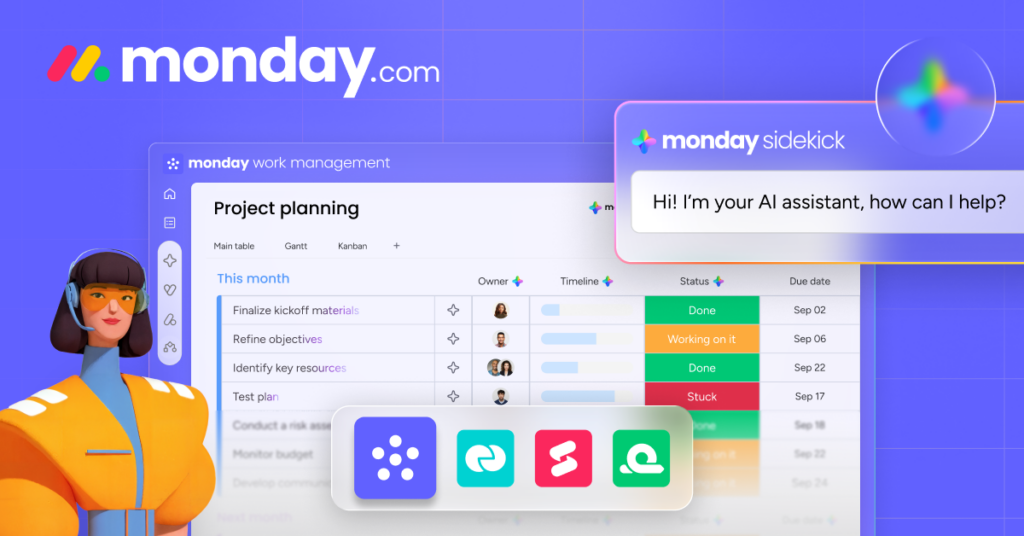
- Visual dashboards for tracking brand metrics
- Content calendar with status tracking
- Brand asset management and file sharing
- Automations for recurring brand audit tasks
- Free plan for up to 2 users
Your 4-Week Personal Branding Action Plan
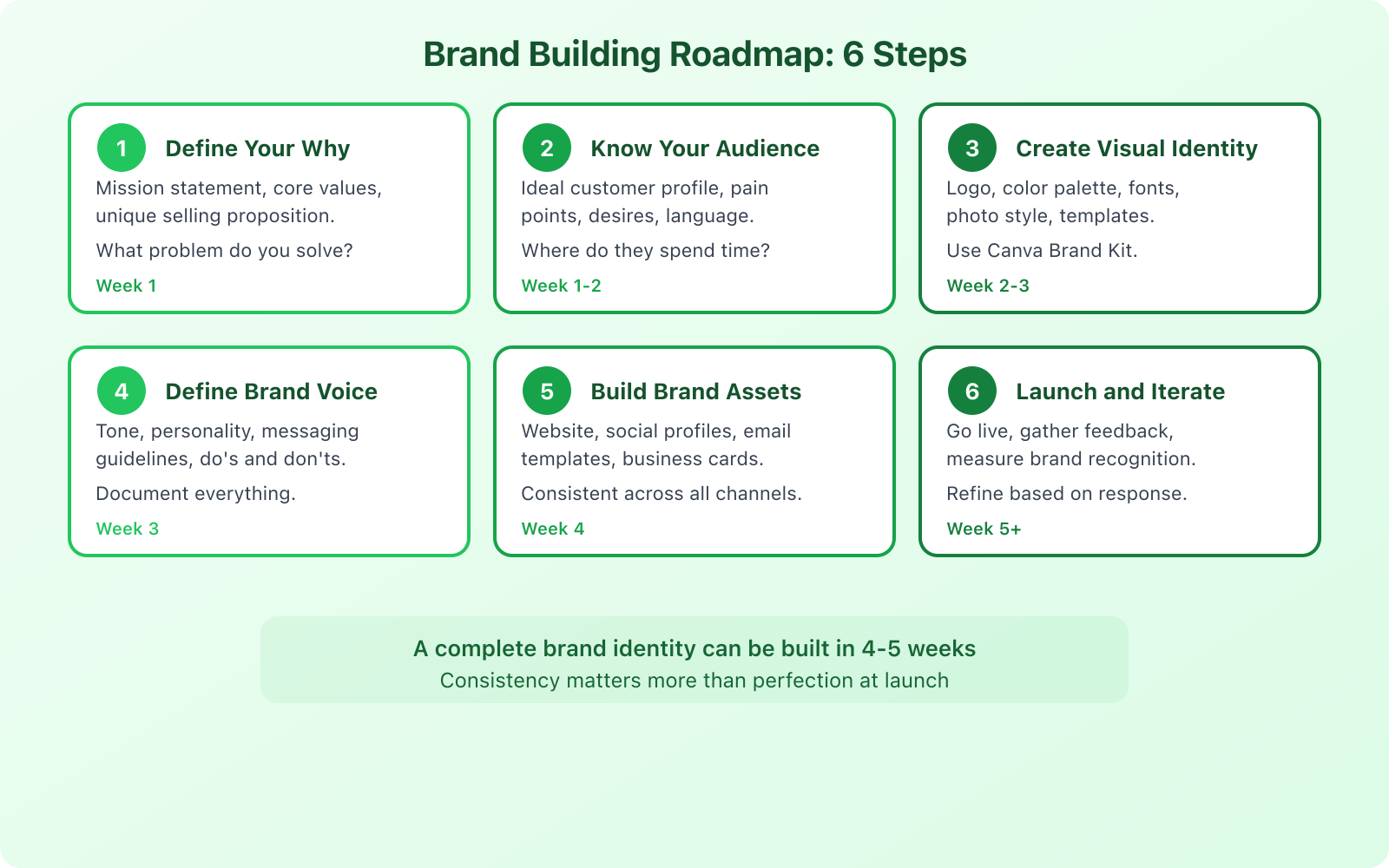
Here’s the exact process I follow when building a personal brand from scratch. It works for bloggers, consultants, coaches, and any solopreneur who sells expertise.
Week 1: Foundation. Write your positioning statement using the formula above. Define your ideal client profile in detail (industry, company size, their biggest frustration, where they spend time online). Write your 3 brand stories (origin, transformation, “why I do this”) in 200 words each. Research 5 competitors and note what they do well and where they’re generic.
Week 2: Visual identity. Choose 3 brand colors and 2 fonts. Get a professional headshot (or take a good one with a smartphone and natural light). Create a wordmark logo in Canva. Set up your Canva Brand Kit. Design templates for social media posts, email headers, and presentation slides.
Week 3: Voice and messaging. Document your brand voice with personality adjectives, “I am / I am not” statements, vocabulary guidelines, and before-and-after examples for 4 scenarios. Write your key messages: elevator pitch (30 seconds), About page copy (300 words), email signature tagline (1 sentence), and a LinkedIn headline that communicates your positioning.
Week 4: Launch and deploy. Update your website with new visual identity and messaging. Align all social media profiles (headshot, bio, cover images). Create a branded email signature. Write and send a “reintroduction” post on LinkedIn announcing your focused positioning. Pitch 3 podcasts or guest post opportunities. Set up your monthly brand metrics tracking.
After week 4, your job is consistency. The branding strategies above only pay off when you run them every week, not once. Publish content that reinforces your positioning. Show up on platforms where your audience lives. Track your metrics. Adjust quarterly based on data. Branding isn’t something you finish. It’s a practice you maintain.
Frequently Asked Questions
How much does personal branding cost for a solopreneur?
You can build a complete personal brand for under $200. Canva Pro costs $13/month for visual design. A professional headshot runs $150 to $300 (one-time). Google Fonts and Coolors.co are free for typography and color selection. Notion is free for brand documentation. The total cost for a solid personal brand setup is roughly $170 to $320. Compare that to agency pricing of $5,000 to $15,000 for essentially the same deliverables.
Should I use my real name or a business name for my brand?
If you’re a solopreneur, consultant, coach, or blogger, use your real name. Personal brands build trust faster because people connect with faces and stories. You can always create a business entity later for legal and tax purposes while keeping your personal brand as the public-facing identity. The exception: if you’re building a product business or plan to hire a team within the first year, start with a business name.
How long does it take to build a recognizable personal brand?
With consistent effort, you’ll see early results in 3 to 6 months and meaningful brand recognition in 12 to 18 months. This assumes you’re publishing content 2 to 4 times per month, actively engaging on at least one social platform daily, and pursuing guest appearances on podcasts or blogs monthly. The timeline shortens significantly if you have an existing audience or network to build on.
Can AI tools replace a professional brand designer?
For early-stage solopreneurs, yes. Tools like Canva Pro produce professional-quality visual assets that are more than adequate for the first 2 to 3 years of business. AI image generators can create custom branded graphics. However, as your revenue grows past $200,000/year, investing $2,000 to $5,000 in a professional designer for your core brand identity is worth it. They bring strategic thinking and originality that AI can’t match.
How do I maintain brand consistency when working with freelancers?
Create a brand guide document in Notion that includes your logo files, color hex codes, font names, voice guidelines with before-and-after examples, and content templates. Share this with every contractor before they start work. Set up a Canva Brand Kit with pre-built templates so freelancers can create on-brand designs without guessing. Review the first 2 to 3 pieces of content from any new contractor before they publish independently.
What’s the single most important element of a personal brand?
Consistency. A decent brand applied consistently beats a brilliant brand applied inconsistently every single time. Consistency builds recognition, and recognition builds trust. This is why documenting your brand elements matters so much. When every touchpoint delivers the same message and visual experience, your brand becomes memorable. Most solopreneurs fail at branding not because their identity is wrong, but because they apply it inconsistently across platforms.
Do I need to be on every social media platform for my personal brand?
No. Pick 1 to 2 platforms where your ideal clients actually spend time and go deep on those. For B2B consultants, LinkedIn is usually the best choice. For creative professionals, Instagram works well. For developers and tech professionals, Twitter/X and personal blogs drive the most authority. Being excellent on one platform beats being mediocre on five. You can always expand later once you’ve built momentum.
How do I differentiate my brand in a crowded market?
Narrow your focus until you’re the obvious expert for a specific type of client. Instead of ‘marketing consultant,’ become ‘the content strategist for B2B SaaS companies under 50 employees.’ Instead of ‘web designer,’ become ‘the WordPress developer for law firms.’ The narrower your niche, the less competition you face and the more you can charge. Combine niche focus with a distinctive voice and consistent content, and differentiation happens naturally within 6 to 12 months.
Tell Google you want more of this.
Add Gaurav Tiwari as a preferred sourceOne tap, and this site shows up more often in your own Top Stories, AI Overviews and AI Mode. Remove it any time.
Disclaimer: This site is reader-supported. If you buy through some links, I may earn a small commission at no extra cost to you. I only recommend tools I trust and would use myself. Your support helps keep gauravtiwari.org free and focused on real-world advice. Thanks. - Gaurav Tiwari