
Best Statistical Mechanics Books for Physics Majors
Statistical mechanics is one of those subjects that separates the physics students who memorize formulas from those who actually understand how the physical world works. I’ve spent years working through these textbooks, recommending them to students, and watching which ones consistently produce that “aha” moment when partition functions and ensemble theory finally click.
The problem with most statistical mechanics book lists? They dump 20 titles on you without telling you which one fits your level. A first-year grad student doesn’t need Landau right away, and a senior undergrad will drown in Tuckerman’s molecular simulation chapters. I’ve organized these 10 books from accessible to advanced, so you can pick the right one for where you are in 2026.
My top recommendation for the best statistical mechanics textbook is Statistical Mechanics by R.K. Pathria and Paul Beale. It strikes the right balance between rigor and readability, covering classical and quantum statistical mechanics with plenty of worked problems.
Every book on this list has been battle-tested in university courses around the world. I’ve included books that cover the classical foundations (Boltzmann, Gibbs, entropy) alongside texts that bridge into modern topics like critical phenomena, renormalization group theory, and Monte Carlo simulation. If you’re serious about physical chemistry or theoretical physics, at least three of these should be on your shelf.
Introduction to Statistical Physics by Kerson Huang
Introduction to Statistical Physics by Kerson Huang
- Covers modern critical phenomena theory alongside classical statistical mechanics foundations
- Includes quantum Hall effect, superfluids, and contemporary research applications
- Published by CRC Press with Landau-Wilson approach in final chapters
- Covers classical and quantum statistical mechanics
- Includes phase transitions and critical phenomena
- Treats ensemble theory comprehensively
- Covers Boltzmann, Fermi-Dirac, and Bose-Einstein statistics
- Includes applications to real physical systems
Kerson Huang’s textbook stands apart from most statistical mechanics books because it doesn’t just teach you the standard material and call it a day. The last three chapters into the Landau-Wilson approach to critical phenomena, which most undergraduate-level texts completely skip. If you want a book that bridges the gap between classical stat mech and modern research topics, this is the one.
The treatment of microscopic bodies and the modern theory of critical phenomena is more thorough than you’ll find in competing textbooks at this level. You also get chapters on the quantum Hall effect, superfluids, and other research-level applications that give you a taste of where the field is heading. At $89.99, it’s reasonably priced for a physics textbook, and I think it’s one of the best investments you can make if you’re planning to go into condensed matter or theoretical physics research.
- Goes beyond standard material with modern critical phenomena theory and the Landau-Wilson approach
- Covers quantum Hall effect, superfluids, and research-level applications
- Strong bridge between undergraduate foundations and graduate-level topics
A Modern Course in Statistical Physics by Linda E. Reichl
A Modern Course in Statistical Physics by Linda E. Reichl
- Completely revised and updated third edition with comprehensive topic coverage
- Covers spectral properties of decay processes and universal nature of matter
- Published by Wiley with extensive references for further research
- Covers classical and quantum statistical mechanics
- Includes phase transitions and critical phenomena
- Treats ensemble theory comprehensively
- Covers Boltzmann, Fermi-Dirac, and Bose-Einstein statistics
- Includes applications to real physical systems
Reichl’s textbook goes well beyond what you’d expect from an introductory course in statistical mechanics. This is a completely revised and updated third edition, and you can tell. The coverage stretches from the latest findings in spectral properties of decay processes to the universal nature of matter. It’s the kind of book that works equally well as a course text and as a research reference you’ll keep reaching for years later.
What I appreciate most about this book is the flexibility it gives professors. The comprehensive coverage of core topics alongside advanced material means you can use it for a standard graduate course or a specialized seminar. The extensive references at the end of each chapter are genuinely useful, not just padding. At $111.15 (down from $131.95), it’s a solid deal for a Wiley physics textbook. If you’re the type who wants one book that covers probability theory, thermodynamic frameworks, and research topics, Reichl delivers.
- Third edition is fully revised with up-to-date coverage of modern statistical physics research
- Flexible structure works for both standard courses and specialized seminars
- Extensive chapter references that actually point you to useful further reading
Statistical Physics by Landau and Lifshitz
Statistical Physics, Part 1 (Course of Theoretical Physics, Vol. 5) by L.D. Landau and E.M. Lifshitz
- Volume 5 of the legendary Course of Theoretical Physics series
- Third edition with clear, concise treatment of thermodynamics and statistical physics
- Covers fundamental principles of theoretical physics in an accessible style
- Covers classical and quantum statistical mechanics
- Includes phase transitions and critical phenomena
- Treats ensemble theory comprehensively
- Covers Boltzmann, Fermi-Dirac, and Bose-Einstein statistics
- Includes applications to real physical systems
If you’ve studied physics at any level, you’ve heard of Landau and Lifshitz. Their Course of Theoretical Physics is one of the most respected textbook series ever written, and Volume 5 on Statistical Physics is no exception. This book is brief, clear, and ruthlessly to the point. There’s no hand-holding here, and that’s exactly why serious physics students love it.
The third edition presents thermodynamics and statistical physics in a way that’s surprisingly understandable given its reputation for rigor. You get all the fundamental principles of theoretical physics, from entropy and free energy to phase transitions and fluctuations. The writing style is dense but elegant. Every sentence carries weight. I wouldn’t recommend this as your first book on the subject, but once you’ve worked through an introductory text, Landau and Lifshitz is where you go to truly understand the foundations. At $86.53, it’s also one of the more affordable options on this list. If you enjoy this level of rigor, you’ll also appreciate the best calculus books for building your mathematical foundation.
- Part of the legendary Landau-Lifshitz Course of Theoretical Physics, trusted for decades
- Brief, precise writing style that doesn’t waste your time on fluff
- Comprehensive coverage of fundamental principles with exceptional mathematical rigor
Statistical Mechanics by R.K. Pathria and Paul D. Beale
Statistical Mechanics by R.K. Pathria and Paul D. Beale
- Comprehensive coverage from ensemble theory to phase transitions and computer simulation
- Includes Monte Carlo and molecular dynamics simulation chapters
- Published by Academic Press, widely adopted in graduate physics programs
- Covers classical and quantum statistical mechanics
- Includes phase transitions and critical phenomena
- Treats ensemble theory comprehensively
- Covers Boltzmann, Fermi-Dirac, and Bose-Einstein statistics
- Includes applications to real physical systems
Pathria and Beale is the default graduate textbook for statistical mechanics in most physics departments, and there’s a good reason for that. This book covers everything from ensemble theory and simple gas behavior to ideal Bose-Fermi systems, phase transitions, and the fluctuation-dissipation theorem. It’s comprehensive without being bloated, which is a rare balance in physics textbooks.
What sets this edition apart is the addition of two newer chapters on Monte Carlo and molecular dynamics simulation, plus a chapter on the thermodynamics of the early universe. These aren’t afterthoughts. They’re well-integrated and genuinely useful for students who plan to do computational physics research. The book also covers the Clausius-Clapeyron equation, correlation functions, scattering, and exact solutions of one-dimensional fluid models. At $57.76 (down from $94.95, a 39% discount), this is the best value on this entire list. If you can only buy one graduate-level statistical mechanics book, make it this one.
- The standard graduate textbook, covering ensemble theory through phase transitions
- Two dedicated chapters on Monte Carlo and molecular dynamics simulation
- Best value at 39% off, making it the most affordable comprehensive option
Statistical Physics of Particles by Mehran Kardar
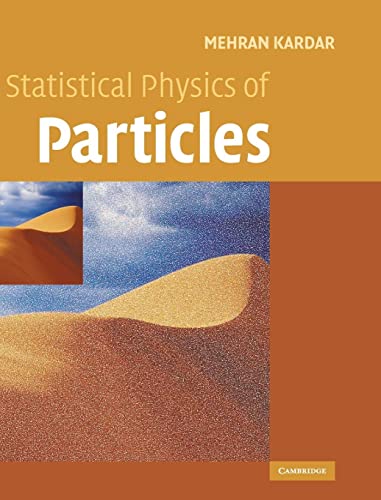
Statistical Physics of Particles by Mehran Kardar
- Based on Professor Kardar's acclaimed MIT graduate lectures
- Covers probability, information theory, and central concepts of statistical physics
- Published by Cambridge University Press, rapidly becoming the standard graduate text
- Covers classical and quantum statistical mechanics
- Includes phase transitions and critical phenomena
- Treats ensemble theory comprehensively
- Covers Boltzmann, Fermi-Dirac, and Bose-Einstein statistics
- Includes applications to real physical systems
Kardar’s Statistical Physics of Particles has been steadily replacing Pathria as the recommended graduate textbook in many top physics programs. Based on Professor Kardar’s lectures at MIT (which are also available online for free, by the way), this book introduces the central concepts and tools of statistical physics with a level of clarity that’s hard to find elsewhere.
The book opens with a chapter on probability and related topics like information theory, which might seem unusual but turns out to be incredibly useful. It builds your intuition for the statistical reasoning that underpins everything that follows. The presentation is modern, the problems are challenging, and the connections between different areas of physics are made explicit rather than left for you to figure out. At $52.88 (38% off), it’s also one of the cheapest books on this list. I’d pair this with the companion volume, Statistical Physics of Fields, for a complete two-semester graduate course. If you’re also building your algebra foundations, make sure those are solid before diving in.
- Based on MIT lectures, with the same rigorous and modern pedagogical approach
- Starts with probability and information theory to build statistical reasoning from scratch
- Excellent companion to Statistical Physics of Fields for a complete graduate course
Thermal Physics by Kittel and Kroemer
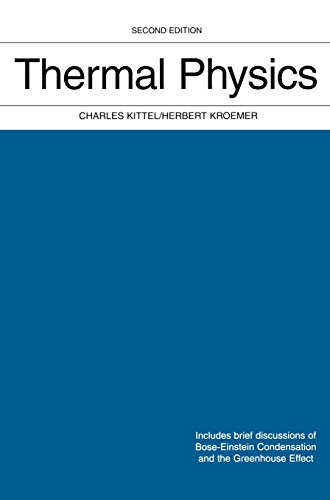
Thermal Physics (2nd Edition) by Charles Kittel and Herbert Kroemer
- Contemporary approach starting with statistical mechanics rather than classical thermodynamics
- Covers temperature, entropy, enthalpy, and all three laws of thermodynamics
- Ideal for freshman and sophomore physics courses in thermal physics
- Covers classical and quantum statistical mechanics
- Includes phase transitions and critical phenomena
- Treats ensemble theory comprehensively
- Covers Boltzmann, Fermi-Dirac, and Bose-Einstein statistics
- Includes applications to real physical systems
Kittel and Kroemer takes a fundamentally different approach from most thermal physics textbooks. Instead of starting with 19th-century classical mechanics concepts and building up to statistical mechanics, it begins with statistical mechanics from page one. The idea is simple: all physical systems can be described in terms of their accessible quantum states, so why not start there? This approach gives you a much more modern and intuitive understanding of temperature, heat, and entropy.
This is a freshman and sophomore-level textbook, which makes it the most accessible book on this list. It covers temperature, entropy, enthalpy, the first, second, and third laws of thermodynamics, and their limitations. The writing is clean and the explanations build logically on each other. The big downside is the price. At $216.99 (even after a 29% discount from $305.99), this is the most expensive book on the list. I’d strongly recommend looking for a used copy or checking your university library first. The content is outstanding, but the W.H. Freeman pricing is brutal.
- Starts with statistical mechanics rather than classical thermodynamics for a modern approach
- Accessible enough for freshman and sophomore physics students
- Clean, logical presentation of all three laws of thermodynamics and their limits
Statistical Physics of Fields by Mehran Kardar
Statistical Physics of Fields by Mehran Kardar
- Covers statistical field theories, renormalization group, and perturbation theory
- Explores universality, non-equilibrium dynamics of interfaces, and directed paths in random media
- Includes selected problems with solutions at the end of the book
- Covers classical and quantum statistical mechanics
- Includes phase transitions and critical phenomena
- Treats ensemble theory comprehensively
- Covers Boltzmann, Fermi-Dirac, and Bose-Einstein statistics
- Includes applications to real physical systems
This is the companion volume to Kardar’s Statistical Physics of Particles, and together they form one of the best two-book sequences for graduate statistical mechanics. While the first volume deals with particles, this one tackles field theories, which is where statistical physics gets really interesting (and really hard). Based on the same MIT lecture series, it covers how statistical field theories are formulated, how perturbation theory and renormalization group methods work, and why universality emerges.
The book also explores non-equilibrium dynamics of interfaces, scale invariance, and directed paths in random media. These aren’t topics you’ll find in most stat mech textbooks at this level. The early chapters build the formalism carefully, so if you’ve worked through the Particles volume first, you’ll have a smooth transition. There’s a set of selected problems with solutions at the back, which is genuinely helpful for self-study. This is an advanced graduate text, so don’t pick it up unless you’re comfortable with the material in the first volume. At around $52.88, the price matches the first volume, which makes buying both an easy decision.
- Natural continuation of Statistical Physics of Particles for a complete two-semester course
- Covers renormalization group, universality, and non-equilibrium dynamics
- Selected problems with solutions make it suitable for self-study
Thermodynamics and Statistical Mechanics by Walter Greiner
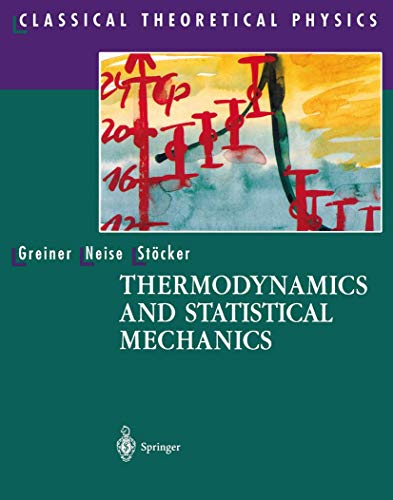
Thermodynamics and Statistical Mechanics (Classical Theoretical Physics) by Walter Greiner
- Part of Greiner's Classical Theoretical Physics series with worked examples throughout
- All results derived from first principles with complete mathematical proofs
- Ideal for university professors teaching introductory statistical physics courses
- Covers classical and quantum statistical mechanics
- Includes phase transitions and critical phenomena
- Treats ensemble theory comprehensively
- Covers Boltzmann, Fermi-Dirac, and Bose-Einstein statistics
- Includes applications to real physical systems
Walter Greiner’s textbooks are known for being full of insights while remaining mathematically rigorous, and this volume on thermodynamics and statistical mechanics is one of his best. What makes Greiner’s approach special is that every result is derived from first principles. Nothing is stated without proof. If you’re the kind of student who needs to see where every equation comes from, this is your book.
This is particularly valuable for university professors teaching introductory statistical physics courses, because the worked examples throughout the text give students a clear roadmap for problem-solving. The coverage of both thermodynamics and statistical mechanics in a single volume makes it convenient for courses that treat both topics together. At $78.76 (down from $99.99), the Springer pricing is fair for a book of this quality. I’d recommend this alongside Landau for a complete theoretical perspective. If you’re studying the broader physical sciences, you might also want to check out these inorganic chemistry books for complementary reading.
- Every result derived from first principles with complete mathematical proofs
- Worked examples throughout make it excellent for self-study and classroom use
- Covers both thermodynamics and statistical mechanics in a single, well-organized volume
Introduction to Modern Statistical Mechanics by David Chandler
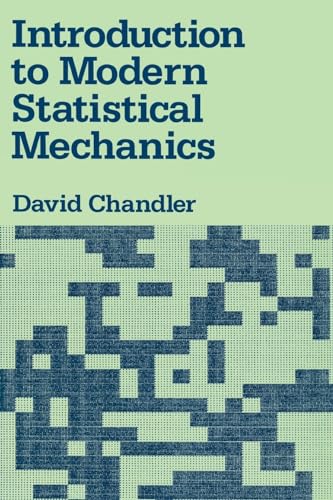
Introduction to Modern Statistical Mechanics by David Chandler
- Concise introduction to modern statistical mechanics concepts by a top physical chemist
- Covers Monte Carlo simulation, time correlation functions, and linear-response theory
- Over 150 exercises with microcomputer programs interspersed throughout
- Covers classical and quantum statistical mechanics
- Includes phase transitions and critical phenomena
- Treats ensemble theory comprehensively
- Covers Boltzmann, Fermi-Dirac, and Bose-Einstein statistics
- Includes applications to real physical systems
David Chandler’s book is a concise, no-nonsense introduction that focuses on the contemporary ideas that matter most. Chandler was one of the top physical chemists of his generation, and his writing reflects that. He introduces the fundamental concepts of statistical mechanics with an understanding that students need to see the applications, not just the theory. The book covers Monte Carlo simulation, time correlation functions, and linear-response theory in a way that feels natural and well-motivated.
What I love about this textbook is the balance between depth and brevity. It’s not a 600-page encyclopedia. Chandler knows what’s essential and what’s not, and he doesn’t waste your time on topics you’ll never use. The 150+ exercises are well-designed and include microcomputer programs that let you see the physics in action. At $84.77 (43% off from $149.99), it’s a strong buy. If you’re a physical chemistry or chemical physics student, this should probably be your first statistical mechanics textbook. It’s also fantastic for anyone who wants a second perspective after working through Pathria or Kardar.
- Concise and modern, written by one of the top physical chemists in the field
- 150+ exercises with computational components for hands-on learning
- Covers Monte Carlo simulation, correlation functions, and linear-response theory
Statistical Mechanics: Theory and Molecular Simulation by Mark E. Tuckerman
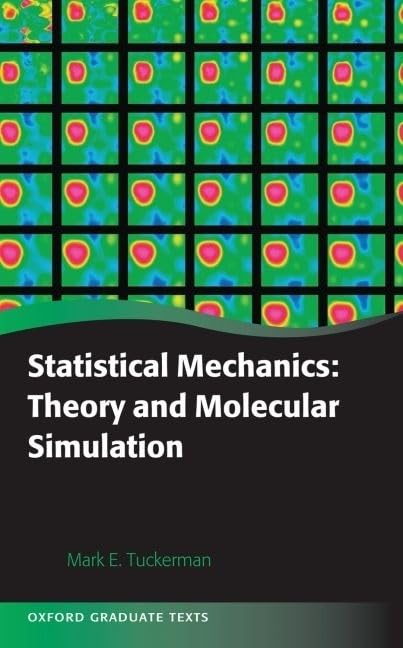
Statistical Mechanics: Theory and Molecular Simulation (Oxford Graduate Texts) by Mark E. Tuckerman
- Uniquely integrates theoretical foundations with modern computational simulation techniques
- In-depth coverage of Monte Carlo, molecular dynamics, and advanced sampling methods
- Covers critical phenomena, free-energy calculations, and generalized Langevin equation
- Covers classical and quantum statistical mechanics
- Includes phase transitions and critical phenomena
- Treats ensemble theory comprehensively
- Covers Boltzmann, Fermi-Dirac, and Bose-Einstein statistics
- Includes applications to real physical systems
Tuckerman’s book is unique on this list because it genuinely integrates statistical mechanics theory with modern computational simulation techniques. Most textbooks treat simulation as an afterthought or a separate chapter at the end. Tuckerman weaves it through the entire text, showing you how Monte Carlo and molecular dynamics methods connect directly to the theoretical foundations you’re learning. If you’re going into computational physics, computational chemistry, or materials science, this is the textbook you need.
The book covers fundamental concepts alongside advanced topics like critical phenomena, free-energy calculations, advanced conformational sampling methods, the generalized Langevin equation, and the harmonic approximation. It’s written with the goal of turning readers into active participants in computational research, not just passive learners. The Oxford Graduate Texts series maintains a high standard, and this book lives up to it. At $107.53, it’s on the pricier side, but the dual coverage of theory and simulation means you’re effectively getting two books in one. I’d recommend this as your primary text if molecular simulation is your research direction.
- ly integrates theory with Monte Carlo and molecular dynamics simulation
- Covers advanced topics like conformational sampling and the generalized Langevin equation
- Designed to prepare readers for active participation in computational research
How to Choose the Right Statistical Mechanics Book
Picking the right textbook depends entirely on where you are in your physics education and where you’re headed. Here’s my honest breakdown of which book fits which student.
If you’re an undergraduate taking your first thermal physics course, start with Kittel and Kroemer. It’s the most accessible option, and the approach of starting with statistical mechanics rather than classical thermodynamics will serve you better in later courses. The price is steep, so check your library first.
For first-year graduate students, I’d recommend Pathria and Beale or Kardar’s Statistical Physics of Particles. Pathria is the safe, comprehensive choice that covers everything you’ll be tested on. Kardar is the modern alternative with a cleaner pedagogical approach. Both are under $60 right now, which is remarkable.
If you’re going into research, you need specialized books. Tuckerman is essential for computational work. Kardar’s Fields volume is essential for theoretical condensed matter. Chandler is perfect for physical chemistry students. And Landau-Lifshitz belongs on every theorist’s shelf, even if it takes you years to fully digest it.
One approach that works well: buy Pathria or Kardar as your main text, then supplement with Chandler or Greiner for a second perspective on the same material. Statistical mechanics is one of those subjects where hearing the same concept explained two different ways can make the difference between confusion and understanding. Make sure your calculus foundations are solid before diving into any of these texts.
Frequently Asked Questions
What is the best statistical mechanics textbook for beginners?
Kittel and Kroemer’s Thermal Physics is the best starting point for beginners. It’s written for freshman and sophomore physics students, starts with statistical mechanics fundamentals rather than classical thermodynamics, and builds concepts logically. If you’re a graduate student who feels underprepared, Chandler’s Introduction to Modern Statistical Mechanics is a concise and modern alternative that won’t overwhelm you.
What is the difference between Pathria and Kardar for graduate courses?
Pathria and Beale is the traditional comprehensive textbook that covers more material in a single volume. Kardar’s two-volume set (Particles and Fields) is more modern in its approach, based on MIT lectures, and provides deeper insight into the statistical reasoning behind the physics. Pathria is better for exam preparation, while Kardar is better for building genuine understanding. Both are excellent choices.
Do I need to know quantum mechanics before studying statistical mechanics?
For classical statistical mechanics, you don’t need quantum mechanics. Books like Kittel and Kroemer and Chandler cover the classical foundations without requiring quantum knowledge. However, for quantum statistical mechanics (Bose-Einstein and Fermi-Dirac statistics), you’ll need at least an introductory quantum mechanics course. Graduate-level texts like Pathria and Kardar assume you’re comfortable with both classical and quantum mechanics.
Which statistical mechanics book is best for self-study?
Greiner’s Thermodynamics and Statistical Mechanics is excellent for self-study because every result is derived from first principles with worked examples throughout. Kardar’s books are also good for self-study since the MIT OpenCourseWare lectures are freely available online to supplement the text. Chandler’s book with its 150+ exercises provides plenty of practice problems for independent learners.
What math prerequisites do I need for statistical mechanics?
You’ll need multivariable calculus, linear algebra, basic probability theory, and differential equations at minimum. For graduate-level texts, add complex analysis and familiarity with partial differential equations. Kardar’s books explicitly build probability theory from scratch, which helps if your math background is weaker in that area. The Landau-Lifshitz volume assumes strong mathematical maturity across the board.
Is Landau and Lifshitz too advanced for a first graduate course?
Landau and Lifshitz is dense and assumes significant mathematical maturity, so it’s not ideal as your first textbook. Most students use it as a reference or second reading alongside a more pedagogical text like Pathria or Kardar. That said, the writing is remarkably clear for its level of rigor. If you’ve already completed an undergraduate thermal physics course, you can work through it alongside a primary graduate text.
Which book is best for computational statistical mechanics?
Tuckerman’s Statistical Mechanics: Theory and Molecular Simulation is the clear winner for computational work. It uniquely integrates Monte Carlo, molecular dynamics, and advanced sampling methods directly into the theoretical framework rather than treating them as separate topics. Pathria’s newer edition also includes chapters on Monte Carlo and molecular dynamics, but Tuckerman’s coverage is far more comprehensive and practical.
Can I use these books for a physical chemistry course?
Chandler’s Introduction to Modern Statistical Mechanics was written by a physical chemist and is the best choice for physical chemistry courses. Tuckerman’s book also works well for chemistry students, especially those focusing on molecular simulation. Kittel and Kroemer is commonly used in interdisciplinary courses that serve both physics and chemistry students. Pathria and Kardar are more physics-oriented but still valuable if your course leans theoretical.