
20+ Best LSAT Prep Books
Your LSAT score decides which law schools you get into. A 10-point jump from 155 to 165 can mean the difference between a mid-tier acceptance and a T14 scholarship offer. The prep material you pick has a direct impact on that number.
The LSAT changed significantly in August 2024 when LSAC dropped the Analytical Reasoning section (the infamous “Logic Games”). If you’re studying with prep books that still dedicate 200 pages to Logic Games diagramming, you’re wasting time on a section that no longer exists.
I’ve updated this list of the best LSAT prep books for 2026 to reflect the current test format. Every recommendation here covers the new structure, and I’ve included options for different budgets, learning styles, and self-study timelines.
What’s New with the LSAT in 2026
The LSAT went through its biggest format change in decades. If you last looked at this exam a few years ago, here’s what’s different now.
- Logic Games section removed — LSAC permanently dropped Analytical Reasoning in August 2024. No more grouping, ordering, or diagramming puzzles.
- Second Reading Comprehension section added — The Logic Games slot is now filled with another Reading Comprehension and Analysis section. Reading skills matter even more than before.
- Fully digital test — There’s no paper option anymore. You take the LSAT on a tablet provided at the test center, with a digital interface for flagging questions and navigating sections.
- Scoring unchanged — Still 120–180. The median sits around 151, and 170+ puts you in the 97th percentile.
- LSAT Writing is separate — The writing sample is a take-home section you complete on your own computer. It’s not scored, but law schools can see it.
This matters when you’re choosing prep books. Anything published before mid-2024 that hasn’t been updated will waste your time on Logic Games. The books I’ve picked below all account for the current format.
Best LSAT Prep Books in 2026
I’ve organized these by what they’re best at. Some are all-around prep courses, others focus on specific sections, and a few work best as supplements. Pick one or two that match your study style and budget.
Any LSAT prep book published before mid-2024 that hasn’t been updated will waste your time on Logic Games. LSAC permanently removed the Analytical Reasoning section in August 2024. Make sure your materials cover the current format.
The LSAT Trainer by Mike Kim — Best Overall Self-Study Guide
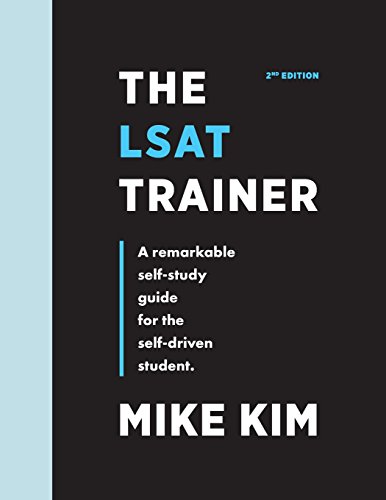
The LSAT Trainer: A Remarkable Self-Study Guide For The Self-Driven Student
- 598 pages of structured LSAT prep by Mike Kim
- Covers Logical Reasoning and Reading Comprehension with step-by-step methods
- 200+ practice questions with detailed explanations
- 12-week and 16-week study schedules included with daily assignments
- Covers Logical Reasoning and Reading Comprehension with method-based approach
- Designed for self-driven students who prefer independent study over courses
- Practice drills integrated into each chapter with progressive difficulty
- Updated content reflects the post-2024 LSAT format without Logic Games
If you can only buy one LSAT prep book, make it this one. Mike Kim’s LSAT Trainer has 5,400+ ratings on Amazon for a reason. It doesn’t just throw practice questions at you. It teaches you how to think about the test.
The book breaks down Logical Reasoning and Reading Comprehension into clear, incremental steps. You learn how to identify argument structures, spot flaws, and approach passages with a method that actually sticks. Kim’s writing style is straightforward and avoids the dry textbook tone that makes most prep books painful to read.
One thing to know: this book doesn’t include full-length practice tests. You’ll need to grab those separately (the official LSAC PrepTests work well for that). But as a teaching resource for building your core LSAT skills, nothing else comes close at this price.
The Loophole in LSAT Logical Reasoning — Best for Logical Reasoning

The Loophole in LSAT Logical Reasoning by Ellen Cassidy
- Teaches the CLIR method for identifying flaws in LSAT arguments
- Covers every Logical Reasoning question type with practice drills
- Written by an LSAT tutor who scored 172
- Teaches the CLIR method (Conclusion, Link, Implication, Role) for LR questions
- Written by a Harvard Law graduate who scored in the 99th percentile
- Focuses exclusively on Logical Reasoning which now comprises 50% of the LSAT
- Practice questions organized by question type with difficulty progression
- Students consistently report 5-10 point score improvements using this method
Logical Reasoning is the section where most test-takers leave points on the table. Ellen Cassidy’s “The Loophole” specifically targets this weakness with her CLIR method (Conclusion, Loophole, Information, Reasoning). It gives you a repeatable framework for breaking down any LR question.
What I like about this book is that it doesn’t just tell you to “read more carefully.” It teaches you a systematic approach to finding gaps in arguments. Once you internalize the method, you start seeing the same patterns across different question types. That’s when your accuracy goes up.
With Logic Games gone from the LSAT, Logical Reasoning now makes up a bigger percentage of your total score. If you’re consistently getting 3-5 LR questions wrong per section, this book can close that gap. Pair it with The LSAT Trainer for full coverage of both major sections.
Princeton Review LSAT Premium Prep — Best All-Around Course

Princeton Review LSAT Premium Prep: Master the Digital LSAT
- 4 full-length practice tests with detailed answer explanations
- Updated strategies for the new digital LSAT format
- Access to online Premium Portal with video explanations
- Four full-length practice tests with detailed scoring and explanations
- Online portal with video explanations and additional practice drills
- Covers all current LSAT sections including the new second RC section
- Diagnostic test helps identify weak areas before beginning study plan
- Strategies for the digital test interface including flagging and navigation
Princeton Review is one of the most recognized names in test prep, and their LSAT book earns that reputation. The latest edition covers the post-Logic Games format and includes 4 full-length practice tests with detailed answer explanations.
The LSAT is now a fully digital exam. Practice on screen, not on paper. Get comfortable with the digital interface, flagging questions, and navigating sections on a tablet before test day.
What sets this apart from section-specific books like The Loophole is that it covers everything in one place. Logical Reasoning strategies, Reading Comprehension techniques, tips for the writing sample, and even a concise overview of the law school application process. You also get access to their online Premium Portal, which includes video walkthroughs of tricky problems.
At around $35 (down from $76), it’s one of the best values on this list. If you want a single book that covers the entire LSAT without needing supplements, start here.
Blueprint LSAT Test Prep — Best Digital Learning Platform

Blueprint LSAT Test Prep: The Smartest Way to 170+
- 6 full-length practice exams covering the current LSAT format
- Lifetime access to Blueprint's e-learning platform
- Score-raising strategies from instructors who scored 170+
- Uses engaging, sometimes humorous writing style to keep students motivated
- Covers logical reasoning with formal logic diagramming techniques
- Reading comprehension strategies focus on passage structure and main point identification
- Includes timing strategies specific to each section of the digital LSAT
- Online resources complement the book with video lessons and practice sets
Blueprint has the highest rating on this list at 4.7 stars, and it’s easy to see why. The book itself comes with 6 full-length practice exams, but the real value is lifetime access to their online learning platform.
Since the LSAT is now a fully digital test, studying on a screen actually makes more sense than studying on paper. Blueprint’s platform mirrors the digital testing environment, so you build familiarity with the interface before test day. The instructors behind this prep all scored 170+, and their strategies are tuned for the post-Logic Games format.
The downside: at ~$47, it costs more than some alternatives. But if you’re serious about 170+ and want structured online learning alongside a physical book, Blueprint is worth it.
PowerScore Bible Trilogy — Most Thorough Deep-Study Option
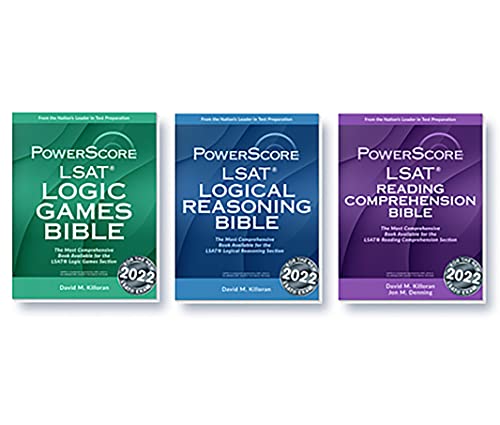
The PowerScore LSAT Bible Trilogy by David M. Killoran
- 2,006 pages across three separate LSAT prep bibles
- Separate volumes for Logical Reasoning, Reading Comprehension, and Logic Games
- Written by David M. Killoran, the gold standard in LSAT prep
- Three separate books covering Logical Reasoning, Reading Comp, and Logic Games legacy
- The LR Bible is considered the gold standard for Logical Reasoning preparation
- Detailed classification of every question type with specific attack strategies
- Hundreds of real LSAT questions with step-by-step solution explanations
- Updated editions available that account for the removal of Analytical Reasoning
The PowerScore Bible Trilogy is the most thorough LSAT prep resource available. It’s three separate books (Logical Reasoning Bible, Reading Comprehension Bible, and the Logic Games Bible) totaling over 2,000 pages. Each volume goes deep into its section with step-by-step explanations, drill sets, and strategy breakdowns.
A note about the Logic Games Bible: since LSAC removed that section, you can skip it entirely. But the Logical Reasoning and Reading Comprehension Bibles are still among the most detailed resources for those sections. If you have 4-6 months to study and want to leave no stone unturned, PowerScore delivers.
The investment is steep at $162 for the set. But if you’re struggling with a specific section, you can buy individual Bibles separately. Many students pair just the Logical Reasoning Bible with The LSAT Trainer and get everything they need.
LSAT Test Prep: Complete Study Guide — Best Value with Practice Tests

LSAT Test Prep: Complete Study Guide with 6 Full-Length Practice Tests
- 6 full-length practice tests covering the updated LSAT format
- Proven strategy system for approaching every question type
- Budget-friendly option at under $30
- Six full-length practice tests provide extensive test simulation opportunities
- Covers Logical Reasoning, Reading Comprehension, and the new LSAT format
- Answer explanations include difficulty ratings and time management tips
- Study schedule templates for 1-month, 2-month, and 3-month prep timelines
- Budget-friendly option that covers all essential LSAT content areas
This is one of the newer LSAT prep books on the market, and it’s built from scratch for the current test format. No recycled Logic Games content. The entire book focuses on Logical Reasoning and Reading Comprehension, which is exactly what you need.
You get 6 full-length practice tests, which is more than most competing books at this price point. The strategy system is structured around question types, so you learn a specific approach for each kind of problem rather than generic “read carefully” advice.
At $26.90, it’s one of the most affordable options with this many practice tests included. If you’re on a tight budget and want a single book that gives you both strategies and practice material, this one punches above its weight.
Mometrix LSAT Prep 2026–2027 — Best Budget Option

Mometrix LSAT Prep 2026-2027: 3 Full-Length Practice Tests and Study Guide
- 3 full-length practice tests with detailed answer explanations
- Covers all current LSAT sections with video walkthroughs
- Step-by-step strategies for each question type
- Three full-length practice tests calibrated to current LSAT difficulty
- Includes online flashcards and video tutorials for visual learners
- Section-by-section strategies with common trap answer identification
- Updated for 2026-2027 test dates reflecting the current LSAT format
- Money-back guarantee if the book doesn't help improve your score
Mometrix has been making test prep materials for years, and their LSAT guide is consistently one of the most affordable options that’s still worth buying. The 2026–2027 edition comes with 3 full-length practice tests and covers the current test format.
The book includes links to online video walkthroughs for each section. If you’re a visual learner who finds it easier to watch someone break down a problem than to read explanations, this is a real advantage. Many students find rewatching a 5-minute video more useful than re-reading a 3-page explanation for the third time.
At $24.99, you can pair this with the LSAT Prep Flashcards below and still spend less than most single books on this list. It’s the smart budget combo.
LSAT Prep Flashcards — Best Supplementary Tool

LSAT Prep Flashcards: Updated Cards and Strategies
- Portable flashcard format for on-the-go LSAT review
- Covers key concepts, question patterns, and reasoning strategies
- Works as a supplement to any full-length prep book
- Portable format allows study during commutes, breaks, and downtime
- Covers key logical reasoning concepts, argument structures, and flaw types
- Reading comprehension vocabulary and passage analysis techniques included
- Organized by topic for targeted review of specific weak areas
- Best used as a supplement alongside a comprehensive prep book
Flashcards aren’t a replacement for a full prep book, but they’re the best way to reinforce concepts during dead time. Commuting, waiting in line, 15-minute study breaks between classes. That’s where these cards earn their keep.
Each card covers a key concept, question pattern, or reasoning strategy. They’re designed to build the kind of instant pattern recognition that matters on test day when you have about 1.5 minutes per question. If you’re someone who benefits from spaced repetition and flashcard-based learning, these are worth picking up alongside your main prep book.
With 863 ratings and a 4.5-star average, these have held up well. I’d pair them with The LSAT Trainer or the Princeton Review for a solid two-resource study plan.
Official LSAT PrepTests — Best for Real Test Practice
Once you’ve learned the strategies from any of the books above, you need to practice with real LSAT questions. Nothing else will give you the exact feel of the actual exam. The Law School Admission Council (LSAC) publishes collections of previously administered LSATs as “PrepTests.”
The newer PrepTests (from 2024 onward) reflect the current format without Logic Games. Older PrepTests are still useful for practicing Logical Reasoning and Reading Comprehension, but you’ll need to skip the Analytical Reasoning sections.
I recommend taking at least 5-10 full-length PrepTests under timed conditions before your exam date. Simulate test-day conditions: find a quiet room, use a timer, take no breaks between sections. The point isn’t just to practice the questions. It’s to build the mental stamina for sitting through 3+ hours of high-concentration work.
Also see: Best Sellers in LSAT Test Guides on Amazon
How to Choose the Right LSAT Prep Book
| # | Preview | Product | Rating | |
|---|---|---|---|---|
| 1 |  | 10 Actual, Official LSAT PrepTests Volume VI: (PrepTests 72–81) Most Popular | 4.5/5 1,911 Reviews | View Deal |
| 2 |  | The Next 8 Actual, Official LSAT PrepTests Newest | 5/5 10 Reviews | View Deal |
| 3 |  | 10 Actual, Official LSAT PrepTests Volume V: (PrepTests 62–71) | 4.5/5 1,252 Reviews | View Deal |
| 4 |  | 10 New Actual, Official LSAT PrepTests with Comparative Reading: (PrepTests 52–61) | 4.5/5 867 Reviews | View Deal |
| 5 | 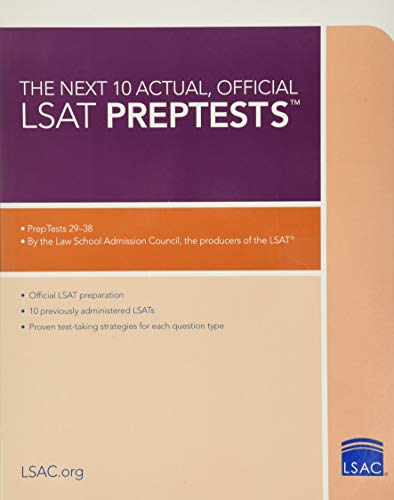 | The Next 10 Actual, Official LSAT PrepTests | 4.5/5 486 Reviews | View Deal |
| 6 |  | 10 More, Actual Official LSAT PrepTests: (PrepTests 19–28) Best Value | 4.5/5 273 Reviews | View Deal |
| 7 |  | 10 Actual, Official LSAT PrepTests | 4.5/5 249 Reviews | View Deal |
| 8 |  | 10 Actual, Official LSAT PrepTests: (PrepTests 42–51) | 4.5/5 188 Reviews | View Deal |
Picking the right book depends on three things: your timeline, your budget, and your weak spots. Here’s how I’d break it down.
By Study Timeline
- 3 months or less: Go with Princeton Review or The LSAT Trainer. You need one focused resource, not five overlapping books.
- 4–6 months: Combine The LSAT Trainer with The Loophole (if LR is your weakness) or add official PrepTests for timed practice.
- 6+ months: The PowerScore Bible Trilogy gives you the depth for a long study plan. Supplement with PrepTests in the final 2 months.
By Budget
- Under $30: Mometrix ($24.99) or the Complete Study Guide ($26.90). Both include practice tests.
- $30–$55: The LSAT Trainer ($54.71) or Princeton Review ($34.82). Best bang for your money.
- $55+: Blueprint ($46.66) plus flashcards ($30.56), or the PowerScore Trilogy ($161.79) if you want the deepest coverage.
By Weak Section
- Logical Reasoning: The Loophole is purpose-built for this. Its CLIR method gives you a repeatable framework.
- Reading Comprehension: PowerScore’s Reading Comprehension Bible goes the deepest. The LSAT Trainer also covers RC well.
- Test-taking stamina: Official PrepTests under timed conditions. There’s no shortcut for building endurance.
Don’t buy more than 2-3 books. I’ve seen students collect six different prep resources and never finish any of them. Pick one main book, one supplementary resource, and a set of PrepTests. That’s all you need. If you’re planning to self-study for the LSAT, a focused two-book approach with timed practice tests is more effective than spreading yourself across five different systems.
My Recommended Study Combos
If I were starting LSAT prep today, here’s what I’d buy based on different goals.
Best Combo Under $60
Princeton Review LSAT Premium Prep ($34.82) + Mometrix LSAT Prep ($24.99) = $59.81 total. You get complete section coverage, video walkthroughs, and 7 full-length practice tests between the two books. This is the best budget combination available.
Best Combo for 170+
The LSAT Trainer ($54.71) + The Loophole ($40.51) + Official PrepTests. This gives you Mike Kim’s strategy foundation, Ellen Cassidy’s LR mastery, and real test practice. Total: around $100 plus PrepTests. This is what I’d recommend to anyone serious about a 170+ score.
Best Digital-First Approach
Blueprint LSAT Test Prep ($46.66) + LSAT Prep Flashcards ($30.56) = $77.22 total. Since the LSAT is now fully digital, studying on Blueprint’s online platform mirrors the real test environment. Add flashcards for on-the-go review. This combination works well if you prefer screen-based learning over physical books.
Whatever combination you pick, make sure you’re using the right study tools alongside your books. A good timer app, a distraction-free study space, and consistent daily practice matter as much as the material itself. And if you want to supplement your study sessions with AI-powered study tools, there are some solid options available now that can help you drill weak areas faster.
Frequently Asked Questions
What is the best LSAT prep book for beginners?
The Princeton Review LSAT Premium Prep is the best starting point for beginners. It covers every section of the current LSAT, includes 4 full-length practice tests, and provides access to an online portal with video explanations. At around $35, it gives you a solid foundation before you decide if you need section-specific resources.
Are Logic Games still on the LSAT?
No. LSAC permanently removed the Analytical Reasoning (Logic Games) section in August 2024. It was replaced with a second Reading Comprehension and Analysis section. Any prep book that still teaches Logic Games is outdated for the current test format.
How many LSAT prep books do I need?
Two to three books is the sweet spot. Pick one main prep book for strategies and content review, one supplementary resource for your weakest section, and a set of official PrepTests for timed practice. Buying more than that usually leads to information overload without better results.
What LSAT score do I need for law school?
It depends on the school. The median LSAT score is around 151. Most accredited law schools accept scores in the 150-160 range. T14 schools (the top 14) typically look for 170+. Check your target schools’ median LSAT scores on their admissions pages to set your goal.
How long should I study for the LSAT?
Most successful test-takers study for 3-6 months, spending 15-25 hours per week. If you’re starting from scratch and aiming for a high score (165+), plan for at least 4 months. Shorter timelines (2-3 months) can work if you’re already scoring close to your goal on practice tests.
Is the LSAT harder without Logic Games?
It depends on your strengths. Logic Games was the most learnable section, meaning students who drilled it could see big score improvements. With Logic Games gone and a second Reading Comprehension section in its place, the test now favors students who are strong readers. If reading comprehension is already your strength, the new format works in your favor.
Can I self-study for the LSAT without a course?
Yes. Many 170+ scorers are self-taught using books and official PrepTests. The LSAT Trainer by Mike Kim is specifically designed for self-study. Combine it with official practice tests and a consistent study schedule, and you have everything you need. Courses are helpful but not required.
What’s the difference between the LSAT and the GRE for law school?
Some law schools now accept the GRE as an alternative to the LSAT. The LSAT focuses specifically on legal reasoning and reading skills, while the GRE tests verbal reasoning, quantitative skills, and writing. Most admissions experts still recommend the LSAT if you’re only applying to law schools, since it’s the standard and schools have more data to compare your score against.