
How to Find and Join Online Study Communities?
 by
by
Learning alone has a failure rate that nobody talks about. You start a course, get stuck on week three, and quietly abandon it. No one notices. No one asks. The course just sits in your dashboard forever.
I’ve done this dozens of times. Started books, courses, and skill-building projects that I never finished because there was no one to hold me accountable. The research backs this up too. Coursera’s own data shows that fewer than 5% of students who enroll in a MOOC actually complete it. The ones who do almost always have some form of community support, a study group, a Discord server, even just one accountability partner.
The moment I joined communities of people learning the same things, my completion rate went through the roof. Here are the best places to find study communities, how to evaluate which ones are worth joining, and how to actually get value out of them.
Why Online Study Communities Work: The Research Is Clear
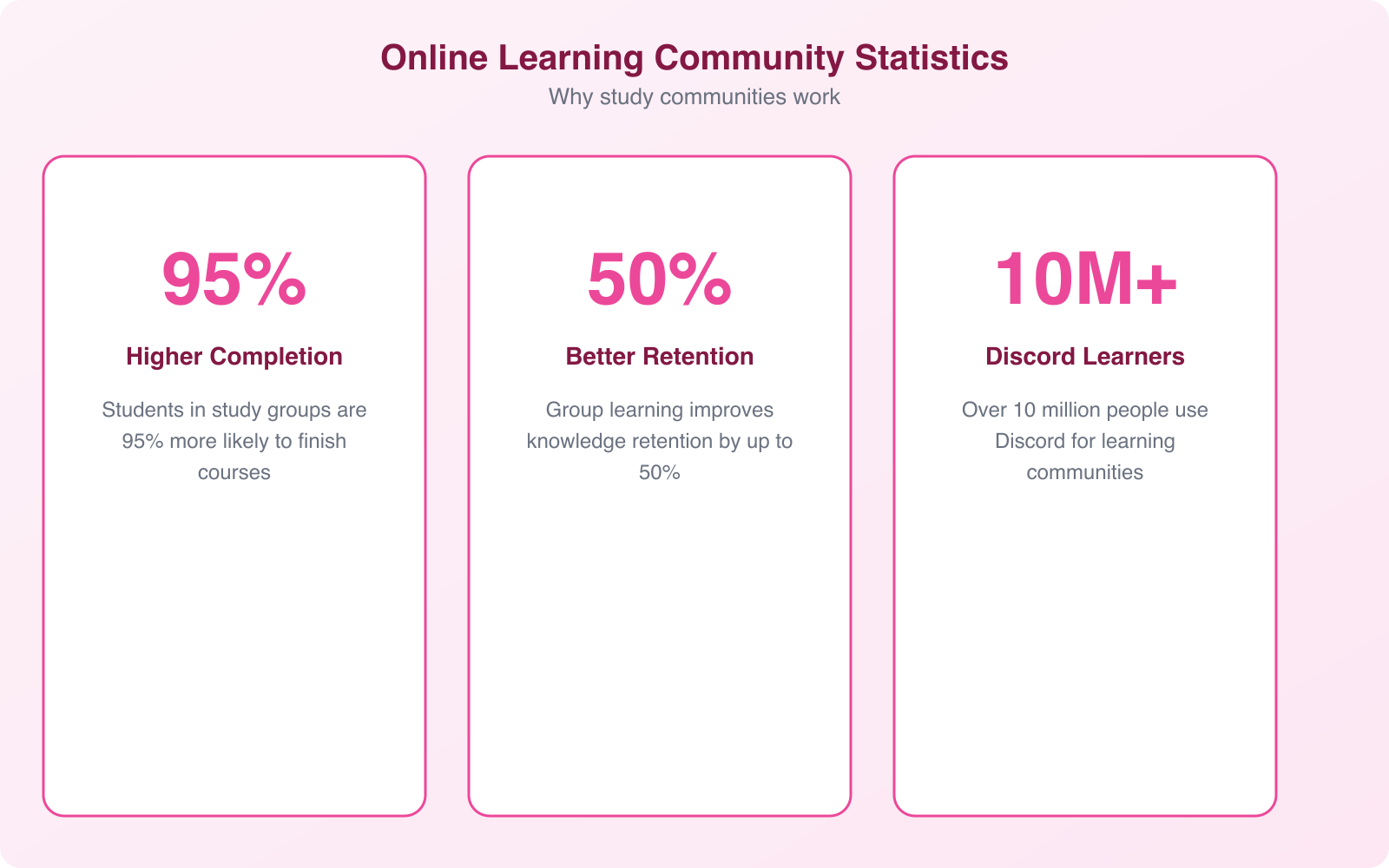
Social learning produces measurably better outcomes than studying alone. A 2014 meta-analysis published in Perspectives on Psychological Science by Dunlosky et al. found that elaborative interrogation and self-explanation, both core features of group study, significantly outperform passive re-reading and highlighting. Separately, research from the University of Texas at Austin found that students in collaborative learning environments had 55% higher exam pass rates than those studying independently. When you’re in a group that expects you to show up and contribute, you do both.
It’s not just accountability either. Study communities give you access to explanations you wouldn’t have found alone. When you’re stuck on a concept, someone else’s way of framing it often clicks where the instructor’s didn’t. You discover resources, shortcuts, and real-world applications you’d never find from a textbook alone. And the social pressure of seeing peers make progress keeps you moving when motivation alone would fail.
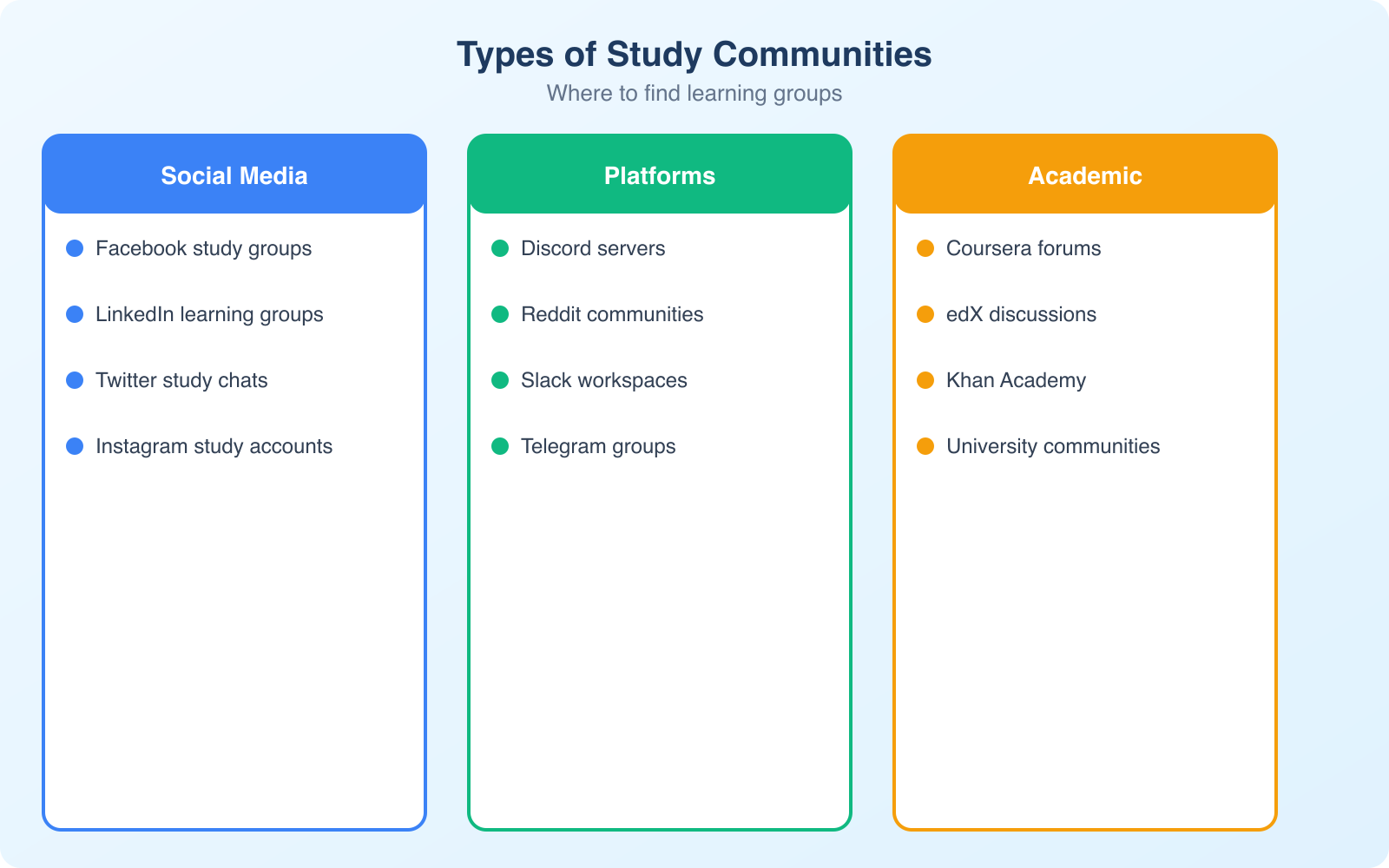
Social Media Study Groups: Where the Largest Communities Live
Social media platforms aren’t just for scrolling. They host some of the most active study communities on the internet, and a few of them are massive. Here’s how to find the right ones by subject category.
Test Prep and Academic Subjects
Facebook Groups are where test prep communities thrive. Despite what people say about Facebook being dead, it has thousands of active study groups. “GRE Prep Community” has 200,000+ members. “Learn Python” has 500,000+ members. “GMAT Prep” groups and subject-specific academic communities are genuinely active. The advantage: easy to search, familiar interface, and most people already have accounts. Search for your exam name or subject plus “study group” or “prep community.” Avoid groups with no recent posts in the last 7 days, those are ghost towns.
STEM and Programming
X (Twitter) Communities and hashtags like #100DaysOfCode, #LearnInPublic, and #StudyWithMe work well for programming and data science. The learning happens through public sharing: people post what they’re building, ask questions, and share resources. It’s accountability through visibility. Post what you’re working on and you’ll find people at your exact level. The r/learnprogramming subreddit (3.5M+ members) and Discord servers like The Programmer’s Hangout are better for real-time help. More on Reddit and Discord below.
Languages and Humanities
Facebook Groups dominate language learning communities too. “English Learning Community” has millions of members. Language exchange groups pair native speakers of one language with learners of another. For humanities subjects like history, philosophy, and literature, look for subject-specific Facebook Groups or Subreddits. The discussions tend to be higher quality in smaller, focused groups than in huge general-subject communities where posts get buried.
Reddit and Online Forums: The Best Free Q&A Communities on the Internet
Reddit is one of the best resources for learning communities, period. Nearly every academic subject and professional skill has a dedicated subreddit with active discussions, and the quality of answers is often better than paid courses because real practitioners respond.
STEM Subreddits
For programming: r/learnprogramming (3.5M+ members), r/webdev, r/python, r/javascript. For mathematics: r/math, r/learnmath. For physics: r/Physics, r/AskPhysics. For data science: r/datascience, r/MachineLearning. These communities have strict rules against low-effort questions, which keeps answer quality high. Post a specific question with context, show what you’ve tried, and you’ll usually get a detailed, accurate response within hours.
Test Prep Subreddits
r/GRE, r/LSAT, r/MCAT, r/SAT, and r/CFA are among the most valuable free resources for standardized test prep. Thousands of people document their study schedules, score improvements, and resource recommendations. Want to know which GRE prep book is actually worth buying? Spend 20 minutes reading the top posts on r/GRE. You’ll get more useful, current information than from any affiliate-sponsored review site.
Professional Skills and Career Forums
r/cscareerquestions for software engineers, r/digitalnomad for remote work, r/personalfinance for money management. Stack Overflow and the Stack Exchange network are also essential: Stack Overflow covers programming, Math Stack Exchange covers mathematics, Cross Validated covers statistics, and there are 170+ subject-specific exchanges. The upvoting system means quality answers rise and bad answers get filtered out, creating a searchable archive that grows more useful every year. Quora is another option, though it has shifted toward more generalist content and the answer quality varies more than Reddit or Stack Exchange.
Discord Servers for Learning: Real-Time Help, Anytime
Discord gives you what Reddit can’t: instant answers. You ask a question and get a response in minutes, not hours. That immediacy changes how you study. Use it for any subject where being stuck kills momentum.
Programming and STEM Discord Servers
The Programmer’s Hangout has tens of thousands of members and channels for every major language and framework. Reactiflux is the go-to Discord for React developers, with many library maintainers active in the server. The Math Community server covers everything from algebra to graduate-level topology. Python Discord has over 200,000 members and runs regular events and code reviews. For STEM broadly, search Disboard.org by subject keyword and filter by member count (1,000+) and activity (active in last 24 hours).
Language Learning and Test Prep Discord Servers
Language Exchange Discord servers pair native speakers for conversation practice. Studycord (general academics) and servers built around specific exams, SAT, IELTS, TOEFL, organize study sessions and resource sharing. Many course creators now include a private Discord server as part of their course package, giving you a direct line to the instructor and fellow students. Check Discord.me for curated server lists by category. Look for servers with pinned resources, recent activity in multiple channels, and visible moderation.
Discord’s voice channels are perfect for virtual study sessions. Find 2-3 study partners in your server and schedule a weekly voice call where you work through problems together. This replicates the in-person study group experience better than any other platform.
Educational Platform Communities: Built-In Study Groups for Your Course
Platform-native communities are the easiest to join because you’re already enrolled. Every major MOOC platform has discussion forums tied to specific courses, and the best ones are genuinely active.
MOOCs and Structured Courses
Educational websites like Khan Academy, Coursera, Udemy, and EdX have built-in discussion forums tied to specific courses. Coursera’s forums are organized by week and topic, so you can ask about exactly the concept you’re struggling with. EdX has a similar structure. When a course is actively running, these forums move fast. The limitation: once a course ends, activity drops sharply. Use platform forums for course-specific help and supplement with Discord or Reddit for ongoing learning.
K-12 and Early College
Khan Academy’s community is one of the most beginner-friendly learning communities on the internet. Questions are answered thoroughly, there’s no gatekeeping, and the subject coverage from arithmetic to AP Calculus and SAT prep is comprehensive. For students doing self-directed K-12 learning or early college subjects, it’s the best free community resource available. The discussion culture is patient and supportive in a way that Reddit’s subject subreddits often aren’t for true beginners.
LinkedIn Groups for Professional Learning: Where Credentials Meet Community
LinkedIn Groups sit at the intersection of learning and career development, which makes them uniquely valuable for working professionals. The discussions blend theoretical knowledge with practical, real-world career advice you won’t find in purely academic communities.
Business and Marketing Groups
The “Digital Marketing” group on LinkedIn has over 1.4 million members and is one of the most active professional learning communities on the platform. “Content Marketing Institute Community” covers content strategy and SEO. “Social Media Marketing” has hundreds of thousands of members with regular discussions on platform algorithm changes, campaign performance, and tool comparisons. Search for your specific field plus “community” or “professionals” in LinkedIn’s group search. The best groups have daily posts, genuine questions (not just self-promotion), and a mix of junior and senior contributors.
Project Management and Certifications
The “Project Management Professionals” group is one of the largest LinkedIn groups for PMP exam prep and professional development, with active discussions on PMI certification changes, study resources, and exam experience reports. “Agile and Scrum” groups are valuable for anyone pursuing SAFe, CSM, or PMP certifications. “Data Science Central” covers machine learning and analytics with a professional lens. For any certification study, LinkedIn groups add something Reddit can’t: you’re learning alongside people who are already working in the field, which gives you context for why the material matters beyond the exam.
Virtual Study Tools and Meetups: Structured Sessions That Actually Work
Meetup.com bridges online and in-person learning in a way that social media platforms can’t. You can find virtual study groups, local study meetups, and hybrid events where remote members join a physical location via video. Filter by “online events” to find virtual groups, or search your city for in-person options.
Meetup.com bridges the gap between online and in-person learning. You can find virtual study groups, local study meetups, and hybrid events where online members join a physical location via video call.
Search for study meetups in your area or filter by “online events” to find virtual groups. Many coding bootcamp graduates organize ongoing study sessions through Meetup. Language learners use it for conversation practice groups. Academics use it for exam prep study sessions.
For virtual study collaboration, there are dedicated apps that combine video calls, shared whiteboards, and timer-based study sessions (like the Pomodoro technique) in one interface. These tools make online studying feel more structured and productive than just hopping on a Zoom call.
How to Start Your Own Study Group: A Step-by-Step Guide
Sometimes the perfect study community doesn’t exist yet. Build it yourself. The founder usually benefits most because you set the pace, the rules, and the culture from day one. Here’s exactly how to do it.
- Pick a platform and keep it simple. Discord is the best choice for most study groups. It’s free, supports text and voice channels, and has bots for scheduling, reminders, and roles. Create a server with 4–5 channels to start: #general, #study-resources, #questions, #accountability, and #off-topic. Don’t overcomplicate it with 20 channels. You can always add more as the group grows.
- Define the group’s purpose with specificity. “Study group for web developers” is too broad. “Study group for people preparing for the AWS Solutions Architect Associate exam in Q3 2026” attracts exactly the right people and filters out everyone else. Write a one-paragraph description that answers three questions: What are we studying? Who is this for? What’s the expected weekly commitment?
- Start with 5–8 people, not 50. Small groups are more accountable, more active, and build stronger relationships. Recruit from existing communities: post in relevant subreddits, Discord servers, or LinkedIn groups that you’re starting a focused study group. Be specific about the commitment level you expect.
- Create a repeating weekly rhythm. Schedule fixed sessions at the same time every week. Monday evening for goal-setting, Thursday for a voice call study session, Sunday for progress check-ins works well. Consistency beats frequency. A group that meets once a week reliably beats one that tries to meet daily but flakes after two weeks.
- Set three ground rules from day one. Be respectful. Contribute at least once per week. No self-promotion or spam. Enforce these consistently. One person who posts irrelevant content or derails discussions will drive out your best members faster than anything else.
Avoiding Toxic or Unproductive Study Communities
Not all communities are worth your time. Some are actively harmful to your learning. Here’s what to look for before committing, with specific examples of the patterns that kill communities.
Constant negativity. If every thread in a GRE prep group is people venting about how unfair the exam is, or an r/cscareerquestions thread is 90% complaints about the job market with no actionable advice, leave. Negativity is genuinely contagious. Communities where the primary shared activity is complaining create anxiety and learned helplessness, not knowledge. Productive communities acknowledge hard realities (“the LSAT verbal section is brutal”) but pivot immediately to solutions (“here’s the specific strategy that worked for me”).
Answer quality is consistently low. Before joining any community, read 10 recent question threads end-to-end. If the answers are vague (“just study more”), incorrect (wrong formulas on a math forum), or dismissive (“Google it”), the community is run by beginners answering beginners. This actively spreads misinformation. One of the most common complaints in MCAT prep communities, for example, is newer students giving each other wrong advice about biochemistry topics. Stick to communities where experienced members are visibly active and engaged.
Heavy self-promotion. A Discord server where half the posts are people advertising their YouTube channels, a Facebook group flooded with course sale announcements, a LinkedIn group where every post is a humble-brag with a product pitch at the end: these are marketing channels wearing the skin of learning communities. Good communities have explicit rules against unsolicited promotion and enforce them. Check the pinned rules before joining.
No active moderation. A community with 100,000 members and inactive mods will be noisier and less useful than one with 5,000 members and engaged moderators. Check when the last mod message was posted. Look at how recent spam or rule violations were handled. A well-moderated community with 1,000 members beats an unmoderated one with 100,000 every time.
Gatekeeping and elitism. Some Stack Exchange communities, certain programming Discord servers, and niche academic subreddits have cultures where beginners get mocked for asking questions that seem “basic” to veterans. This is easy to spot: read the comment sections on questions posted by newer members. If the top response is condescending rather than helpful, that community will slow your learning rather than accelerate it. The best communities treat every genuine question as worth answering.
How to Get Real Value from Study Communities
Joining is step one. Getting consistent value requires a different approach than most people take.
Contribute before you consume. In r/learnprogramming, the members who get the fastest, most detailed answers are the ones who are visibly helping others. In a Coursera course forum, students who answer other people’s questions get better answers to their own. This isn’t coincidence. Contribution builds reputation and reciprocity. When you’ve spent two weeks answering questions in a Python Discord server, people know who you are. Your questions get real answers, not one-liners.
Limit yourself to 3–4 communities maximum. Joining 10 communities guarantees you’ll be active in none. Pick one primary community where you invest most of your time, and 1–2 supplementary ones for specific needs. I spent months trying to stay active across 6 different Discord servers for web development. I was useless in all of them. Picked two, went deep, and the quality of my learning and my network both improved immediately.
Schedule participation the same way you schedule studying. 15–20 minutes per day is enough. Check the community, answer one question, post one update. Don’t let community browsing replace actual studying. Set a timer. When it goes off, close the tab. The goal is to be a consistent participant, not an all-day moderator.
Build 1:1 connections. The best outcome from any study community isn’t the public discussions. It’s the 2–3 people you end up studying with directly. In a Studycord Discord server for exam prep, find the people posting at your level, offer to exchange notes, suggest a weekly voice call. Those individual relationships compound. Two years later, those are the professional contacts who refer you to jobs, coauthor projects with you, and tell you about opportunities before they’re public.
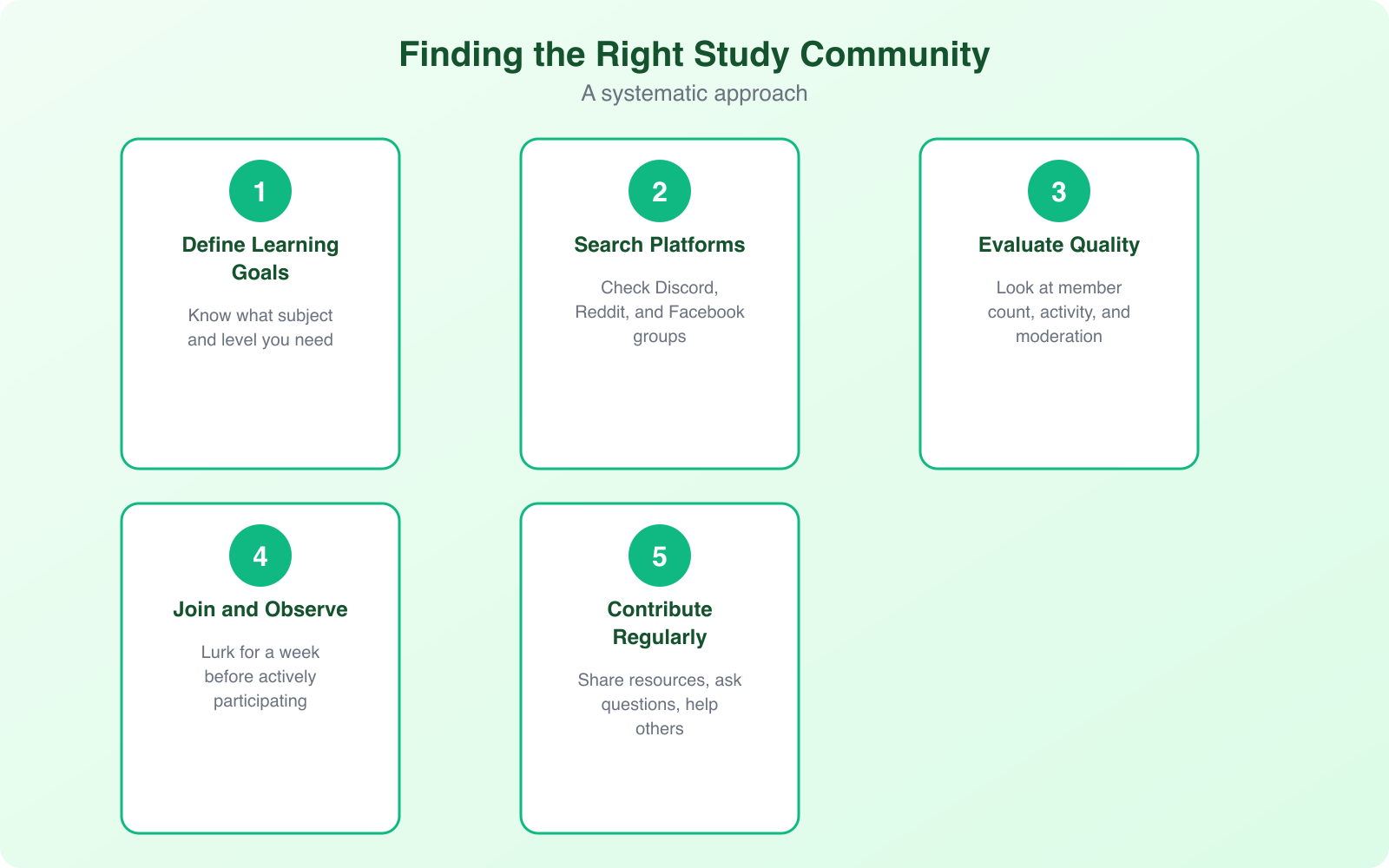
Before joining any community, lurk for 48 hours first. Read the recent discussions. Check the quality of responses. See if moderators are active. A community with great members but no moderation quickly devolves into spam. A community with strict moderation but low activity isn’t useful either. Look for the balance.
Study Community Tools That Make Collaboration Easier
Beyond the platforms where communities live, there are tools that make studying together more effective, even when you’re in different time zones.
Shared note-taking: Notion is my top pick for collaborative study notes. Create a shared workspace where group members can add notes, organize them by topic, and build a collective knowledge base that’s more comprehensive than anything one person could create alone. Google Docs works for simpler needs.
Flashcard apps: Anki and Quizlet let you create and share flashcard decks with your study group. One person creates cards for chapter 1, another for chapter 2, and everyone benefits from the full set. Shared flashcard decks are especially effective for exam prep, language learning, and memorization-heavy subjects.
Video study sessions: Zoom and Google Meet work for scheduled study calls. But for spontaneous “body doubling” (studying alongside others for accountability), try platforms built specifically for this. Study Stream and Focusmate match you with study partners for timed sessions. The simple act of knowing someone else is working alongside you dramatically reduces procrastination.
Progress tracking: Share your study hours with your group using a shared spreadsheet or a habit-tracking app. Seeing that your study partners logged 10 hours this week when you only logged 3 creates healthy accountability. Some Discord servers use bots to track study time, with leaderboards that gamify the process.
Whiteboard tools: For subjects that require visual explanation (math, physics, architecture, design), shared whiteboards like Miro, FigJam, or Excalidraw let you draw diagrams and work through problems together in real-time. These are essential for any group studying technical or visual subjects.
Online study communities won’t replace the discipline of sitting down and doing the work. But they’ll make the work more enjoyable, help you learn faster, and connect you with people who can become lifelong professional contacts. Start with one community that matches your current learning goal. Be an active participant. Build real relationships. The knowledge compounds, and so do the connections. For more resources on collaborative learning, check out the ultimate study toolkit for students and my list of study tools for college students.
Frequently Asked Questions
Are online study communities actually effective?
Yes. Research shows that social learning improves retention by 50-75% compared to studying alone. Study communities provide accountability, diverse perspectives, and peer support. The key is choosing active communities with quality discussions and being a contributor, not just a lurker.
Which platform is best for study groups?
Discord is the best for real-time interaction and voice study sessions. Reddit is best for long-form discussions, Q&A, and resource sharing. Facebook Groups are best for large communities around test prep and language learning. LinkedIn Groups are best for professional development. The right platform depends on your subject and learning style.
How many study communities should I join?
No more than 3-4. Joining too many communities splits your attention and makes it impossible to be an active participant in any of them. Pick one primary community where you invest most of your time, and add 1-2 supplementary ones for specific needs. Quality of participation beats quantity of memberships every time.
How do I find a study partner online?
Join a community related to your subject and look for people posting at a similar level to you. Start by responding to their posts and offering help. After a few interactions, suggest a weekly study session via voice call. Discord and Meetup.com are the best platforms for finding study partners because they support both text and voice communication.
Are paid study communities better than free ones?
Not necessarily. Many free communities on Discord and Reddit are excellent. Paid communities sometimes offer more structure (scheduled calls, curated resources, active moderation), but the price alone doesn’t guarantee quality. Before paying, check if there’s a free trial, read reviews from current members, and evaluate whether the paid community offers something you can’t get for free elsewhere.
Tell Google you want more of this.
Add Gaurav Tiwari as a preferred sourceOne tap, and this site shows up more often in your own Top Stories, AI Overviews and AI Mode. Remove it any time.
Disclaimer: This site is reader-supported. If you buy through some links, I may earn a small commission at no extra cost to you. I only recommend tools I trust and would use myself. Your support helps keep gauravtiwari.org free and focused on real-world advice. Thanks. - Gaurav Tiwari