
20 Best Cyber Security Books to Read in 2026
I’ve been building websites and managing server infrastructure for over 16 years. In that time, I’ve dealt with brute force attacks, SQL injections, compromised plugins, and clients who used “password123” for their admin login. The best cyber security books aren’t something I read for fun. They’re something I’ve had to study the hard way, often at 2 AM while patching a hacked WordPress site.
These 20 cybersecurity books are the best books to learn cyber security from. Some taught me how attackers think. Others helped me build better defenses for my clients’ projects. Whether you’re a developer who wants to write more secure code, a student exploring the field, or someone who just wants to understand how digital threats actually work, this list covers the ground you need in 2026.
I’ve organized these from hands-on technical guides (exploitation, penetration testing, malware analysis) to broader strategic reads (cyberpsychology, geopolitics, risk measurement). This list includes the best ethical hacking books 2026 has to offer, alongside defensive security reads. Each book gets a quick breakdown of who it’s for, what makes it worth your time, and where it falls short.
Set up a home lab with VirtualBox or VMware before you start any ethical hacking book. Most hands-on exercises need a safe environment to practice in. Kali Linux + a vulnerable target VM (like Metasploitable) takes 30 minutes to set up and gives you a legal playground for testing.
Hacking: The Art of Exploitation
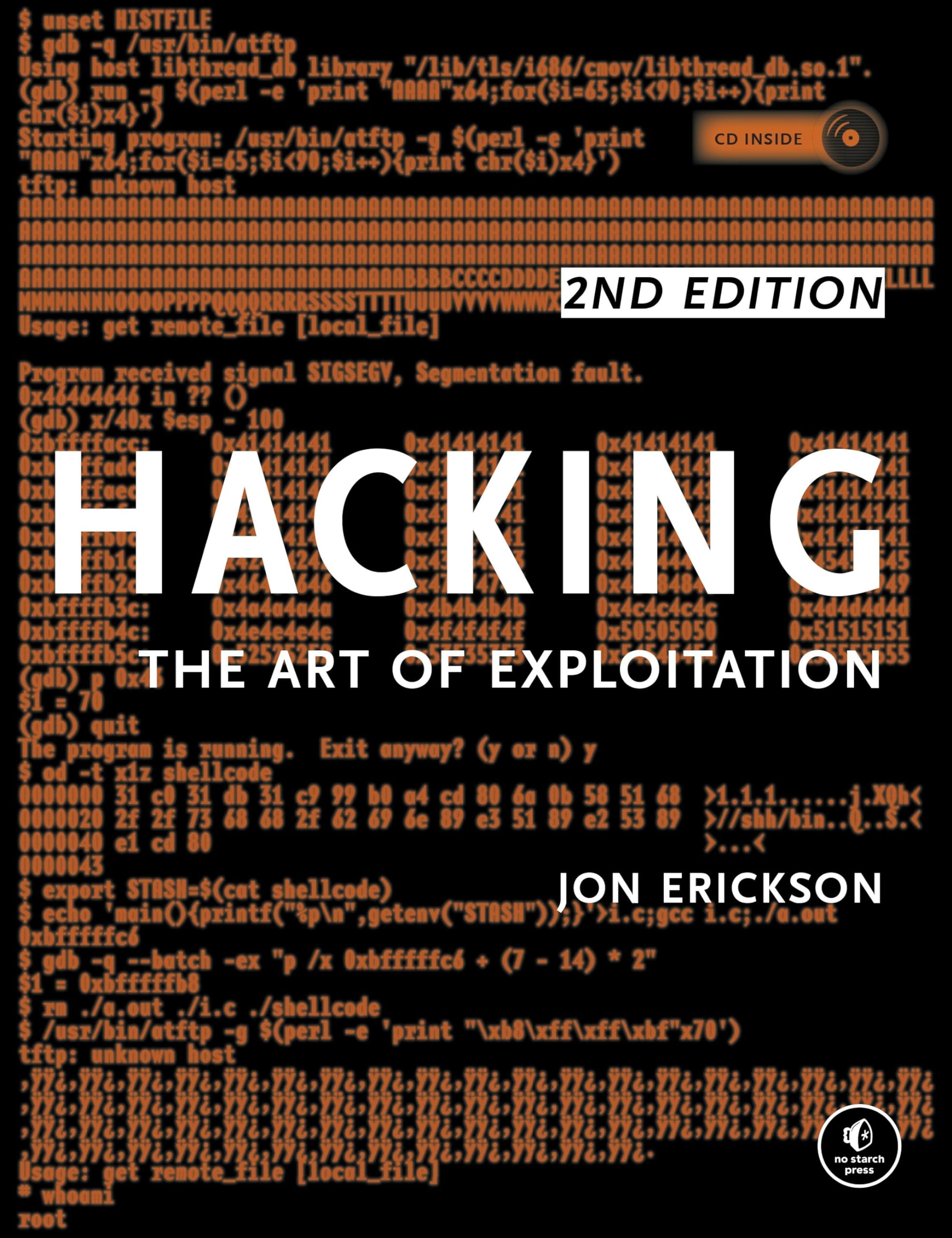
Hacking: The Art of Exploitation, 2nd Edition
- Covers C programming, networking, shellcode, and cryptology from an attacker's perspective
- Includes a LiveCD with a preconfigured Linux environment for hands-on practice
This is the book I recommend to anyone who asks “where do I start with hacking?” Jon Erickson doesn’t just teach you techniques. He teaches you how to think like an attacker. The second edition walks you through C programming, networking, shellcode, and cryptology, all from the perspective of someone trying to break things.
What sets this book apart is the included LiveCD. You get a preconfigured Linux environment where you can write exploits, debug programs, and experiment without risking your actual system. I’ve seen university courses built around this single book. It’s technical, but Erickson’s writing makes complex topics approachable. If you’re serious about understanding how software exploitation actually works at the binary level, start here.
The one downside: it was published in 2008, so some specific exploits are dated. But the fundamental concepts of buffer overflows, memory corruption, and network attacks haven’t changed. You’ll build a foundation that transfers directly to modern vulnerability research.
Penetration Testing: A Hands-On Introduction to Hacking
Georgia Weidman wrote this book for people who want to actually do penetration testing, not just read about it. She walks you through the entire pentest methodology: setting up a lab, scanning networks, exploiting vulnerabilities, cracking passwords, and writing reports. It’s the closest thing to a hands-on training course in book form.
I especially like how she covers wireless network attacks, social engineering, and web application testing alongside the traditional network stuff. You’ll learn brute force attacks, wordlist attacks, and how to bypass antivirus software. The exercises use real tools like Metasploit, Nmap, and Burp Suite, which are the same tools professional pentesters use on actual engagements.
If you’re considering a career in penetration testing or want to understand how security assessments work, this is the best starting point I’ve found. It assumes no prior experience, which is rare for a book this thorough.
Practical Malware Analysis
– wp:paragraph –>When malware hits your network, you need to act fast. This book teaches you how professional analysts dissect malicious software to understand what it does, how it spreads, and how to stop it. Authors Michael Sikorski and Andrew Honig (both former NSA analysts) cover everything from basic static analysis to advanced dynamic techniques.
You’ll learn to use IDA Pro, OllyDbg, and WinDbg to reverse-engineer malware samples. The book includes hands-on labs where you actually analyze real malware in a safe environment. I found the chapter on anti-debugging techniques particularly valuable because modern malware actively tries to detect and evade analysis tools.
This isn’t a beginner book. You’ll need some familiarity with C programming and x86 assembly. But if you’re working in incident response or want to understand what happens after a breach, this is the definitive resource. I’ve referenced it multiple times when investigating suspicious files on client servers.
Metasploit: The Penetration Tester’s Guide
–>Metasploit is the most widely used penetration testing framework in the world, and this book is the best way to learn it. David Kennedy wrote it for complete beginners, which I appreciate. He doesn’t assume you know anything about pentesting and builds your skills progressively from basic network scanning to advanced exploitation techniques.
The book covers network reconnaissance, enumeration, client-side attacks, wireless attacks, and targeted social engineering. What I like most is how practical it is. Every technique you learn gets applied in the Metasploit framework immediately. You’re not reading theory; you’re running actual exploits against test targets.
For anyone using cyber security books to build a career in this field, understanding Metasploit is non-negotiable. This book gives you that foundation. Pair it with “The Hacker Playbook 3” (also on this list) for a more advanced follow-up, and you’ll have a solid penetration testing skill set.
Black Hat Python: Python Programming for Hackers and Pentesters
wp:paragraph –>Python is the go-to language for security professionals, and this book shows you exactly why. Justin Seitz walks you through building network sniffers, manipulating packets, infecting virtual machines, creating trojans, and automating tasks that would take hours manually. It’s the “dark side” of Python, and it’s fascinating.
You’ll build a GitHub-based trojan command-and-control system, automate common malware functions, and learn how to detect sandboxing environments. The book also covers web application hacking and Windows privilege escalation using Python. Every chapter produces a working tool you can actually use in a pentest lab.
I recommend this to any programmer who wants to understand security from a coding perspective. You’ll need basic Python knowledge, but Seitz keeps the code clean and well-explained. If you write Python at work, this book will change how you think about the code you ship.
Social Engineering: The Science of Human Hacking
>The biggest security vulnerability in any organization isn’t software. It’s people. Christopher Hadnagy’s book is the definitive guide to understanding how attackers exploit human psychology to bypass even the strongest technical defenses. He covers pretexting, influence, manipulation, and elicitation with real-world examples that’ll make you rethink every phone call and email you receive.
I’ve seen firsthand how effective social engineering is. A client once had their entire WordPress admin compromised because an employee clicked a phishing link that looked like a hosting provider notice. This book explains exactly why those attacks work and how to train yourself (and your team) to recognize them.
Hadnagy doesn’t just explain the theory. He shows you techniques that can fool even well-trained security personnel. That’s both the book’s strength and its ethical complexity. But if you’re responsible for protecting any organization’s data, you need to understand these attacks from the attacker’s perspective.
The Art of Invisibility by Kevin Mitnick
<!-!– wp:paragraph –>Kevin Mitnick once had the FBI chasing him across the country. Now he teaches people how to protect themselves online. The irony isn’t lost on me, and it makes for a compelling read. This book covers practical privacy techniques: how to protect your identity, your financial data, your health records, and your online communications from both hackers and surveillance.
What I appreciate about Mitnick’s approach is that he gives you actionable steps at multiple skill levels. Basic users get simple counter-measures they can implement today. More advanced readers get techniques involving VPNs, Tor, encrypted communications, and operational security practices. He also covers advanced topics like defeating Wi-Fi tracking and protecting against physical surveillance.
This isn’t a deeply technical book. It’s written for regular people who are concerned about their digital privacy. If you’ve ever wondered who’s watching you online (spoiler: more entities than you think), Mitnick lays it all out in a way that’s alarming but empowering. I’ve recommended this to several clients who wanted to understand the privacy implications of their online businesses.
Cyber Wars: Hacks that Shocked the Business World
/–>Not every cybersecurity book needs to teach you how to write shellcode. Cyber Wars is a storytelling book, and Charles Arthur tells these stories well. He covers some of the most devastating cyberattacks in recent history and breaks them down in a way that anyone can understand, no technical background required.
What makes this book valuable is how it communicates security risks to non-technical stakeholders. If you’ve ever tried to explain to a client or boss why they need to invest in security, this book gives you the ammunition. The real-world examples are compelling enough to make anyone pay attention.
I’ve given this to business owners who didn’t understand why their antivirus software alone wasn’t enough. After reading it, they approved the security budget I’d been requesting for months. It’s that persuasive.
Applied Cryptography: Protocols, Algorithms, and Source Code in C
->Bruce Schneier’s Applied Cryptography is the bible of cryptographic techniques. If you’re a developer who needs to understand encryption beyond “just use TLS,” this book covers everything: symmetric and asymmetric algorithms, digital signatures, key exchange protocols, hash functions, and real-world implementations in C.
I won’t pretend this is light reading. It’s dense, it’s technical, and you’ll need a decent math background to follow the algorithm discussions. But Schneier has a gift for making complex cryptographic concepts as clear as they can possibly be. The practical advice on implementation is especially valuable because cryptography is one of those fields where a small implementation mistake can destroy your entire security model.
At under $7 for the current price, this is absurd value for what you get. It’s a reference book I still pull off the shelf when evaluating cryptographic approaches for web applications. Every developer who works with sensitive data should have a copy.
The Code Book: The Science of Secrecy from Ancient Egypt to Quantum Cryptography
w”} /–>Simon Singh takes you on a journey through the entire history of encryption, from hieroglyphics in ancient Egypt to the Enigma machine in World War II to modern quantum cryptography. It’s a history book disguised as a tech book, and it’s one of the most engaging reads on this entire list.
What makes The Code Book special is context. Understanding why encryption exists, how it evolved, and what problems it was designed to solve gives you a deeper appreciation for the cryptographic systems we rely on today. Singh connects historical events to modern cybersecurity in ways that feel natural and illuminating.
This is the book I recommend to people who say “I’m not technical enough for cybersecurity.” You don’t need to be. Singh writes for a general audience, and the stories are genuinely fascinating. It’s also a great companion to Applied Cryptography if you want the human story behind the mathematics.
Threat Modeling: Designing for Security
“preview”} /–>Most developers treat security as an afterthought. Build first, secure later. Adam Shostack’s book argues that’s exactly backwards, and after 16 years of fixing security holes in production websites, I completely agree. Threat Modeling teaches you how to incorporate security into systems while they’re being designed, not after they’ve been breached.
Shostack’s recommendations are entirely action-oriented. He doesn’t just theorize about threats. He gives you frameworks and checklists you can apply to real projects. The STRIDE model (Spoofing, Tampering, Repudiation, Information Disclosure, Denial of Service, Elevation of Privilege) alone is worth the price of the book.
This is aimed at developers, architects, and security managers rather than casual readers. If you build web applications, APIs, or any system that handles user data, this book will change how you think about security from day one of a project. I wish I’d read it earlier in my career.
The Cyber Effect by Mary Aiken
->Dr. Mary Aiken is a forensic cyberpsychologist, and this book explores something most security books ignore: how the internet changes the way humans think and behave. She covers everything from the impact on child development to the escalation of cyberstalking, cyberchondria (obsessive online self-diagnosis), and organized crime on the deep web.
I found this book eye-opening because it connects cybersecurity to human psychology in a way that technical books simply can’t. Understanding why people fall for phishing attacks, why they share too much personal information, and why online behavior differs from offline behavior is crucial for anyone building secure systems.
If you manage a team or build products that people use online, the behavioral insights in this book will inform better security design decisions. It’s less about protecting servers and more about understanding the humans who use them. That perspective is often the missing piece in cybersecurity strategy.
Hacking Exposed 7: Network Security Secrets and Solutions
iew”} /–>The Hacking Exposed series has been the go-to reference for network security since the first edition. This seventh edition, written by Stuart McClure, Joel Scambray, and George Kurtz, covers everything from footprinting and scanning to advanced exploitation techniques and their countermeasures.
What I like about this book’s approach is the attack-defense pairing. Every attack technique is followed by the corresponding defensive countermeasure. You learn how hackers think and what you can do to stop them in the same chapter. For security professionals who need to both identify and fix vulnerabilities, this format is efficient.
Cybersecurity moves fast, and some concepts in older books lose relevance quickly. Hacking Exposed has stayed current through multiple editions because the authors focus on foundational attack patterns that persist across technology generations. It’s the kind of book that belongs on every security team’s bookshelf.
Gray Hat Hacking: The Ethical Hacker’s Handbook (Best Ethical Hacking Books 2026)
“preview”} /–>Gray hat hackers sit in the interesting middle ground between malicious attackers and pure defenders. They use the same tools and techniques as black hats, but with the goal of finding and reporting vulnerabilities rather than exploiting them. This handbook by Allen Harper covers that space in depth.
The fifth edition covers information gathering, attack techniques, exploit development, and countermeasures. It’s one of the more ethical hacking references available, and at 82% off the original price right now, it’s a steal. The book is particularly good at explaining the legal and ethical boundaries of security testing, which is something many technical books skip entirely.
If you’re working toward certifications like CEH (Certified Ethical Hacker) or OSCP, this book covers much of the same ground. It’s a solid study companion and a practical reference you’ll use long after the exam.
The Hacker Playbook 3: Practical Guide to Penetration Testing
“mode”:”preview”} /–>Peter Kim’s Hacker Playbook series is the closest thing to a step-by-step pentest cookbook. The third edition focuses on red team operations: reconnaissance, scanning, enumeration, vulnerability assessment, exploitation, and post-exploitation activities like data exfiltration and lateral movement.
What separates this from other pentesting books is the “playbook” format. Each chapter reads like a game plan with specific plays you can run. Kim walks you through real-world scenarios and shows you exactly which tools to use and in what order. It’s practical in a way that academic security books simply aren’t.
I’d pair this with “Metasploit: The Penetration Tester’s Guide” as a natural progression. Start with Metasploit for fundamentals, then move to The Hacker Playbook 3 for advanced red team techniques. Together, they give you a penetration testing education that rivals expensive training courses.
Mastering Hacking: The Art of Information Gathering and Scanni_text”},”mode”:”preview”} /–>
Harsh Bothra takes a focused approach in this book: information gathering and scanning. These are the first two phases of any penetration test, and most books rush through them to get to the “exciting” exploitation part. Mastering Hacking doesn’t. It gives these foundational steps the attention they deserve.
The book covers the latest tools and methods used in the penetration testing framework. It teaches you how to identify your target’s attack surface, enumerate services, and map network architectures before launching a single exploit. In real-world pentesting, this recon phase often determines whether an engagement succeeds or fails.
At $13.56, this is one of the most affordable books on the list. It’s suitable for readers with varying levels of technical expertise, making it a good entry point if you’re specifically interested in the reconnaissance side of cybersecurity. Pair it with more advanced exploitation books once you’ve mastered the fundamentals covered here.
The Hacker and the State: Cyber Attacks and the New Normal of G_feature_text”},”mode”:”preview”} /–>
Ben Buchanan’s book examines cybersecurity from a perspective most technical books ignore: geopolitics. He covers significant nation-state cyberattacks, from Stuxnet targeting Iran’s nuclear program to Russian interference in elections, and explains how cyber warfare has become the new normal in international relations.
This book is particularly relevant in 2026 as state-sponsored attacks continue to escalate. Buchanan provides detailed case studies and interviews that reveal how governments use hacking as a tool of foreign policy. It’s a sobering read, but an essential one if you want to understand the bigger picture of why cybersecurity matters beyond protecting your own network.
I recommend this to anyone who works in cybersecurity policy, government IT, or critical infrastructure. But honestly, it’s valuable for anyone who wants to understand why countries are investing billions in offensive cyber capabilities and what that means for the rest of us.
The Pentester Blueprint: Starting a Career asfield_pb_feature_text”},”mode”:”preview”} /–>
If you’re considering a career switch into penetration testing, this is the book to read first. Phillip L. Wylie doesn’t just teach you technical skills. He maps out the entire career path: what certifications to pursue, how to build a home lab, how to practice on bug bounty platforms, and how to land your first pentesting job.
The book covers both basic and advanced pentesting concepts, but its real strength is the career guidance. Wylie includes information about networking in the security community, building a portfolio, and the day-to-day reality of working as a professional pentester. This context is invaluable because technical books rarely address the “how do I actually get hired” question.
At 48% off right now, it’s an easy recommendation for students and career changers. Released in late 2020, it’s also one of the newer books on this list, which means the career advice and tool recommendations are still current.
How to Measure Anyt_text”:”field_pb_feature_text”},”mode”:”preview”} /–>
Douglas W. Hubbard takes aim at one of cybersecurity’s biggest problems: the industry’s reliance on subjective risk assessments. You know the ones. “High,” “Medium,” “Low” risk labels that mean different things to different people and don’t actually help you make better decisions. This book shows you how to replace that guesswork with quantitative measurement.
Hubbard demonstrates that cybersecurity risk can be measured far more precisely than most practitioners believe. He examines the shortcomings of popular risk frameworks and provides alternative methods based on probability and statistics. If you’ve ever sat in a meeting where someone assigned a “risk score” based on gut feeling, this book will change your perspective.
This is aimed at security managers, CISOs, and anyone who has to justify security spending to executives. The quantitative approach Hubbard advocates makes it much easier to communicate risk in terms decision-makers actually understand: dollars and probability. I use his framework concepts when advising clients on their security investments.
certification exams”,”_pb_features_1_pb_feature_text”:”field_pb_feature_text”},”mode”:”preview”} /–>
If you’re brand new to cybersecurity, this is where I’d start. Charles J. Brooks covers the fundamentals: network security, access control, cryptography basics, risk management, and incident response. It’s a textbook-style approach with real-world examples that help bridge theory and practice.
Brooks wrote this to help prepare readers for certification exams like CompTIA Security+. The structure follows the exam objectives closely, which makes it both a learning resource and a study guide. Each chapter includes review questions that test your understanding of the material.
I keep recommending this to people who email me asking “where do I start with cybersecurity?” It doesn’t assume prior knowledge, it covers all the major domains, and it’s organized in a logical progression from basic concepts to more advanced topics. At 44% off, it’s a solid investment for anyone entering the field.
Which Cybersecurity Book Should You Read First? Best Book to Learn Cyber Security
If you’re a complete beginner, start with Cybersecurity Essentials or The Code Book. The first gives you the technical foundations. The second gives you the historical context that makes everything else click.
For developers who want to write more secure code, go with Threat Modeling first, then Black Hat Python. Understanding how to design for security is more valuable than knowing how to exploit weaknesses. But knowing both makes you dangerous in the best way.
If you’re pursuing a career in penetration testing, the sequence I’d recommend is: Metasploit: The Penetration Tester’s Guide, then Penetration Testing by Georgia Weidman, then The Hacker Playbook 3. That takes you from beginner to advanced red team operations.
For managers and executives, Cyber Wars and How to Measure Anything in Cybersecurity Risk are the two must-reads. One explains why cybersecurity matters. The other shows you how to measure and manage it effectively.
The cybersecurity field is expanding rapidly, with new threats appearing daily and professionals spending long hours at their monitors analyzing them. Whether you’re protecting your own data or building a career in the industry, these books give you the knowledge foundation you need. The best time to start reading was yesterday. The second best time is now.