
 by
byWorking with an SEO expert pays off when your business already has an offer that converts and a site that could rank but doesn’t. It wastes money when you hire one to fix a product nobody wants, or to rank a page that has nothing on it worth ranking. The benefits exist, and they’re narrower than the sales pitch.
Most owners who ask whether an SEO expert is worth it fall into 1 of 2 camps. The first signs a 12-month retainer on the strength of a ranking report and wonders a year later why the phone didn’t ring. The second tries to do it all from YouTube tutorials, spends 40 evenings on it, and ends up with 9 blog posts nobody searched for.
The useful question isn’t “should I hire one.” It’s “what would a good one change in the first 90 days that I can’t change myself.”
I run an agency that sells this service, so read everything below as advice from someone who’d rather you hire right than hire me.
What an SEO Expert Changes
A competent SEO expert doesn’t add traffic to a business. They remove the reasons search engines and buyers skip you, in an order that compounds. That order is the benefit. A generalist does the same tasks in the wrong sequence and gets a fraction of the result for the same spend.
The concrete changes, in the order a good one usually makes them:
- They match pages to the searches people run. Your “Services” page becomes “Emergency plumber in Leeds,” because that’s the query, and the old page was invisible for it.
- They find the technical reasons you’re not indexed. A noindex tag left over from staging, a canonical pointing at the wrong URL, or 3 versions of the homepage splitting authority. These cost nothing to fix and months to notice on your own.
- They stop you publishing into the void. Keyword research tells you which 10 articles have demand before you write 40 that don’t.
- They build or earn links you’d never get alone. Outreach, digital PR, and partner mentions are a skill and a network. Most owners have neither.
- They read the data. Search Console shows which queries already bring impressions without clicks. That’s free growth sitting in a report nobody opens.
Every item on that list is learnable. The expert’s edge is that they’ve done each one a few hundred times and know which fix matters first on a site like yours.
What the SEO Numbers Say
Two datasets explain most of what an SEO expert is actually for. The first is the size of the haystack. When Ahrefs analyzed roughly 14 billion pages in its Content Explorer index in December 2023, 96.55% of them got no Google traffic at all, and another 1.94% got between 1 and 10 visits a month. Ahrefs notes its sample skews toward the better end of the web, which makes the number worse, not better.
So the default outcome for a published page is nothing. An expert’s value is knowing which few pages escape that, and in what order to build them.
The second dataset is what the work costs. Ahrefs surveyed 439 SEO providers and verified their sites by hand. The spread by provider type is wide enough that quotes 3x apart can both be normal.
| Provider type | Average hourly | Average monthly retainer | What the gap buys |
|---|---|---|---|
| Freelancer | $71.59 | $1,348 | One person, one focused scope |
| Agency | $98.90 | $3,209 | A team across content, links, and technical |
| Consultant | $171.18 | $3,250 | Strategy and audits you implement yourself |
| All providers | $111 | $2,917 | 78.2% bill on a retainer, not by the hour |
The most common retainer band in that survey was $501 to $1,000 a month, chosen by 20.4% of providers, and 47% set hourly rates between $75 and $200. Experience moves the number in a predictable way: providers with more than 2 years behind them charged about 33% more on retainer than those with less, $2,023 against $1,540. All figures describe the survey population, not a price list, so treat them as the shape of the market rather than a quote.
On timing, there is no institutional dataset, only practitioner consensus. Ahrefs polled 3,680 people on LinkedIn and X and the modal answer was 3 to 6 months for first results, longer on competitive terms. It’s a poll, not a study, and worth exactly that much: it tells you the expectation inside the industry, not a measured average.
Budget for 2 quarters before you judge anything.
When Hiring Pays Off
SEO compounds on top of a working business. It can’t create one. Before the first invoice, you want 3 things in place: an offer people already pay for, a site that loads and converts visitors who do arrive, and enough margin per sale that a few extra customers a month covers the retainer.
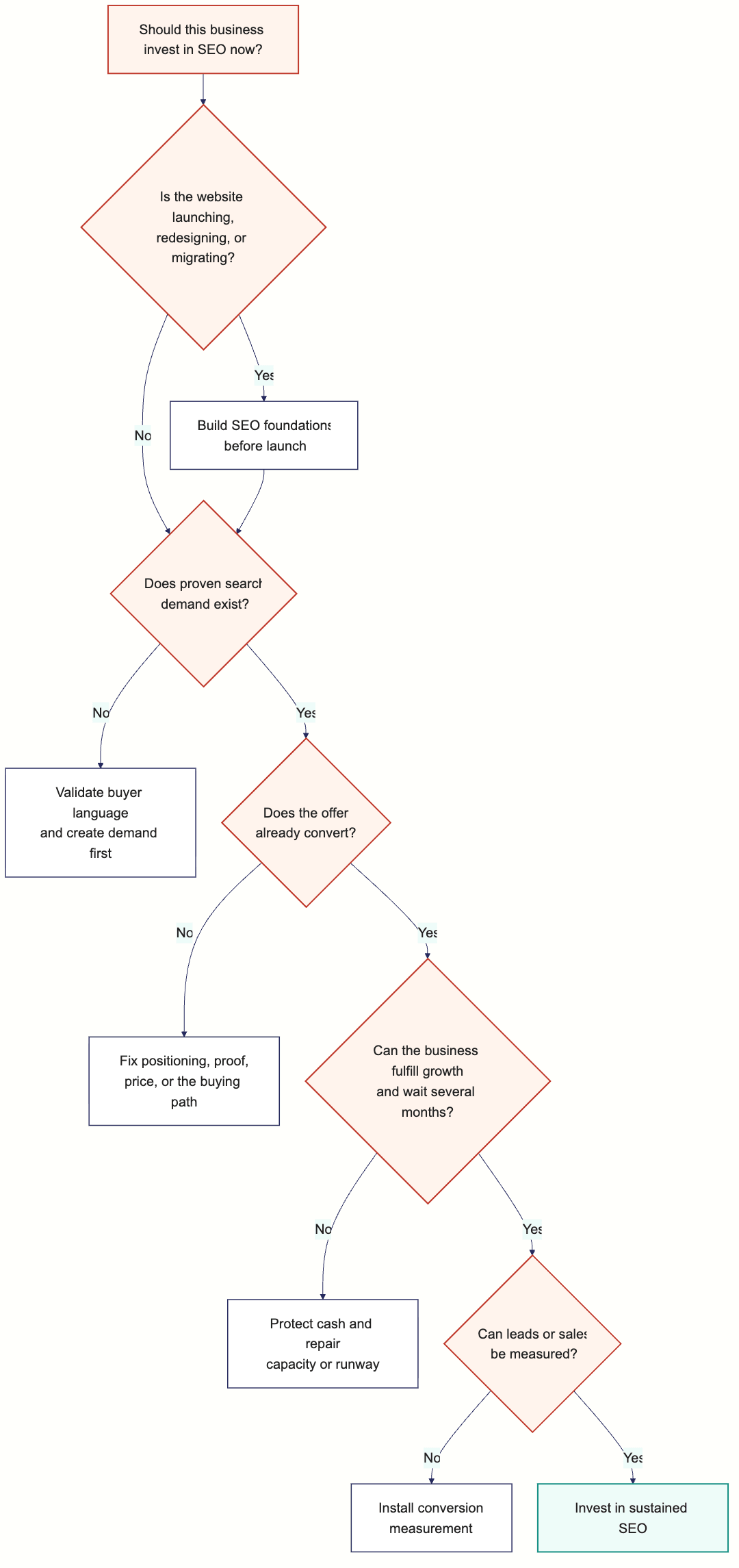
The math is simple once you know your numbers. A plumber who nets $180 per job needs about 8 extra jobs a month to cover a $1,400 retainer. A SaaS with a $600 annual plan needs 3 new signups. A consultant billing $5,000 projects needs 1 every 3 months. If you can’t name the number of sales that pays for the expert, you’re not ready to hire one.
Price it before you buy it.
What SEO Experts Cost
Ahrefs surveyed 439 SEO providers and the spread is wide enough to confuse anyone. The average hourly rate came out at $111, but freelancers averaged about $72 an hour, agencies about $99, and consultants about $171. Monthly retainers followed the same shape: freelancers near $1,350, agencies and consultants a little over $3,200. Nearly 4 in 5 providers bill on a retainer, and the single most common band was $501 to $1,000 a month.
| Route | Typical monthly cost | What you get | What you give up |
|---|---|---|---|
| Freelancer | $500 to $1,500 | 1 person’s full attention on a focused scope | Breadth. 1 freelancer rarely covers content, links, and technical equally |
| Consultant | $2,500 to $4,000, or hourly | Strategy and audits you implement yourself | Execution. You still need hands to do the work |
| Agency | $2,000 to $5,000 and up | A team across content, links, and technical | Attention. Small accounts get junior staff |
| Doing it yourself | Tools and your evenings | Full control and the learning | Speed. Expect 6 to 12 months to reach what a pro does in 3 |
Cheap isn’t the risk here. Vague is. A $700 retainer with a written scope beats a $3,000 one that promises “ongoing optimization.”
If you’re choosing between a solo operator and a firm, my guide to what to look for in an SEO freelancer covers the questions that separate the good ones, and the signs it’s time to hire an SEO company covers the moment a freelancer stops being enough.
The First 90 Days
You can judge an SEO expert by what they do before any ranking moves, because rankings lag the work by months. A good engagement has a visible shape in the first quarter.
Month 1 is diagnosis. Crawl the site, read Search Console, map what you sell to what people search, and hand you a short list of fixes ranked by effect. If the audit arrives as a 60-page PDF of automated warnings, that’s a tool’s output, not a person’s judgment.
Month 2 is repair. Technical fixes ship, the money pages get rewritten around the queries people type, and the content plan names specific articles with specific target searches. You should be able to read that plan and recognize your customers in it.
Month 3 is the first signal. Impressions rise in Search Console before clicks do. Pages that were on page 3 move to page 2. Nobody celebrates yet, but the direction is visible and the expert can explain which change caused which movement.
No visible shape by day 90 means no shape at all.
Ask for Search Console access on day 1, in your own Google account. The data belongs to you, and an expert who resists sharing it is telling you something.
Red Flags
Bad SEO is more expensive than no SEO, because the cleanup costs money and the penalty costs months. Most of the damage comes from a handful of patterns you can spot in the first conversation.
- Guaranteed rankings. Nobody controls Google’s results. A guarantee means either a meaningless keyword or a link scheme.
- Links sold by the hundred. Cheap link packages are the fastest route to a manual action, and the cleanup is slower than the build.
- No questions about your customers. An expert who doesn’t ask who buys from you and why can’t choose the right queries.
- Reports without decisions. A monthly PDF of positions, with no “so next month we’ll…” attached, is billing, not strategy.
- Ownership games. Content, accounts, and domains stay in your name. Always.
The link trap catches the most people because it works briefly. I’ve written about the hidden cost of DIY link building, and the cost of bought links is the same problem with a bigger invoice.
Doing It Yourself
You can run your own SEO. Plenty of small sites do, and for a business with 1 location and 5 services, the whole job is smaller than it looks. The basics are free to learn, and my getting started guide to SEO covers the parts that matter in the first year.
What you’ll spend instead of money is attention. Keyword research takes an afternoon once you have a tool like Semrush, but interpreting the results takes practice. Writing a page that ranks takes longer than writing a page. And links don’t arrive because you asked nicely once.
The trade is clear. Do it yourself when your time is cheaper than $1,000 a month and you’ll stick with it for a year. Hire when your time is worth more than the retainer, or when you’ve tried for 6 months and the needle hasn’t moved.
The Limits
An SEO expert can’t fix a weak offer, because search brings people who are comparing, and a worse deal loses the comparison. They can’t make a slow, confusing site convert, though they’ll tell you it’s the bottleneck. And they can’t make a brand-new domain outrank 10-year-old competitors in 3 months. Authority is built, not bought.
They also can’t promise where AI search lands. Assistants now answer many questions without a click, and the share varies by topic. A good expert will tell you which of your queries are exposed to that and which still send traffic. Anyone who claims certainty about it is guessing.
What Quietly Ruins It
Changing the scope every month. Each pivot resets the compounding, so a year of redirected effort produces 3 months of result.
Judging by rankings instead of revenue. Position 3 for a query nobody buys from is a vanity number, and chasing it spends the budget on the wrong pages.
Leaving the implementation to nobody. The expert recommends, your developer is busy, and 4 months later the fixes are still in a spreadsheet. Decide who ships the work before you sign.
Quitting at month 4. That’s usually the month the first pages cross onto page 1, and the month most owners decide it isn’t working.
Ignoring the rest of the site. An expert fixes the 20 pages that matter. If the other 300 keep publishing thin content, the average drags everything down.
FAQs on Hiring an SEO Expert
Impressions usually move within 60 to 90 days and meaningful traffic within 4 to 6 months on an established site. A new domain takes longer. Judge the first quarter by the quality of the fixes and the plan, not by rankings.
A freelancer suits a focused scope and a budget under about $1,500 a month. An agency suits a business that needs content, links, and technical work running at once and can fund $2,000 a month or more. Either way, insist on a written scope and your own access to the data.
Ask which queries they’d target first and why, what they’d fix in the first 30 days, how they build links, who owns the content and accounts, and how they’ll report progress against sales rather than positions. Vague answers to any of those are the answer.
Final Remarks
The benefit of working with an SEO expert isn’t rankings. It’s the months you don’t lose learning which 5 things matter on your site, and the mistakes you don’t make while learning them. That’s worth a retainer to a business that already works, and worth nothing to one that doesn’t yet.
Fix the offer, fix the site, then buy the speed.
Tell Google you want more of this.
Add Gaurav Tiwari as a preferred sourceOne tap, and this site shows up more often in your own Top Stories, AI Overviews and AI Mode. Remove it any time.
Disclaimer: This site is reader-supported. If you buy through some links, I may earn a small commission at no extra cost to you. I only recommend tools I trust and would use myself. Your support helps keep gauravtiwari.org free and focused on real-world advice. Thanks. - Gaurav Tiwari