
The Mathematics of Risk Assessment
Every decision involves risk. Hiring someone, launching a product, investing money, choosing a supplier – each carries uncertainty about outcomes. Most people manage this risk intuitively, based on gut feeling and experience. That works until it doesn’t.
Mathematics offers better tools. Probability theory, expected value calculations, variance analysis, and simulation methods let you quantify risk, compare options objectively, and make decisions that optimize for outcomes you actually want.
This article covers the mathematical frameworks for assessing risk. Not academic theory for its own sake, but practical tools you can apply to business and life decisions.
The Foundation: Probability
Risk assessment starts with probability—the mathematical measure of uncertainty. A probability is a number between 0 and 1, where 0 means impossible and 1 means certain. It can also be represented as percentage and fractional values.
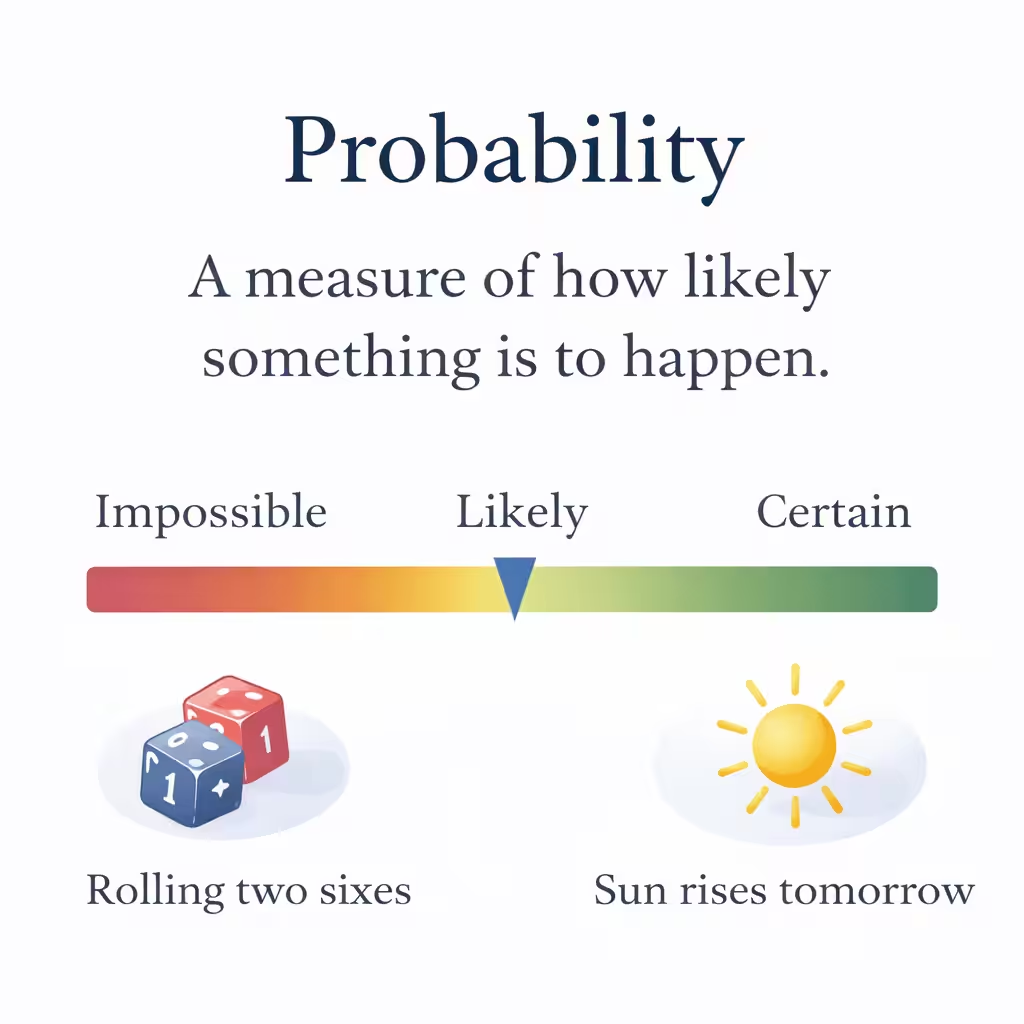
For any event \(A\), we write its probability as \(P(A)\). If you flip a fair coin, \(P(\text{heads}) = 0.5\). If you roll a fair die, \(P(\text{six}) = \frac{1}{6} \approx 0.167\) or 16.7% or just \(\frac{1}{6}\).
Combining Probabilities
When events are independent (one doesn’t affect the other), multiply probabilities:
$$P(A \text{ and } B) = P(A) \times P(B)$$
A 90% reliable system with a 90% reliable backup has:
$$P(\text{both fail}) = 0.1 \times 0.1 = 0.01 = 1\%$$
When events are mutually exclusive (can’t both happen), add probabilities:
$$P(A \text{ or } B) = P(A) + P(B)$$
The probability of rolling a 1 or a 6 on a die:
$$P(\text{1 or 6}) = \frac{1}{6} + \frac{1}{6} = \frac{2}{6} = \frac{1}{3}$$
Complementary Probability
The probability of something not happening is 1 minus the probability it happens:
$$P(\text{not } A) = 1 – P(A)$$
This is often easier to calculate. If there’s a 15% chance of rain, there’s an 85% chance of no rain.
The Problem of Small Probabilities Over Time
A 1% daily failure risk seems small. But over a year?
$$P(\text{at least one failure in 365 days}) = 1 – (0.99)^{365} \approx 0.9747 = 97.47\%$$
That’s why “rare” problems become near-certain over long periods. Small probabilities compound.
Expected Value: The Average Outcome

Expected value (EV) is the probability-weighted average of all possible outcomes. It tells you what you’d get on average if you repeated a decision many times.
For a discrete set of outcomes with values \(x_1, x_2, …, x_n\) and probabilities \(p_1, p_2, …, p_n\):
$$E[X] = \sum_{i=1}^{n} p_i \cdot x_i = p_1 x_1 + p_2 x_2 + … + p_n x_n$$
Example: Should You Take This Project?
You’re bidding on a project. Winning the bid costs time and resources worth 5,000 dollars regardless of outcome. If you win (40% chance), you’ll profit 30,000. dollars. If you lose (60% chance), you lose the 5,000 dollars bid cost.
$$E[\text{bidding}] = 0.4 \times \$30{,}000 + 0.6 \times (-\$5{,}000)$$ $$E[\text{bidding}] = \$12{,}000 – \$3{,}000 = \$9{,}000$$
The expected value is positive (9,000 dollars), so mathematically you should bid. Over many similar opportunities, you’d average 9,000 dollars per bid.
Example: Insurance Pricing
Insurance companies use expected value to set premiums. Suppose a 500,000 dollar policy covers an event with 0.2% annual probability:
$$E[\text{payout}] = 0.002 \times \$500{,}000 = \$1{,}000$$
The actuarially fair premium is 1,000 dollars/year. The company charges more (say $1,500) to cover overhead and profit. You pay the premium because you’re transferring risk, not because it’s a good bet mathematically.
The Limitation of Expected Value
Expected value treats all outcomes as equally acceptable as long as the average is good. But losing $1 million once hurts more than winning $10,000 one hundred times helps you.
Consider two games:
- Game A: 100% chance of winning $100,000
- Game B: 10% chance of winning $1,000,000, 90% chance of $0
Both have E = $100,000. But most people prefer Game A. You can’t pay rent with expected value.
This leads us to variance.
Variance and Standard Deviation: Measuring Spread
Variance measures how spread out outcomes are around the expected value. Standard deviation is its square root.
$$\text{Var}(X) = E[(X – \mu)^2] = \sum_{i=1}^{n} p_i (x_i – \mu)^2$$
where \(\mu = E[X]\) is the expected value.
$$\text{StdDev}(X) = \sigma = \sqrt{\text{Var}(X)}$$
Comparing Investments
Consider two investments, each requiring $10,000:
Investment A:
- 50% chance: returns $12,000 (+$2,000)
- 50% chance: returns $8,000 (-$2,000)
Investment B:
- 50% chance: returns $20,000 (+$10,000)
- 50% chance: returns $0 (-$10,000)
Both have \(E = \$10{,}000\) (break even on average). But:
For Investment A: $$\sigma_A = \sqrt{0.5 \times (2{,}000)^2 + 0.5 \times (-2{,}000)^2} = \$2{,}000$$
For Investment B: $$\sigma_B = \sqrt{0.5 \times (10{,}000)^2 + 0.5 \times (-10{,}000)^2} = \$10{,}000$$
Investment B has 5× higher standard deviation. Same expected return, five times the risk. Unless you specifically need the possibility of high returns, Investment A is better.
The Coefficient of Variation
To compare risk across different scales, use the coefficient of variation:
$$CV = \frac{\sigma}{\mu}$$
This expresses risk relative to expected return. A 1,000 dollar standard deviation matters more for a 5,000 dollar expected value (CV = 0.2) than for a 100,000 dollar expected value → CV = 0.01.
Risk-Adjusted Return: Sharpe Ratio
The Sharpe ratio measures return per unit of risk:
$$\text{Sharpe Ratio} = \frac{R_p – R_f}{\sigma_p}$$
where:
- \(R_p\) = expected return of the portfolio/investment
- \(R_f\) = risk-free rate (e.g., government bond yield)
- \(\sigma_p\) = standard deviation of returns
Higher Sharpe ratios are better. You’re getting more return for each unit of risk taken.
Example
Investment with 12% expected return, 15% standard deviation, risk-free rate 3%:
$$\text{Sharpe} = \frac{0.12 – 0.03}{0.15} = 0.6$$
Another investment with 18% expected return, 30% standard deviation:
$$\text{Sharpe} = \frac{0.18 – 0.03}{0.30} = 0.5$$
Despite higher expected return, the second investment has lower risk-adjusted return. You’re taking proportionally more risk for the extra gain.
Value at Risk (VaR): Quantifying Downside
Value at Risk answers: “What’s the maximum I can lose with X% confidence?”
If a portfolio has a 95% VaR of $50,000, that means there’s a 5% chance of losing more than $50,000.
For normally distributed returns with mean \(\mu\) and standard deviation \(\sigma\):
$$\text{VaR}{\alpha} = \mu + z{\alpha} \cdot \sigma$$
where \(z_{\alpha}\) is the z-score for confidence level \(\alpha\). For 95% confidence, \(z_{0.05} \approx -1.645\).
Example
A portfolio has daily expected return of 0.04% and daily standard deviation of 1.2%. For a $1,000,000 portfolio, the 95% daily VaR:
$$\text{VaR}{95\%} = 1{,}000{,}000 \times (0.0004 + (-1.645) \times 0.012)$$
$$\text{VaR}{95\%} = 1{,}000{,}000 \times (-0.0193) = -\$19{,}340$$
With 95% confidence, daily losses won’t exceed $19,340. But 5% of the time, they will exceed that.
Limitations of VaR
VaR tells you the threshold but not how bad things can get beyond it. A portfolio might have 95% VaR of $50,000, but the worst 5% of outcomes might average $200,000 in losses or $2,000,000.
Expected Shortfall (ES), also called Conditional VaR, addresses this by averaging the losses beyond VaR:
$$ES{\alpha} = E[L | L > \text{VaR}{\alpha}]$$
This provides more complete risk information.
The Kelly Criterion: Optimal Bet Sizing
The Kelly Criterion tells you what fraction of your capital to risk on a favorable bet to maximize long-term growth.
For a simple bet with win probability \(p\), loss probability \(q = 1-p\), and odds \(b\) (win \(b\) for every 1 risked):
$$f^* = \frac{bp – q}{b} = \frac{p(b+1) – 1}{b}$$
where \(f^*\) is the optimal fraction of capital to bet.
Example: A Favorable Coin Flip
You can bet on a biased coin: 60% heads, 40% tails. Heads pays 1:1 (double your bet). What fraction to bet?
$$f^* = \frac{(1)(0.6) – 0.4}{1} = \frac{0.6 – 0.4}{1} = 0.2 = 20\%$$
Bet 20% of your bankroll each time to maximize long-term growth rate.
Why This Matters for Business
The Kelly Criterion applies beyond gambling:
Investing: How much of your portfolio in any single stock?
Business ventures: How much capital to allocate to a new product line?
Hiring: How aggressively to hire for an uncertain market expansion?
The key insight: even with positive expected value, betting too much is dangerous. Over-betting leads to ruin even with favorable odds.
Fractional Kelly
Most practitioners use “fractional Kelly”—betting some percentage of the Kelly amount (e.g., half-Kelly = 10% in the example above). This reduces variance and risk of ruin at the cost of somewhat lower expected growth.
Bayesian Updating: Revising Probabilities with Evidence
Often you don’t know true probabilities. Bayes’ Theorem lets you update estimates as you gather evidence.
$$P(H|E) = \frac{P(E|H) \cdot P(H)}{P(E)}$$
where:
- \(P(H|E)\) = posterior probability of hypothesis given evidence
- \(P(E|H)\) = likelihood of evidence given hypothesis
- \(P(H)\) = prior probability of hypothesis
- \(P(E)\) = probability of evidence (normalizing constant)
Example: Is This Employee a Good Hire?
You estimate a 70% prior probability that a new hire is a “good performer.” After one month, their output is below average—something that happens with 20% of good performers but 80% of poor performers.
Let \(G\) = good performer, \(B\) = below average first month.
$$P(G|B) = \frac{P(B|G) \cdot P(G)}{P(B)}$$
$$P(B) = P(B|G)P(G) + P(B|\text{not }G)P(\text{not }G)$$ $$P(B) = (0.20)(0.70) + (0.80)(0.30) = 0.14 + 0.24 = 0.38$$
$$P(G|B) = \frac{(0.20)(0.70)}{0.38} = \frac{0.14}{0.38} \approx 0.368$$
Your estimate drops from 70% to about 37%. One data point significantly shifts probability when it’s diagnostic.
The Base Rate Fallacy
Bayes’ Theorem highlights why base rates matter. A 99% accurate test still produces many false positives if the condition is rare.
If a disease affects 0.1% of the population and a test is 99% accurate (99% true positives, 99% true negatives):
$$P(\text{disease}|\text{positive}) = \frac{(0.99)(0.001)}{(0.99)(0.001) + (0.01)(0.999)}$$
$$P(\text{disease}|\text{positive}) = \frac{0.00099}{0.00099 + 0.00999} = \frac{0.00099}{0.01098} \approx 9\%$$
Even with a positive test, there’s only about 9% chance of having the disease. The rare base rate dominates.
Monte Carlo Simulation: When Math Gets Complex
For complicated scenarios with multiple variables and non-obvious distributions, Monte Carlo simulation uses random sampling to estimate outcomes.
The process:
- Define probability distributions for each uncertain variable
- Randomly sample from each distribution
- Calculate the outcome for that scenario
- Repeat thousands of times
- Analyze the distribution of outcomes
Example: Project Cost Estimation
A construction project has uncertain costs:
- Materials: $80,000-$120,000 (uniform distribution)
- Labor: mean $150,000, std dev $20,000 (normal distribution)
- Permits: 80% chance of $10,000, 20% chance of $25,000
Running 10,000 simulations might produce:
| Percentile | Total Cost |
|---|---|
| 5th | $242,000 |
| 25th | $258,000 |
| 50th (median) | $272,000 |
| 75th | $287,000 |
| 95th | $310,000 |
You now know: 90% confidence interval is $242,000-$310,000. Budget $285,000 for 75% confidence, $310,000 for 95%.
When to Use Monte Carlo
Monte Carlo becomes valuable when:
- Multiple sources of uncertainty interact
- Distributions are complex (not normal)
- Dependencies exist between variables
- Analytical solutions are intractable
Spreadsheets like Excel can run simple Monte Carlo simulations. More complex scenarios use Python, R, or specialized tools.
Risk Matrices: Qualitative Framework
Not all risks have numerical data. Risk matrices combine likelihood and impact qualitatively.
A typical 5×5 matrix:
| MATRIX | Negligible | Minor | Moderate | Major | Severe |
|---|---|---|---|---|---|
| Almost Certain | Medium | High | High | Extreme | Extreme |
| Likely | Medium | Medium | High | High | Extreme |
| Possible | Low | Medium | Medium | High | High |
| Unlikely | Low | Low | Medium | Medium | High |
| Rare | Low | Low | Low | Medium | Medium |
Risks in “Extreme” cells need immediate mitigation. “High” risks need management plans. “Low” risks can be accepted or monitored.
Quantifying the Matrix
You can add numbers to make the matrix more useful:
Probability scale:
- Almost Certain: >90%
- Likely: 50-90%
- Possible: 10-50%
- Unlikely: 1-10%
- Rare: <1%
Impact scale (example: revenue impact):
- Negligible: <$1,000
- Minor: $1,000-$10,000
- Moderate: $10,000-$100,000
- Major: $100,000-$1,000,000
- Severe: >$1,000,000
Risk score: Multiply probability midpoint by impact midpoint for rough expected loss.
Applying Risk Math to Decisions
Decision Trees
For sequential decisions with uncertainty, decision trees map out paths and calculate expected values.
Example: Product Launch Decision
Launch options:
- Full launch: costs $500,000
- 60% probability: success, revenue $2,000,000
- 40% probability: failure, revenue $200,000
- Limited launch: costs $100,000
- 70% probability: success, revenue $400,000
- 30% probability: failure, revenue $50,000
- No launch: $0 cost, $0 revenue
Expected value calculations:
Full launch: $$E = 0.6 \times (\$2{,}000{,}000 – \$500{,}000) + 0.4 \times (\$200{,}000 – \$500{,}000)$$ $$E = 0.6 \times \$1{,}500{,}000 + 0.4 \times (-\$300{,}000) = \$900{,}000 – \$120{,}000 = \$780{,}000$$
Limited launch: $$E = 0.7 \times (\$400{,}000 – \$100{,}000) + 0.3 \times (\$50{,}000 – \$100{,}000)$$ $$E = 0.7 \times \$300{,}000 + 0.3 \times (-\$50{,}000) = \$210{,}000 – \$15{,}000 = \$195{,}000$$
Full launch has higher expected value ($780,000 vs $195,000), but also higher variance and potential for significant loss. The choice depends on your risk tolerance.
Expected Utility Theory
People don’t value money linearly. Losing $100,000 hurts more than gaining $100,000 helps. Expected utility theory models this with a utility function.
A common form is logarithmic utility: $$U(W) = \ln(W)$$
where \(W\) is wealth.
Example with logarithmic utility:
Current wealth: $1,000,000 Gamble: 50% chance to win $500,000, 50% chance to lose $500,000
Expected value: $$E[\text{wealth}] = 0.5 \times \$1{,}500{,}000 + 0.5 \times \$500{,}000 = \$1{,}000{,}000$$
Zero expected change in wealth. But expected utility:
$$E[U] = 0.5 \times \ln(1{,}500{,}000) + 0.5 \times \ln(500{,}000)$$ $$E[U] = 0.5 \times 14.22 + 0.5 \times 13.12 = 13.67$$
Current utility: \(\ln(1{,}000{,}000) = 13.82\)
Expected utility of the gamble (13.67) is lower than current utility (13.82). A risk-averse agent should refuse, even though expected value is neutral.
Common Risk Assessment Errors
Ignoring Correlation
Risks that seem independent often aren’t. In 2008, housing markets across the US declined simultaneously, not independently as models assumed. Correlated risks multiply rather than diversify.
If events \(A\) and \(B\) are positively correlated: $$P(A \text{ and } B) > P(A) \times P(B)$$
Models using independence assumptions underestimate joint probability of bad outcomes.
Confusing Low Probability with Zero Probability
A 0.1% annual risk seems negligible. Over 30 years: $$P(\text{at least once}) = 1 – (0.999)^{30} \approx 3\%$$
Still sounds small. But 3% is one in 33. That’s not a freak occurrence.
Overfitting to Recent Data
If the last 20 years were calm, risk models calibrated to that period underestimate true risk. The absence of past crises doesn’t mean crises can’t happen. Fat-tailed distributions mean extreme events are more likely than normal distributions suggest.
Neglecting Tail Risk
Normal distributions underestimate extreme events. Many real phenomena have fat tails—extreme events are more common than Gaussian models predict.
The 2008 financial crisis was a “25-sigma event” by normal distribution standards—literally should never happen in the universe’s history. It happened because returns aren’t normally distributed.
Use t-distributions or explicit tail modeling for phenomena where extremes matter.
Anchoring on Single Point Estimates
Saying “the project will cost $500,000” ignores uncertainty. Saying “the project will cost $400,000 to $600,000 with 80% confidence, with 10% chance of exceeding $750,000” communicates risk properly.
Always present ranges, not single numbers, for uncertain quantities.
Building Your Risk Assessment Practice
Start simple and add sophistication as needed.
Level 1: Basic Expected Value
For any decision, list outcomes, estimate probabilities, calculate expected value:
$$E = \sum p_i \times \text{outcome}_i$$
This beats pure intuition and catches obviously bad decisions.
Level 2: Include Variance
Add standard deviation or range to expected value. Compare options on risk-adjusted basis. Implement rough Sharpe-ratio thinking: how much return per unit of risk?
Level 3: Formal Probability Updates
Track predictions. When new information arrives, use Bayes’ Theorem to update. Keep a record of your probability estimates and calibrate over time.
Level 4: Monte Carlo Simulation
For complex projects or investments, build spreadsheet models with probability distributions. Run simulations to understand range of outcomes. Use percentiles, not averages, for planning.
Level 5: Full Risk Management Framework
Implement risk matrices for qualitative risks. Calculate VaR for financial positions. Apply Kelly Criterion for position sizing. Model correlations between risks.
Most business decisions only need Level 1 or 2. But knowing the full toolkit lets you apply the right tool to each situation.
The Limits of Risk Mathematics
Mathematics helps you think clearly about risk. It doesn’t eliminate uncertainty. Models are simplifications of reality with assumptions that may not hold.
Common limitations:
- Unknown unknowns. You can’t assign probabilities to risks you haven’t imagined.
- Model error. The mathematical structure might not match reality.
- Parameter error. Even with the right model, estimated probabilities might be wrong.
- Human error. People misapply frameworks, ignore uncomfortable results, and overweight recent experience.
Use mathematical risk assessment as one input, not the final word. Combine it with qualitative judgment, scenario planning, and humility about what you don’t know.
The goal isn’t perfect prediction. It’s better decisions than you’d make without the math. On that criterion, risk mathematics delivers.
FAQs
What’s the difference between risk and uncertainty?
Risk involves known probabilities: you know there’s a 20% chance of rain. Uncertainty involves unknown probabilities: you don’t know the chance of a new technology succeeding. Most real decisions involve both. Mathematical risk assessment works best with risk (known distributions) but can structure thinking about uncertainty too. Use wider probability ranges and scenario analysis when facing genuine uncertainty rather than quantifiable risk.
How do I estimate probabilities when I have no data?
Start with reference classes: find similar situations with known outcomes. If you’re launching a restaurant, look at restaurant failure rates. Use expert judgment, but calibrate it: track predictions and see how accurate your estimates are over time. Assign wide probability ranges initially (e.g., 10-40% rather than exactly 25%). Update as evidence arrives using Bayesian thinking. Imperfect probability estimates still beat ignoring probabilities entirely.
Should I always maximize expected value?
Not always. Expected value assumes you can survive all possible outcomes. If one outcome would bankrupt you, it doesn’t matter that the average is good. For one-time decisions with potentially catastrophic downsides, consider expected utility (which accounts for risk aversion) or explicitly protect against ruin. For repeated small decisions where you can absorb losses, expected value optimization works well. Size of risk relative to your resources matters.
What is a fat-tailed distribution and why does it matter?
Fat-tailed distributions have more extreme events than normal (Gaussian) distributions predict. In a normal distribution, events beyond 5 standard deviations are essentially impossible. In fat-tailed distributions (like financial returns), such extremes occur regularly. This matters because risk models using normal distributions dramatically underestimate the probability of crashes, catastrophes, and outlier events. Use t-distributions or explicit tail modeling for phenomena where Black Swan events are possible.
How is the Kelly Criterion used in business?
The Kelly Criterion helps size investments and resource allocations. For venture investments, it suggests what fraction of your portfolio to commit to a single opportunity. For new product development, it guides how much capital to risk on uncertain launches. The core insight: even with positive expected value, over-betting leads to ruin. Most practitioners use fractional Kelly (betting half or less of the calculated amount) to reduce variance and account for estimation errors.
What’s the simplest useful risk calculation?
Expected value: list possible outcomes, estimate their probabilities, multiply each outcome by its probability, and sum the results. E = Σ(probability × outcome). This takes minutes and immediately reveals whether an opportunity is positive or negative on average. For decisions with two or three outcomes, you can do this in your head. It’s the minimum viable risk assessment and provides most of the value for everyday decisions.
When should I use Monte Carlo simulation?
Use Monte Carlo when: multiple uncertain variables interact (project with uncertain costs, timeline, AND revenue); distributions are non-normal or complex; you need percentile estimates rather than just averages; or analytical calculation is too complex. Spreadsheets can handle simple simulations with a few variables. More complex scenarios need Python, R, or specialized software. Monte Carlo is overkill for simple decisions but valuable for major capital allocation or project planning.
How do I account for correlated risks?
When risks are correlated, you can’t just multiply individual probabilities. The joint probability P(A and B) equals P(A) × P(B) only for independent events. For correlated events, use correlation coefficients in your models, or explicitly model the joint distribution. In Monte Carlo simulation, sample from multivariate distributions with specified correlations. Most importantly, ask: ‘What could cause multiple things to go wrong simultaneously?’ Those scenarios often matter more than individual risks.
Is VaR (Value at Risk) useful for small businesses?
VaR is primarily used in financial institutions for trading portfolios. For small businesses, simpler concepts usually suffice: ‘What’s our worst-case monthly loss?’ or ‘How much cash reserve do we need to survive 3 bad months?’ The VaR framework can structure this thinking: define a confidence level (95%), time horizon (monthly), and estimate the loss threshold. But formal VaR calculation requires reliable return distributions that most small businesses don’t have.
How do I get better at estimating probabilities?
Practice and track results. Write down probability estimates for predictions (e.g., ‘70% chance this project finishes on time’), then review accuracy later. Over time, you learn whether your ‘70% confident’ predictions come true about 70% of the time. Use reference classes: look at base rates for similar situations. Decompose complex judgments into simpler ones. Avoid round numbers (50%, 90%) which are often default guesses rather than calibrated estimates. Calibration training significantly improves probability estimation.