
 by
by
A gaming blog in 2026 is still one of the cheapest businesses you can start. Under $60 to launch, a niche you already spend hours inside, and an audience that reads 2,000-word guides on builds, mods, and patch notes without complaining about length. The catch: most new gaming blogs die inside six months because the founder picked a niche too broad, bought the wrong host, and published opinion takes instead of searchable guides.
This is the step-by-step I’d give a friend starting today. Pre-launch niche work, domain and hosting, WordPress setup, a 90-day content plan, the capture tools you actually need, and the monetization paths that pay before ad revenue shows up. No fluff, no “follow your passion,” and no $299 hosting recommendations when $2.99 does the job for the first year.
Why a Gaming Blog Still Works in 2026 (and Who Shouldn’t Start One)
A gaming blog still works in 2026 because game search traffic is sticky, recurring, and under-served by AI content. Every new patch, season, boss, mod, or DLC generates thousands of fresh queries the day it ships. Google and AI search engines both reward first-hand playthroughs because the generic “top 10 tips” pages get outdated within a week of a balance update.
The number everyone quotes is 3.2 billion active gamers worldwide. That’s not the useful number. The useful number is this: a mid-sized guide blog in a single franchise (think Elden Ring, Helldivers 2, EA FC, or Path of Exile 2) can pull 200,000 to 500,000 monthly pageviews within 18 months if the founder publishes two guides a week and never skips a patch. I’ve watched that exact pattern play out on at least a dozen sites since 2018.
Who shouldn’t start one? Anyone who wants to write “industry takes” instead of specific guides. Anyone who hates playing the same game for 200 hours. And anyone expecting AdSense money inside 90 days. Gaming RPMs on display ads run $3 to $8 in 2026, which means the first dollar rarely arrives before month six. If that timeline breaks you, pick YouTube or Twitch instead. The written gaming blog is a compounding play, not a cash-flow play.
Pick a Gaming Niche That Isn’t Saturated
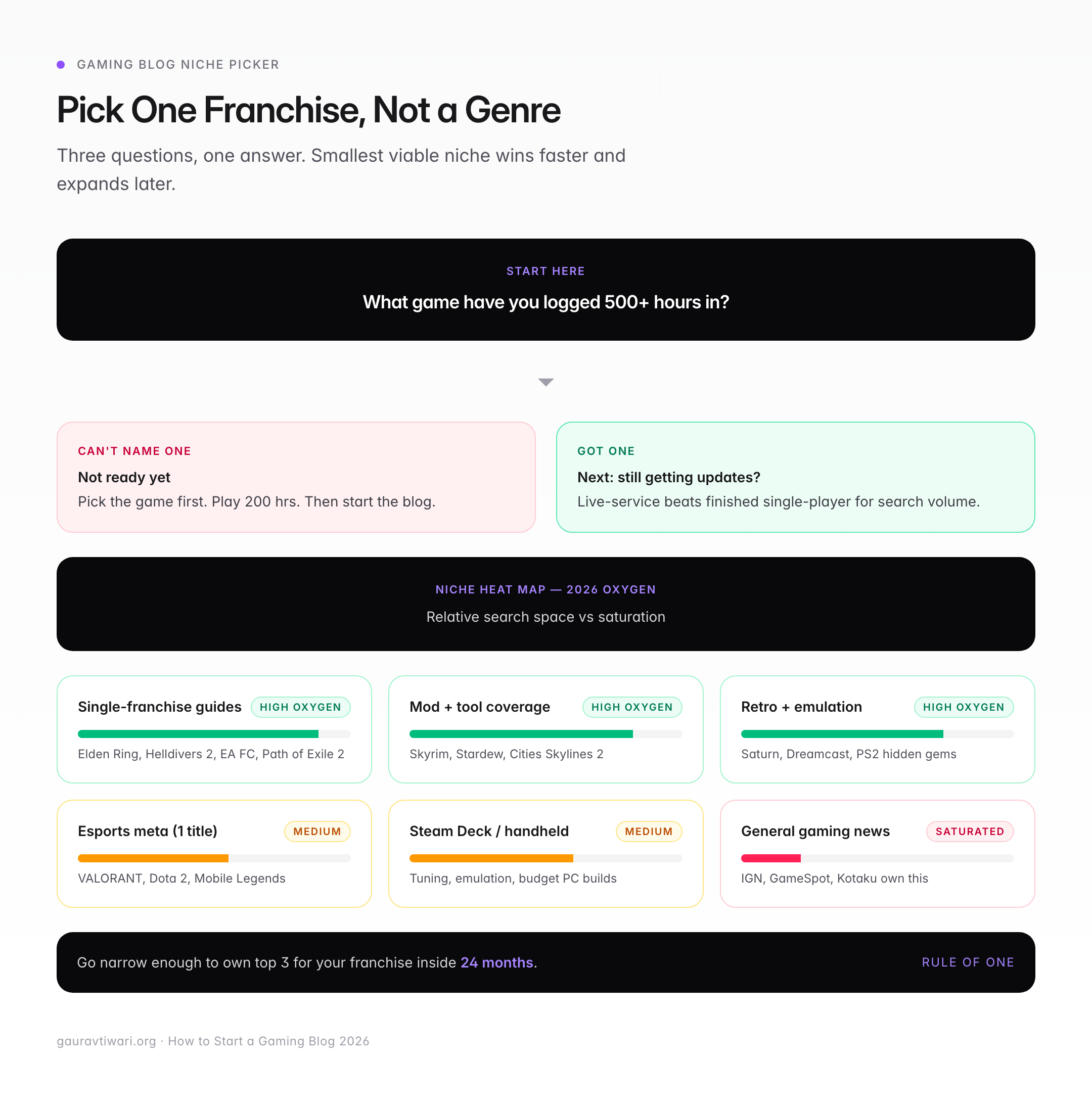
The answer to niche selection is to pick one franchise or one format, not one genre. “FPS blog” is dead on arrival in 2026. “Helldivers 2 builds and loadouts” is a business. The smaller you go at launch, the faster you build authority, and the easier it gets to expand later once Google trusts the domain.
Here’s the gaming sub-niche decision I walk new bloggers through. Answer three questions honestly:
- What game have you logged 500+ hours in? If you can’t name one, you’re not ready. Pick the game before the blog.
- Is the game still getting content updates? Live-service titles (Fortnite, Marvel Rivals, Destiny 2, Warframe, Path of Exile 2) beat finished single-players for search volume because every update spawns new queries.
- Can you publish a new guide every 3-4 days for a year? If the answer is no, widen to two related games in the same genre rather than going broader.
Sub-niche formats that still have oxygen in 2026:
- Single-franchise guide sites (Elden Ring builds, Helldivers 2 loadouts, EA FC squads)
- Retro and emulation (specific consoles: Saturn, Dreamcast, PS2 hidden gems)
- Competitive/esports meta coverage for one title (VALORANT, Dota 2, Mobile Legends)
- Mod and tool coverage for moddable games (Skyrim, Stardew Valley, Minecraft, Cities Skylines 2)
- Indie game discovery curated by mood or mechanic, not genre
- Hardware-adjacent: Steam Deck tuning, handheld emulation, budget gaming PC builds under $800
Sub-niches I’d skip: “general gaming news” (IGN, GameSpot, Kotaku own this and you can’t out-publish them), “console wars commentary” (YouTube ate this), and “mobile gaming in general” (the Chinese and Korean publishers dominate their own SEO in-language). Go narrow enough that you can realistically own the top 3 for your franchise inside 24 months.
If you want the framework I use for picking any niche (gaming or otherwise), my profitable niche framework walks through keyword difficulty bands, monetization fit, and the five-year relevance test.
Domain and Hosting Setup
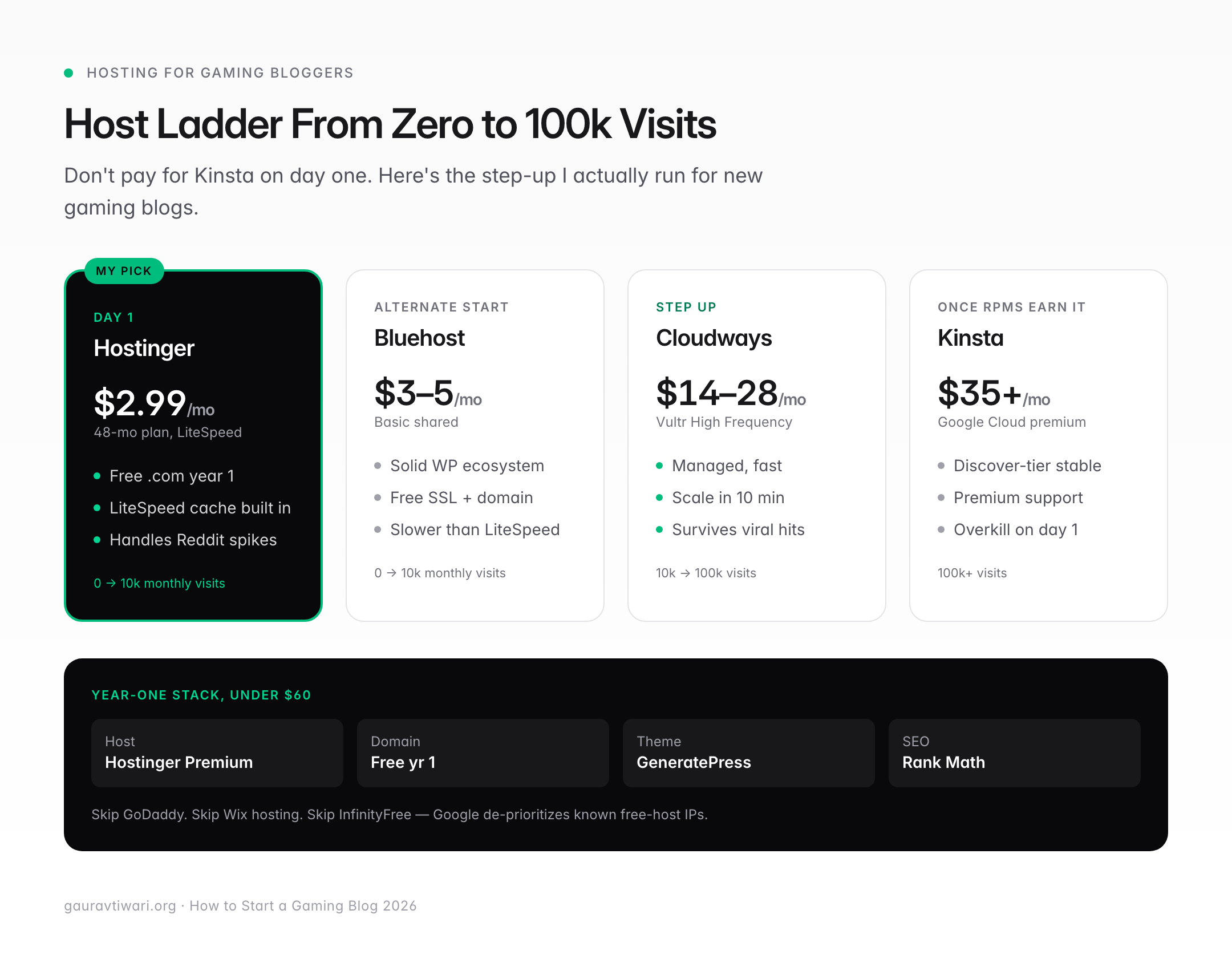
For a new gaming blog in 2026, Hostinger at roughly $2.99 per month on a 48-month plan is the right starting host. You get LiteSpeed servers, free SSL, a free .com for year one, and enough CPU headroom to handle a Reddit-front-page spike without falling over. That’s the whole setup for the first year under $60 including the domain.
Here’s the ladder I recommend, stage by stage:
- 0 to 10k monthly visits: Hostinger Premium or Bluehost Basic. Roughly $3-5/month. LiteSpeed cache handles the caching layer so you don’t need WP Rocket yet.
- 10k to 100k monthly visits: Cloudways on Vultr High Frequency ($14-28/month). Managed, fast, and you can scale the server up in 10 minutes when a guide hits Reddit.
- 100k+ monthly visits or Discover traffic: Kinsta ($35+/month). Worth the premium once ad RPMs justify it. Don’t jump here on day one.
On domains: pick a .com, keep it short (under 14 characters), and avoid the game name in the URL. If you put “eldenring” in your domain and later want to cover Elden Ring’s sequel or a different FromSoftware title, you’re stuck. “SoulsGuides.com” survives a franchise pivot. “EldenRingWiki.com” doesn’t.
Skip GoDaddy. Skip Wix hosting. And skip the “free hosting” InfinityFree tier, because Google crawlers de-prioritize known free-host IP ranges and your ranking ceiling caps at page three. I’ve watched three promising gaming blogs stall on free hosting in 2022-2023 alone.
WordPress Setup and Essential Plugins (Keep It Under Ten)
Install WordPress, pick GeneratePress or Kadence as your theme, and keep the plugin count under ten for the first year. Ghost is a cleaner alternative if you only want to write long-form posts and send a newsletter, but you lose the plugin ecosystem that makes a gaming blog scalable once you want tier lists, build calculators, or affiliate comparison tables.
The starter stack I install on every new gaming blog:
- Theme: GeneratePress (free) or Kadence (free). Both pass Core Web Vitals out of the box.
- Page builder (optional): GenerateBlocks. Skip Elementor and Divi. They add 300-500ms of bloat you’ll regret on mobile.
- SEO: Rank Math (free tier). Handles schema, sitemaps, redirections. Yoast’s free tier is weaker in 2026.
- Images: ShortPixel or Converter for Media. Auto-convert screenshots to WebP. Gaming blogs are image-heavy, this matters.
- Caching: LiteSpeed Cache (free) if you’re on Hostinger/LiteSpeed, otherwise WP Rocket ($59/year) at month six.
- Forms: Fluent Forms (free). For contact, guest pitches, and your email list signup.
- Analytics: Google Analytics 4 + Google Search Console. Both free. That’s the whole measurement stack for year one.
- Spam: Akismet or Cleantalk. Comment spam on gaming blogs gets ugly fast.
- Backup: UpdraftPlus (free) to Google Drive. Weekly auto-backup.
What I’d skip on day one: security plugins (Wordfence, iThemes Security), related posts plugins, social share plugins, and every “AI writer” plugin that’s appeared in the last 18 months. A properly configured host handles 90% of security, and Google doesn’t care about share counts.
Content Strategy: What to Publish in the First 90 Days
The first ninety days of a gaming blog should be 80% searchable guides and 20% news. Not opinion. Not editorials. Guides. Google needs to see you’re a guide site before it ranks you for competitive opinion pieces. I’ve seen new bloggers spend three months writing “Why Baldur’s Gate 3 changed RPGs forever” posts and then wonder why traffic sits at 40 visits a day. Wrong content type for a new domain.
Here’s the 90-day schedule that actually compounds:
Weeks 1-4: Pillar Guides
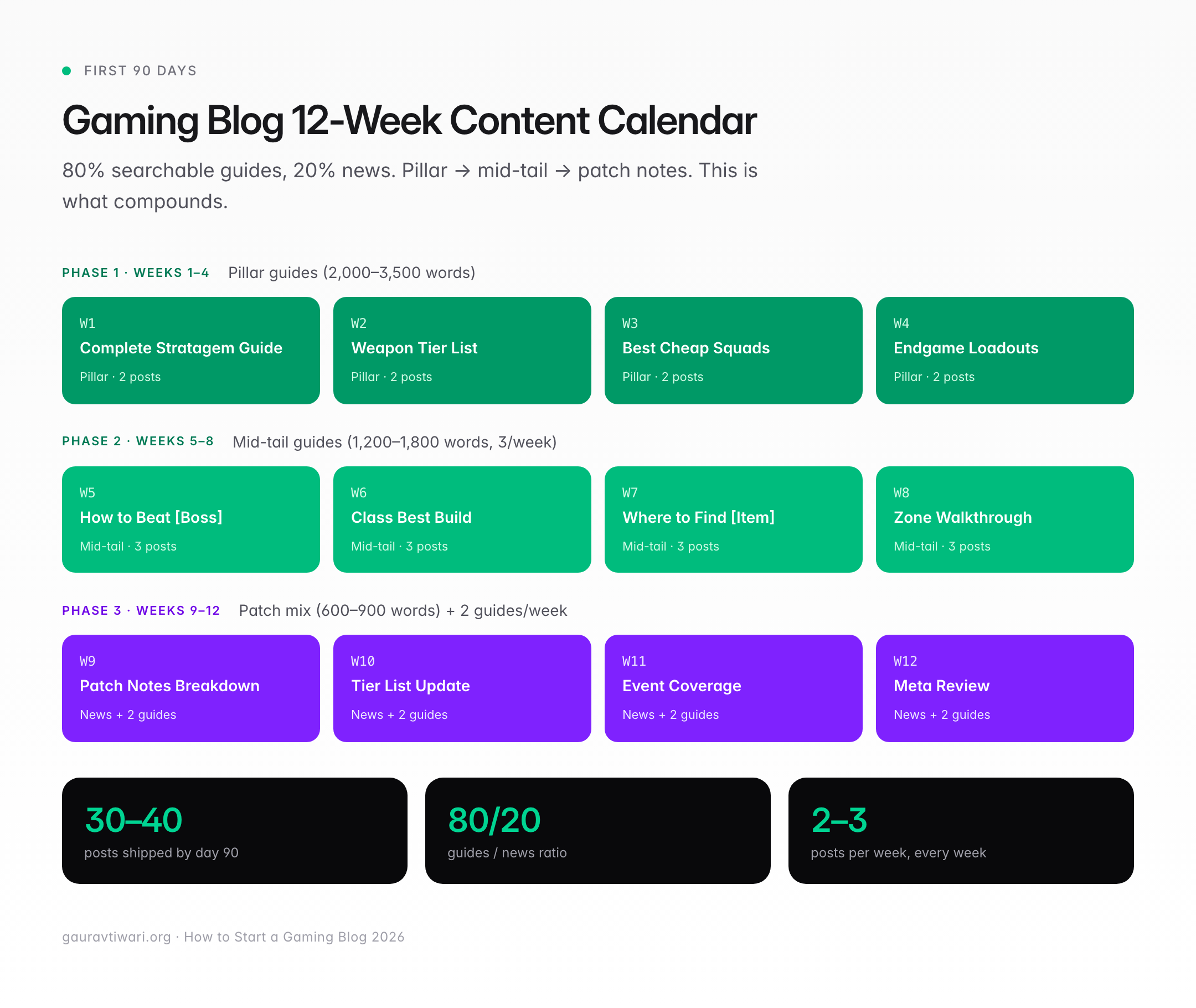
Publish eight long-form pillar guides of 2,000-3,500 words each. These are evergreen posts that will still pull traffic in year three. Examples: “Complete Helldivers 2 Stratagem Guide,” “Every Elden Ring Weapon Tier List,” “EA FC 26 Best Cheap Squads Under 100k Coins.” Pick the 8 queries nobody in your niche has covered well and own them.
Weeks 5-8: Mid-Tail Guides
Shift to 1,200-1,800 word guides answering specific questions: “How to Beat [Boss Name],” “[Class Name] Best Build for [Difficulty],” “Where to Find [Item] in [Zone].” Target 3 per week. These rank faster than pillars because competition is thinner, and they feed your pillars internal link juice.
Weeks 9-12: Patch and News Mix
Add patch-note breakdowns, tier list updates, and event coverage. These are short (600-900 words), fast to publish, and spike traffic hard on launch day. Mix them with 2 new guides per week. By day 90 you should have 30-40 published posts, most of them searchable, and at least one post starting to move into positions 20-50 in Google Search Console.
If you get stuck on what to write, blog post ideas that pull traffic has 25 formats that apply cleanly to gaming content.
Essential Tools for Gaming Bloggers
The gaming blogger tool stack is smaller than YouTubers think. You need four things: a way to capture screenshots, a way to capture gameplay clips, a way to make featured images, and an email collector. That’s it for year one.
- Screenshots and screen recording: OBS Studio and ShareX. Both free. OBS handles long capture, ShareX handles quick-grabs with annotations. Steam’s built-in F12 works for PC games. PlayStation and Xbox have native share buttons.
- Video clipping: CapCut (free) or DaVinci Resolve (free). You only need short clips embedded in guides, not feature films. Skip Premiere for year one.
- Featured images and tier lists: Canva Pro ($12.99/month). Templates for YouTube thumbnails double as blog featured images. TierMaker for actual tier list graphics.
- Email capture: ConvertKit or MailerLite. Free tiers on both. Start the list on day one, even if you have 4 subscribers. Gaming audiences convert well on “new guide alerts.”
- Keyword research: Google Search Console (free), Keywords Everywhere ($2.25/month), or Ahrefs Webmaster Tools (free for your own site). Don’t buy a $99/month Ahrefs subscription in month one.
On hardware: you don’t need a gaming laptop to run a gaming blog. You need a device that can run your games plus OBS simultaneously. If you already own a gaming PC or console, the blog adds zero hardware cost. If you’re buying fresh, prioritize RAM (32GB) and storage (1TB NVMe) over the GPU tier, because recording and editing eats memory harder than frame rate does.
Building the First 100 Readers
Your first 100 readers won’t come from Google. They’ll come from three places: game-specific subreddits, Discord servers, and strategic YouTube comments on videos ranking for your target queries. Don’t spam links. Answer questions in full, then mention you wrote a longer guide if the asker wants more.
This is the cold-start bridge, not a long-term growth plan. Once you’re publishing consistently, Google starts sending search traffic at around month four, and that’s when growth compounds. For the full playbook on promoting a gaming blog (YouTube integration, Twitch cross-promo, Reddit strategy, community building), read my separate piece on marketing a gaming blog. This guide stays focused on launch mechanics.
Monetization Paths That Work for Gaming Blogs
Gaming blogs monetize through five channels, stacked in roughly this order as traffic grows. Don’t try to run all five in month one. You’ll spread thin and nail none of them.
- Affiliate (month 1 onward): Amazon Associates for hardware (mice, headsets, controllers, chairs). Humble Partner for game keys. Fanatical and GreenManGaming for PC deals. Expect 4-8% commission on hardware, 5-15% on keys. My primer on affiliate marketing for beginners covers disclosure and link management.
- Display ads (month 6 onward): Start with Google AdSense. Migrate to Ezoic at 10k monthly sessions, Mediavine at 50k, Raptive (formerly AdThrive) at 100k. Gaming RPMs: $3-8 AdSense, $10-18 Ezoic, $18-35 Mediavine.
- Digital products (month 9 onward): Build calculators, premium tier-list PDFs, Notion templates for raid planning, coaching for competitive titles. Higher margin than ads but needs audience trust.
- YouTube integration (month 6 onward): Every guide becomes a YouTube short or long-form. YouTube monetizes at $6-15 RPM for gaming. Embeds back to the blog close the loop.
- Patreon or Ko-fi (month 12 onward): Only works if you’ve built a community. Patron tiers for early guide access, private Discord, monthly meta reports. $3-10/month tiers convert best in gaming.
Realistic earnings target for a focused gaming blog in year one: $200-800/month by month 12 if you publish consistently and pick a niche with hardware affiliate opportunity. Year two is where the math changes, because ad RPMs unlock at scale. Year three is where a gaming blog becomes a $3-8k/month business if you stayed consistent. If you stopped publishing after month four, year three looks like $0. Consistency is the variable, not talent.
Common Mistakes New Gaming Bloggers Make
I’ve reviewed enough new gaming blogs to know which mistakes kill them early. These are the six I see most, in order of how often they show up:
- Writing opinion pieces before guides. Google ranks the site as a news source, not a guide source, and the traffic ceiling stays low.
- Using AI to write the whole post. Gaming readers spot AI content in two paragraphs. Gameplay specificity and screenshots are your moat. AI can’t play the game.
- Chasing too many games. A blog covering 12 games equally ranks for none. Pick one franchise for the first 50 posts.
- Skipping screenshots. Gaming guides without in-game screenshots feel like Wikipedia. Capture as you play. Label the UI elements you reference.
- Copying existing guides. If your “best build” guide matches Fextralife’s or Game8’s within rearranged sentences, you’re dead in the Google rankings and you’ll eat a manual action eventually.
- Quitting at month four. Month four is the statistical graveyard. Traffic is still flat, ad money hasn’t arrived, and motivation dips. The bloggers who ship post 50 in month five are the ones making money in month 18.
If you want the wider view on founding-stage blogging mistakes across niches, I covered the pattern in amateur blogging mistakes.
The Honest Starter Budget for a Gaming Blog in 2026
Total cash to start a gaming blog in 2026, realistic: $59 to $180 for year one, depending on tool choices.
- Hostinger Premium (48-month): ~$144 total, or $36 on a 12-month deal
- Domain (.com, year one free on Hostinger): $0
- GeneratePress theme: $0 (free tier works)
- Rank Math SEO: $0
- Canva Pro (optional, year one): $155/year or free tier
- ConvertKit free tier up to 10k subscribers: $0
- Capture tools (OBS, ShareX, CapCut): $0
That’s the stack. Anyone selling you a $500 “gaming blog starter course” in 2026 is selling repackaged versions of the above. Save the money, spend it on a keyboard you actually want to game on.
Frequently Asked Questions
How much does it cost to start a gaming blog in 2026?
Expect $59 to $180 for year one. Hostinger Premium on a 12-month plan runs about $36, the .com domain is free the first year, a free GeneratePress theme covers design, and Grammarly Free handles proofreading. The only other must-have is ShareX or OBS Studio, both free.
Which WordPress host should a new gaming blogger use?
Hostinger Premium at roughly $2.99 per month on a 48-month plan is the cleanest entry point. Bluehost Basic works too. Once you pass 10,000 monthly pageviews or start making real ad revenue, migrate to Cloudways or Kinsta for faster server response times, better uptime, and proper staging.
Do I need to stream on Twitch or run a YouTube channel to grow a gaming blog?
No. Written guides, patch breakdowns, and tier lists rank independently of video. That said, embedding a short YouTube clip or a Twitch highlight inside your posts lifts dwell time and gives readers another reason to stay. Start with the written side, add video once the blog has 20 to 30 strong posts.
What’s the best niche for a new gaming blog in 2026?
Pick a sub-niche, not gaming in general. Examples that still convert: retro handheld emulation, budget gaming PC builds under $800, Steam Deck optimization, Helldivers 2 guides, or Monster Hunter Wilds weapon tier lists. The niche sub-niche decision filter is simple: search traffic + low AI saturation + an affiliate angle you can actually monetize.
How long before a gaming blog starts making money?
Affiliate commissions (hosting, gaming gear, Amazon) can start in month two. Display ad networks like Mediavine need 50,000 monthly sessions, which usually takes 9 to 18 months of consistent posting. Sponsorships come later and depend on niche, not pageviews.
Is it too late to start a gaming blog in 2026?
Not if you pick a specific niche and publish consistently. Big general gaming sites are losing ground to AI summaries on broad queries, but long-tail, patch-specific, and gear-specific content still converts. The first 90 days of a gaming blog should be 15 to 20 posts deep on one slice of the market.
Should I use WordPress, Ghost, or Substack?
WordPress for monetization and SEO control. Ghost if you care about speed and clean writing without plugins. Substack only if your business model is a paid newsletter. For a gaming blog that plans to run affiliate links, display ads, and a Patreon, WordPress wins.
The Bottom Line
Starting a gaming blog in 2026 is a month-one decision followed by a month-five survival test. Pick one franchise. Buy $3 hosting. Ship eight pillar guides in the first month. Add 30 more by day 90. Ignore the people telling you blogging is dead, because they’re talking about generic listicle content, not the kind of gameplay-specific, screenshot-heavy, patch-current content that gaming audiences still read for hours. The sites winning in 2026 aren’t the ones with the best writers. They’re the ones still publishing in month five.
Tell Google you want more of this.
Add Gaurav Tiwari as a preferred sourceOne tap, and this site shows up more often in your own Top Stories, AI Overviews and AI Mode. Remove it any time.