
How SEO Content Builds Brand Identity
Most businesses spend thousands on brand guidelines. Color palettes. Typography systems. Logo variations for every conceivable background. Then they wonder why nobody recognizes them.
Here’s the uncomfortable truth: your brand isn’t what your design team created in Figma. Your brand is what shows up when someone types your name into Google. That’s it. That’s the whole thing.
The search engine results page is your storefront, your business card, and your first impression rolled into one. And it’s shaped almost entirely by your SEO content strategy… not your brand book.
I’ve spent 16+ years building websites, writing content, and watching brands rise and fall in search results. The pattern is always the same. Companies that treat SEO content as a branding exercise win. Companies that treat them as separate departments don’t. Not eventually. Not sometimes. Consistently.
Let me show you the numbers behind why.
The Brand Is the SERP
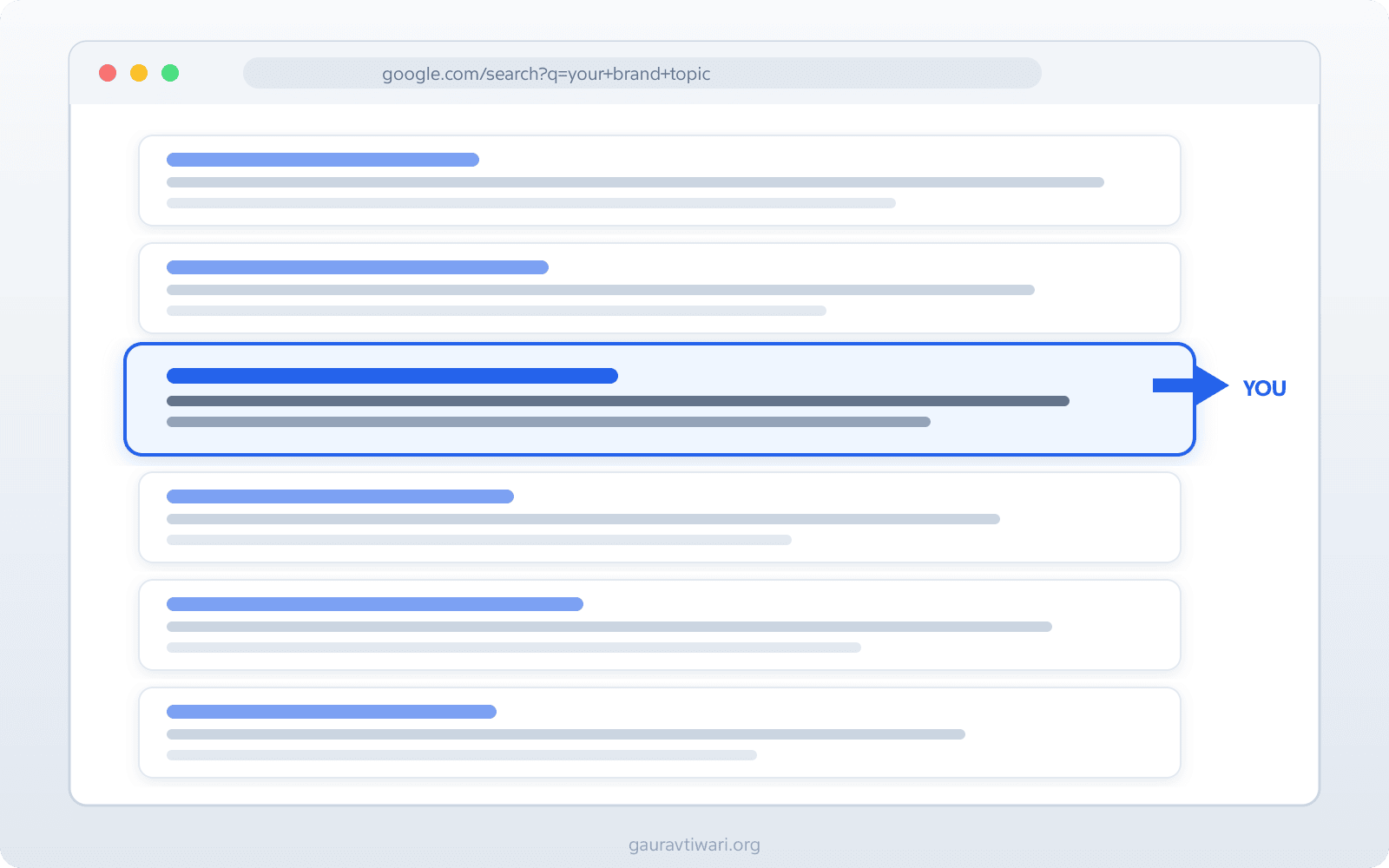
Search your brand name right now. Go ahead. What you see on that page is what 90% of your potential customers see as their first interaction with you. Not your homepage. Not your Instagram feed. The SERP.
According to research from BrightEdge, 68% of all online experiences start with a search engine. That means before anyone sees your carefully crafted logo, they’re scanning a list of blue links and deciding whether you’re worth clicking on.
Think about what occupies that page for your brand name:
- Your homepage title tag and meta description
- Your blog posts ranking for branded queries
- Third-party reviews and mentions
- Your Knowledge Panel (if you have one)
- Social profiles
- People Also Ask boxes triggered by your brand
Every single one of those elements is influenced by your content strategy. The companies that control 7+ of the top 10 results for their own brand name aren’t lucky. They’ve built a content ecosystem that dominates the SERP real estate.
Look, if someone searches your company name and the first thing they see is a Reddit thread complaining about your product… that’s your brand now. Your logo doesn’t matter. Your hex codes don’t matter. The SERP is the brand.
The Content-SEO-Brand Triangle
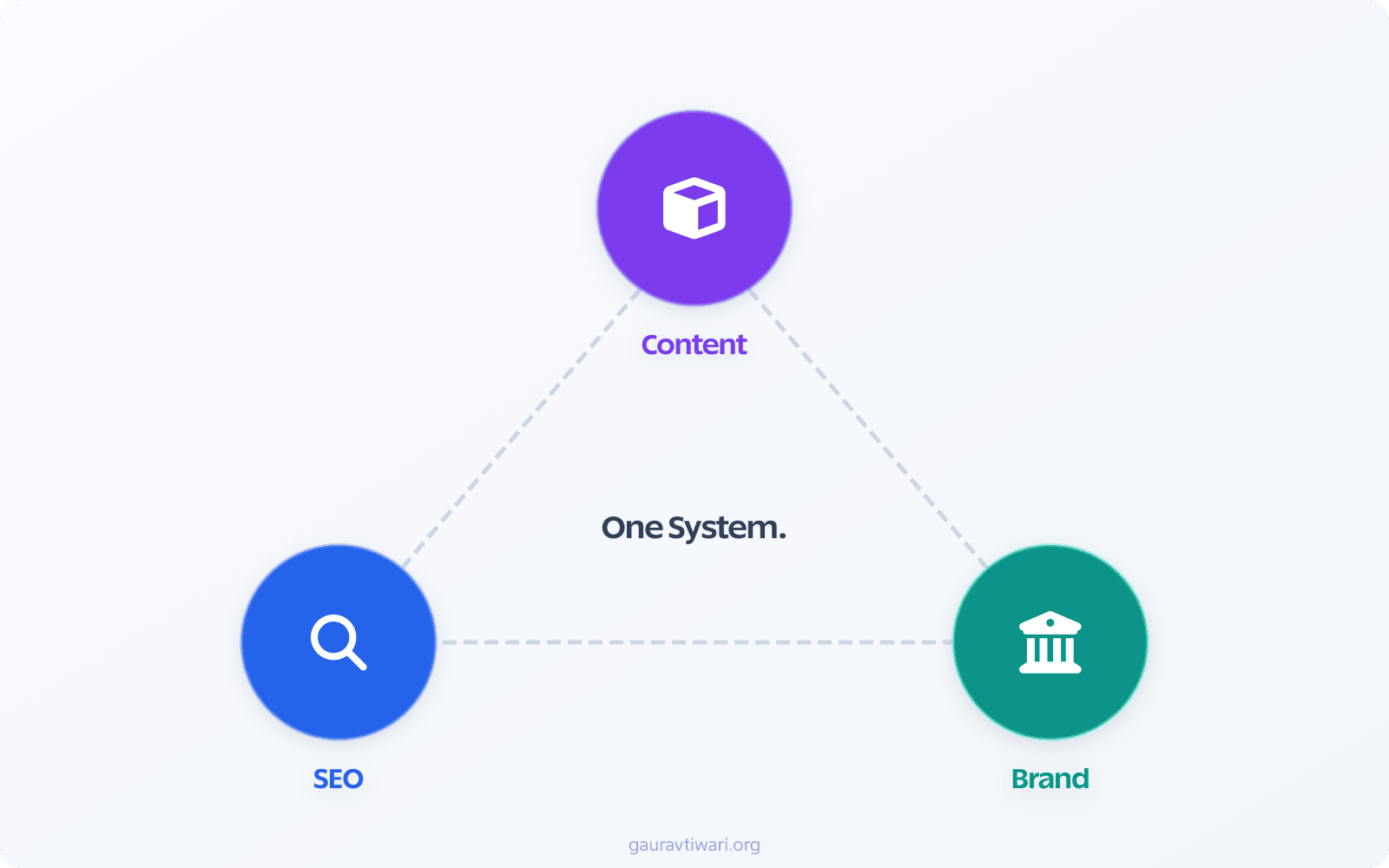
Most marketing teams treat content marketing, SEO, and brand strategy as three separate workflows. Three separate teams. Three separate budgets. This is the foundational mistake that makes everything harder than it needs to be.
They’re not three strategies. They’re one system with three faces.
| Discipline | What It Actually Does | Brand Impact |
|---|---|---|
| Content Marketing | Creates the substance | Defines what you’re known for |
| SEO | Makes that substance discoverable | Determines who encounters your brand |
| Brand Strategy | Ensures consistency of voice and values | Controls how people remember you |
Remove any one leg and the system collapses. Content without SEO is a diary nobody reads. SEO without brand consistency is a traffic machine with no memory. Brand strategy without content is a promise with no proof.
This is exactly why a solid content marketing strategy can’t exist in isolation. It has to be wired into your SEO architecture from day one… and both have to serve the brand narrative.
7 Ways SEO Content Builds Brand Identity
Not theory. Mechanisms. Here’s how the actual mechanics work.
1. Topical Authority Through Content Clusters
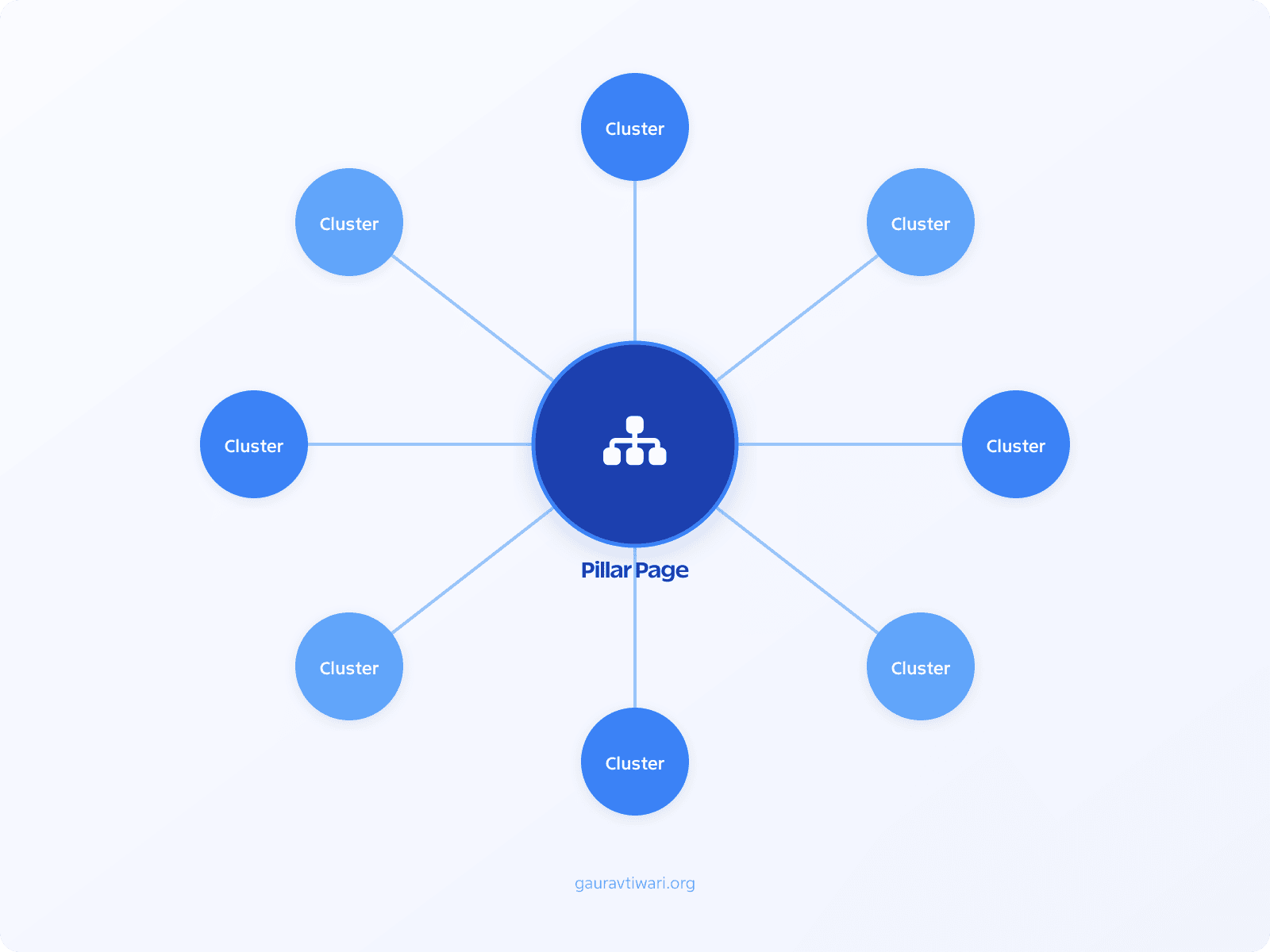
Google doesn’t rank individual pages in a vacuum anymore. It evaluates your site’s authority on entire topics. Publish one article about WordPress performance and you’re a random voice. Publish 25 interconnected articles covering caching, image optimization, Core Web Vitals, CDN configuration, and plugin audits — now you’re an authority.
HubSpot documented this shift: after restructuring into topic clusters, they saw a 25% increase in organic traffic within months. The mechanism is straightforward. Google’s algorithms recognize depth. When your site covers a topic comprehensively with interlinked content, it signals expertise at the domain level.
For brand identity, this means something specific. When someone encounters your content on 3-4 different subtopics within the same domain, they start associating your brand with that subject. Not because you said so in your tagline. Because your search footprint proved it.
Honestly, this is where proper keyword research becomes a brand-building exercise, not just a traffic exercise.
2. Search Intent Matching = Brand Trust
When someone searches “how to speed up WordPress” and your article actually answers their question — clearly, completely, without a 2,000-word preamble about the history of the internet — something clicks. This brand respects my time. This brand understands what I need.
That’s trust. Built in 30 seconds of reading.
Websites that align content with search intent see 3x higher engagement rates and significantly lower bounce rates. Every low bounce rate is a micro-vote of confidence in your brand. Every completed read is a relationship deposit.
The inverse is brutal. Rank for a query and fail to deliver on the intent… you’ve actively damaged your brand. That reader won’t click your result next time. You taught them not to.
3. Featured Snippets = Perceived Expertise
Featured snippets sit at position zero. Above everything else. When your content occupies that box, Google is essentially saying: this is the answer.
Ahrefs data shows featured snippets get approximately 8.6% of clicks when present. But the brand impact goes beyond clicks. Seeing your brand name in position zero 4-5 times during a research session creates recognition through repetition. You don’t even need clicks for this to work.
Structuring content to win snippets isn’t difficult. Clear definitions. Numbered steps. Concise answer paragraphs under 40-50 words placed directly below the target heading. Using the right SEO tools to identify snippet opportunities is step one.
4. Consistent Voice Across Rankings = Brand Recognition
OK, this one is subtle but powerful. When a reader encounters your content across multiple different search queries and the voice, structure, and quality are consistent every time, something happens at the subconscious level. They start recognizing you before they see your logo.
Most companies outsource articles to 5 different freelancers with 5 different writing styles and wonder why nobody remembers them. The content is technically correct but tonally anonymous.
Good writing techniques aren’t just about clarity. They’re about creating a voice distinctive enough that readers can identify you from a paragraph alone… without seeing the byline. That’s brand equity you can’t buy with ads.
5. Long-Tail Content = Niche Authority
Long-tail keywords represent 70% of all search queries. These aren’t the flashy head terms everyone fights over. They’re the specific, intent-rich questions that signal a reader deep in their decision-making process.
“WordPress caching plugin” is a head term. “How to configure FlyingPress for WooCommerce on Cloudways” is a long-tail query. The person searching that second phrase isn’t browsing. They’re executing. And if your content answers that exact question, you own a tiny but permanent piece of their mental map.
Multiply that across hundreds of long-tail articles and you’ve built something nobody can replicate quickly. Long-tail content also converts at 2.5x higher rates compared to head-term traffic. These readers already know what they want.
6. Internal Linking Architecture = Brand Narrative
Internal links aren’t just SEO mechanics. They’re narrative architecture. Every internal link says: “Here’s what else we know about this.”
A reader lands on your FlyingPress review, clicks through to your broader performance optimization guide, then finds your comparison of Perfmatters and other asset optimization tools. They didn’t just read one article. They experienced your entire perspective on WordPress performance.
That journey — from article to article, each building on the last — is brand storytelling through content architecture. Sites with strong internal linking see 40% more pages per session. That’s 40% more brand exposure per visitor.
7. Schema Markup = Brand Entity in Google’s Knowledge Graph
This is the most technical mechanism on the list, and the one with the biggest long-term implications. Schema markup tells Google what your content is about in a language it can parse directly. When Google understands you as an entity, things change. Knowledge Panel. Rich results — review stars, FAQ dropdowns, How-To steps. These take up 2-3x more SERP space than standard blue links.
Tools like Rank Math make implementing schema accessible even if you’re not writing JSON-LD by hand. Once Google recognizes your brand as an entity in its Knowledge Graph, you’ve graduated from “website that ranks” to “known thing in Google’s understanding of the world.”
The Compound Effect of SEO Content
Here’s where the numbers get interesting.
Paid advertising stops the moment you stop paying. A tweet is functionally dead within 18 minutes. An Instagram post reaches 50% of its total engagement within 6 hours.
SEO content operates on a completely different timeline.
An article published 3 years ago can still drive 30-50% of a site’s total monthly traffic. I’ve seen this in my own analytics. Posts written in 2022 still rank on page one, still bring in readers, still build brand recognition with people who have no idea when the content was created.
Ahrefs found that the average top-ranking page is over 2 years old. Only 5.7% of newly published pages reach the top 10 within a year. Every piece of content you publish today is a long-term brand asset that appreciates over time… not a disposable marketing expense.
| Time Frame | Content Assets | Est. Monthly Organic Visits | Brand Impressions (Monthly) |
|---|---|---|---|
| Month 6 | 25 articles | 2,000-5,000 | 20,000-50,000 |
| Year 1 | 50 articles | 8,000-20,000 | 80,000-200,000 |
| Year 2 | 100 articles | 25,000-60,000 | 250,000-600,000 |
| Year 3 | 150 articles | 50,000-120,000 | 500,000-1,200,000 |
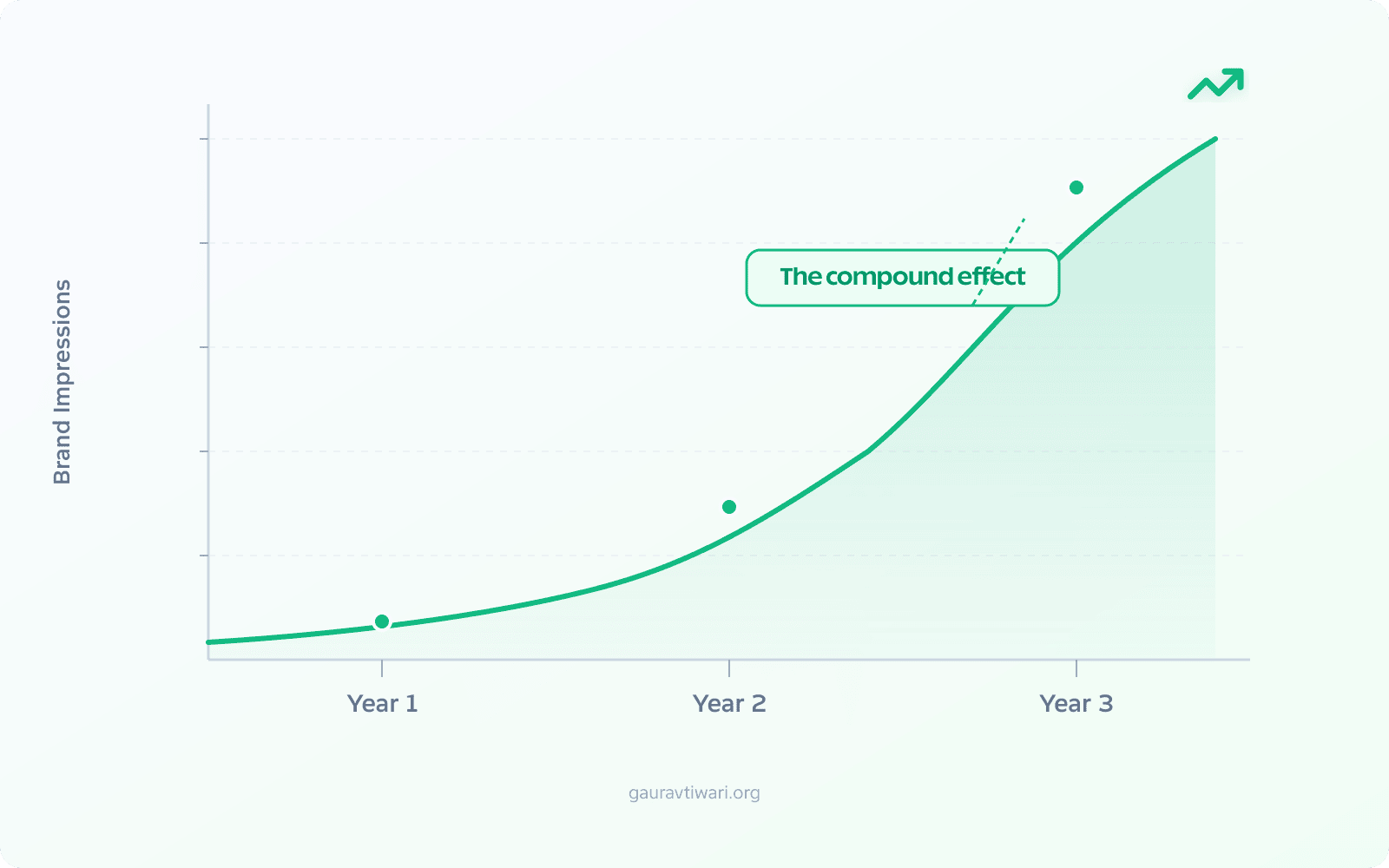
Brand impressions compound faster than traffic because each visitor sees your brand in search results multiple times before clicking. Search Console typically shows impressions at 10x the click volume.
Honestly, the closest analogy is compound interest. The first year feels slow. By year three, the curve bends upward in ways that make paid acquisition look expensive by comparison.
What Most Companies Get Wrong
I need to be direct here because I see these mistakes constantly.
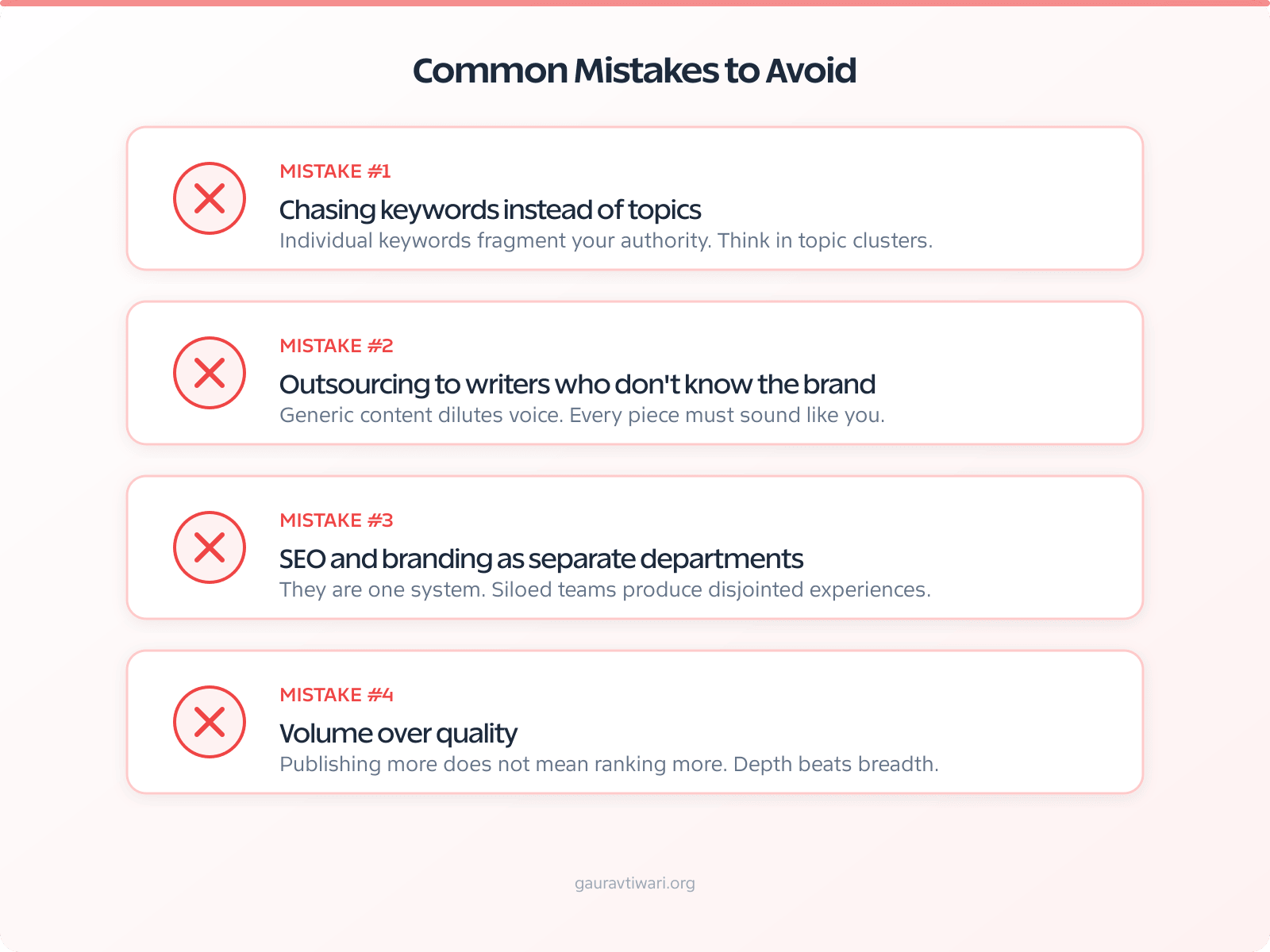
Chasing Keywords Instead of Topics
The keyword-first approach produces a content library that looks like a spreadsheet. 500 articles targeting 500 different keywords with no relationship between them. No clusters. No depth. No narrative.
Google’s Helpful Content system explicitly evaluates whether a site demonstrates depth. A site with 50 loosely related articles across 30 different subjects signals “content farm,” not “brand authority.”
The fix: start with 5-7 core topics your brand should own. Build 15-20 pieces around each topic before expanding to new territory. Depth before breadth. Every time.
Outsourcing Content to People Who Don’t Understand the Brand
The silent brand killer. A company hires a content agency. The writing is technically competent. Hits the right keywords. Follows SEO best practices. But it sounds like everyone else’s content because the writers have no connection to the brand’s perspective.
I call it “Wikipedia tone content” — informational, accurate, forgettable. It might rank. It won’t build a brand. Nobody bookmarks Wikipedia-tone content. Nobody thinks “I should check what Brand X says” when the content reads like it could have come from any of 200 competitors.
Treating SEO and Branding as Separate Departments
I’ve sat in meetings where the SEO team presents keyword targets and the brand team presents messaging frameworks and neither group references the other’s work. This guarantees mediocre results from both.
The solution: a shared brief for every piece of content that includes both the target keyword and the brand voice requirements. One brief. Both perspectives. Every time.
Publishing Volume Over Quality
A site with 100 high-quality articles will outperform a site with 1,000 mediocre ones. I’ve watched sites cut 60-70% of their content through strategic pruning and see organic traffic increase within 3-4 months.
Every weak piece of content on your site is a potential first impression. If someone’s first encounter with your brand is a thin, generic article you published just to hit a quota… that’s your brand to them.
How to Audit Your Brand’s SEO Content
A framework you can run this week. Not next quarter.
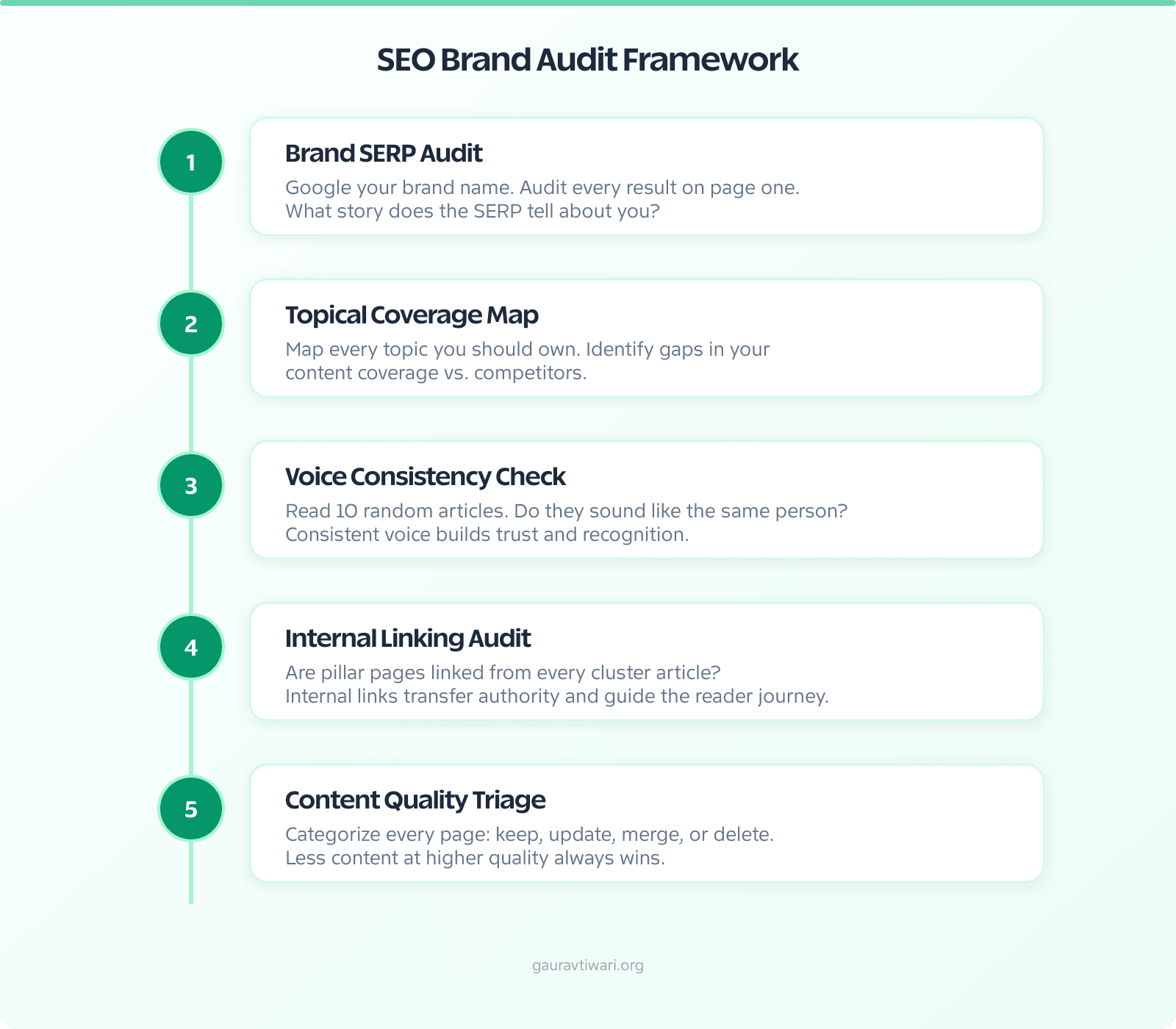
Step 1: Brand SERP Audit
Search your brand name in incognito. Screenshot the first page. Answer:
- How many of the top 10 results do you control?
- Do title tags and meta descriptions represent your brand accurately?
- Is there a Knowledge Panel? If not, why not?
- What do the People Also Ask questions suggest about public perception?
- Are there negative results you need to push down?
Target: control at least 7 of 10 first-page results for your brand name.
Step 2: Topical Coverage Map
List your 5 core topics. For each, count published articles and articles ranking in the top 20.
| Coverage Grade | Articles Ranking (Top 20) | Status |
|---|---|---|
| A | 15+ | Strong topical authority |
| B | 8-14 | Building, keep going |
| C | 3-7 | Weak, prioritize gaps |
| F | Under 3 | Not building authority at all |
Any topic graded C or below isn’t building brand authority. It’s just noise.
Step 3: Voice Consistency Check
Pull your 10 most-trafficked articles. Read the opening paragraph of each one back to back. Do they sound like the same brand? Same tone? Same personality?
If they don’t, you have a voice fragmentation problem. People can’t remember a brand that sounds different every time they encounter it.
Step 4: Internal Linking Audit
Crawl your site’s internal links. Look for:
- Orphan pages — articles with zero internal links. Invisible to Google and your brand narrative.
- Hub pages — does each core topic have a pillar page connecting the cluster?
- Cross-cluster links — are your topics connected to each other? Your brand is a unified perspective, not separate silos.
Step 5: Content Quality Triage
Sort all content into three buckets:
- Keep and promote — high-quality, ranks well, represents your brand. Add proper schema, strong internal links, updated info.
- Update and improve — decent foundation but outdated or thin. Refreshing existing content is 2-3x faster than creating new and often produces better results.
- Remove or consolidate — low quality, no traffic, hurting brand perception. Redirect to better content or remove entirely.
Most sites find 20-30% of content drives 80-90% of results. The rest is dead weight.
The Decisive Take
SEO content isn’t a marketing channel. It’s brand infrastructure.
The companies that figure this out early build brand equity that compounds for years. The ones that don’t keep spending on ads, keep wondering why nobody remembers them, keep redesigning their logo hoping that this time it’ll stick.
It won’t. Because the logo isn’t the brand. The SERP is the brand.
Start treating your content strategy as a brand strategy. Audit your search footprint. Map your topical authority gaps. Fix your voice consistency. Build the internal linking architecture that tells your brand’s story.
And stop spending money on brand guidelines nobody outside your company will ever see… when the thing your customers actually see is page one of Google. That’s where your brand lives. Build it there.
Frequently Asked Questions
How does SEO content build brand identity?
SEO content builds brand identity by controlling what people see when they search for your brand or related topics. Through topical authority (content clusters), search intent matching, featured snippets, consistent voice, internal linking, and schema markup, your content defines how your brand appears in search results. Since 68% of online experiences start with a search engine, your SERP presence effectively IS your brand for most customers.
What is topical authority and why does it matter for branding?
Topical authority means Google recognizes your site as an expert on a specific subject because you’ve published comprehensive, interlinked content covering that topic in depth. For branding, this means when someone encounters your content across 3-4 subtopics, they associate your brand with that subject. HubSpot saw a 25% traffic increase after restructuring into topic clusters. It’s how brands become synonymous with their niche.
How long does SEO content take to build brand recognition?
SEO content compounds over time. At 6 months with 25 articles, expect 20,000-50,000 monthly brand impressions. By year 2 with 100 articles, that grows to 250,000-600,000. By year 3, over 500,000-1,200,000 monthly impressions. The average top-ranking page is over 2 years old, so content published today is a long-term brand asset that appreciates, not a disposable expense.
Should SEO and branding be handled by the same team?
Ideally, yes. When SEO and branding operate as separate departments, you get either brand-consistent content nobody finds, or high-traffic content that erodes your positioning. The solution is a shared content brief that includes both the target keyword and search intent alongside brand voice requirements. One brief, both perspectives, every piece of content.
What is a brand SERP and how do I audit it?
A brand SERP is the search results page that appears when someone Googles your brand name. To audit it: search your brand in incognito, screenshot the first page, and count how many of the top 10 results you control. Target is 7 or more. Check for a Knowledge Panel, review the People Also Ask questions, and identify any negative results that need to be pushed down with better content.
How do featured snippets help brand identity?
Featured snippets place your brand at position zero in search results, above all other organic results. Ahrefs data shows they capture about 8.6% of clicks. But the brand impact goes beyond clicks. Seeing your brand name in position zero 4-5 times during a research session creates recognition through repetition. Structure content with clear definitions and concise 40-50 word answer paragraphs to win them.
Why is consistent brand voice important in SEO content?
When readers encounter your content across multiple search queries and the voice is consistent every time, they start recognizing your brand before they see the logo. Companies that outsource to 5 different freelancers with 5 different writing styles create tonally anonymous content that ranks but doesn’t build brand memory. Distinctive voice is brand equity that advertising can’t replicate.
How does schema markup build brand presence in Google?
Schema markup (Organization, Author, Article, FAQ types) tells Google about your brand as an entity, not just a website. This can trigger a Knowledge Panel, enable rich results like review stars and FAQ dropdowns, and occupy 2-3x more SERP real estate than standard blue links. Tools like Rank Math make implementation accessible. Once Google recognizes your brand as an entity in its Knowledge Graph, you’ve graduated from website to known entity.