
Why Page Speed and Refresh Rate Are So Important in Gaming
Gaming isn’t what it used to be. It’s not just about pretty graphics or gripping storylines anymore. Performance is the heart of the experience now.
Whether you’re battling online, exploring open worlds, or spinning a digital slot, how fast a game responds and how smoothly it appears on screen shapes your entire session. Page speed and refresh rate sound technical. For players, they translate directly into comfort, control, and enjoyment.
I’ve been gaming since the days when 30 frames per second was considered smooth. Trust me, once you experience the difference that modern refresh rates and fast-loading games make, you can’t go back. It’s like switching from dial-up to fiber optic internet. The old way suddenly feels broken.

What Refresh Rate Actually Does
Refresh rate is how often your screen updates every second, measured in hertz (Hz). A standard display refreshes 60 times per second. Modern gaming screens hit 120Hz, 144Hz, or higher. Some monitors now push 240Hz or even 360Hz for competitive esports players.
The higher the number, the more you feel in control of fast-paced action. Movement feels fluid. Animations look cleaner. Your actions feel tightly connected to what’s happening on screen. That’s the sense of mastery that keeps you playing.
Think about it this way. At 60Hz, your screen shows you 60 snapshots of the game world every second. At 144Hz, you’re getting 144 snapshots. More information reaches your eyes, and your brain processes movement more naturally. The difference is subtle when you’re standing still in a game. The moment you start moving quickly, or tracking an enemy across the screen, it becomes obvious.
The Science Behind Smoother Gameplay
Smooth visuals aren’t just about aesthetics. Higher refresh rates reduce motion blur and make tracking objects easier. You stay focused during intense moments instead of squinting at a blurry mess.
Human eyes don’t see in “frames per second” the way screens display them. We perceive motion continuously. When a screen updates slowly, our brains notice the gaps. We interpret those gaps as stutter, blur, or that vague feeling that something’s off. Higher refresh rates close those gaps.
There’s also a responsiveness factor. When a display updates more frequently, on-screen feedback feels faster. Controls seem more precise. That subtle improvement adds up during longer sessions or competitive play.
I noticed this most when I switched from a 60Hz monitor to a 144Hz display while playing first-person shooters. My aim didn’t magically improve overnight. But tracking moving targets felt more natural. I stopped overcorrecting because I could see exactly where my crosshair was at any moment. The visual feedback loop tightened.
Input Lag and the Full Picture
Refresh rate doesn’t work in isolation. Input lag matters too. Input lag is the delay between pressing a button and seeing the result on screen. A high refresh rate reduces one component of that delay, but other factors contribute.
Your GPU needs to render frames fast enough to match the refresh rate. If your graphics card outputs 60 frames per second but your monitor refreshes at 144Hz, you’re not getting the full benefit. The screen can only show what the GPU provides.
This is why serious gamers often lower graphical settings to maintain higher frame rates. A game running at medium settings and 144fps feels more responsive than the same game at ultra settings and 60fps. The visual fidelity drops slightly. The gameplay experience improves.
Why Page Speed Matters for Immersion
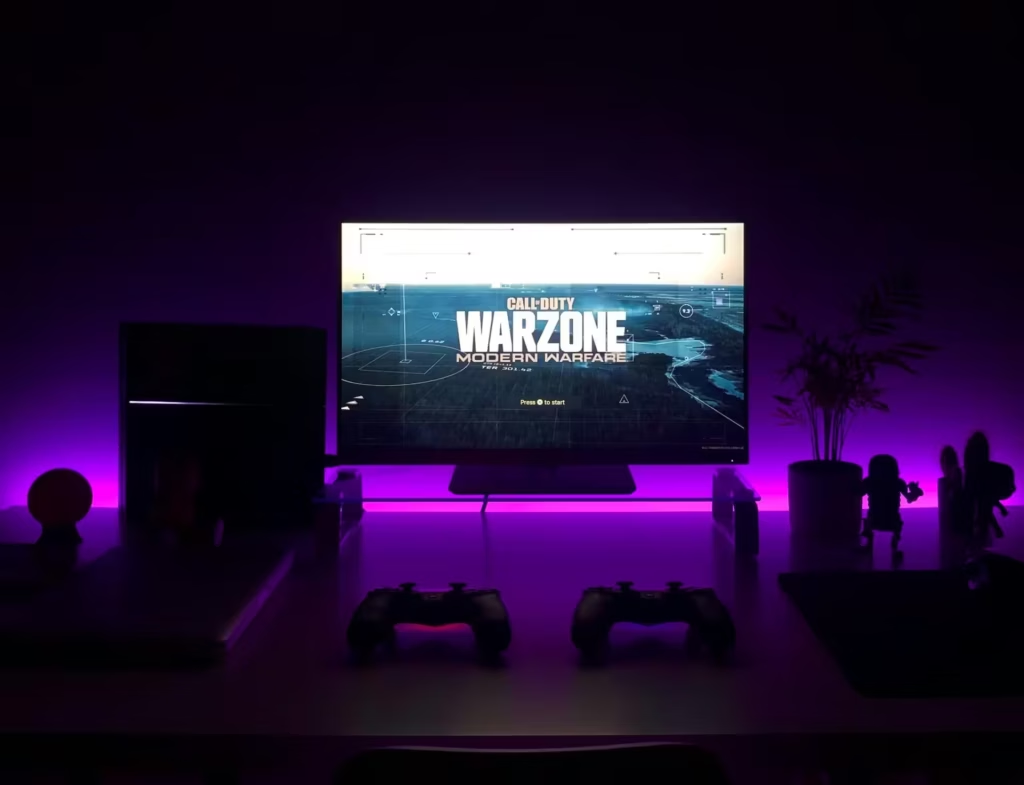
Page speed, or how fast content loads and responds, keeps you immersed. Delays, blank screens, and lag break the flow instantly.
This affects everything from launching games to navigating menus and loading new areas. Nobody wants to wait. You want to play.
Gaming used to tolerate loading screens. We’d watch progress bars crawl across the screen, maybe read some lore text or gameplay tips. That patience has evaporated. Modern players expect near-instant transitions. The arrival of SSDs in consoles and PCs trained everyone to expect speed.
The Psychology of Waiting
When you’re engaged in a game, your brain enters a state of flow. Psychologists describe flow as complete absorption in an activity. Time feels different. You stop noticing the outside world. Great games create and sustain this state.
Loading screens shatter flow. Every time the game pauses to load, your brain disconnects from the experience. You check your phone. You grab a snack. You remember that email you forgot to send. The game has to earn your attention all over again when loading finishes.
Fast page speed and quick loading preserve flow. You move from one area to another without mental interruption. The game world feels continuous and real instead of chopped into segments.
Where Gaming Platforms Converge
Here’s where different gaming spaces overlap more than people realize. Console, PC, mobile, and browser-based experiences share the same expectations. Players want things to work immediately. That applies equally to shooters, strategy titles, and online casino games. Delays during loading, betting, or switching games push users to leave without a second thought.
With any online casino, speed plays a huge role in trust and retention. A slow-loading lobby or an unresponsive cashier screen creates doubt. Players rarely analyze the problem. They simply move on. When pages load quickly and actions respond right away, the platform feels solid and reliable. That sense of stability encourages people to return.
This applies to any browser-based gaming experience. Slot games, poker rooms, sports betting interfaces, casual puzzle games. The platform that loads fastest and responds smoothest wins. Users don’t consciously compare load times. They just gravitate toward whatever feels better.
Mobile gaming faces the same pressure. App store reviews punish slow, laggy games with one-star ratings. Players have thousands of alternatives one tap away. If your game stutters during the tutorial, they’ll uninstall and try something else.
Server Response and Network Latency
Page speed in online gaming depends on more than just your device. Server response time matters. Network latency matters. The physical distance between you and the game server matters.
When you click a button in an online game, your input travels to a server, gets processed, and the result travels back. That round trip takes time. The best gaming infrastructure minimizes this delay through server distribution, optimized code, and efficient network routing.
You’ve probably experienced the frustration of high ping in online games. Your character moves a half-second after you press the key. Shots that should hit somehow miss. Enemies seem to teleport around corners. That’s network latency destroying the connection between your inputs and the game’s response.
Serious online games invest heavily in server infrastructure. They place servers in multiple regions. They optimize their netcode to reduce the data traveling back and forth. They implement prediction systems that guess what should happen while waiting for server confirmation.
Not Every Game Needs Extreme Refresh Rates
Slower, story-driven titles feel fine at 60Hz. But racing games, competitive shooters, sports simulations, and action-heavy experiences all gain noticeable smoothness from higher refresh displays.
Here’s how to think about it. If a game involves fast camera movement, quick reactions, or tracking moving objects, higher refresh rates help. If a game involves slow exploration, dialogue choices, and turn-based combat, refresh rate matters less.
Matching Hardware to Game Types
A visual novel or strategy game doesn’t need a 360Hz monitor. The extra frames provide no meaningful benefit when you’re reading text or planning troop movements. Save your money.
A competitive shooter or racing game benefits from every frame you can get. Professional esports players notice the difference between 144Hz and 240Hz. For casual players, 120Hz or 144Hz offers the sweet spot of noticeable improvement without extreme cost.
Sports games and fighting games sit in the middle. Frame timing affects input windows and visual clarity. Higher refresh rates help, but the difference isn’t as dramatic as in first-person shooters.
The Diminishing Returns Curve
Page speed and refresh rate both hit diminishing returns at some point. The jump from 30Hz to 60Hz is massive. Anyone can see it. The jump from 60Hz to 120Hz is significant. Most players notice it. The jump from 120Hz to 240Hz is subtle. Competitive players care about it.
The same applies to loading times. Cutting a 30-second load to 5 seconds transforms the experience. Cutting a 5-second load to 2 seconds is nice. Cutting a 2-second load to 1 second barely registers.
Smart players and smart developers focus investment where it matters most. Fix the major performance problems first. Optimize the most frequent transitions. Then worry about marginal gains.
The Hardware Trade-Offs
Trade-offs exist, of course. Higher refresh rates demand stronger hardware. Faster systems use more power. Still, most players find the improvement worthwhile once they experience it firsthand.
GPU and CPU Demands
Pushing high frame rates requires a capable graphics card. Rendering 144 frames per second means your GPU works more than twice as hard as rendering 60 frames per second. The processor also works harder, handling game logic, physics, and AI calculations more frequently.
This is why gaming laptops and high-refresh-rate gaming drain batteries quickly. The components run at higher power states to maintain performance. Desktop gamers don’t worry about batteries, but they do pay higher electricity bills.
Budget-conscious gamers face a choice. Buy a high-refresh-rate monitor and turn down graphical settings? Or stick with 60Hz and max out visual quality? There’s no universal right answer. It depends on what you value and what games you play.
Storage Speed and Loading
Fast loading requires fast storage. Traditional hard drives can’t keep up with modern game expectations. Solid-state drives transformed console and PC gaming over the past few years.
The PlayStation 5 and Xbox Series X both use custom SSDs designed for gaming. Their marketing emphasizes near-instant loading. That’s not hype. Games designed for these consoles assume fast storage and build their worlds accordingly.
PC gamers benefit from NVMe drives, which read data several times faster than SATA SSDs. The speed advantage shows most in open-world games that stream content constantly as you move through the world.
Network Infrastructure
Online gaming performance depends partly on factors outside your control. Your internet connection matters. Your ISP’s routing matters. The game’s server quality matters.
You can optimize your end of the connection. Use wired ethernet instead of WiFi when possible. Close bandwidth-hungry applications during gaming sessions. Choose servers closest to your location.
Beyond that, you’re at the mercy of infrastructure. This is why some online games feel great in certain regions and terrible in others. Server coverage varies. Network paths vary. Physical distance is an unavoidable constraint.
What Developers and Platforms Can Do
Game developers and platform operators bear responsibility for performance. Players can upgrade their hardware, but they can’t fix poorly optimized games.
Good developers profile their code and find bottlenecks. They optimize asset loading. They implement level-of-detail systems that reduce rendering work for distant objects. They test on a range of hardware configurations.
Platform operators maintain servers, optimize their backend systems, and monitor performance metrics. When loading times creep up or servers lag, they investigate and fix the issue. The best platforms invest in infrastructure before problems become visible to users.
Players notice when these things are done well. They also notice when they’re done poorly. The difference between a polished, performant game and a laggy mess is often the difference between success and failure.
Bringing It Together
Gaming is about flow. Page speed keeps that flow uninterrupted. Refresh rate keeps it visually smooth.
These aren’t separate concerns. They’re two sides of the same coin. A beautiful game that stutters during combat fails. A fast-loading game that looks like a slideshow fails. Players expect both speed and smoothness now.
The good news is that hardware keeps improving. SSDs are standard. High-refresh monitors are affordable. Game engines are more optimized than ever. The baseline for acceptable performance rises every year.
When both page speed and refresh rate are handled well, you stop thinking about performance entirely. You just play. The technology disappears. The experience remains.
That’s when gaming actually works. Not when you’re admiring the frame rate counter in the corner of your screen. Not when you’re waiting for a progress bar to fill. When you forget about all of that and lose yourself in the game.
That’s the goal. Every technical improvement in page speed and refresh rate serves that single purpose: getting out of your way so you can play.