
Finding Domain Names: Trends and Best Practices for 2026
Your domain name is the first thing people see, type, and remember about your online presence. Pick the wrong one and you’re fighting an uphill battle with branding, SEO, and credibility from day one. I’ve registered hundreds of domains for client projects, and the patterns for what works (and what doesn’t) are surprisingly consistent.
Whether you’re launching a new business, starting a blog, or building a personal brand, the domain you choose in 2026 needs to work across search engines, voice assistants, and social media. Let me walk you through the current trends, best practices, and strategies that actually help you find the right domain name.
The Changing Landscape of Domain Names
The domain market has shifted dramatically in recent years. Gone are the days when .com was the only credible option. New extensions, AI-powered search, and voice-first browsing have changed what makes a “good” domain name.
New gTLDs Are Now Credible
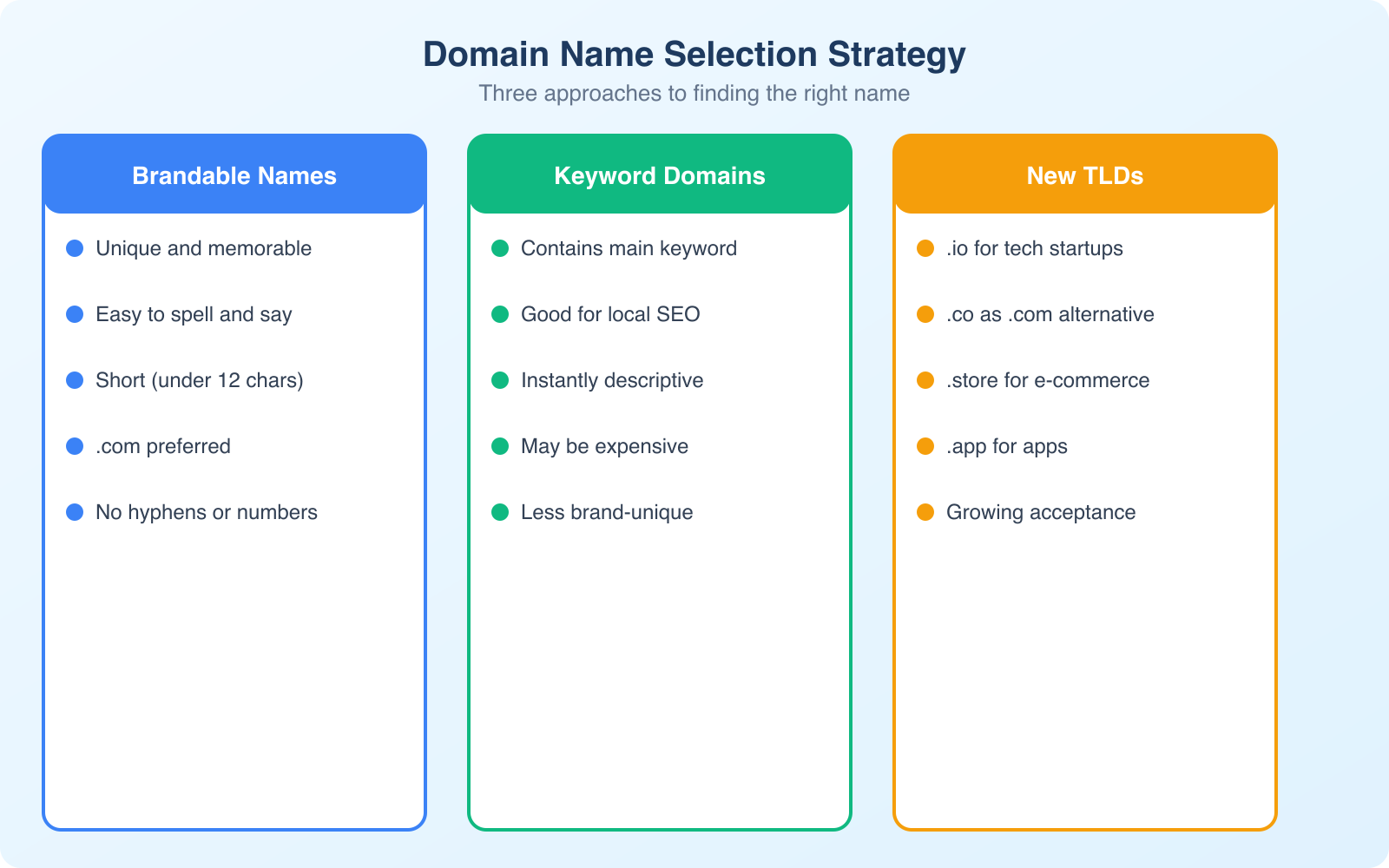
Generic top-level domains (gTLDs) have expanded far beyond .com, .net, and .org. You can now register domains with extensions like .tech, .shop, .blog, .io, .co, .ai, and hundreds more. Initially, these felt gimmicky. In 2026, many are well-established and carry real credibility in their respective industries.
A .tech domain for a software company, a .shop domain for an e-commerce store, or a .design domain for a creative agency all make intuitive sense. They’re often more available and affordable than their .com equivalents. I’ve seen startups build successful brands on .io and .co domains without any credibility issues. The stigma has largely faded.
That said, .com is still the default for most businesses. If the .com is available and reasonably priced, get it. But don’t let the absence of a perfect .com stop you from launching. A strong brand on a relevant gTLD beats a mediocre .com every time.
Brandable Domains Over Keyword Domains
The old strategy of stuffing keywords into your domain (best-cheap-shoes-online.com) is dead. Search engines no longer give significant ranking boosts to exact-match keyword domains, and they look unprofessional to users.
The trend in 2026 is brandable domains: unique, memorable names that become synonymous with your brand. Think Stripe, Notion, Figma, or Canva. None of these tell you what the company does from the name alone. They’re short, distinctive, and easy to remember. That’s what you’re aiming for.
Voice Search Optimization
With over 1 billion voice searches happening monthly through Alexa, Siri, and Google Assistant, your domain name needs to work when spoken aloud. This means easy pronunciation, clear spelling, and no ambiguity.
“Flickr” works visually but fails the voice test (is it Flickr or Flicker?). “Basecamp” works perfectly in voice. When someone says “Go to basecamp.com,” there’s zero ambiguity. Test your domain ideas by saying them out loud and asking others to spell what they heard.
Best Practices for Securing Your Ideal Domain Name
Now let’s get practical. Here’s the process I follow when searching for domains for any new project.
Start with a Keyword and Concept List
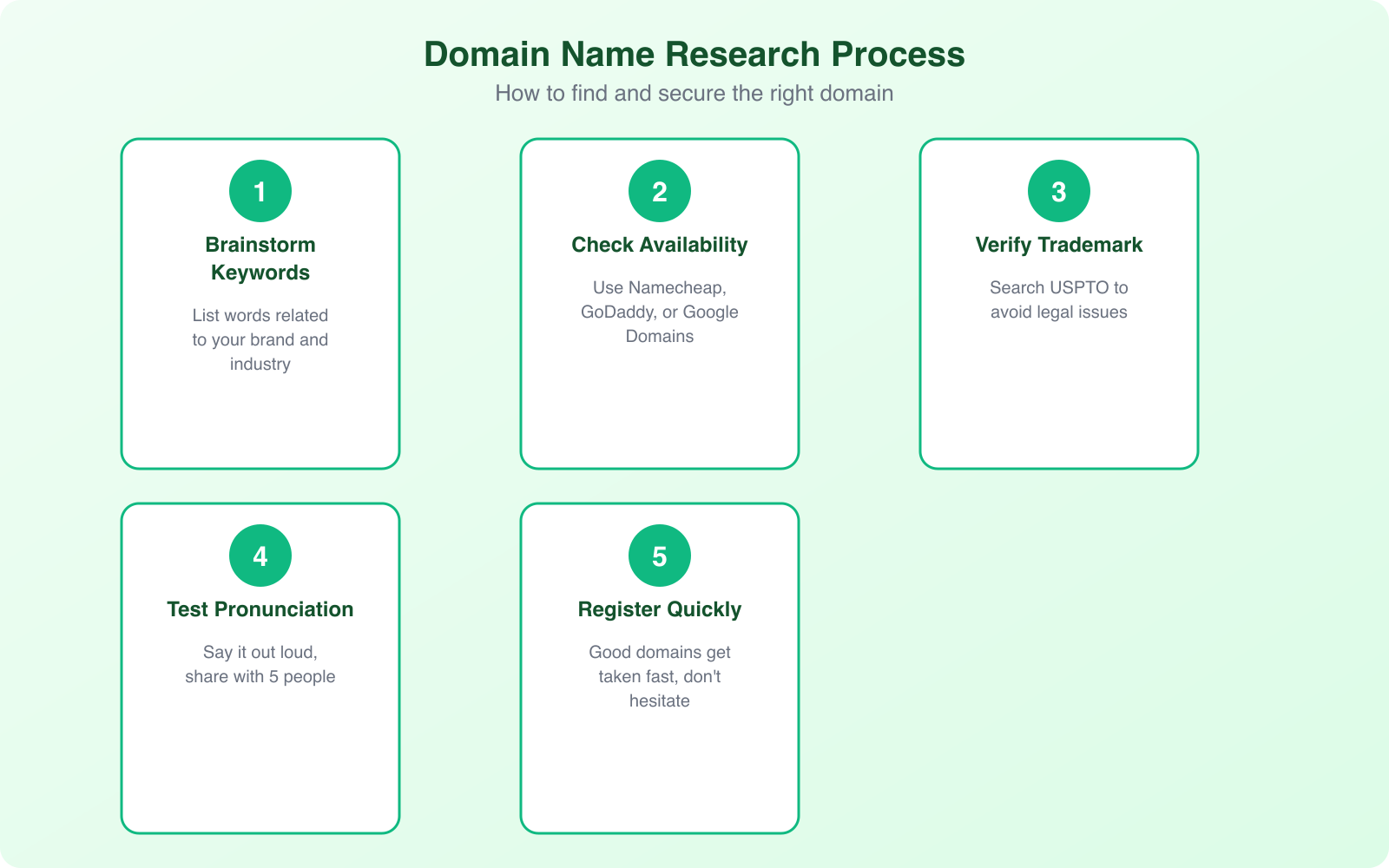
Brainstorm 20-30 words related to your business, industry, target audience, and brand personality. Don’t limit yourself to obvious keywords. Include adjectives, verbs, and abstract concepts. A project management tool doesn’t have to include “project” or “manage” in its name. “Monday” and “Notion” prove that.
Combine words, create portmanteaus, or invent entirely new words. Instagram (instant + telegram), Pinterest (pin + interest), and Shopify (shop + simplify) all emerged from creative word combinations. Play with your keyword list until something clicks.
Use Domain Name Generators
Domain generators can surface combinations you’d never think of. Namecheap‘s Beast Mode generator, LeanDomainSearch, and Namelix (AI-powered) all produce useful suggestions based on your keywords. Run your keyword list through 2-3 generators and compile the best results.
Most generators also check availability in real time, saving you the frustration of falling in love with a name that’s already taken. Export all promising options to a spreadsheet before making your final decision.
Keep It Short and Simple
The ideal domain length is 6-14 characters. Shorter is better for typing, remembering, and fitting on business cards. Avoid hyphens, numbers, and double letters that create confusion when spoken aloud or typed quickly.
“gauravtiwari.org” works because it’s a personal brand (names are naturally long). “best-seo-tools-for-beginners.com” doesn’t work because it’s unmemorable and looks spammy. If your domain is longer than 15 characters, keep looking.
Before registering, do the “phone test.” Call a friend and say your domain name once. Ask them to text it back to you. If they can’t spell it correctly from hearing it once, the domain will cause problems with word-of-mouth referrals, podcast mentions, and voice search. Pick something simpler.
Future-Proof Your Domain
Choose a name that won’t limit your business as it grows. “AustinCupcakes.com” locks you into a city and a product. What happens when you expand to Dallas or start selling cookies? A brandable name like “SweetBatch.com” grows with you.
Avoid trend-dependent names too. “.ai” domains are hot right now, but will they feel dated in 5 years if the AI hype cools? Timeless names outlast trends.
Domain Registrar Comparison
Where you register matters. Registrars vary significantly in pricing, renewal rates, and included features. Here’s what I recommend based on actual experience.
Namecheap is my go-to registrar. Registration prices are competitive ($8-10/year for .com), renewals are transparent (no surprise price jumps), and free WHOIS privacy is included with every domain. The interface is clean and the DNS management tools are solid. For most people, this is the right choice.
Cloudflare Registrar offers at-cost pricing with zero markup. You pay the wholesale price from the registry. .com domains run about $9.15/year. The catch is a more limited extension selection and a more technical interface. Great for developers and tech-savvy users.
Google Domains (now Squarespace Domains) was excellent but the transition to Squarespace has been rocky. Pricing remains reasonable ($12/year for .com with free privacy), but the user experience has declined. Wait for the platform to stabilize before registering new domains here.
GoDaddy has the biggest market share but I don’t recommend it. First-year prices look attractive ($1-5 for .com), but renewals jump to $20+/year. They aggressively upsell add-ons during checkout. The interface is cluttered. Better options exist for every use case.
Advanced Strategies for 2026
If the simple approach doesn’t yield the perfect domain, try these advanced tactics.
Monitor Expiring Domains
Thousands of domains expire daily. Many are high-quality names that previous owners let lapse. Services like ExpiredDomains.net, NameJet, and SnapNames let you search for and bid on expiring domains. Some expired domains come with existing backlinks and domain authority, giving you an SEO head start.
Check any expired domain’s history on the Wayback Machine before purchasing. Some expired domains were previously used for spam or adult content, which carries negative SEO history. A clean history with relevant previous use is the ideal find.
Protect Your Brand
Once you’ve chosen your primary domain, protect it from competitors and typosquatters. Register common misspellings, the plural version, and the most relevant alternative extensions (.com, .net, and your country code at minimum). Redirect all variations to your main domain.
Enable WHOIS privacy protection on every domain. This keeps your personal contact information out of public databases and reduces spam. Most registrars now include this for free. If yours charges for it, switch registrars.
Innovative Trends to Watch in 2026
The domain landscape keeps evolving. Here are the trends worth watching.
AI-powered domain search. AI tools can now predict trending keywords, suggest domain names that align with future search patterns, and evaluate brandability scores. Namelix and DomainWheel use machine learning to generate domain suggestions tailored to your industry and target audience. These tools are genuinely useful for brainstorming, though the final decision should still be human.
Blockchain domains. Extensions like .crypto, .eth, and .nft run on blockchain infrastructure rather than traditional DNS. They offer enhanced security and censorship resistance. For now, they’re mainly relevant for cryptocurrency and Web3 projects. Mainstream adoption is still years away, so don’t bet your primary business identity on blockchain domains yet.
.ai domain explosion. The .ai extension (technically the country code for Anguilla) has become the go-to for AI startups. Companies like perplexity.ai, character.ai, and midjourney.ai have normalized this extension. Prices range from $50-90/year, higher than .com but a reasonable premium for the brand signal it sends in the AI industry.
Always check trademark databases (USPTO for the US, WIPO globally) before registering a domain. Using a name that infringes on an existing trademark can result in losing the domain and facing legal action. A 5-minute trademark search can save you thousands in legal fees and the pain of rebranding.
Frequently Asked Questions
Is a .com domain still necessary in 2026?
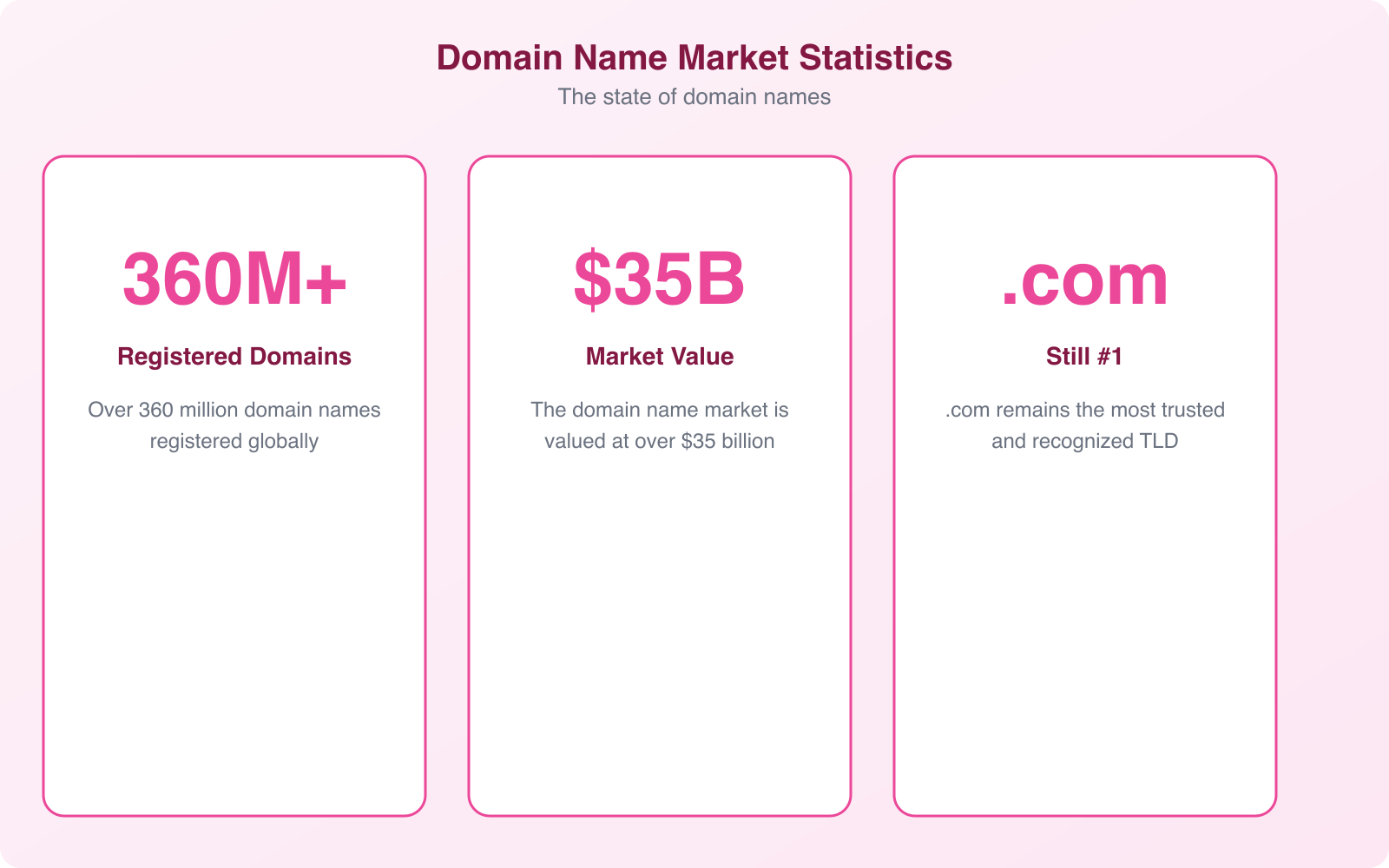
A .com is still the strongest choice for credibility and global recognition. People instinctively type .com, and it’s the most trusted TLD for businesses. However, it’s no longer the only viable option. Country-code TLDs (.co.uk, .de, .in) are perfectly fine for local businesses. New TLDs like .io (tech), .co (startups), and .store (e-commerce) are increasingly accepted. If the .com version of your ideal name is available and affordable, grab it. If not, don’t let the TLD stop you from using a great brand name.
How much should I pay for a domain name?
Standard domain registration costs $10-$15/year for a .com through registrars like Namecheap, Cloudflare, or Porkbun. Premium domains (short, dictionary words, or high-demand phrases) can cost $500 to $100,000+. As a rule of thumb, don’t pay more than $2,000-$3,000 for a domain unless it’s a perfect brand-match keyword domain with proven search volume. The domain name is important, but it’s not worth bankrupting your startup budget.
Should I buy expired domains for SEO?
Expired domains can carry existing backlinks and domain authority, which gives you an SEO head start. However, they also carry risks: spammy link profiles, Google penalties, or negative brand associations. Before buying, check the domain’s backlink profile using Ahrefs or Semrush, review its history on the Wayback Machine, and verify it’s not on any spam blacklists. A clean expired domain in your niche can be valuable. A spammy one can actively hurt your SEO.
What’s the best domain registrar?
Cloudflare Registrar offers at-cost pricing with no markup and free WHOIS privacy. Namecheap is the most popular budget option with excellent UI and free privacy protection. Porkbun is newer but offers competitive pricing and good features. Avoid GoDaddy for domain registration (they’re more expensive and use aggressive upselling). For businesses with many domains, Cloudflare or Google Domains (now Squarespace Domains) offer the cleanest management experience.
How do I transfer a domain to a different registrar?
The process takes 5-7 days typically. First, unlock your domain at the current registrar and get the authorization (EPP) code. Then initiate the transfer at the new registrar by entering the domain name and EPP code. Confirm the transfer via email. Both registrars will send confirmation emails. The transfer extends your registration by one year in most cases. Note: domains cannot be transferred within 60 days of registration or a previous transfer. Plan ahead if you’re switching registrars.
Secure Your Digital Identity
Finding the right domain name in 2026 is about balancing brandability, availability, and practicality. Start with a brandable concept, test it against the checklist (short, pronounceable, no trademark conflicts, future-proof), and register it with a reputable registrar that won’t surprise you with hidden fees.
Don’t overthink it. I’ve seen too many businesses delay their launch for months searching for the “perfect” domain. A good domain name with excellent execution beats a perfect domain name with no website behind it. Pick one that passes the basic tests, register it today, and focus your energy on building something worth visiting.
Disclaimer: This site is reader-supported. If you buy through some links, I may earn a small commission at no extra cost to you. I only recommend tools I trust and would use myself. Your support helps keep gauravtiwari.org free and focused on real-world advice. Thanks. - Gaurav Tiwari