
How to Find and Join Online Study Communities?
Learning alone is hard. I’ve started dozens of courses, books, and skill-building projects that I never finished because there was no one to hold me accountable. The moment I joined communities of people learning the same things, my completion rate went through the roof. Online study communities aren’t just nice to have. For most people, they’re the difference between finishing a course and abandoning it on week three.
Here are the best places to find study communities, how to evaluate which ones are worth joining, and how to get real value out of them once you’re in.
Why Online Study Communities Work
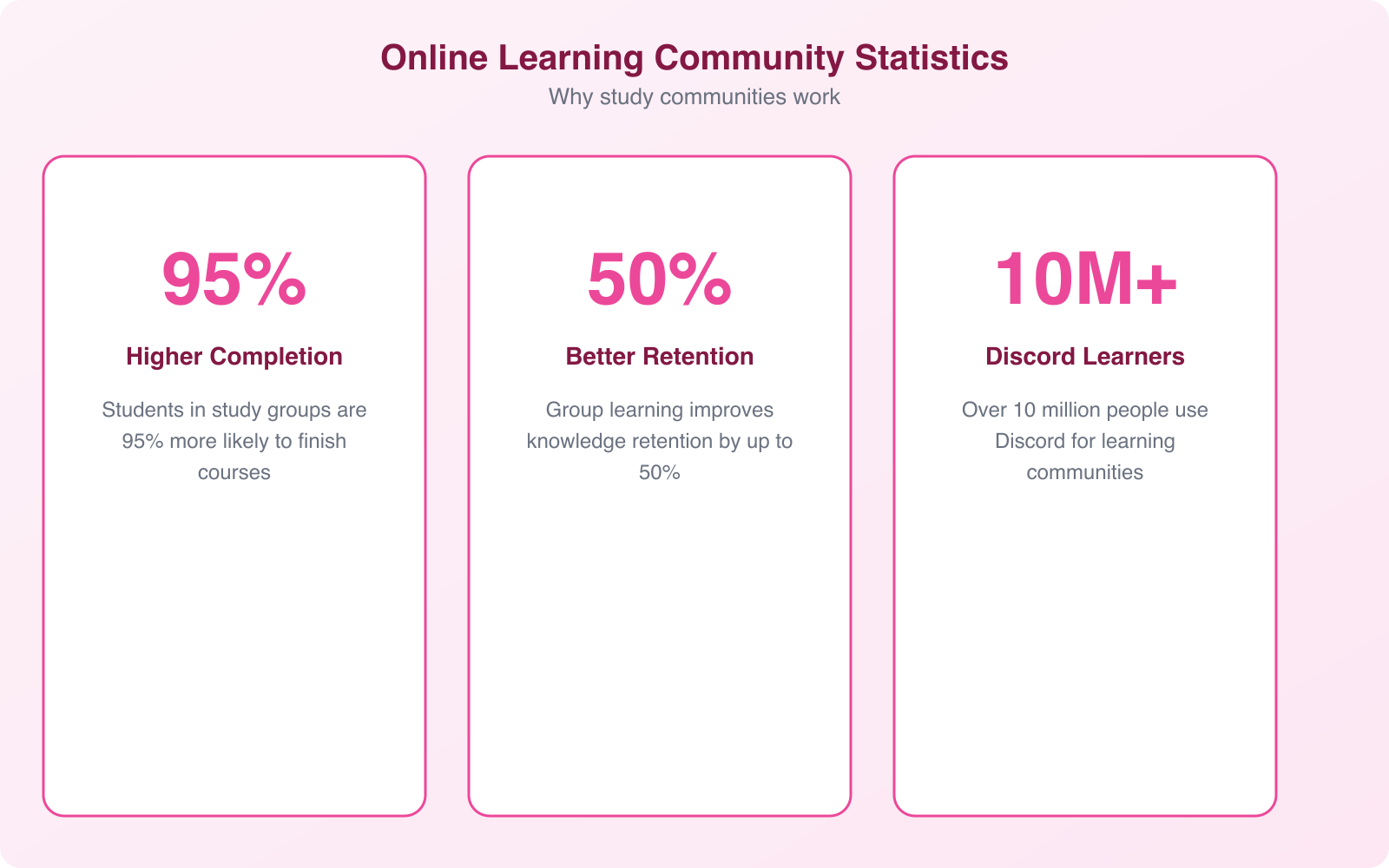
Before I list the platforms, let me explain why communities matter for learning. Research consistently shows that social learning improves retention, motivation, and completion rates. When you study alone, there’s no consequence for skipping a day. When you’re in a group that expects you to show up, you show up.
Study communities also give you access to diverse perspectives. When you’re stuck on a concept, someone else’s explanation might click where the instructor’s didn’t. You’ll discover resources, shortcuts, and insights you’d never find on your own. And the social pressure of seeing peers make progress pushes you to keep going.
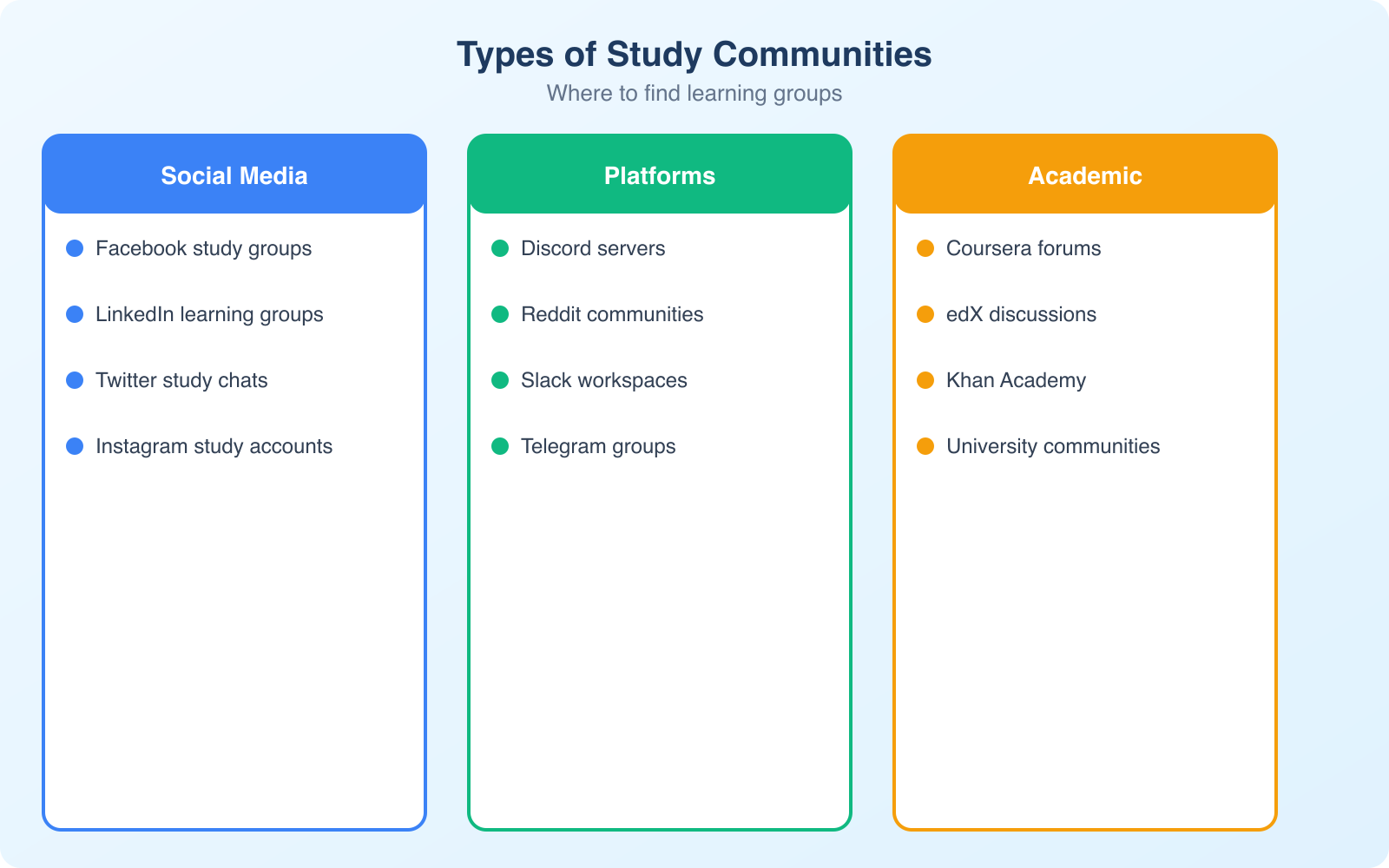
Social Media Study Groups
Social media platforms aren’t just for scrolling. They host some of the most active study communities on the internet.
Facebook Groups: Despite what people say about Facebook being dead, it has thousands of active study groups. Search for your subject plus “study group” or “learning community.” Groups like “GRE Prep Community” (200,000+ members), “Learn Python” (500,000+ members), and subject-specific academic groups are thriving. The advantage of Facebook groups is that they’re easy to search, have a familiar interface, and most people already have accounts.
X (Twitter) Communities: X has topic-based communities and hashtags like #StudyTwitter, #LearnInPublic, and #100DaysOfCode. These work best for tech and creative fields. The learning happens through public sharing: people post what they’re studying, ask questions, and share resources. It’s less structured than a group but great for accountability.
Reddit and Online Forums
Reddit is one of the best resources for learning communities, period. Nearly every academic subject and professional skill has a dedicated subreddit with active discussions.
For programming: r/learnprogramming (3.5M+ members), r/webdev, r/python, r/javascript. For academics: r/math, r/physics, r/biology. For test prep: r/GRE, r/LSAT, r/MCAT. For career development: r/cscareerquestions, r/datascience.
The quality of answers on Reddit’s study subreddits is often better than what you’ll find in paid courses. Real practitioners answer questions, share resources, and provide feedback on your work. The downside is that Reddit can be a time sink if you’re not disciplined about staying on topic.
Stack Overflow and Stack Exchange are also worth mentioning. While they’re Q&A sites rather than traditional communities, they function as some of the largest knowledge-sharing platforms for specific subjects. Stack Overflow covers programming. Math Stack Exchange covers mathematics. Cross Validated covers statistics. The answering format enforces quality: good answers rise to the top, bad answers get downvoted, and the result is a searchable archive of expert knowledge that grows more useful every day.
Quora is another option, though it’s shifted more toward general knowledge than deep academic discussions. It’s still useful for specific questions where you want expert perspectives.
Discord Servers for Learning
Discord has evolved way beyond gaming. It’s now one of the best platforms for real-time learning communities. The advantage of Discord over forums is immediacy. You can ask a question and get an answer in minutes, not days.
Popular learning servers include The Programmer’s Hangout (programming), Studycord (general academics), The Math Community, and hundreds of subject-specific servers. Many course creators now include a Discord server as part of their course package, giving you a direct line to instructors and fellow students.
To find Discord study servers, search on Disboard.org or Discord.me using keywords related to your subject. Look for servers with at least 1,000 members and recent activity in the last 24 hours. Smaller servers can be great too, but they need to be active to provide value.
Discord’s voice channels are perfect for virtual study sessions. Find 2-3 study partners in your server and schedule a weekly voice call where you work through problems together. This replicates the in-person study group experience better than any other platform.
Educational Platform Communities
Educational websites like Khan Academy, Coursera, Udemy, and EdX have built-in discussion forums tied to specific courses. These are valuable because everyone in the forum is studying the same material at roughly the same time.
Coursera’s forums are particularly active. Each course has discussion threads organized by week and topic. You can ask questions, share notes, and help other students, all within the context of the course material. EdX has a similar setup. Khan Academy’s community is great for K-12 and early college-level subjects.
The limitation of platform-specific forums is that they’re tied to the course timeline. Once a course ends, activity often drops off. Supplement these with platform-independent communities (like Discord or Reddit) for ongoing learning.
LinkedIn Groups for Professional Learning
LinkedIn Groups are underrated for professional development. They sit at the intersection of academic learning and career advancement. You’ll find groups focused on specific industries, certifications, and professional skills.
Search for keywords like “PMP study group,” “data science learning,” or “digital marketing community” in LinkedIn’s group search. The best groups have regular posts, genuine discussions (not just self-promotion), and a mix of beginners and experienced professionals.
LinkedIn groups work especially well for working professionals who want to learn from others in their industry. The discussions often blend theoretical knowledge with practical career advice, which you won’t get from purely academic communities.
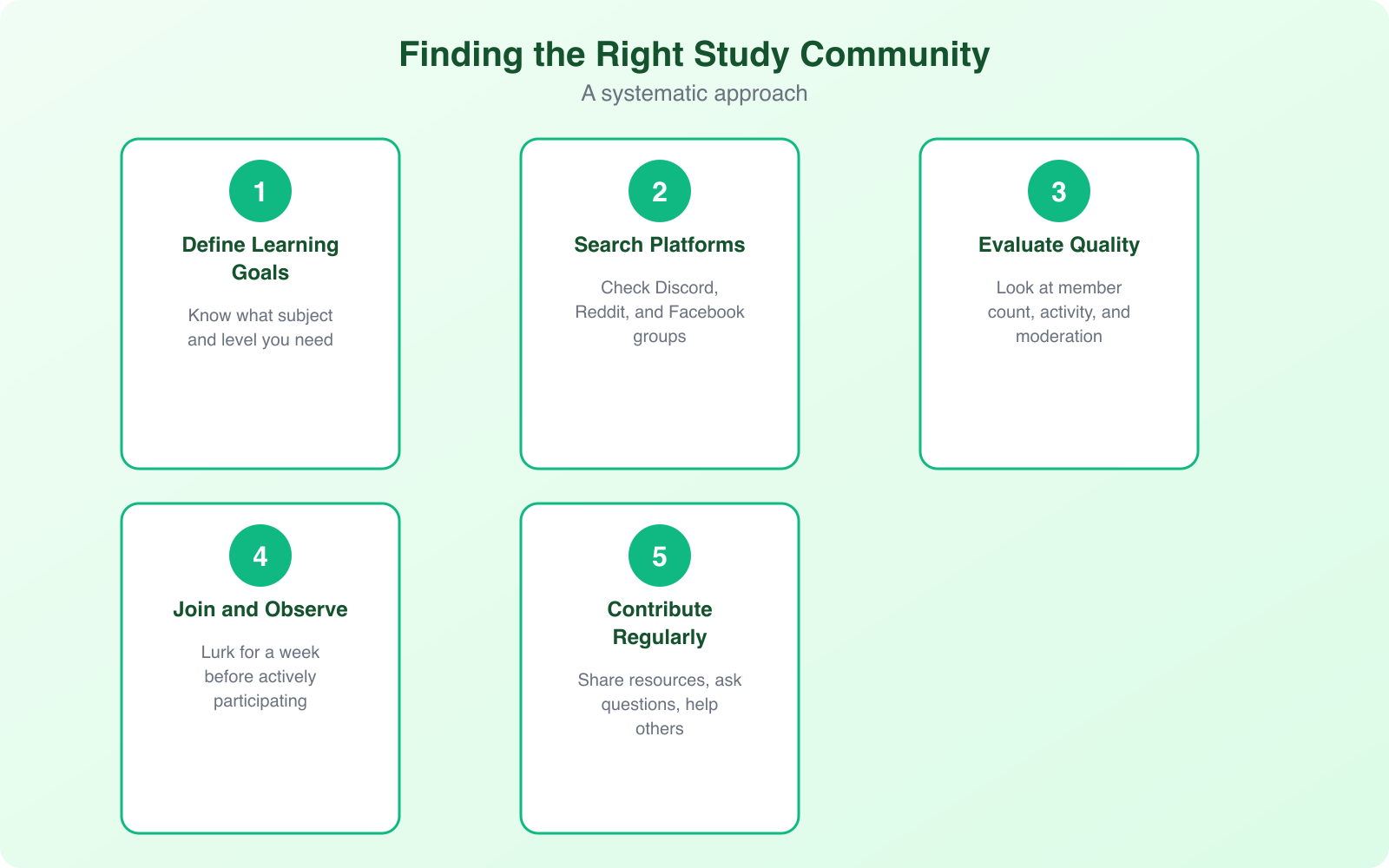
Virtual Study Tools and Meetups
Meetup.com bridges the gap between online and in-person learning. You can find virtual study groups, local study meetups, and hybrid events where online members join a physical location via video call.
Search for study meetups in your area or filter by “online events” to find virtual groups. Many coding bootcamp graduates organize ongoing study sessions through Meetup. Language learners use it for conversation practice groups. Academics use it for exam prep study sessions.
For virtual study collaboration, there are dedicated apps that combine video calls, shared whiteboards, and timer-based study sessions (like the Pomodoro technique) in one interface. These tools make online studying feel more structured and productive than just hopping on a Zoom call.
How to Start Your Own Study Group
Sometimes the perfect study community doesn’t exist yet. That means you get to build it. Starting your own group is easier than you think, and the founder usually benefits the most because you set the pace, the rules, and the culture from day one.
Pick a platform and keep it simple. Discord is the best choice for most study groups because it’s free, supports text and voice channels, and has bots that can manage scheduling, reminders, and roles. Create a server with 4-5 channels: general, study-resources, questions, accountability, and off-topic. Don’t overcomplicate it with 20 channels at the start.
Define the group’s purpose clearly. “Study group for web developers” is too broad. “Study group for people preparing for the AWS Solutions Architect exam in Q2 2026” is specific and attracts the right people. Write a one-paragraph description that answers: What are we studying? Who is this for? What’s the expected commitment? Post it when you recruit members.
Start with 5-8 people, not 50. Small groups are more active, more accountable, and build stronger relationships. You can always grow later. Recruit from existing communities: post in relevant subreddits, Discord servers, or LinkedIn groups that you’re starting a focused study group and looking for committed members.
Create a weekly rhythm. Schedule a fixed study session every week at the same time. Monday evening for goal setting, Thursday for a voice call study session, Sunday for progress check-ins. Consistency matters more than frequency. A group that meets reliably once a week outperforms one that tries to meet daily but flakes out after two weeks.
Set ground rules early. Three rules are enough to start: be respectful, contribute at least once per week, and no self-promotion or spam. Enforce them consistently. One person who derails discussions or posts irrelevant content will drive away your best members faster than anything else.
Avoiding Toxic or Unproductive Study Communities
Not all communities are worth your time. Some are outright harmful to your learning. Here’s what to watch for before committing.
Constant negativity. If every discussion is people complaining about how hard the exam is, how unfair the grading is, or how the industry doesn’t value certifications, leave. Negativity is contagious and drains motivation. Productive communities acknowledge challenges but focus on solutions.
Answer quality is low. Read 10 recent question threads. Are the answers helpful, specific, and accurate? Or are they vague, incorrect, or just “Google it”? A community where beginners answer beginners can reinforce bad habits and spread misinformation.
Heavy self-promotion. If half the posts are people plugging their own courses, YouTube channels, or products, the community has become a marketing channel, not a learning space. Good communities have strict rules against unsolicited promotion.
No moderation. Communities without active moderators decay fast. Spam creeps in, off-topic posts dominate, and helpful members leave. Check if moderators are active by looking at pinned posts and recent mod actions. A well-moderated community with 1,000 members is more valuable than an unmoderated one with 100,000.
Gatekeeping and elitism. Some communities mock beginners for asking “basic” questions. This kills participation and creates a hostile environment. The best communities welcome all levels and have a culture where experienced members help newer ones without condescension.
How to Get Real Value from Study Communities
Joining a community is step one. Getting value from it requires a bit more effort. Here’s what works.
Contribute, don’t just consume. The people who get the most from study communities are the ones who help others. Answering questions reinforces your own knowledge. Sharing resources builds goodwill. Being an active participant means people remember your name and are more willing to help you when you need it.
Limit yourself to 3-4 communities. Joining 10 communities means you’ll be active in none of them. Pick one primary community where you spend most of your time, and 2-3 others for specific needs.
Schedule your participation. Set aside 15-20 minutes per day to check your communities, answer a question, and post an update. Don’t let community browsing replace actual studying.
Build 1:1 connections. The real networking value comes from individual relationships, not from posting in public channels. Find 2-3 people at your level and build a study partnership. Exchange notes, quiz each other, and hold each other accountable.
Before joining any community, lurk for 48 hours first. Read the recent discussions. Check the quality of responses. See if moderators are active. A community with great members but no moderation quickly devolves into spam. A community with strict moderation but low activity isn’t useful either. Look for the balance.
Study Community Tools That Make Collaboration Easier
Beyond the platforms where communities live, there are tools that make studying together more effective, even when you’re in different time zones.
Shared note-taking: Notion is my top pick for collaborative study notes. Create a shared workspace where group members can add notes, organize them by topic, and build a collective knowledge base that’s more comprehensive than anything one person could create alone. Google Docs works for simpler needs.
Flashcard apps: Anki and Quizlet let you create and share flashcard decks with your study group. One person creates cards for chapter 1, another for chapter 2, and everyone benefits from the full set. Shared flashcard decks are especially effective for exam prep, language learning, and memorization-heavy subjects.
Video study sessions: Zoom and Google Meet work for scheduled study calls. But for spontaneous “body doubling” (studying alongside others for accountability), try platforms built specifically for this. Study Stream and Focusmate match you with study partners for timed sessions. The simple act of knowing someone else is working alongside you dramatically reduces procrastination.
Progress tracking: Share your study hours with your group using a shared spreadsheet or a habit-tracking app. Seeing that your study partners logged 10 hours this week when you only logged 3 creates healthy accountability. Some Discord servers use bots to track study time, with leaderboards that gamify the process.
Whiteboard tools: For subjects that require visual explanation (math, physics, architecture, design), shared whiteboards like Miro, FigJam, or Excalidraw let you draw diagrams and work through problems together in real-time. These are essential for any group studying technical or visual subjects.
Online study communities won’t replace the discipline of sitting down and doing the work. But they’ll make the work more enjoyable, help you learn faster, and connect you with people who can become lifelong professional contacts. Start with one community that matches your current learning goal. Be an active participant. Build real relationships. The knowledge compounds, and so do the connections. For more resources on collaborative learning, check out the ultimate study toolkit for students and my list of study tools for college students.
Frequently Asked Questions
Are online study communities actually effective?
Yes. Research shows that social learning improves retention by 50-75% compared to studying alone. Study communities provide accountability, diverse perspectives, and peer support. The key is choosing active communities with quality discussions and being a contributor, not just a lurker.
Which platform is best for study groups?
Discord is the best for real-time interaction and voice study sessions. Reddit is best for long-form discussions, Q&A, and resource sharing. Facebook Groups are best for large communities around test prep and language learning. LinkedIn Groups are best for professional development. The right platform depends on your subject and learning style.
How many study communities should I join?
No more than 3-4. Joining too many communities splits your attention and makes it impossible to be an active participant in any of them. Pick one primary community where you invest most of your time, and add 1-2 supplementary ones for specific needs. Quality of participation beats quantity of memberships every time.
How do I find a study partner online?
Join a community related to your subject and look for people posting at a similar level to you. Start by responding to their posts and offering help. After a few interactions, suggest a weekly study session via voice call. Discord and Meetup.com are the best platforms for finding study partners because they support both text and voice communication.
Are paid study communities better than free ones?
Not necessarily. Many free communities on Discord and Reddit are excellent. Paid communities sometimes offer more structure (scheduled calls, curated resources, active moderation), but the price alone doesn’t guarantee quality. Before paying, check if there’s a free trial, read reviews from current members, and evaluate whether the paid community offers something you can’t get for free elsewhere.
Disclaimer: This site is reader-supported. If you buy through some links, I may earn a small commission at no extra cost to you. I only recommend tools I trust and would use myself. Your support helps keep gauravtiwari.org free and focused on real-world advice. Thanks. - Gaurav Tiwari