
The Environmental Impact of Bitcoin Mining: Challenges and Green Solutions

The environmental impact of bitcoin mining is real, but the story changed a lot since the panic headlines of 2021. The Cambridge Centre for Alternative Finance now pegs the network at roughly 138 terawatt-hours a year, about half a percent of global electricity. That’s a country-sized appetite. The honest update is that more than half of that power now comes from sustainable sources, coal collapsed, and most worn-out machines get reused instead of landfilled. So it’s a genuine problem that’s improving faster than its reputation suggests.
I’ve followed crypto since the early ASIC era, and I’ve watched the same numbers get quoted wildly out of context. Below I’ve pulled the latest 2025-2026 figures from the people who actually measure this, the trade-offs nobody likes to mention, and a straight answer to whether bitcoin is bad for the planet. No cheerleading, no doom.
Table of Contents
The Environmental Impact of Bitcoin Mining in 2026
Verdict: Bitcoin mining’s environmental impact is real but improving. The network draws about 138 TWh a year and emits roughly 39.8 million tonnes of CO2, yet 52.4% of its electricity is now zero-emission, coal fell from 36.6% to 8.9% since 2022, and 86.9% of mining hardware gets reused. It’s a heavy footprint trending in the right direction, not the climate apocalypse the early headlines sold. The fight worth having now is over where miners plug in, not whether mining should exist.
Proof, sourced: The figures here come from the Cambridge Digital Mining Industry Report 2025 (built on primary data from 49 mining companies), Digiconomist’s Bitcoin Energy Consumption Index, the US Energy Information Administration’s 2024 crypto-mining tracking, and de Vries and Stoll’s peer-reviewed e-waste study. Last verified June 2026.
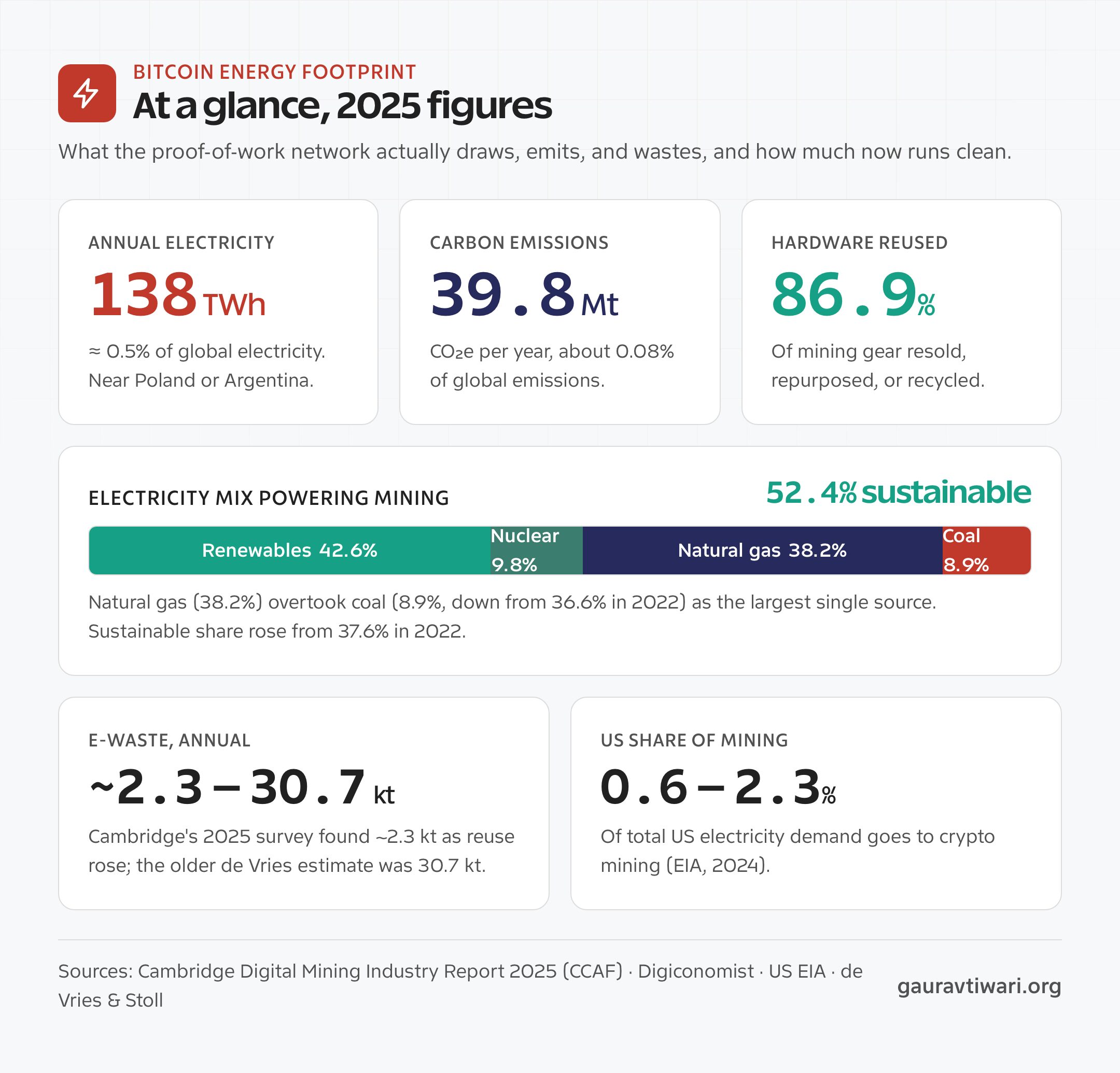
What changed (2026): The 2024 halving roughly doubled the energy needed to mint a single coin, and hashrate kept climbing past 900 EH/s. But the energy mix got cleaner. Natural gas (38.2%) overtook coal (8.9%) as the top single source, and sustainable energy crossed 52%. The pressure point shifted from “how much” to “from where.”
How Much Energy Bitcoin Mining Actually Uses
Bitcoin energy consumption sits around 138 TWh per year, according to Cambridge’s latest index. That’s roughly the annual electricity use of Poland or Argentina, and close to 0.5% of global power generation. The demand comes from proof-of-work, the system that makes the network secure by forcing miners to burn real computation to add each block. There’s no way to fake the work, which is exactly the point, and exactly the cost.
Per-machine efficiency keeps improving, but total bitcoin mining electricity rises because more miners join. After the April 2024 halving cut the block reward from 6.25 to 3.125 BTC, the power needed to produce one bitcoin roughly doubled, and the network hashrate still climbed past 900 exahashes per second by mid-2025. In the US alone, the EIA estimates crypto mining draws between 0.6% and 2.3% of national electricity, comparable to entire states.
| Metric | Latest figure | Context |
|---|---|---|
| Annual electricity | ~138 TWh | About 0.5% of global electricity |
| Comparable country | Poland / Argentina | Similar national consumption |
| Annual CO2 emissions | ~39.8 Mt CO2e | About 0.08% of global emissions |
| US share of mining | 0.6% – 2.3% of US grid | EIA, 2024 |
| Network hashrate | ~900+ EH/s | Mid-2025, up sharply post-halving |
The Carbon Footprint of Crypto Mining
The crypto mining carbon footprint depends almost entirely on what fuels the grid behind the miners. Cambridge estimates network-wide emissions at about 39.8 million tonnes of CO2 equivalent a year, roughly 0.08% of global greenhouse gases. Digiconomist runs higher (near 98 Mt) because it assumes a dirtier energy mix. Both can be true at once, which tells you the answer hinges on assumptions about where mining happens.
The encouraging shift is in the fuel mix itself. Coal, which powered 36.6% of mining in 2022, dropped to 8.9% by 2025. Natural gas rose to 38.2%, and sustainable sources (renewables plus nuclear) reached 52.4%. Renewables alone, mostly hydro and wind, account for 42.6%, with nuclear adding 9.8%. That migration, much of it triggered when China banned mining and operations relocated, did more for bitcoin’s carbon profile than any voluntary pledge.
The Nuance Most People Miss: Grid Mix and Stranded Energy
Here’s the part most environmental impact of bitcoin mining articles skip. A miner’s footprint isn’t a fixed number, it’s whatever the local grid emits at the moment those machines run. The same rig is nearly carbon-free in hydro-rich Sichuan or geothermal Iceland and filthy on a coal grid. Averages hide that completely, which is why two credible studies can land 2.5x apart.
Then there’s stranded energy. Miners are uniquely mobile and interruptible, so they chase power that would otherwise be wasted: flared gas at oil wells, curtailed wind that the grid can’t absorb, hydro spilling during the wet season. In Texas, miners now act as a flexible load that powers down within seconds during demand spikes, getting paid to stabilize the grid. That doesn’t erase the footprint. It does mean a well-sited miner can be a grid asset, while a badly-sited one is pure waste. Location is the whole game.
Electronic Waste From Mining Hardware
Mining ASICs are single-purpose chips that go obsolete fast, often within one to two years, so e-waste is a legitimate concern. The widely-cited de Vries and Stoll study put annual mining e-waste near 30.7 metric kilotons, with each machine lasting about 1.29 years. That figure still gets quoted as if nothing changed.
It did change. Cambridge’s 2025 survey, using primary data from operators, found annual e-waste closer to 2.3 kilotons, because 86.9% of retired hardware is now resold, repurposed, or recycled and only 3.2% of companies have no e-waste plan at all. The truth sits between the two: older ASICs increasingly get shipped to regions with cheaper power for a second life rather than scrapped. Recycling the specialized chips remains hard, but the wasteful image is dated.
Local Impact on Water, Grids, and Communities
Beyond the global numbers, mining lands hard on specific places. Large facilities can strain local water supplies for cooling and push up retail electricity prices for nearby residents when they tap into regional grids. Noise from thousands of fans has triggered real complaints and lawsuits in rural US counties hosting mining sheds.
The flip side is jobs and tax revenue in places that had little of either. Rural towns have gained employment and a buyer for otherwise stranded power. The fair conclusion is that local outcomes swing on siting and regulation, not on mining as an abstraction. A site on curtailed wind with proper noise controls is a different animal from a coal-fed shed next to homes.
Regulation and Where Policy Is Heading
Policy is catching up unevenly. China banned mining outright in 2021, which scattered operations across the US, Kazakhstan, and beyond. The EU’s Markets in Crypto-Assets (MiCA) framework brought disclosure and environmental reporting into the rulebook. The US has leaned toward energy-use transparency and grid-impact studies rather than bans.
Where it’s heading: more mandatory energy-source disclosure, incentives that reward miners for using renewables or stranded gas, and stricter e-waste rules for hardware disposal. The smart regulatory move isn’t to outlaw mining, it’s to price in the externalities so the dirty sites lose money and the clean ones win. That’s already starting to happen through electricity markets.
Is Bitcoin Bad for the Environment? My Honest Take
So is bitcoin bad for the environment? My honest answer: it has a heavy footprint that’s getting lighter per unit of value, and the bitcoin renewable energy share is now the majority of its power. It’s not green, and pretending otherwise is dishonest. But the 2021-era framing of bitcoin as a climate wrecker hasn’t kept pace with a network that’s over half sustainable, mostly off coal, and increasingly built on energy that would otherwise be wasted.
If you care about this, the leverage isn’t boycotting bitcoin, it’s pushing mining toward clean and stranded power and demanding transparency on where machines plug in. If you’re weighing crypto more broadly, it’s worth understanding the trade-offs before you commit. I’ve written a grounded primer on investing in cryptocurrency for that, and a practical guide on how to exchange and buy crypto profitably if you decide to.
Proof-of-stake coins sidestep most of this energy debate entirely, which is part of why the conversation around assets like Dogecoin and the broader market keeps shifting. And if you publish in this space, my notes on crypto SEO and how to rank cover how to write about it credibly.
Frequently Asked Questions
How much energy does bitcoin mining use in 2026?
Bitcoin mining uses about 138 terawatt-hours of electricity a year, according to the Cambridge Centre for Alternative Finance. That’s roughly 0.5% of global electricity and comparable to the annual consumption of Poland or Argentina. The figure rises over time as more miners join, even though individual machines keep getting more efficient.
What percentage of bitcoin mining uses renewable energy?
As of the Cambridge 2025 report, 52.4% of bitcoin mining electricity comes from sustainable sources. Renewables like hydro and wind make up 42.6%, and nuclear adds another 9.8%. Coal dropped from 36.6% in 2022 to 8.9%, while natural gas rose to 38.2% and is now the single largest source.
Is bitcoin bad for the environment?
Bitcoin has a real environmental footprint, emitting roughly 39.8 million tonnes of CO2 a year, about 0.08% of global emissions. But it’s improving: more than half its power is now zero-emission, coal use collapsed, and most hardware gets reused. It’s a heavy but shrinking footprint, not the climate disaster early headlines described.
How much e-waste does bitcoin mining create?
Estimates range widely. The older de Vries and Stoll study put it near 30.7 metric kilotons a year, but Cambridge’s 2025 operator survey found closer to 2.3 kilotons because 86.9% of retired mining hardware is now resold, repurposed, or recycled rather than scrapped.
What is stranded energy and why does it matter for bitcoin?
Stranded energy is power that would otherwise be wasted, like flared gas at oil wells or curtailed wind the grid can’t absorb. Because miners are mobile and can power down in seconds, they can soak up this energy and even stabilize grids, as they do in Texas. A well-sited miner can be a grid asset rather than pure waste.
Did the 2024 bitcoin halving affect energy use?
Yes. The April 2024 halving cut the block reward from 6.25 to 3.125 BTC, which roughly doubled the energy needed to produce a single bitcoin. Network hashrate still climbed past 900 exahashes per second by mid-2025, so total consumption stayed high even as the energy mix grew cleaner.