Difference Quotient Calculator
The difference quotient measures how a function changes between two points. It’s the formula \( \dfrac{f(a+h) – f(a)}{h} \), and it sits between algebra and calculus — once you understand it, derivatives stop feeling mysterious.
Difference Quotient Calculator
\( \dfrac{f(a+h) - f(a)}{h} \)
Enter a function of x, a point a, and a step size h. The calculator returns the difference quotient and an approximation of \( f'(a) \).
x, + - * /, ^ for powers, and sqrt(x), sin(x), cos(x), ln(x), exp(x), abs(x). ————The formula
Given a function \( f \) and a point \( a \), the difference quotient with step \( h \) is:
$$DQ(a, h) = \dfrac{f(a + h) – f(a)}{h}$$
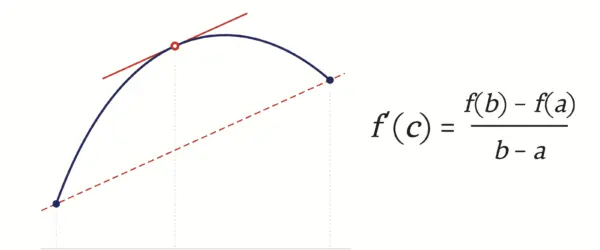
Geometrically, this is the slope of the secant line connecting two points on the graph of \( f \): the point \( (a, f(a)) \) and the point \( (a+h, f(a+h)) \). The numerator is the rise. The denominator is the run. Dividing them gives the average rate of change of \( f \) over the interval from \( a \) to \( a+h \).
As \( h \) shrinks toward zero, the secant line rotates and approaches the tangent line at \( a \), and the difference quotient approaches the derivative \( f'(a) \). That limit is the definition of the derivative:
$$f'(a) = \lim_{h \to 0} \dfrac{f(a + h) – f(a)}{h}$$
How to compute the difference quotient by hand
The mechanical steps work for any function, but the algebra is cleanest on polynomials.
- Substitute a + h into f. Wherever you see x in the function, replace it with the expression a + h.
- Subtract f(a). Compute f(a) and subtract it from f(a + h). Most algebraic terms cancel for polynomials.
- Divide by h. Factor h out of every remaining term in the numerator, then cancel against the denominator. If you can’t factor h cleanly, you’ve made an algebra mistake earlier.
- Simplify what’s left. The result should be an expression in a and h. As h goes to 0, only terms without h survive — those terms equal f′(a).
Worked example: \( f(x) = x^2 \)
Substitute: \( f(a + h) = (a + h)^2 = a^2 + 2ah + h^2 \). Subtract \( f(a) = a^2 \). Numerator: \( 2ah + h^2 \). Factor \( h \): \( h(2a + h) \). Divide by \( h \): \( 2a + h \). As \( h \to 0 \), the result is \( 2a \), which matches the standard derivative \( f'(x) = 2x \).
Worked example: \( f(x) = 1/x \)
Substitute: \( f(a + h) = \dfrac{1}{a + h} \). Subtract \( f(a) = \dfrac{1}{a} \). Common denominator: \( \dfrac{a – (a + h)}{a(a + h)} = \dfrac{-h}{a(a + h)} \). Divide by \( h \): \( \dfrac{-1}{a(a + h)} \). As \( h \to 0 \), the denominator becomes \( a^2 \), so \( f'(a) = -\dfrac{1}{a^2} \). Matches the derivative of \( 1/x \).
Worked examples table
Numerical results from the calculator above for common functions, paired with the symbolic derivative each one converges to.
| Function | Inputs | Difference quotient | True \( f'(a) \) |
|---|---|---|---|
| \( f(x) = x^2 \) | \( a = 2,\ h = 0.001 \) | \( \frac{2.001^2 – 2^2}{0.001} = 4.001 \) | \( 4 \) (= \( 2a \)) |
| \( f(x) = 3x + 5 \) | \( a = 7,\ h = 0.5 \) | \( \frac{(3 \cdot 7.5 + 5) – (3 \cdot 7 + 5)}{0.5} = 3 \) | \( 3 \) (constant slope) |
| \( f(x) = x^3 \) | \( a = 1,\ h = 0.0001 \) | \( \frac{1.0001^3 – 1^3}{0.0001} \approx 3.00030001 \) | \( 3 \) (= \( 3a^2 \)) |
| \( f(x) = \sqrt{x} \) | \( a = 4,\ h = 0.0001 \) | \( \frac{\sqrt{4.0001} – \sqrt{4}}{0.0001} \approx 0.249998 \) | \( 0.25 \) (= \( 1/(2\sqrt{a}) \)) |
| \( f(x) = \sin x \) | \( a = 0,\ h = 0.0001 \) | \( \frac{\sin(0.0001) – 0}{0.0001} \approx 0.999999998 \) | \( 1 \) (= \( \cos 0 \)) |
Difference quotient vs. derivative
They’re closely related, but not the same.
- The difference quotient is a number for any specific h > 0. It’s defined for any two points on f and represents the average rate of change.
- The derivative is the limit of the difference quotient as h goes to zero. It exists only when that limit exists (most smooth functions, but not at corners or cusps).
- Numerical use: if you can’t differentiate f symbolically (an experimental dataset, a black-box function), the difference quotient with small h gives a usable derivative estimate.
- Symbolic use: the difference quotient is the algebraic ladder you climb to derive f′(x) from first principles in calculus.
Forward, backward, and central difference quotients
The standard formula \( \dfrac{f(a+h) – f(a)}{h} \) is the forward difference quotient. Two close cousins show up in numerical methods:
- Backward difference: \( \dfrac{f(a) – f(a – h)}{h} \). Same accuracy as forward; useful when \( f \) is only defined for \( x \leq a \).
- Central difference: \( \dfrac{f(a + h) – f(a – h)}{2h} \). Uses points on both sides of \( a \). Significantly more accurate than forward or backward at the same \( h \). The calculator above reports this as the \( f'(a) \) approximation.
If you need a derivative estimate from data, prefer the central difference. Its error decreases as \( h^2 \) (instead of \( h \)), so a step of \( 0.001 \) gives derivative accuracy comparable to a forward step of \( 0.000001 \).
Common mistakes
- Forgetting parentheses around \( (a + h) \). Writing \( f(a + h) = a^2 + h^2 \) for \( f(x) = x^2 \) is wrong because \( (a + h)^2 = a^2 + 2ah + h^2 \). Always wrap \( a + h \) in parentheses before substituting.
- Cancelling \( h \) before factoring. The \( h \) in the denominator can only cancel after you’ve factored \( h \) out of every term in the numerator. Cancel only with the factored expression, never term-by-term.
- Setting \( h = 0 \) too early. The difference quotient is undefined at \( h = 0 \) (division by zero). The derivative is the limit as \( h \to 0 \), which is something you take after you’ve simplified.
- Using \( h \) that’s too small in numerical work. For floating-point arithmetic, \( h \) below \( \sim 10^{-8} \) amplifies round-off error and makes the estimate worse, not better. The sweet spot is around \( 10^{-4} \) to \( 10^{-6} \).
Related calculators
Other calculus calculators on the same series:
- Partial Derivative Calculator
- Inverse Function Calculator
- L’Hôpital’s Rule Calculator
- Definite Integral Solver
- Taylor Series Calculator
- All calculators on gauravtiwari.org
Useful calculus books and tools
For a difference quotient, simplify symbolically before substituting a small value for the increment. Calculus answers are easier to trust when you can connect the symbolic work to a graph, an estimate, and the theorem behind the method.
- Practice beyond one example: Browse calculus textbooks and workbooks on Amazon. Look for worked problems, review exercises, and clear treatment of limits and applications.
- Sketch before calculating: Browse graph-paper notebooks on Amazon. A quick graph often reveals sign errors, incorrect bounds, and unreasonable answers.
As an Amazon Associate, I earn from qualifying purchases.
Frequently asked questions
What is the difference quotient?
The difference quotient is the formula \( \dfrac{f(a+h) – f(a)}{h} \). It measures the average rate of change of a function \( f \) over an interval of length \( h \) starting at the point \( a \). As \( h \) shrinks toward zero, the difference quotient becomes the derivative \( f'(a) \).
How is the difference quotient related to the derivative?
The derivative is the limit of the difference quotient as \( h \to 0 \): \( f'(a) = \lim_{h \to 0} \dfrac{f(a+h) – f(a)}{h} \). The difference quotient is the geometric secant-line slope between two points on \( f \); the derivative is the tangent-line slope at a single point.
How do you simplify the difference quotient?
For a polynomial like \( f(x) = x^2 \), expand \( f(a+h) = (a+h)^2 = a^2 + 2ah + h^2 \). Subtract \( f(a) = a^2 \) to get \( 2ah + h^2 \). Divide by \( h \) to get \( 2a + h \). The \( h \) cancels cleanly, leaving an expression you can evaluate at any \( a \).
What is the difference quotient of x squared?
For \( f(x) = x^2 \), the difference quotient is \( \dfrac{(a+h)^2 – a^2}{h} = \dfrac{2ah + h^2}{h} = 2a + h \). As \( h \to 0 \), this becomes \( 2a \), which is the well-known derivative \( f'(x) = 2x \).
What is the difference quotient of x cubed?
For \( f(x) = x^3 \), the difference quotient simplifies to \( 3a^2 + 3ah + h^2 \). As \( h \to 0 \), the \( 3ah \) and \( h^2 \) terms vanish, leaving \( 3a^2 \). That matches \( f'(x) = 3x^2 \) for the cubic.
Why does smaller h give a more accurate derivative?
The difference quotient is the slope of a secant line through \( (a, f(a)) \) and \( (a+h, f(a+h)) \). As \( h \) shrinks, the second point slides toward the first, and the secant rotates into the tangent. In floating-point, however, \( h \) that is too small (below \( \sim 10^{-8} \)) introduces round-off error and the estimate gets worse, not better.
Can the difference quotient be negative?
Yes. A negative difference quotient means \( f \) is decreasing over the interval \( [a, a+h] \). The sign of the difference quotient at a point matches the sign of \( f'(a) \) for a smooth function: positive means rising, negative means falling, zero means a local flat point.
What is a good value of h to use?
For numerical estimates, \( h = 0.001 \) or \( h = 0.0001 \) is a good default — small enough to closely approximate \( f'(a) \), large enough to avoid floating-point round-off. The calculator on this page also returns a central-difference estimate, which uses \( h \) on both sides of \( a \) and is typically two orders of magnitude more accurate than the forward difference.