
5 Proven Strategies to Help Your Business Rank Well in Search Engines in 2026
Roughly 96.55% of all pages get zero organic traffic from Google, according to an Ahrefs study. Your website could be one of them right now, sitting on page four while competitors own the top spots. You’ve probably installed an SEO plugin, thrown keywords into your content, and waited for results that never came.
The problem isn’t effort. It’s approach. Google evaluates over 200 ranking factors, rolled out multiple core updates in 2026, and AI Overviews now dominate search results for high-value queries. The old playbook of stuffing keywords and building random backlinks doesn’t work anymore. It actively hurts you. Meanwhile, businesses that follow a disciplined set of strategies keep climbing while everyone else scrambles after each algorithm shift.
This guide covers the 5 strategies that consistently move the needle for businesses trying to rank, with specific tools, real metrics, and implementation steps at every stage.
Thorough Keyword Research and Search Intent Matching
Every successful SEO campaign starts with understanding what your potential customers actually search for and why. Keyword research is not just about finding high-volume terms. It is about mapping search intent to the content you create.
Google categorizes search intent into four types: informational (learning something), navigational (finding a specific site), commercial (comparing options), and transactional (ready to buy). A business that only targets transactional keywords misses the 80% of searches that happen earlier in the buying journey.
Here is how I approach keyword research for client sites:
- Start with seed keywords. List 10-15 core terms your customers use to describe your products or services. Not marketing jargon. Their actual words.
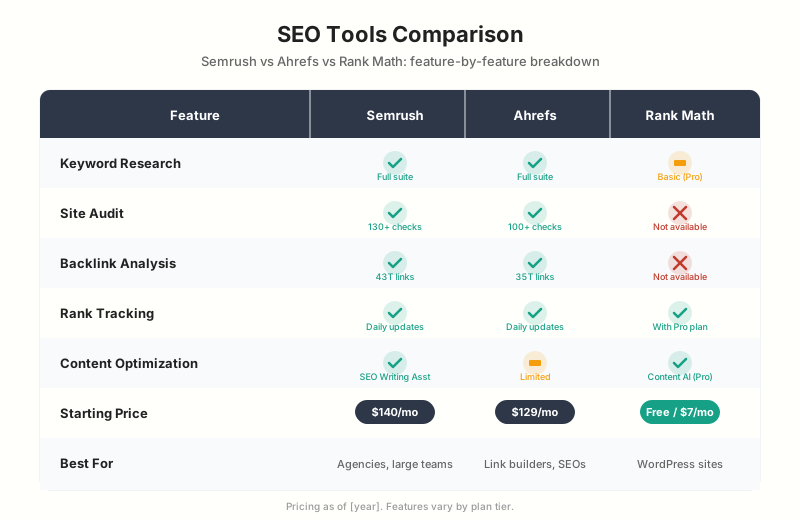
- Expand using tools. Semrush and Ahrefs both generate thousands of related keywords from a single seed. I use Semrush’s Keyword Magic Tool because it clusters keywords by topic automatically.
- Analyze the SERP for each keyword. Before targeting any term, search it yourself. Are the top results blog posts, product pages, videos, or local listings? That tells you what Google considers the right format for that query.
- Check keyword difficulty. A keyword with 50,000 monthly searches and a difficulty score of 85 is not worth targeting if your site has a Domain Authority of 20. Focus on terms where you can realistically compete.
- Group by topic clusters. Instead of targeting individual keywords, build content clusters: one pillar page covering the broad topic and supporting pages targeting long-tail variations.
The biggest mistake I see businesses make with keyword research is treating it as a one-time task. Search behavior evolves. New competitors enter your space. Google’s algorithm changes what it prioritizes. I revisit keyword strategies quarterly, at minimum.
Semrush
- Keyword Magic Tool with 26B+ keywords
- Site Audit with 140+ technical checks
- Competitor analysis and gap reports
- Position tracking across devices and locations
- Content optimization with SEO Writing Assistant
On-Page SEO That Actually Moves Rankings
On-page SEO is every optimization you make directly on your website pages. It is the part you have complete control over, and getting it right gives you an immediate advantage over competitors who neglect it.
The fundamentals have not changed, but the standards have gotten stricter. Google’s systems are significantly better at understanding content quality, context, and user experience than they were even two years ago.
Title Tags and Meta Descriptions
Your title tag is the single most important on-page ranking factor. Keep it under 60 characters, place your primary keyword near the front, and make it compelling enough to earn clicks. A higher click-through rate from search results signals relevance to Google.
Meta descriptions do not directly affect rankings, but they influence CTR. Write them as a 150-160 character sales pitch for your page. Include the primary keyword naturally and end with a reason to click.
Header Structure and Content Organization
Use a single H1 tag (your page title), then organize content with H2 and H3 subheadings. Each H2 should cover a distinct subtopic. This structure helps both users scanning the page and search engines understanding your content hierarchy.
I structure every article so that each H2 section can stand alone as a useful answer. This is especially important now that Google’s AI Overviews pull specific sections from pages to answer queries directly.
Internal Linking
Internal links distribute authority across your site and help Google discover and understand your content. Every page on your site should link to and be linked from at least 3-5 other relevant pages.
Use descriptive anchor text that tells both users and search engines what the linked page covers. “Click here” is wasted anchor text. “Our guide to keyword research” tells Google exactly what that page is about.
Schema Markup
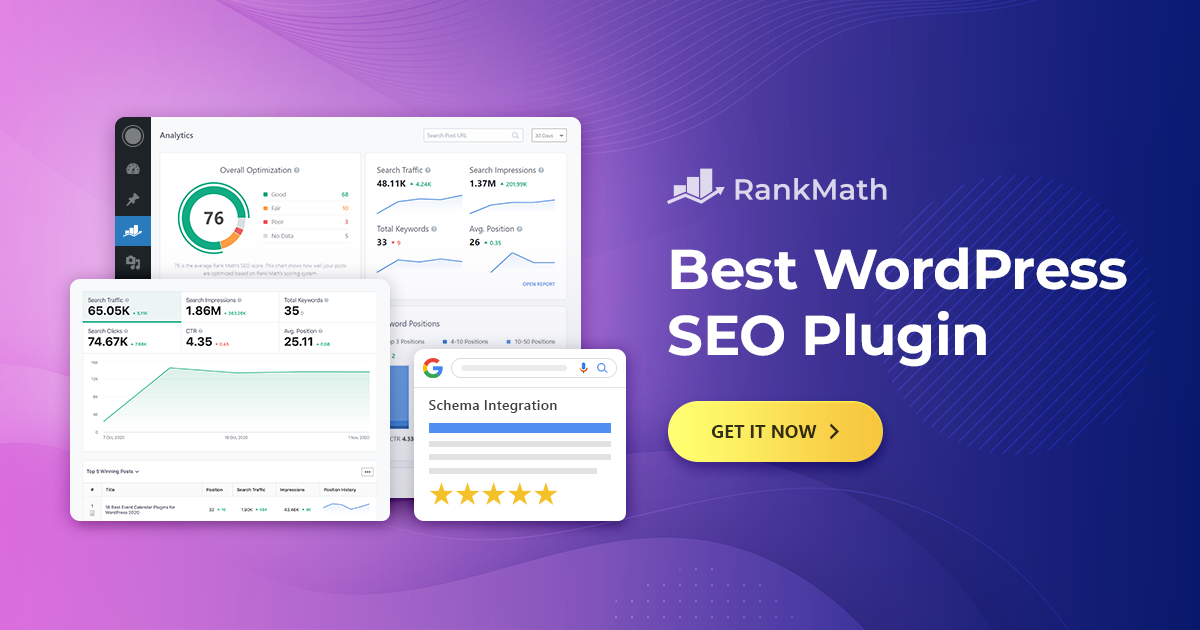
Structured data helps search engines understand your content type. For business sites, implement Organization schema, LocalBusiness schema (if applicable), FAQ schema, and Article schema at minimum. Rank Math handles most schema automatically for WordPress sites.
Rank Math SEO
- AI-powered content analysis and suggestions
- Automatic schema markup for 20+ content types
- Advanced SEO analytics dashboard in WordPress
- Google Search Console and Analytics integration
- Redirect manager and 404 monitoring
Technical SEO and Core Web Vitals
Technical SEO ensures search engines can crawl, index, and render your site without obstacles. A site with brilliant content that loads slowly, has broken pages, or blocks search engine bots will underperform a mediocre site with clean technical foundations.
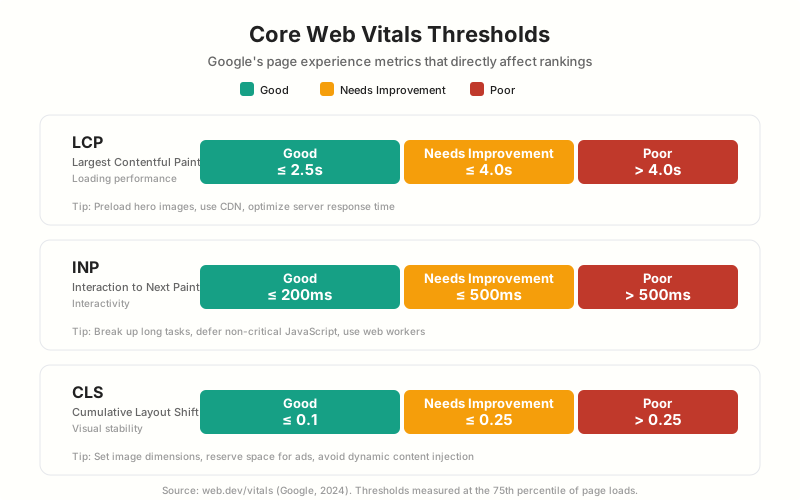
Google confirmed that Core Web Vitals remain a ranking signal in 2026. The three metrics that matter:
- Largest Contentful Paint (LCP): Measures loading speed. Target: under 2.5 seconds. The biggest content element on your page (usually a hero image or heading block) must render within this window.
- Interaction to Next Paint (INP): Replaced First Input Delay in March 2024. Measures responsiveness to all user interactions, not just the first one. Target: under 200 milliseconds.
- Cumulative Layout Shift (CLS): Measures visual stability. Target: under 0.1. Elements should not jump around as the page loads.
Technical Checklist for Business Sites
I run this technical audit on every client site before touching content:
- Mobile-first indexing: Google primarily uses the mobile version of your site for ranking. Test every page on mobile devices, not just desktop.
- HTTPS everywhere: Every page, image, and resource must load over HTTPS. Mixed content warnings tank trust signals.
- XML sitemap: Submit a clean sitemap to Google Search Console. Exclude noindex pages, redirects, and 404s.
- Crawl budget optimization: Block search engines from crawling admin pages, tag archives, and other low-value URLs via robots.txt.
- Page speed: Compress images (WebP format), enable browser caching, minify CSS and JavaScript, and use a CDN. Tools like WP Rocket handle most of this for WordPress sites.
- Fix broken links: Run a site audit monthly to catch 404 errors and redirect chains. Semrush’s Site Audit checks 140+ technical issues automatically.
Content Strategy That Builds Authority Over Time
Content is what you rank for. Without a deliberate strategy, you end up with a scattered collection of pages that compete with each other and confuse search engines about your site’s expertise.
Google’s E-E-A-T framework (Experience, Expertise, Authoritativeness, Trustworthiness) is not a ranking algorithm. It is the quality standard Google’s human evaluators use to assess whether search results serve users well. Sites that demonstrate genuine expertise rank better, especially in competitive niches.
Topic Clusters and Pillar Pages
The most effective content architecture for SEO in 2026 is the topic cluster model. You create one comprehensive pillar page covering a broad topic (2,500-4,000 words), then build 8-15 supporting articles targeting specific subtopics. Each supporting article links back to the pillar page and to relevant sibling articles.
For example, a law firm might build a pillar page on “Personal Injury Claims” with supporting articles covering car accidents, workplace injuries, slip and fall cases, medical malpractice, statute of limitations, and settlement negotiation. Each article reinforces the site’s topical authority for the entire cluster.
Content Quality Standards for 2026
Google’s helpful content system, which became part of the core ranking algorithm in 2026, evaluates whether your content provides genuine value or exists primarily to attract search traffic. Pages that pass this filter share common characteristics:
- First-hand experience. Include original data, screenshots, case studies, or personal testing results. “I implemented this strategy on 12 client sites and saw an average 34% increase in organic traffic” is infinitely more valuable than “experts recommend.”
- Specific, actionable advice. “Optimize your images” is generic. “Convert images to WebP format, set max width to 1200px, and use lazy loading for images below the fold” is actionable.
- Comprehensive coverage. Your page should be the last one a searcher needs to visit. If someone reads your article and still needs to search Google for the next step, your content is incomplete.
- Regular updates. Stale content loses rankings. I update my top-performing articles every 3-6 months with fresh data, new tools, and current best practices.
For a deeper framework on building a content engine, see my content marketing strategy guide.
Link Building and Off-Page Authority
Backlinks remain one of Google’s strongest ranking signals. A link from another website to yours is essentially a vote of confidence. But not all links are equal. One link from a relevant, authoritative site in your industry is worth more than 100 links from random directories.
Link building in 2026 requires a different approach than the mass outreach campaigns that worked five years ago. Google’s spam detection (SpamBrain) identifies and devalues manipulative link patterns with increasing accuracy.
Link Building Strategies That Still Work
- Create linkable assets. Original research, industry surveys, data visualizations, and comprehensive guides naturally attract links. My SEO tools roundup earns links consistently because it provides genuine comparative value.
- Digital PR. Publish original data or insights that journalists and bloggers want to reference. HARO (Help A Reporter Out) and similar platforms connect you with writers actively looking for expert sources.
- Guest posting on relevant sites. Write for publications your audience actually reads. One guest post on an industry-specific site with engaged readers beats ten posts on generic “write for us” sites.
- Broken link building. Use Ahrefs to find broken links on competitor sites and sites in your niche. Reach out to suggest your content as a replacement. This works because you are solving a problem for the site owner.
- Competitor backlink analysis. Study where your top-ranking competitors get their links. If they have links from industry directories, podcast appearances, or association memberships, pursue those same opportunities.
Ahrefs
- Largest backlink index with 35T+ known links
- Content Explorer for finding linkable content ideas
- Broken link finder for outreach opportunities
- Rank tracker with SERP feature monitoring
- Site audit with actionable fix recommendations
Local SEO for Businesses Serving Specific Areas
If your business serves customers in a specific geographic area, local SEO is not optional. It is the fastest path to visibility. Google shows local results (the Map Pack) for nearly 46% of all searches, and those results get clicked before the traditional organic listings below them.
Google Business Profile Optimization
Your Google Business Profile (formerly Google My Business) is your most important local SEO asset. A fully optimized profile ranks higher in Map Pack results and gives potential customers the information they need to choose you.
- Complete every field. Business name, address, phone number, website, hours, service areas, attributes, and categories. Google rewards completeness.
- Choose the right categories. Your primary category is the strongest local ranking factor. Pick the most specific category that matches your core service. Add 2-3 secondary categories for additional services.
- Post weekly updates. Google Business Profile posts signal an active business. Share offers, events, and updates regularly.
- Collect and respond to reviews. Review quantity, quality, and recency are all ranking factors. Respond to every review, positive or negative, within 24 hours.
- Add photos and videos. Businesses with 100+ photos get 520% more calls than the average listing, according to BrightLocal data.
Local Citations and NAP Consistency
Your business name, address, and phone number (NAP) must be identical everywhere it appears online. Inconsistencies confuse Google and erode trust. List your business on relevant directories: Yelp, Apple Maps, Bing Places, Facebook, and industry-specific directories. For a detailed breakdown, check my guide on mastering local SEO for brick-and-mortar businesses.
How AI Is Changing Search Engine Rankings in 2026
AI has reshaped both how search engines work and how businesses need to approach SEO. Google’s AI Overviews (formerly Search Generative Experience) now appear for a significant percentage of queries, providing AI-generated answers directly in search results. This changes the game for traditional organic rankings.
Optimizing for AI Search
AI search engines (Google AI Overviews, Perplexity, ChatGPT Search, Claude) pull information from pages that demonstrate high entity density, information gain, and structural clarity. To get cited by AI systems:
- Answer questions directly. Start each section with a clear, factual answer before expanding with context. AI systems extract concise statements.
- Include specific data. Numbers, percentages, prices, dates, and proper nouns give AI systems concrete facts to cite. “SEO takes 4-6 months to show results” is citable. “SEO takes time” is not.
- Use structured markup. FAQ schema, HowTo schema, and Article schema make your content machine-readable. AI systems preferentially cite structured content.
- Demonstrate expertise. First-person experience, original research, and specific examples signal to AI systems that your content is authoritative, not just aggregated from other sources.
AI Tools for SEO Workflow
AI also helps with the SEO workflow itself. I use AI tools for content briefs, meta description drafts, schema markup generation, and identifying content gaps. But the strategy, expertise, and quality control remain human. Google’s stance is clear: AI-generated content is fine as long as it provides genuine value. Content that is obviously mass-produced by AI without human oversight gets filtered by the helpful content system.
For WordPress sites, SEO plugins like Rank Math now include AI-powered features for content analysis, automatic schema generation, and SEO scoring. These save hours of manual work without compromising content quality.
Measuring SEO Results: Metrics That Matter
SEO without measurement is guesswork. The businesses that sustain long-term ranking improvements track specific metrics monthly and adjust their strategy based on data, not assumptions.
Key Performance Indicators for SEO
- Organic traffic: The total number of visitors from search engines. Track in Google Analytics 4, segmented by landing page and search query.
- Keyword rankings: Monitor positions for your target keywords weekly. Focus on movement trends, not individual daily fluctuations.
- Click-through rate (CTR): Your average CTR from search results. Check in Google Search Console. If you rank well but CTR is low, your title tags and meta descriptions need work.
- Organic conversions: The metric that actually matters for business. Track form submissions, phone calls, purchases, or whatever conversion event drives your revenue.
- Backlink growth: New referring domains acquired per month. Steady growth indicates your content strategy is working.
- Core Web Vitals scores: Monitor in Google Search Console’s Core Web Vitals report. Fix any pages in the “poor” category immediately.
Realistic SEO Timeline
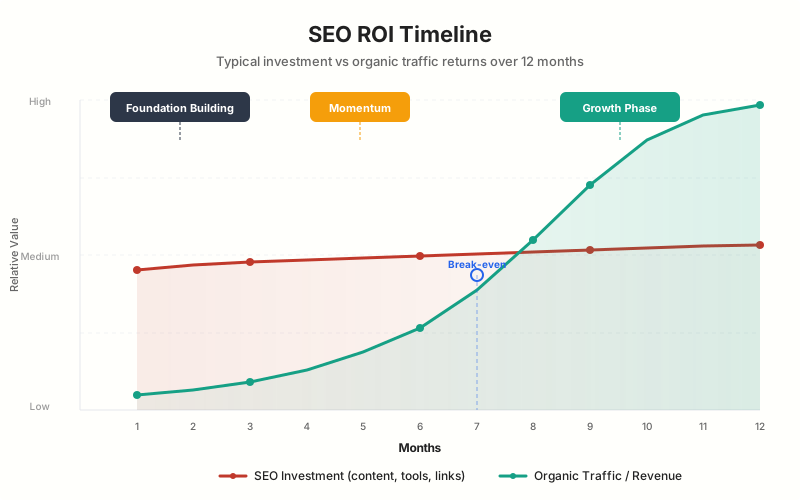
SEO is not instant. In my experience across hundreds of projects, here is a realistic timeline:
- Months 1-3: Technical fixes, on-page optimization, content audit, and strategy development. You are building the foundation. Rankings may not move yet.
- Months 4-6: New content publishing, link building campaigns starting, and initial ranking improvements for lower-competition keywords.
- Months 7-12: Compounding effects kick in. Higher-difficulty keywords start ranking. Organic traffic growth accelerates. This is where the ROI becomes visible.
Businesses that abandon SEO at month 3 because they do not see results are quitting right before the payoff. The ones that commit for 12+ months build a sustainable competitive advantage that paid advertising cannot replicate.
Common SEO Mistakes That Hold Businesses Back
After working with hundreds of business websites, these are the mistakes I see most frequently. Each one is fixable, but they silently drain ranking potential until you address them.
- Targeting keywords that are too competitive. A 6-month-old site targeting “best CRM software” (keyword difficulty 90+) will not rank. Start with longer, more specific terms and work up as your domain authority grows.
- Ignoring search intent. Creating a product page when Google shows blog posts for that query, or writing a guide when Google shows comparison tables. Always check the SERP before creating content.
- Thin content across many pages. Twenty 300-word pages rank worse than five 1,500-word comprehensive pages. Consolidate thin content into fewer, stronger pages.
- Neglecting mobile experience. Google uses mobile-first indexing. If your site is clunky on phones, your rankings suffer regardless of how good the desktop version looks.
- No content update schedule. Publishing once and forgetting about it. The sites that rank consistently update their top content every 3-6 months with fresh data and insights.
- Skipping technical SEO. Brilliant content on a technically broken site underperforms mediocre content on a technically sound site. Fix the foundation first.
Putting It All Together: Your SEO Action Plan
If I were starting SEO for a business site from scratch today, here is the exact sequence I would follow:
- Week 1-2: Run a full technical audit using Semrush Site Audit or Ahrefs Site Audit. Fix critical issues (broken links, missing meta tags, slow pages, mobile usability problems).
- Week 2-3: Set up Google Search Console and Google Analytics 4. Install Rank Math if on WordPress. Configure sitemaps and schema markup.
- Week 3-4: Complete keyword research. Map keywords to existing pages and identify content gaps. Build a topic cluster plan for your top 3-5 business areas.
- Month 2-3: Optimize existing pages (title tags, headers, internal links, content depth). Start publishing new cluster content at 2-4 articles per month.
- Month 3+: Begin link building through digital PR, guest posting, and broken link outreach. Monitor rankings weekly and adjust based on performance data.
- Ongoing: Update top content quarterly. Run technical audits monthly. Track KPIs and report to stakeholders. Never stop building links.
The businesses that rank well in search engines are not lucky. They execute these strategies consistently, month after month. SEO compounds over time. The work you do today builds on everything you did last month, and next month’s efforts build on today’s. Start now, stay disciplined, and the results follow.
For more tools and techniques, explore my complete list of the best SEO tools that professionals use, and check the latest digital marketing trends to stay ahead of algorithm changes.
How long does it take for SEO to show results?
Most businesses see initial ranking improvements within 4-6 months and significant traffic growth within 7-12 months. The timeline depends on your starting point, competition level, and how aggressively you execute. Highly competitive industries (legal, finance, insurance) may take 12-18 months. Low-competition local niches can see results in 2-3 months.
Is SEO worth it for small businesses with limited budgets?
Yes. SEO delivers the highest long-term ROI of any digital marketing channel. Unlike paid ads that stop generating traffic when you stop paying, SEO traffic compounds over time. Small businesses can start with free tools like Google Search Console and Rank Math’s free WordPress plugin, focusing on local SEO and long-tail keywords where competition is manageable.
What is the difference between on-page and off-page SEO?
On-page SEO covers everything you optimize directly on your website: title tags, meta descriptions, content quality, header structure, internal links, and schema markup. Off-page SEO refers to signals from outside your website, primarily backlinks from other sites, brand mentions, and social signals. Both are essential for ranking well.
How many backlinks do I need to rank on the first page?
There is no fixed number. The backlinks you need depend entirely on the competition for your target keywords. For low-competition keywords, strong on-page optimization alone might be enough. For competitive terms, you might need 50-200+ referring domains pointing to that specific page. Quality matters far more than quantity. One link from a relevant, authoritative site outweighs dozens from low-quality directories.
Do I need to hire an SEO agency or can I do it myself?
It depends on your time, technical ability, and budget. Business owners can handle basic on-page SEO, Google Business Profile optimization, and content creation themselves. Technical SEO audits, advanced link building, and competitive keyword targeting typically benefit from professional expertise. A middle ground is hiring a consultant for strategy while executing the day-to-day work in-house.
What are Core Web Vitals and why do they matter for rankings?
Core Web Vitals are three performance metrics Google uses as ranking signals: Largest Contentful Paint (LCP) measures loading speed (target under 2.5 seconds), Interaction to Next Paint (INP) measures responsiveness (target under 200 milliseconds), and Cumulative Layout Shift (CLS) measures visual stability (target under 0.1). Pages that fail these thresholds rank lower than equivalent pages that pass them.
How has AI changed SEO strategy?
AI has changed SEO in two major ways. First, Google’s AI Overviews now provide direct answers in search results, reducing clicks to websites for some queries. To stay visible, your content needs to be the source AI systems cite, which requires high entity density, specific data, and structured markup. Second, AI tools now assist with keyword research, content optimization, and technical audits, making SEO workflows more efficient.
Should I focus on SEO or paid advertising?
Both serve different purposes. Paid ads (Google Ads, social media ads) deliver immediate visibility and work well for time-sensitive promotions, new product launches, or testing market demand. SEO builds sustainable organic traffic that does not require ongoing ad spend. For most businesses, the ideal approach is running paid ads for immediate results while investing in SEO for long-term growth. Over time, strong organic rankings reduce your dependence on paid advertising.
Disclaimer: This site is reader-supported. If you buy through some links, I may earn a small commission at no extra cost to you. I only recommend tools I trust and would use myself. Your support helps keep gauravtiwari.org free and focused on real-world advice. Thanks. - Gaurav Tiwari