
Black Hole
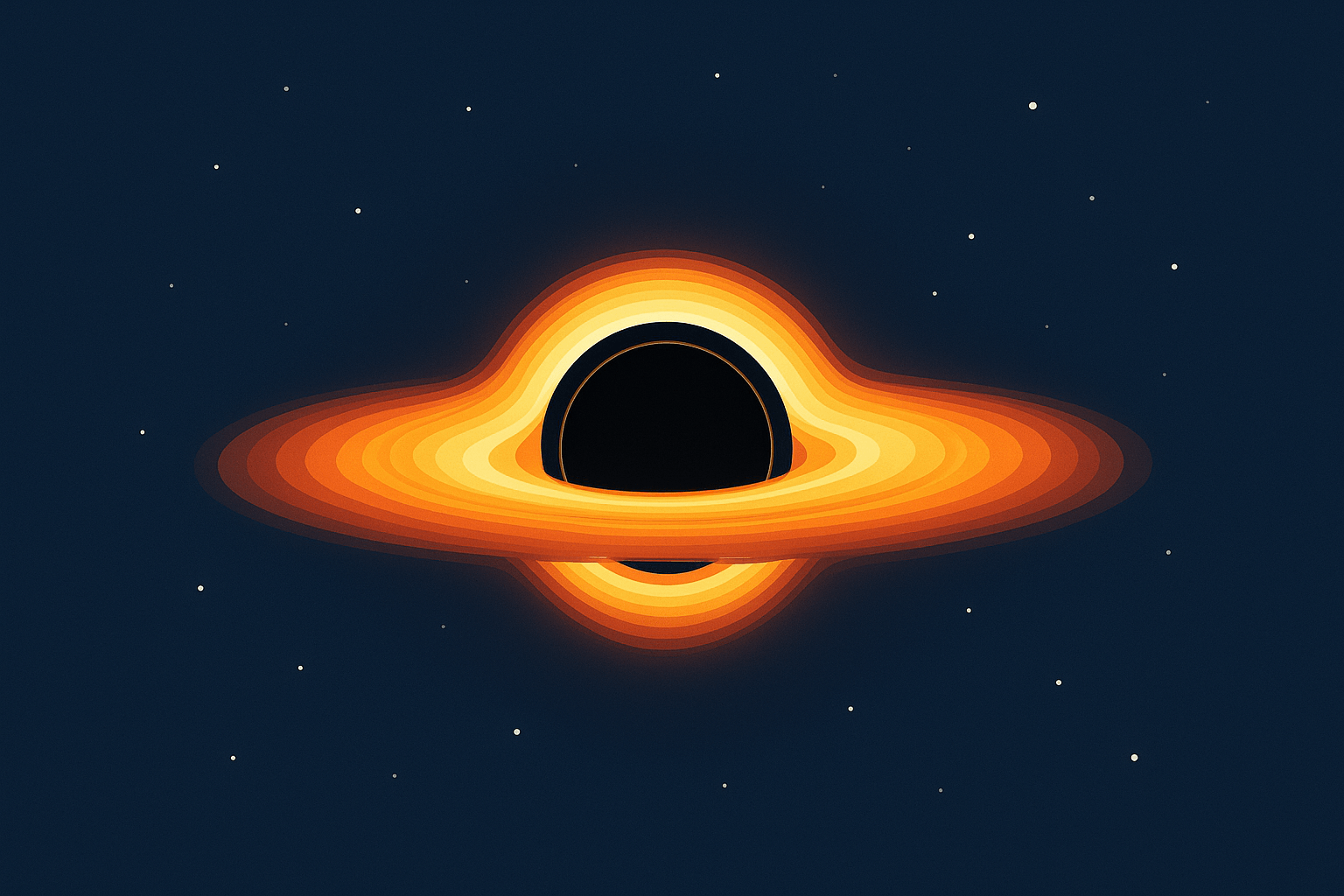
A black hole is a region of spacetime where gravity is so intense that nothing, not even light, can escape once it crosses the event horizon. A black hole forms when a massive star collapses at the end of its life, when two neutron stars merge, or (for the largest ones) through processes nobody fully understands yet at the center of galaxies. This note walks through what a black hole actually is, how it is structured, what the mathematics says, how astronomers detect them, and what the open questions in 2026 still are.
What a Black Hole Is
A black hole is defined by a single property: an event horizon. The event horizon is the boundary inside which the escape velocity exceeds the speed of light. Because nothing can travel faster than light, nothing inside the horizon can ever leave. From outside the horizon, the black hole behaves like an ordinary gravitational mass. The strangeness only begins at the boundary.
The defining mathematical quantity is the Schwarzschild radius, the radius of the event horizon for a non-rotating black hole. It depends only on the mass:
$$ r_s = \dfrac{2GM}{c^2} $$
Plug in numbers: for a black hole with the mass of the Sun \( M_\odot \approx 1.989 \times 10^{30} \) kg, \( r_s \approx 2.95 \) km. That is, if the Sun were compressed into a sphere about 6 km across, it would become a black hole. For the Earth’s mass, \( r_s \approx 8.87 \) mm. The mathematics is clean. The compression required is the hard part.
How a Black Hole Forms
Stellar-mass black holes (typically 5 to 50 solar masses) form when a star more massive than roughly 20 solar masses runs out of nuclear fuel. The core collapses under gravity, the outer layers blow off as a supernova, and what remains exceeds the Tolman-Oppenheimer-Volkoff limit (the mass beyond which neutron-degeneracy pressure cannot support the star). At that point gravitational collapse continues all the way to a singularity.
Intermediate-mass black holes (100 to 100,000 solar masses) are harder to explain. The current best candidates involve runaway mergers in dense star clusters or the leftover seeds of early massive stars. Direct detections of intermediate-mass black holes via LIGO-Virgo became possible only after 2019.
Supermassive black holes (millions to billions of solar masses) sit at the centers of most large galaxies, including our own. Sagittarius A* at the center of the Milky Way is about 4.3 million solar masses. How supermassive black holes grew so large so early in the universe is one of the major open questions in 2026.
Structure of a Black Hole
From the inside out, a non-rotating Schwarzschild black hole has three concentric regions worth naming.
Singularity
At the geometric center sits the singularity, where general relativity predicts the curvature of spacetime becomes infinite and the laws of physics, as we know them, stop describing the situation. The singularity is not a place inside space; it is a moment in the future of anything that crosses the event horizon. Quantum gravity should eventually replace the classical singularity with something finite, but we do not yet know what that something is.
Event Horizon
The event horizon at radius \( r_s = 2GM/c^2 \) is a one-way membrane. From outside, the horizon is the surface from which no information can ever reach the outside universe. Time dilation diverges at the horizon: a clock falling in appears to a distant observer to slow asymptotically to a stop and never quite reach the horizon, though the falling clock itself crosses cleanly without noticing anything locally peculiar.
Photon Sphere
At \( r = 1.5 \, r_s \), light can orbit the black hole on circular geodesics. The photon sphere is what gives Event Horizon Telescope images their iconic bright ring: photons whip around once or several times before escaping toward the camera. The 2019 image of M87* and the 2022 image of Sagittarius A* are the photon ring made visible.
Types of Black Holes
| Type | Mass range | Origin | Examples |
|---|---|---|---|
| Stellar-mass | 5 – 50 M☉ | Collapse of massive star | Cygnus X-1, V404 Cygni |
| Intermediate | 100 – 10⁵ M☉ | Star cluster mergers (theorized) | HLX-1 candidate |
| Supermassive | 10⁶ – 10¹⁰ M☉ | Galactic center, unknown growth path | Sagittarius A*, M87* |
| Primordial | Tiny – planetary | Early universe (hypothesized) | None confirmed |
Hawking Radiation
Stephen Hawking showed in 1974 that black holes are not perfectly black. Quantum field effects near the event horizon cause the black hole to emit a faint thermal radiation with temperature inversely proportional to its mass:
$$ T_H = \dfrac{\hbar c^3}{8 \pi G M k_B} $$
For a stellar-mass black hole this temperature is around \( 10^{-8} \) K, far below the 2.7 K cosmic microwave background. Stellar-mass black holes therefore absorb far more from the CMB than they radiate, and effectively never evaporate within the current age of the universe. A primordial black hole of about \( 10^{12} \) kg, however, would be evaporating right now and ending its life in a final flash. None has been observed.
How We Detect Black Holes
- X-ray binaries. A black hole in a binary system pulls matter from its companion star. The infalling gas heats to millions of kelvin and emits X-rays. Cygnus X-1 was identified this way in 1971.
- Stellar orbits. Stars orbiting an invisible massive object reveal the central mass. Andrea Ghez and Reinhard Genzel won the 2020 Nobel Prize for tracking stellar orbits around Sagittarius A*.
- Gravitational waves. LIGO and Virgo detect the ripples in spacetime produced when two black holes merge. The first detection, GW150914, was announced in 2016 and earned the 2017 Nobel Prize.
- Event Horizon Telescope. A planet-scale very-long-baseline interferometry array imaged the photon ring of M87* (2019) and Sagittarius A* (2022). These are the first direct images of black-hole shadows.
Open Questions in 2026
Black-hole physics remains one of the most active areas of theoretical and observational physics. A short list of questions that remain unresolved:
- Information paradox. What happens to the information about matter that falls in? Unitary quantum mechanics says it must be preserved. Hawking radiation appears thermal and therefore information-free. Recent (2019 onward) calculations using the replica trick and quantum extremal surfaces suggest the information does come back, but the mechanism is not fully understood.
- Singularity resolution. What does the actual interior look like once quantum gravity is included? String theory and loop quantum gravity make different predictions; no observation can yet distinguish them.
- Supermassive black hole origins. JWST has revealed mature supermassive black holes at redshift 7+, less than a billion years after the Big Bang. The growth mechanism remains an open problem.
- Firewalls and complementarity. Is the equivalence principle violated at the horizon for an infalling observer? The AMPS firewall argument suggests yes; ER=EPR-type arguments suggest no.
Related study notes: Special Relativity, Einstein Field Equations, The Four Fundamental Forces.
Frequently Asked Questions
What is the simplest definition of a black hole?
A black hole is a region of spacetime bounded by an event horizon, the surface at which gravity becomes strong enough that nothing, not even light, can escape. From outside, a black hole behaves like a normal gravitating mass; the strangeness only appears at and inside the horizon.
What is the Schwarzschild radius?
The Schwarzschild radius r_s = 2GM/c² is the radius of the event horizon for a non-rotating black hole. For a Sun-mass black hole it is about 2.95 km; for an Earth-mass black hole, about 8.87 mm. Anything compressed inside its Schwarzschild radius becomes a black hole.
Do black holes really evaporate?
Yes, through Hawking radiation, but extremely slowly for any black hole formed by stellar collapse. A stellar-mass black hole has a Hawking temperature around 10⁻⁸ K, far below the cosmic microwave background, so it currently absorbs more than it emits. Only primordial black holes near 10¹² kg would be evaporating now, and none has been observed.
What is at the center of a black hole?
Classical general relativity predicts a singularity, a point where spacetime curvature is infinite and the theory breaks down. A complete theory of quantum gravity should replace the singularity with something finite, but no consensus answer exists in 2026.
Did the Event Horizon Telescope photograph the actual event horizon?
Not directly. The 2019 image of M87* and the 2022 image of Sagittarius A* show the bright photon ring at roughly 1.5 times the Schwarzschild radius, with the black-hole shadow inside it. The event horizon itself is slightly smaller and produces no light, so what is photographed is the silhouette cast by the horizon on the bright accretion disc behind it.
How massive is the black hole at the center of the Milky Way?
Sagittarius A*, at the center of the Milky Way, is about 4.3 million solar masses. It is one of the closest supermassive black holes to Earth (about 26,000 light-years away) and one of the two black holes the Event Horizon Telescope has imaged directly.